
Health Fitness Tracker Recovery Metrics: What HRV, Readiness Score, and Body Battery Actually Mean
If your fitness tracker shows a recovery score but you are not sure what it means or whether to trust it, this guide decodes the metrics across WHOOP, Oura, Garmin, and Fitbit. Learn how HRV, resting heart rate, sleep, and strain feed into these scores, how accurate they really are, and how to use them as a practical trend reference — not a medical diagnosis.
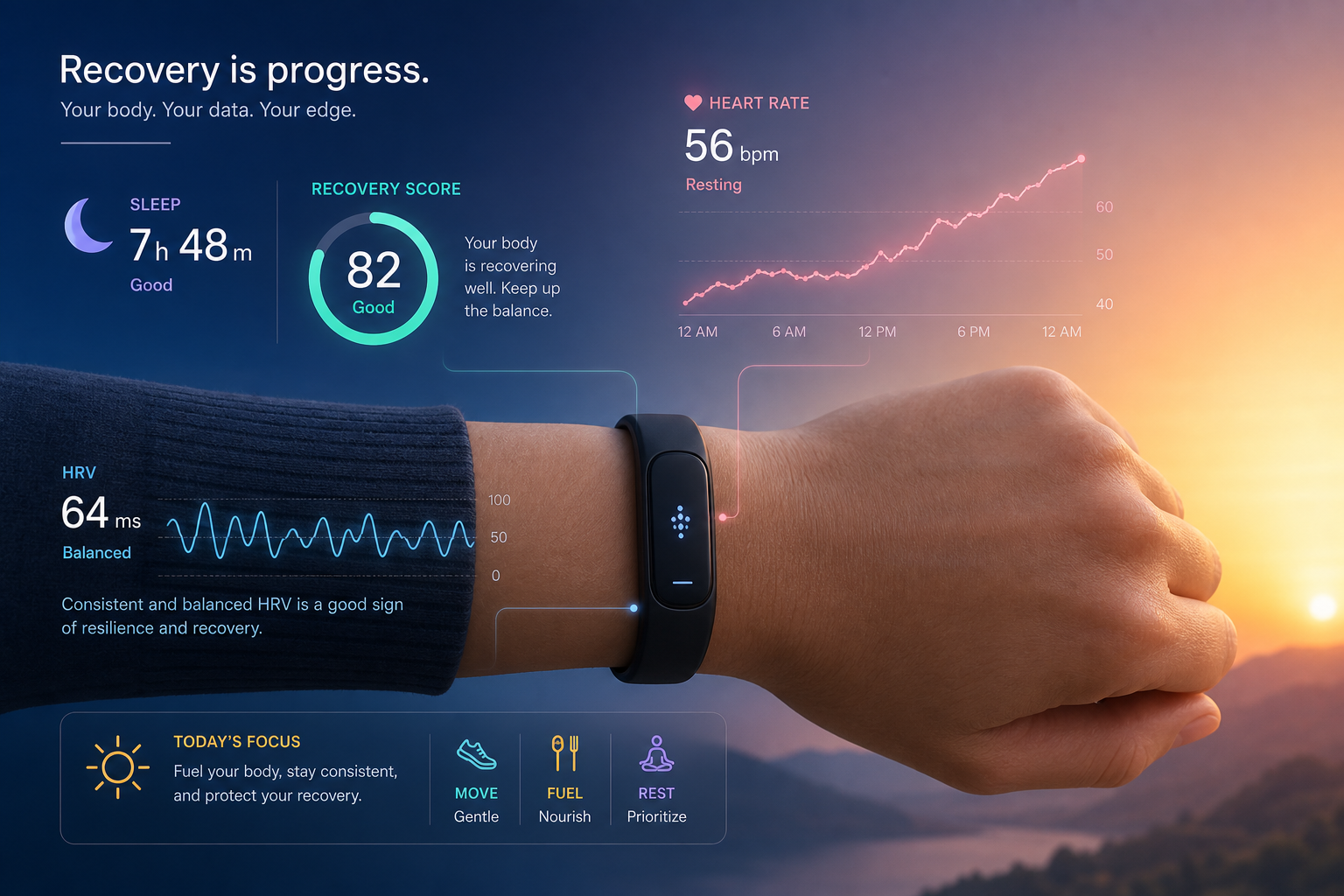
Every Major Tracker Now Gives You a Recovery Score — But What Does It Actually Mean?
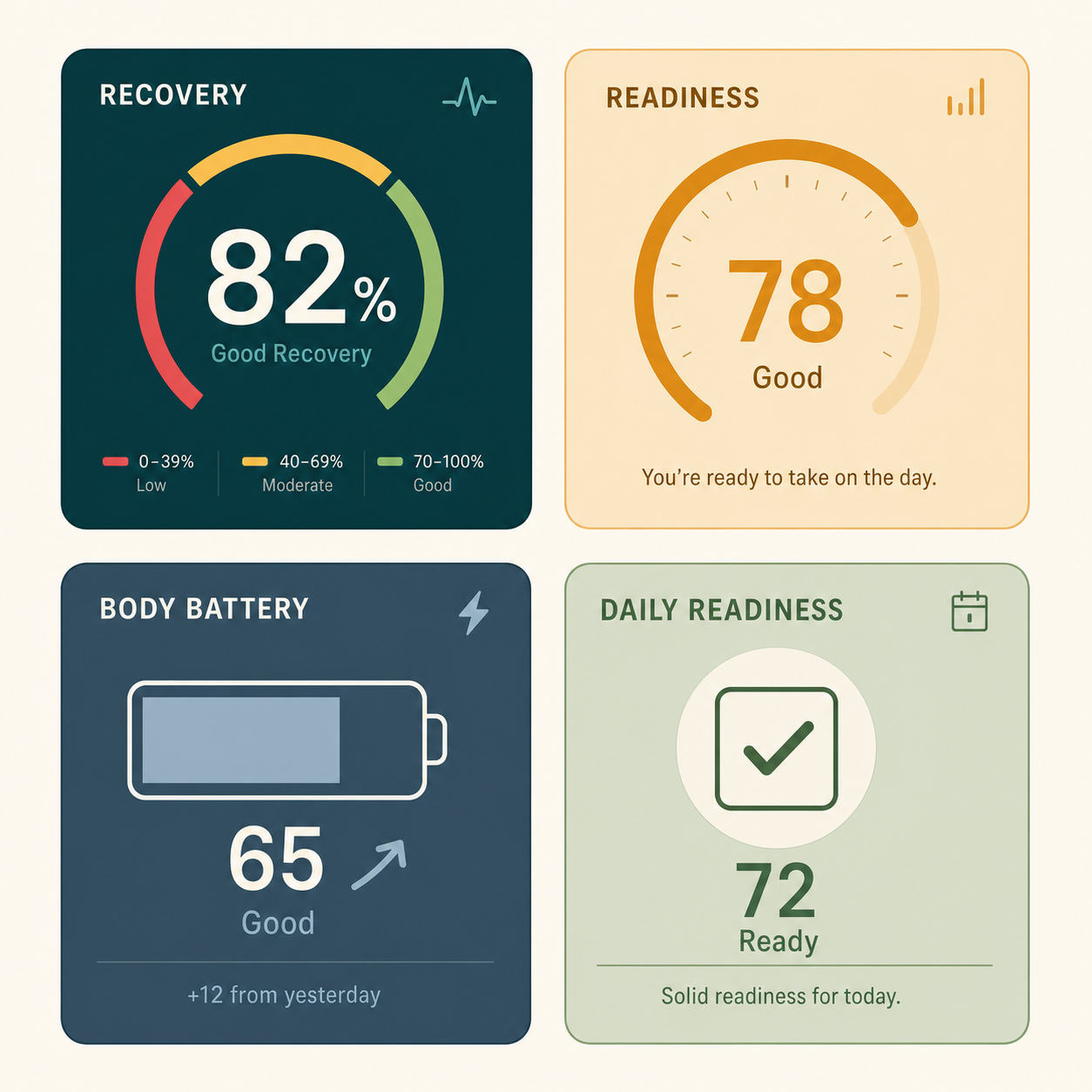
Open your WHOOP app and you see a recovery percentage color-coded green, yellow, or red. Swipe to your Oura Ring dashboard and a readiness score greets you between 0 and 100. Garmin users have Training Readiness and Body Battery. Fitbit offers a Daily Readiness Score. These metrics have become a standard feature across nearly every wearable, yet the number on the screen often arrives without explanation.
The confusion is understandable. A single number that claims to summarize how recovered you are feels both powerful and opaque. Is 72% a good recovery? Why did your score drop when you slept eight hours? Can you trust it enough to decide whether to train hard or take a rest day?
This article decodes what recovery scores actually are, how each major brand calculates them differently, how accurate they really are, and — most importantly — how to use them as a practical trend reference without treating them as a medical diagnosis. If you own a fitness tracker and have ever stared at a recovery number wondering what it means, this guide is for you.
What Is a Recovery Score? How Wearables Build a Number From Overnight Signals
A recovery score — also called a readiness score, body battery, or daily readiness — is not a direct measurement of anything. It is an algorithm-derived estimate that combines several physiological signals collected primarily while you sleep. Your wearable tracks heart rate, heart rate variability, breathing rate, skin temperature, and movement overnight, then runs those raw data points through a proprietary formula to produce a single number.
This distinction matters because the score is a constructed metric, not a lab-grade diagnostic. As the WellnessPulse explainer notes, there is no single reference test against which these scores can be validated. The underlying algorithms are not public, which means the scores remain something of a black box — they cannot be independently replicated or validated by outside researchers.
This doesn't mean the scores are useless. It means they should be understood as summaries of real physiological signals — summaries that are useful for spotting patterns over time, not for making medical decisions.
The Core Inputs: HRV, Resting Heart Rate, Sleep, and Recent Strain
Though each brand's algorithm is different, the inputs are largely the same. Four main signals feed into every recovery score, and understanding each one helps you interpret why your number looks the way it does on any given morning.
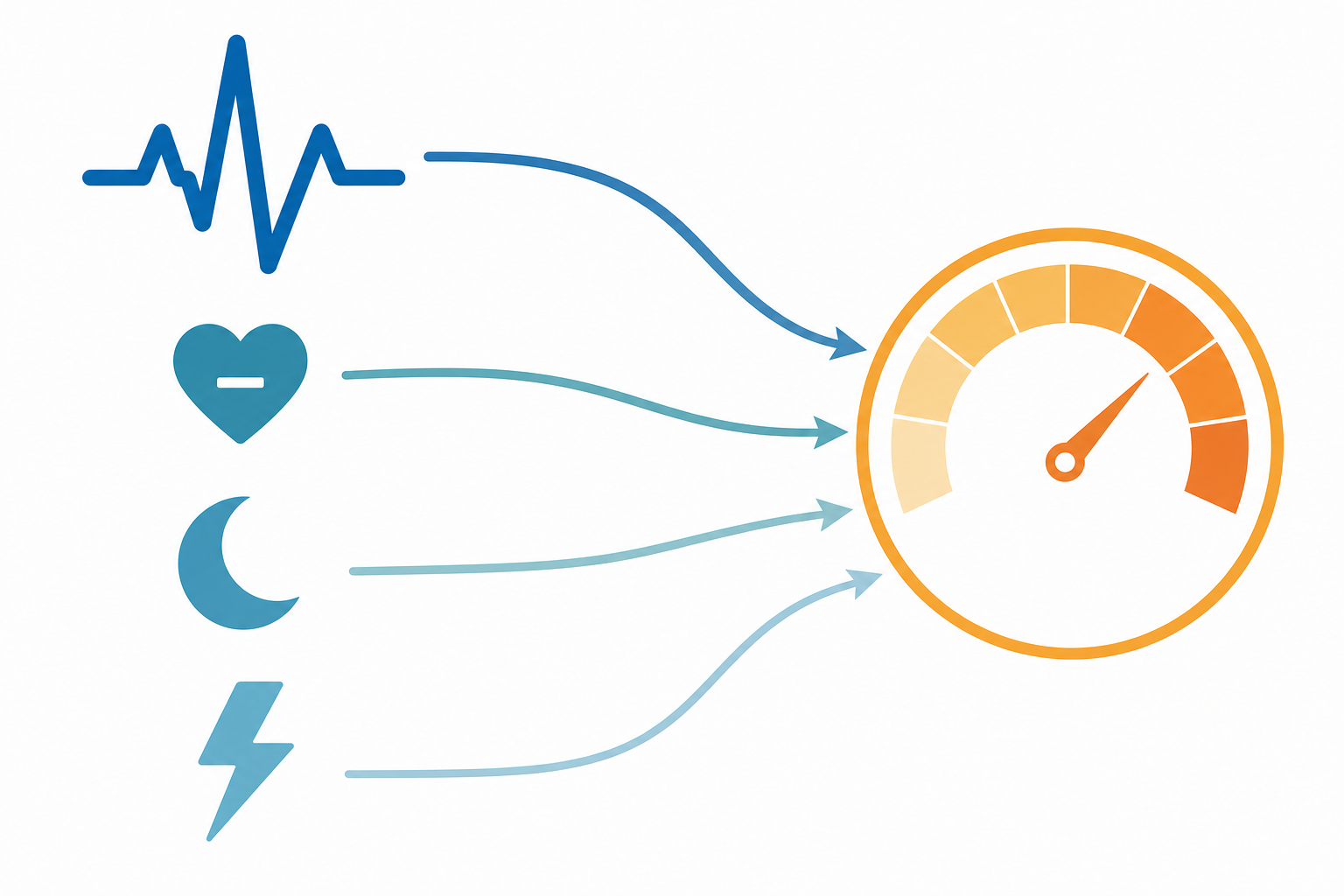
Heart Rate Variability (HRV)
HRV measures the variation in time between consecutive heartbeats. Contrary to what you might expect, more variation is generally better — it indicates that your autonomic nervous system is responsive and balanced. A higher HRV suggests your body is well-recovered and ready to handle stress, while a lower HRV can signal fatigue, illness, or accumulated training load.
According to the WellnessPulse recovery score explainer, HRV typically carries the most weight in recovery scores, often accounting for more than half of the final number. This makes HRV the single most important metric to understand if you want to make sense of your daily score.
Dr. Sawalla Guseh, director of the Cardiovascular Performance Program at Harvard-affiliated Massachusetts General Hospital, told Harvard Health that more variability suggests better heart health and that tracking trends over time is the most useful approach.
Resting Heart Rate
Your resting heart rate (RHR) is the number of beats per minute when you are fully at rest — ideally measured while you sleep or first thing in the morning before getting out of bed. The Texas Health guide notes that the normal range for adults is 60–100 bpm, with highly active individuals often as low as 40 bpm. A lower RHR generally indicates better cardiovascular fitness and recovery. If your resting heart rate is elevated above your personal baseline, it often signals that your body is still working to recover from previous training, poor sleep, or illness.
Sleep Duration and Quality
Sleep is when most physiological repair happens. Most adults need 7–9 hours per night according to the U.S. Department of Health and Human Services, as cited by Texas Health. But recovery scores don't just look at total sleep time — they also consider sleep stages (deep sleep, REM, light sleep), sleep consistency, and how much your sleep was interrupted. A night with eight hours of fragmented sleep will produce a lower recovery score than a night with seven hours of uninterrupted deep sleep.
Recent Training Strain
The final major input is your recent activity load. If you completed a high-intensity workout or a long endurance session the previous day, your recovery score will reflect the physiological stress that activity placed on your body. This is why a hard leg day often results in a lower recovery score the next morning — your body is signaling that it is still in the process of repairing and adapting.
How Major Brands Calculate Recovery Differently: WHOOP, Oura, Garmin, Fitbit
While the inputs are similar, each brand packages them into a different metric with its own scale, terminology, and visual presentation. Understanding these differences helps you interpret your specific device's output and explains why scores are not directly comparable between platforms.
| Brand | Metric Name | Scale | Key Zones / Tiers |
|---|---|---|---|
| WHOOP | Recovery | 1–100% | Green (67%+), Yellow (34–66%), Red (≤33%) |
| Oura Ring | Readiness | 0–100 | Optimal (85–100), Good (70–84), Pay Attention (<70) |
| Garmin | Training Readiness + Body Battery | 0–100 (each) | Training Readiness: 0–100 scale; Body Battery: 0–100 with charge/discharge visualization |
| Fitbit | Daily Readiness | Score out of 100 | Score with activity recommendations based on readiness level |
WHOOP's recovery score is the most straightforward percentage, color-coded into three zones that make training decisions easy: green means go, yellow means proceed with caution, red means prioritize recovery. Oura's readiness score uses a similar 0–100 scale but with different tier boundaries and a stronger emphasis on sleep metrics. Garmin offers two separate but related metrics — Training Readiness tells you how prepared you are for a workout, while Body Battery tracks your energy reserves throughout the day. Fitbit's Daily Readiness Score is the newest entrant and focuses on whether you should prioritize activity or recovery on a given day.
The Accuracy Reality Check: How Reliable Are These Scores?
The honest answer is that recovery scores themselves cannot be independently validated. Because the algorithms are proprietary, there is no way to run a controlled test that says "this recovery score of 74% is correct" or "this readiness score of 68 is wrong." What we can evaluate is the accuracy of the underlying sensor data that feeds into these scores.
A comprehensive meta-analysis by WellnessPulse researchers, published in April 2025, examined 45 scientific studies with 168 data points and found that commonly worn fitness trackers overall scored 67.40% accuracy across heart rate, step count, and energy expenditure. The breakdown by metric reveals significant variation:
| Metric | Overall Accuracy | Most Accurate Brand | Brand Accuracy |
|---|---|---|---|
| Heart Rate | 76.35% | Apple Watch | 86.31% |
| Step Count | 68.75% | Garmin | 82.58% |
| Energy Expenditure | 56.63% | Apple | 71.02% |
A separate controlled test by CNET found the Apple Watch Series 11 had the lowest average heart rate error at 0.98% (about 1.40 BPM) when tested against a Polar H10 chest strap over 30+ miles of running. The Garmin Venu 4 came second at 3.89% error (5.5 BPM). These results suggest that optical heart rate sensors have improved significantly, but they are still not as accurate as chest straps, especially during high-intensity or interval training.
It's really less of a diagnostic score than it is a motivational score.
That assessment comes from Eamon Duffy, MD, a sports cardiologist at Columbia University, speaking to Health.com in May 2026. Dr. Duffy's framing is important: recovery scores are best understood as motivational tools that encourage you to pay attention to your body, not as diagnostic instruments that can detect medical conditions.
How to Use Recovery Scores Wisely: Trends, Not Absolutes
The most practical way to use recovery scores is to track trends over time rather than fixating on any single day's number. A single low score might mean nothing — you had a restless night, ate late, or your strap was loose. A pattern of declining scores over several days or weeks is much more informative and worth paying attention to.
Here are the most common causes of low recovery scores, based on the physiological inputs discussed earlier:
- Poor sleep quality or insufficient duration — the most common cause of a low score
- Alcohol consumption — even moderate drinking can significantly lower HRV and raise resting heart rate overnight
- Illness or impending illness — your immune system's activity affects heart rate and HRV
- Overtraining — accumulated training load without adequate recovery days
- Psychological stress — mental stress affects the autonomic nervous system just as physical stress does
- Late eating or eating close to bedtime — digestion elevates heart rate and can disrupt sleep quality
When you see a low score, the most useful response is to check in with how you actually feel. Do you feel tired, sore, or run down? Or do you feel fine despite the number? The Health.com article quotes certified personal trainer Ashton Leal, who notes that you can "catch those things very quickly" regarding patterns in overtraining or poor sleep. Both experts agreed that recovery scores should not replace bodily awareness, with Dr. Duffy stating "How you feel is the most important metric."
The Texas Health guide emphasizes that tracking trends over time is more important than fixating on daily numbers. A practical approach: look at your seven-day average recovery score rather than today's number. If your seven-day average is trending downward, consider adding an extra rest day, prioritizing sleep, or reducing training volume. If it's stable or trending upward, you're likely managing your training load and recovery well.
When to See a Doctor: Red Flags Your Tracker Can't Diagnose
Recovery scores are useful tools, but they have clear limits. A fitness tracker cannot diagnose illness, detect overtraining syndrome, or identify underlying medical conditions. The data it provides is a general wellness indicator, not a clinical assessment.
There are situations where persistently abnormal tracker data, combined with physical symptoms, warrants a conversation with a healthcare provider. According to Harvard Health and Texas Health, consider consulting a doctor if you experience:
- Persistently low recovery scores combined with ongoing fatigue that doesn't improve with rest
- Resting heart rate that remains elevated above your normal baseline for an extended period
- Unexplained weight changes alongside changes in your heart rate or HRV trends
- Chest discomfort, shortness of breath, or dizziness during exercise — regardless of what your tracker shows
- Heart rate readings that seem consistently erratic or unusually high or low
Balance: Data Awareness Meets Body Awareness
Recovery scores from fitness trackers are genuinely useful tools — when used correctly. They provide a structured way to notice patterns in your sleep, training load, and physiological response that might otherwise go unnoticed. A trend of declining HRV over several weeks can prompt you to examine your stress levels, sleep habits, or training volume more carefully.
But the most important skill is learning to balance what the data says with what your body tells you. Your tracker might say 45% recovery, but if you feel well-rested, energetic, and ready to train, trust your body. Conversely, your tracker might show 85% recovery, but if you feel run down and sore, honor that feeling and take an easy day.
Dr. Guseh of Harvard-affiliated Massachusetts General Hospital described wearable data as "measurable, meaningful, and motivating." That's the right framing — the data is meaningful when it motivates you to pay attention to your recovery, but it is not the final word on your health or readiness.
Use your recovery score as a conversation starter with your own body. When the number is low, ask yourself why. When it's high, notice what you did right. Over time, this practice builds a deeper understanding of how your lifestyle choices affect your recovery — and that awareness is far more valuable than any single number on a dashboard.
This is general fitness education, not medical advice. For diagnosis or treatment of pain or injury, consult a qualified clinician.
Pick your next session
Browse all routines to find an appropriately-spaced next session.
Spot something off?
This content sits adjacent to health guidance — tell us if a citation or figure needs a correction.