
Top-Rated Fitness Trackers and Heart Rate Accuracy: What Changes When You Lift or Do HIIT
Most fitness tracker rankings are built on running tests — but wrist-based optical sensors behave very differently during strength training and HIIT. This guide explains why workout type is the most important accuracy variable, and what that means for home fitness users evaluating the top-rated devices of 2026.
Why Your Top-Rated Tracker May Be Giving You Bad Data During Workouts
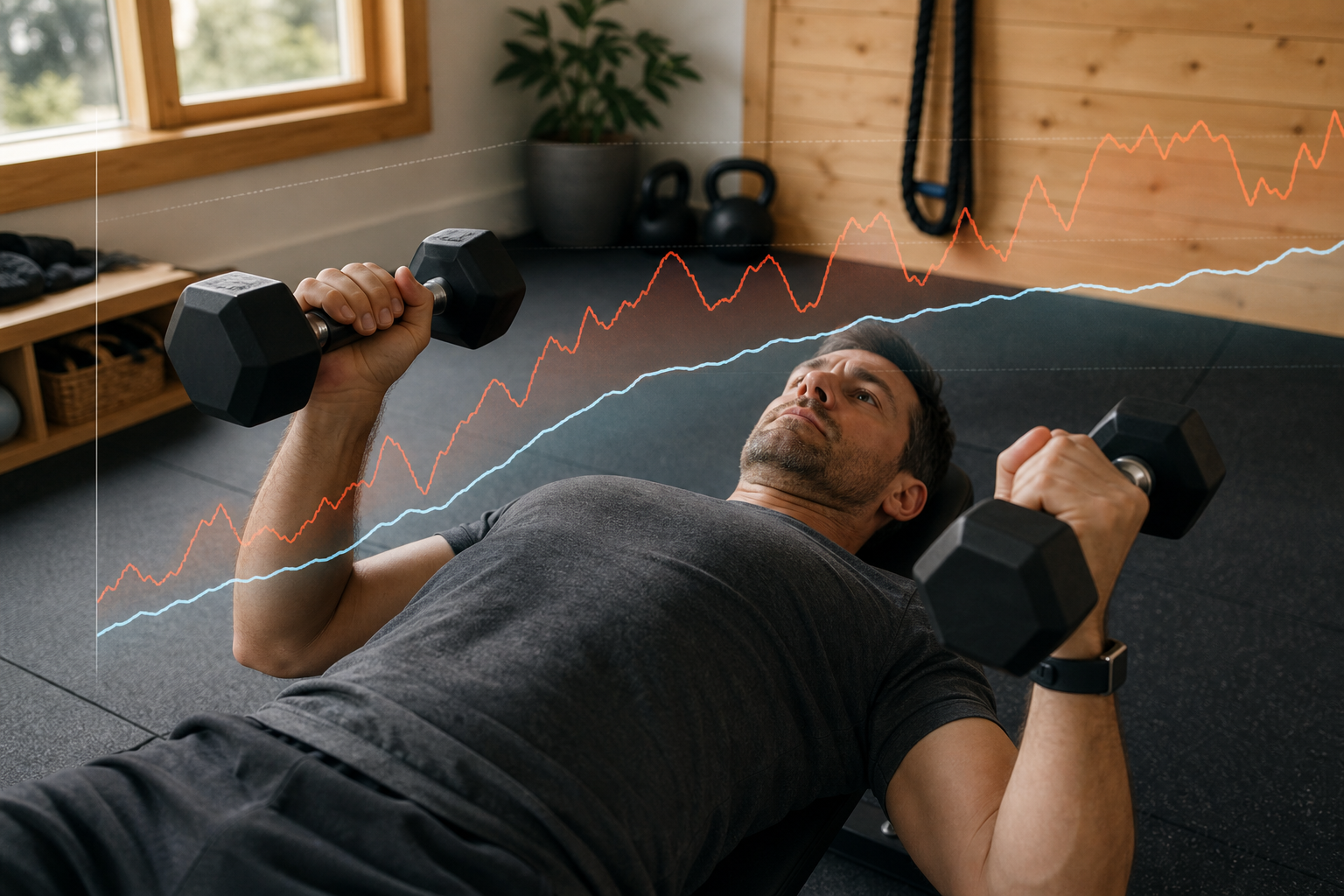
Every major fitness tracker ranking published in 2026 — from CNET to Forbes to PCMag — tests devices primarily on running. The Apple Watch Series 11 earned CNET's Lab Award for lowest heart rate error at running pace: 0.98% average error, approximately 1.40 bpm off against a Polar H10 chest strap over 30 miles of flat-track running at 70–80% heart rate intensity. That's a genuinely impressive result. But flat-track running at steady pace is almost the perfect condition for a wrist-based optical sensor — minimal wrist flexion, stable blood flow, consistent arm swing.
The devices dominating 2026 roundups — Fitbit Charge 6, Apple Watch Series 11, Garmin Vivoactive 5, Whoop 5.0, Oura Ring 4 — are ranked on criteria that don't transfer well to strength training or HIIT. If you spend most of your workout time doing dumbbell presses, squats, or interval circuits in a home gym, the accuracy numbers used to rank these devices tell you very little about what you'll actually see on your wrist.
How Optical PPG Wrist Sensors Work — and Where They Break Down
Wrist-based fitness trackers use photoplethysmography (PPG) — a green LED light shines into the skin on the underside of your wrist, and a photodetector measures how much light bounces back. Blood absorbs green light more than surrounding tissue, so as blood pulses through the wrist capillaries with each heartbeat, the reflected light fluctuates. The device's algorithm converts those fluctuations into a heart rate reading.
The system works well when your wrist is relatively still and blood flow is elevated and consistent. It struggles when either of those conditions changes.
Strength training creates two specific problems. First, wrist flexion during curls, presses, and rows physically shifts the sensor's position relative to the capillaries, introducing motion artifact — noise in the optical signal that the algorithm can't always distinguish from a real heartbeat. Second, gripping a barbell or dumbbell under load restricts blood flow to the hand and wrist, reducing the signal the sensor has to work with.
- Motion artifact: Wrist flexion during lifts moves the sensor relative to the capillaries it's reading, creating noise in the optical signal.
- Blood flow restriction: Gripping a load under tension reduces peripheral blood flow to the wrist, weakening the PPG signal.
- Arm positioning: Overhead presses and rows place the wrist in positions that further disrupt consistent sensor contact.
Chest straps work on a completely different principle: they measure the electrical signals produced by the heart directly, using electrocardiography (ECG). There's no optical inference involved, which is why Garage Gym Reviews notes that chest straps measure heart rate directly rather than indirectly through your pulse — and why they consistently outperform wrist sensors during high-motion activities.
Arm-worn sensors (worn on the upper arm or forearm) also use PPG, but they sit in a location with less wrist flexion artifact and more stable blood flow during most lifting movements. This architectural difference matters more than brand or algorithm quality.
Accuracy by Workout Type: What the Research Shows
A 2025 validation study published in JMIR Cardio by Schweizer and Gilgen-Ammann at the Swiss Federal Institute of Sport provides the most detailed workout-type breakdown currently available. The study compared an arm-worn Polar Verity Sense (upper arm) against a wrist-worn Polar Vantage V2 across a range of activities including weight training, HIIT, cycling, and sedentary tasks.
The arm-worn device achieved a mean absolute percentage error (MAPE) of 1.35% and a mean absolute error (MAE) of 1.43 bpm across all activities. The wrist-worn device showed overall MAPE of 6.82% and MAE of 6.41 bpm — roughly five times worse. But the aggregate numbers obscure something more important: the wrist device's concordance correlation coefficient (CCC) ranged from 0.24 during object-picking tasks to 0.97 during cycling and post-exercise sitting. The same device, in the same study, produced near-perfect agreement with the reference sensor in some conditions and near-useless agreement in others.
It's worth being explicit about what these findings do and don't tell us. The study tested Polar devices — not the Fitbit Charge 6, Apple Watch Series 11, or Garmin Vivoactive 5 that appear in 2026 consumer roundups. The findings are best understood as directional evidence about wrist PPG sensor technology as a class, not as product-specific ratings for the devices you're likely comparing.
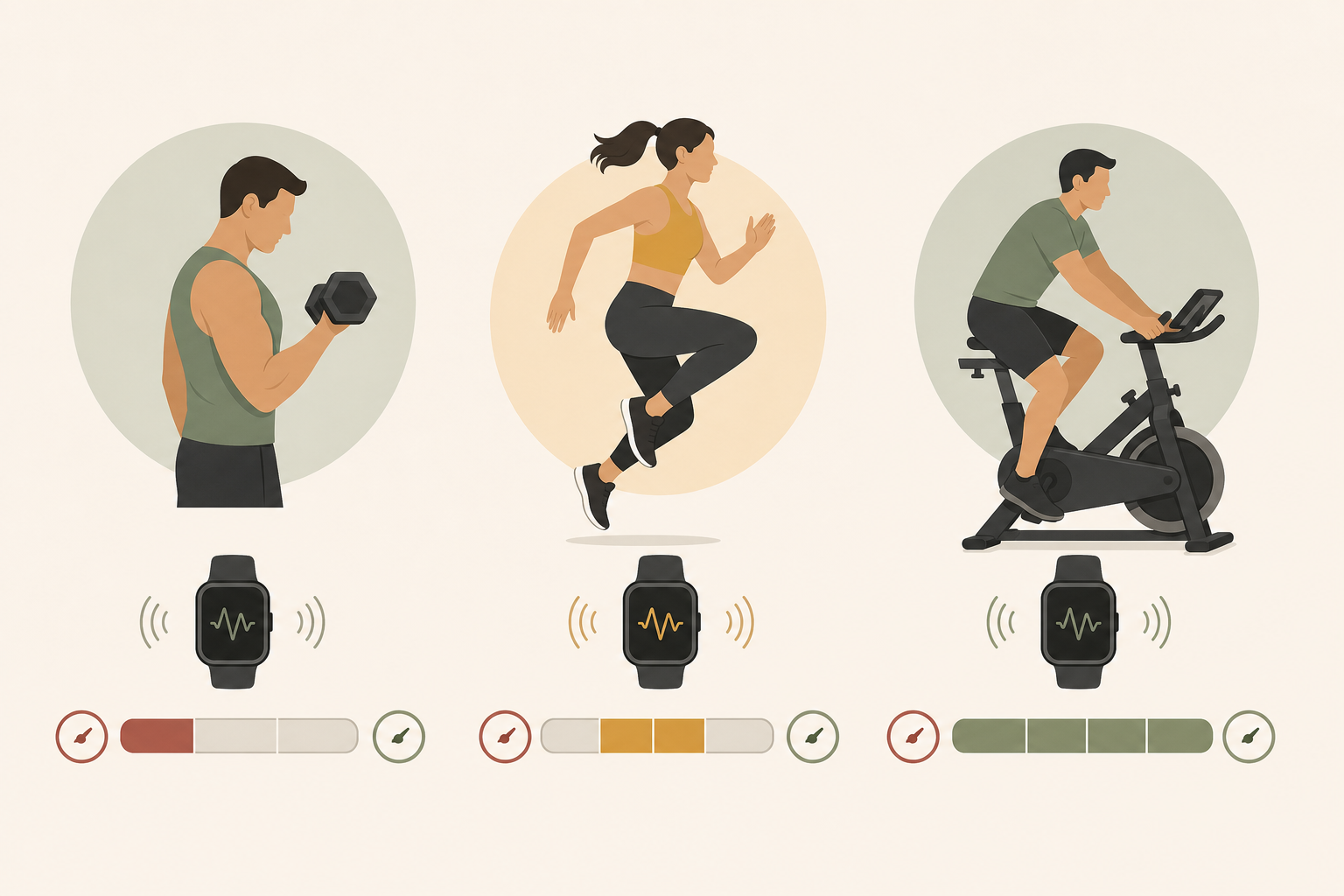
Strength Training: Worst Case for Wrist Sensors
Weight training — squats, biceps curls, lunges, presses — combines wrist flexion, grip-induced blood flow restriction, and variable arm positioning in a way that degrades wrist PPG signal quality more than almost any other activity. In the JMIR study, weight training was the weakest activity even for the arm-worn Polar Verity Sense, which achieved an RMSE of 6.49 bpm during that protocol. For a wrist-worn device, performance would be expected to be worse.
The practical implication: if you're using heart rate zones to guide effort during a lifting session, wrist-sensor data is likely to be the least reliable in this context compared to any other workout type.
HIIT: Lag at Transitions, Inflated Aggregate Scores
HIIT creates a different accuracy problem. Wrist sensors struggle at intensity transitions — the rapid heart rate spikes that define interval training take several seconds to register accurately. During the high-effort interval itself, the sensor may lag behind actual heart rate. But during the recovery periods and especially post-exercise sitting, wrist sensors perform well.
The JMIR data showed the wrist device achieved CCC of 0.97 during post-exercise sitting — its best performance. When a lab test includes meaningful post-exercise rest periods, those high-accuracy readings pull the aggregate metrics upward, making overall HIIT accuracy look better than it actually is during the work intervals that matter most for zone-based training.
Stationary Indoor Cardio: Best Case for Wrist Sensors
Recumbent bike, indoor cycling, and similar stationary cardio activities are the best-case scenario for wrist optical sensors. Wrist flexion is minimal, hands are resting or lightly gripping, and heart rate is elevated and relatively stable. The JMIR study showed cycling as one of the highest-CCC activities for the wrist device. This is also the context closest to running — which is why running-test accuracy figures are most applicable to users who primarily do indoor cycling.
| Workout Type | Wrist PPG Accuracy Expectation | Primary Cause of Error |
|---|---|---|
| Strength training (curls, presses, squats) | Low | Wrist flexion, grip-load blood flow restriction, arm positioning |
| HIIT (interval circuits) | Moderate — with lag at transitions | Sensor lag at intensity spikes; post-exercise rest inflates aggregate scores |
| Stationary indoor cardio (recumbent bike, cycling) | High — closest to running-test conditions | Minimal wrist flexion; stable elevated blood flow |
How the Top-Rated 2026 Devices Perform Across Home Workout Scenarios
Lifting-specific validation data is absent for most of the devices in 2026 roundups. What follows draws on available real-world tester observations and published study data, with explicit notes on what's confirmed and what's inferred from sensor class behavior.
Apple Watch Series 11
The Series 11's 0.98% running accuracy (CNET lab test) is a real result, but it was produced under flat-track running conditions that minimize exactly the variables that degrade wrist sensor performance during lifting. That figure is not a valid proxy for strength training accuracy. Forbes Vetted's tester noted that a previous Apple Watch 'accurately tracked heart rate variability, including how long I spent in certain zones' — but this observation covers general HRV and zone tracking, not lifting-specific accuracy.
PCMag notes the Series 11 has a harder screen 'in case you accidentally knock into it while lifting weights' — a durability note, not an accuracy one. No independent lifting-specific HR accuracy data was found for the Series 11.
Fitbit Charge 6
Forbes Vetted's ACE-certified personal trainer tester provided the most direct real-world lifting observation available for this device class:
The accuracy of the heart rate tracking can be inconsistent. During a few lifting sessions, the heart rate tracking got a slow start and was off for a few sets compared with my control device before catching up by the middle or end of my workout.
This is consistent with what the JMIR research predicts for wrist PPG sensors during strength training: initial lag and reduced accuracy during the high-motion early sets, with partial recovery as the sensor algorithm adapts. If you're tracking effort during the first half of a lifting session, this lag matters.
Garmin Vivoactive 5
PCMag describes the Vivoactive 5 as having 'accurate heart rate measurements,' but no lifting-specific test data was found for this model. The contextually relevant data point comes from Forbes Vetted, where the Garmin Venu 3 — a different model in the Garmin wrist sensor family — was their most accurate device overall across sessions combining strength training with light cardio. This suggests Garmin's wrist sensor implementation performs reasonably well in mixed-workout conditions, but the Venu 3 result shouldn't be applied directly to the Vivoactive 5 without independent confirmation.
Whoop 5.0
Whoop is worn as a strap on the wrist or forearm rather than as a watch, which may reduce some wrist-flexion artifact compared to a standard watch form factor — the sensor sits more stably against the skin during arm movements. However, Garage Gym Reviews noted in real-world testing that the Whoop 5.0 'doesn't always do the greatest job of picking up the correct activity,' suggesting the activity detection algorithm has gaps that affect how data is categorized and interpreted after a session.
One trust-relevant note on Whoop's broader health claim ecosystem: Wirecutter confirmed that the FDA issued a warning letter to Whoop in July 2025 regarding marketing for its Blood Pressure Insights feature, stating the marketing was in violation of the Federal Food, Drug, and Cosmetic Act. Whoop maintains the device is not a medical device. This doesn't affect the strap's HR monitoring function, but it's worth knowing when evaluating Whoop's health metric claims broadly.
Oura Ring 4
The Oura Ring 4 uses a finger-based PPG sensor rather than a wrist sensor. Finger placement avoids the wrist-flexion artifact that affects watches and bands during lifting — the ring stays on your finger regardless of how your wrist moves. This is an architectural advantage for strength training accuracy, not a tested performance claim.
No independently quantified HR accuracy data for the Oura Ring 4 during strength training or HIIT was found in available sources. The advantage is structural and plausible, but it hasn't been validated against a reference device under lifting conditions in any source reviewed for this article.
| Device | Sensor Placement | Strength Training HR Accuracy | HIIT HR Accuracy | Stationary Cardio HR Accuracy | Key Caveat |
|---|---|---|---|---|---|
| Apple Watch Series 11 | Wrist (watch) | No lifting data; running accuracy (0.98%) not transferable | Moderate — lag at transitions expected | High — running-test results most applicable here | Running test ≠ lifting accuracy |
| Fitbit Charge 6 | Wrist (band) | Low–Moderate; real-world tester noted lag and early-set inaccuracy | Moderate | High | Sensor lag confirmed during lifting sets |
| Garmin Vivoactive 5 | Wrist (watch) | No lifting-specific data; Venu 3 (same family) performed well in mixed sessions | Moderate | High | Venu 3 data not directly transferable to Vivoactive 5 |
| Whoop 5.0 | Wrist strap | Moderate — strap form may reduce flexion artifact vs. watch | Moderate | Moderate–High | Activity detection inconsistencies noted in real-world testing |
| Oura Ring 4 | Finger (ring) | Architectural advantage over wrist; no quantified lifting accuracy data found | Plausible advantage; unvalidated for HIIT | High | No independent lifting accuracy data available |
The Skin Tone Accuracy Variable Most Reviews Skip
A 2025 study published in PLOS ONE by Hung et al. at the University of British Columbia tested the Fitbit Charge 5 against a Polar H10 chest strap on a recumbent cycle ergometer. The protocol was specifically designed to minimize arm motion artifact — participants kept their hands at their sides throughout. This means the errors observed are attributable to the sensor itself, not to movement.
The findings show a clear interaction between skin tone and exercise intensity. At rest, no significant differences in accuracy were observed across skin tones. As intensity increased, the gap widened substantially.
| Skin Tone | Intensity Level | Mean Error vs. Light Skin at Low Intensity |
|---|---|---|
| Medium | >60% HRR | +11.8 bpm (p<0.001) |
| Darker | 40–60% HRR | +7.6 bpm (p=0.011) |
| Darker | >60% HRR | +11.7 bpm (p<0.001) |
The mechanism is melanin absorption. Darker skin contains more melanin, which absorbs green LED light more readily. As heart rate rises, the PPG signal becomes smaller relative to the noise floor, and melanin's absorption effect becomes more significant. The result is that the sensor's effective accuracy degrades faster at high intensities for users with medium or darker skin tones.
Most mainstream fitness tracker reviews don't address this variable. It's worth knowing before you assume the accuracy figures cited in a roundup apply to your specific situation.
When to Consider an Arm-Worn Sensor or Chest Strap
If you do significant strength training or high-intensity interval work and want reliable heart rate zone data during those sessions, two categories of devices are worth considering alongside or instead of a wrist tracker.
Arm-Worn Optical Sensors
Devices like the Polar Verity Sense and Wahoo Tickr Fit armband sit on the upper arm or forearm, where wrist-flexion artifact is dramatically reduced during most lifting movements. The JMIR Cardio study showed the arm-worn Polar Verity Sense achieved 1.35% MAPE across all activities including weight training and HIIT — roughly five times better than the wrist-worn device in the same study.
Garage Gym Reviews confirmed through real-world testing that the Wahoo Tickr Fit armband is 'more accurate than wrist-based monitors' for lifting, while scoring it slightly below chest strap accuracy overall. For users who want better lifting HR data without giving up the convenience of a wrist tracker for daily metrics, pairing the two is a practical approach: wrist tracker for all-day monitoring, arm sensor for workout sessions.
Chest Straps
Chest straps using ECG technology — the Polar H10 is the standard reference device used in most of the validation studies cited in this article — remain the most accurate option for workout HR monitoring. Because they measure the heart's electrical signal directly rather than inferring pulse from blood volume changes in the skin, they're not affected by motion artifact, skin tone, or wrist flexion.
The trade-off is real: chest straps don't track sleep, don't provide HRV trends over days, don't count steps, and aren't comfortable for all-day wear. They're a workout tool, not a wearable.
- Arm-worn sensors (Polar Verity Sense, Wahoo Tickr Fit): Better accuracy than wrist watches during lifting; still PPG-based so not perfect, but substantially less affected by wrist flexion.
- Chest straps (Polar H10): Most accurate option for workout HR; ECG-based, not affected by motion artifact or skin tone effects; no all-day wearability or sleep tracking.
- Pairing strategy: Use a wrist tracker for daily metrics and HRV trends; use an arm sensor or chest strap during strength training and HIIT sessions for reliable zone data.
If you decide to pair a chest strap or arm sensor with an app for workout tracking, see our guide to the best free fitness apps for home workouts — several apps can receive HR data from third-party devices via Bluetooth.
Tracker-to-Workout-Type Matching: A Quick Reference
| Device | Strength Training | HIIT | Stationary Indoor Cardio | Notes |
|---|---|---|---|---|
| Apple Watch Series 11 | Low confidence | Moderate | High | Running accuracy (0.98%) not a lifting proxy; no lifting-specific test data |
| Fitbit Charge 6 | Low–Moderate | Moderate | High | Real-world tester confirmed early-set lag during lifting |
| Garmin Vivoactive 5 | Moderate (inferred) | Moderate | High | No lifting-specific data; Venu 3 (same family) performed well in mixed sessions |
| Whoop 5.0 | Moderate | Moderate | Moderate–High | Strap form reduces flexion artifact; activity detection inconsistencies noted |
| Oura Ring 4 | Moderate–High (architectural) | Moderate–High (architectural) | High | Finger placement avoids wrist flexion artifact; no quantified lifting accuracy data |
| Arm-worn sensor (e.g., Wahoo Tickr Fit, Polar Verity Sense) | High | High | High | Best non-chest-strap option for high-motion workouts; no all-day smartwatch features |
| Chest strap (e.g., Polar H10) | Highest | Highest | Highest | ECG-based; most accurate overall; workout-only, no daily wear or sleep tracking |
Frequently Asked Questions
Does wearing a tracker higher on the wrist improve accuracy during lifting?
Moving the device slightly higher on the wrist — closer to the forearm — can reduce some wrist-flexion artifact by positioning the sensor over a more stable part of the arm. Most manufacturers recommend a snug fit two finger-widths above the wrist bone. In practice, the improvement is modest for heavy compound lifts where the entire forearm is involved in the movement. Placement helps at the margins; it doesn't resolve the fundamental motion artifact problem during high-load wrist-flexion movements.
Are optical HR readings accurate enough for training zone work during strength training?
For broad effort awareness — distinguishing low effort from high effort — wrist sensors provide useful information even during lifting. For precise zone-based training where you want to stay within a specific 10–15 bpm band, the error margins during strength training (which can exceed 10% MAPE for wrist devices in validation studies) make zone boundaries unreliable. If training zones matter for your lifting sessions, an arm-worn sensor or chest strap will give you more actionable data.
Why does my tracker show a smooth HR curve during HIIT when my effort clearly spiked?
Wrist optical sensors have a lag at rapid intensity transitions — the algorithm takes several seconds to register a sharp heart rate increase. During a 20-second all-out interval, the sensor may not reach your actual peak HR before the interval ends. What you see in the post-workout graph is a smoothed version of what happened, with peaks that are lower and transitions that are slower than your actual cardiovascular response. This is a known limitation of PPG sensors during interval work, not a device-specific defect.
Does the Oura Ring avoid wrist motion artifact entirely?
The Oura Ring's finger placement avoids wrist-specific flexion artifact — the ring doesn't move relative to the finger during most lifting movements the way a watch does relative to the wrist. However, it still uses PPG technology, so it's subject to motion artifact from finger movement, grip compression, and the skin-tone effects described in the PLOS ONE study. The architectural advantage is real; it doesn't make the Ring immune to optical sensor limitations. And as noted above, no quantified lifting accuracy data for the Oura Ring 4 was available in any source reviewed for this article.
Where can I find broader device recommendations if I also care about subscription cost and phone compatibility?
This article focuses specifically on sensor accuracy by workout type. For full device comparisons that include subscription cost breakdowns, phone OS compatibility, and tiered picks by budget, see our full home workout tracker recommendations. For a structured decision guide that walks through phone OS, budget, form factor, and use case in sequence, see choosing a fitness tracker for home workouts.
This result comes from one real apartment under the stated conditions — it is a strong signal, not a guarantee your space will measure identically.
Builds this evidence supports
No build currently links to this specific test. Browse all builds with a matching tag.
Spot something off?
If this result didn't match your own space, let us know — floor-damage and noise claims carry real deposit-risk consequences if we get them wrong.