
How to Choose a Wearable Fitness Tracker for Home Workouts
A constraint-first buyer's guide for home fitness users comparing wearable trackers: covers phone OS compatibility, true cost of ownership including subscriptions, form factor trade-offs, and the specs that actually matter for indoor training — so you can match the right device to your budget and routine without overpaying for features you won't use.
What a Wearable Fitness Tracker Actually Does (and Who This Guide Is For)
A wearable fitness tracker is a sensor platform worn on your wrist, finger, or chest that continuously monitors physiological signals — primarily heart rate, movement, and skin temperature — and translates them into data you can act on: sleep quality, activity levels, recovery readiness, and workout intensity.
For home fitness users, the relevant metrics are: resting and active heart rate, sleep duration and fragmentation, step count, and — on more capable devices — heart rate variability (HRV) as a recovery signal. That's most of what you'll actually use.
Most tracker buying guides are ranked lists sorted by product tier. This guide is organized differently: it follows the decision logic that actually prevents expensive mistakes. Phone OS compatibility first. True budget — including subscriptions — second. Form factor third. Then specs.
Step 1: Check Your Phone OS Before Anything Else
Compatibility is the only truly non-negotiable constraint. A tracker that doesn't work with your phone is useless, regardless of its specs or price.
The most common and expensive mistake in this category: buying a Samsung Galaxy Watch for an iPhone. Galaxy Watch is designed for Android phones running Android 12 or later, and many features are exclusive to Samsung handsets. iOS functionality is severely limited. The Samsung Galaxy Fit3 does not work with iOS at all.
| Device / Brand | iPhone (iOS) | Android | Notes |
|---|---|---|---|
| Apple Watch (all models) | Full functionality | Not compatible | Requires iPhone 11 or later |
| Samsung Galaxy Watch 8 | Very limited | Full functionality | Best on Samsung Android phones; iOS support is minimal |
| Samsung Galaxy Fit3 | Not compatible | Full functionality | Android-only; confirmed by PCMag testing |
| Fitbit (all current models) | Full functionality | Full functionality | Requires Google account; uses Google Health app |
| Garmin (all models) | Full functionality | Full functionality | Garmin Connect app works cross-platform |
| Whoop 5.0 | Full functionality | Full functionality | App-only device; cross-platform |
| Oura Ring 4 / Ring 5 | Full functionality | Full functionality | Cross-platform; subscription required |
| Xiaomi Smart Band 10 | Full functionality | Full functionality | Cross-platform; limited app ecosystem |
One additional note on Fitbit: all current Fitbit devices — including the Fitbit Air and Charge 6 — require a Google account and run through the Google Health app. Google acquired Fitbit in 2021. New users must accept Google's privacy policy, which governs how Fitbit data is collected, stored, and shared. If data privacy under Google's terms is a concern, factor this in before choosing any current Fitbit device.
Form Factor Trade-Offs: Band, Smartwatch, Ring, or Screenless Strap
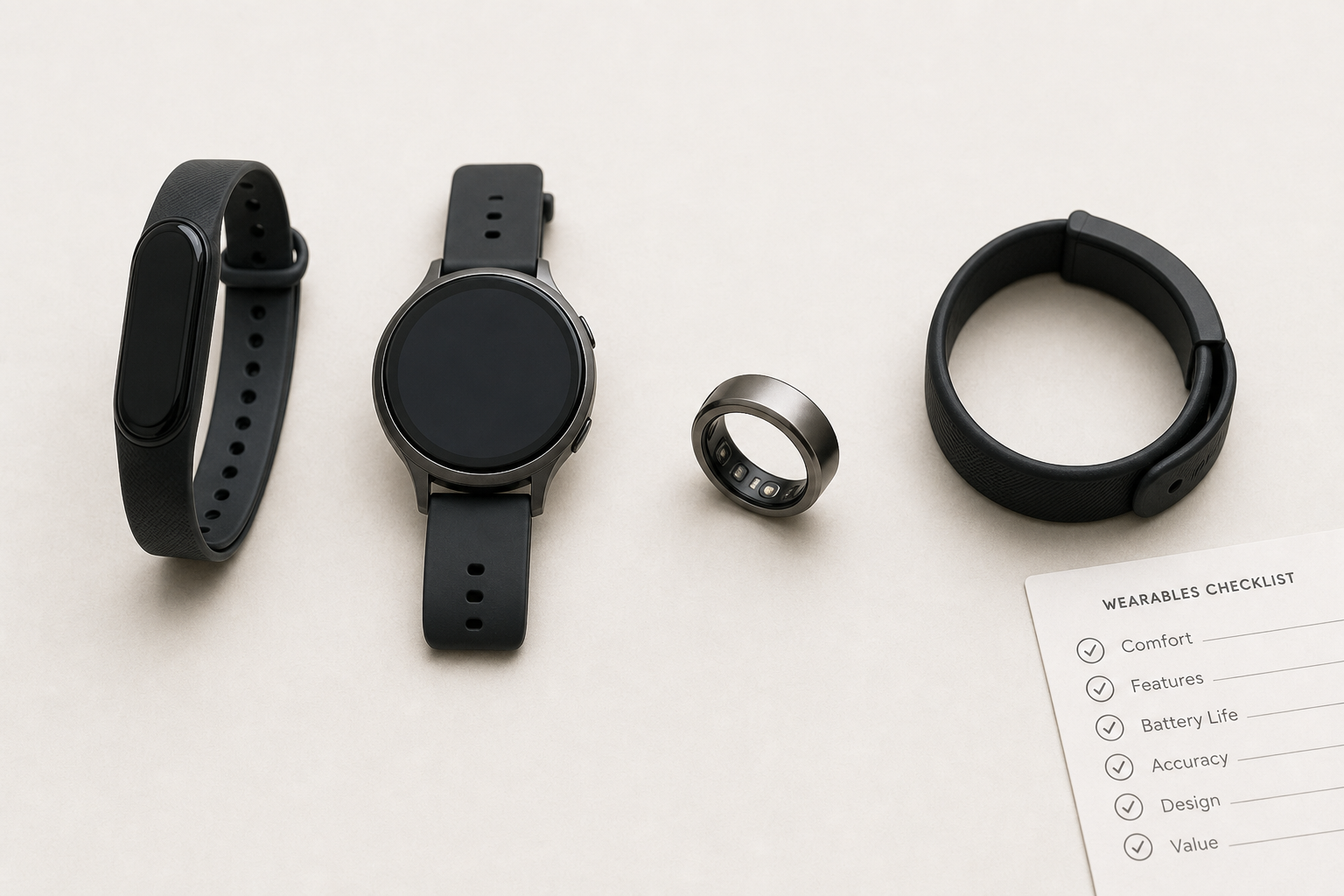
Once you've confirmed OS compatibility, form factor is the next filter. Each form factor involves genuine trade-offs between battery life, comfort for 24/7 wear, real-time workout display, and the depth of workout data captured.
| Form Factor | Battery Life | Sleep Comfort | Real-Time Display | Workout Detail | Typical Price Range |
|---|---|---|---|---|---|
| Slim fitness band | 7–21 days | Good — lightweight | Yes, small screen | Moderate | $30–$150 |
| Smartwatch | 1–2 days | Fair — heavier, larger | Yes, full screen | High | $150–$500+ |
| Smart ring | 5–8 days | Excellent — minimal bulk | No — app only | Lower than wrist trackers | $300–$500+ |
| Screenless strap | 7–14 days | Excellent — no display bulk | No — app only | Moderate to high (Whoop) | $0 upfront + subscription |
Slim bands are the practical default for most home fitness users. They track the core metrics — heart rate, sleep, steps — at a comfortable weight, with enough battery to go a week or more between charges. The Fitbit Inspire 3 and Xiaomi Smart Band 10 both represent this category well.
Smartwatches offer more features — apps, notifications, GPS, larger displays — but their 1–2 day battery life means daily charging, which disrupts overnight sleep tracking. If you want to track sleep consistently, a smartwatch requires a disciplined charging routine.
Smart rings (Oura Ring 4, Ring 5) are the most comfortable option for 24/7 wear and sleep tracking. The trade-off: they provide less workout detail than wrist-based trackers. During a strength session, a ring can't show you real-time heart rate on your wrist — you check the app after.
Screenless straps like the Fitbit Air and Whoop 5.0 remove the display entirely. This makes them lighter and more comfortable for sleep, and eliminates the temptation to check your wrist mid-workout. The downside: you can't see real-time data without unlocking your phone.
The Specs That Matter for Home Training
For home fitness users, four specs determine whether a tracker is actually useful day-to-day. GPS is not one of them.
Heart Rate Accuracy
All wrist-based trackers use optical photoplethysmography (PPG) — a green LED that shines through your skin and detects blood flow changes. This works well during steady-state activity like walking or a moderate-pace bike ride. It becomes less reliable during high-intensity intervals and weightlifting, where wrist movement and muscle tension interfere with the sensor reading.
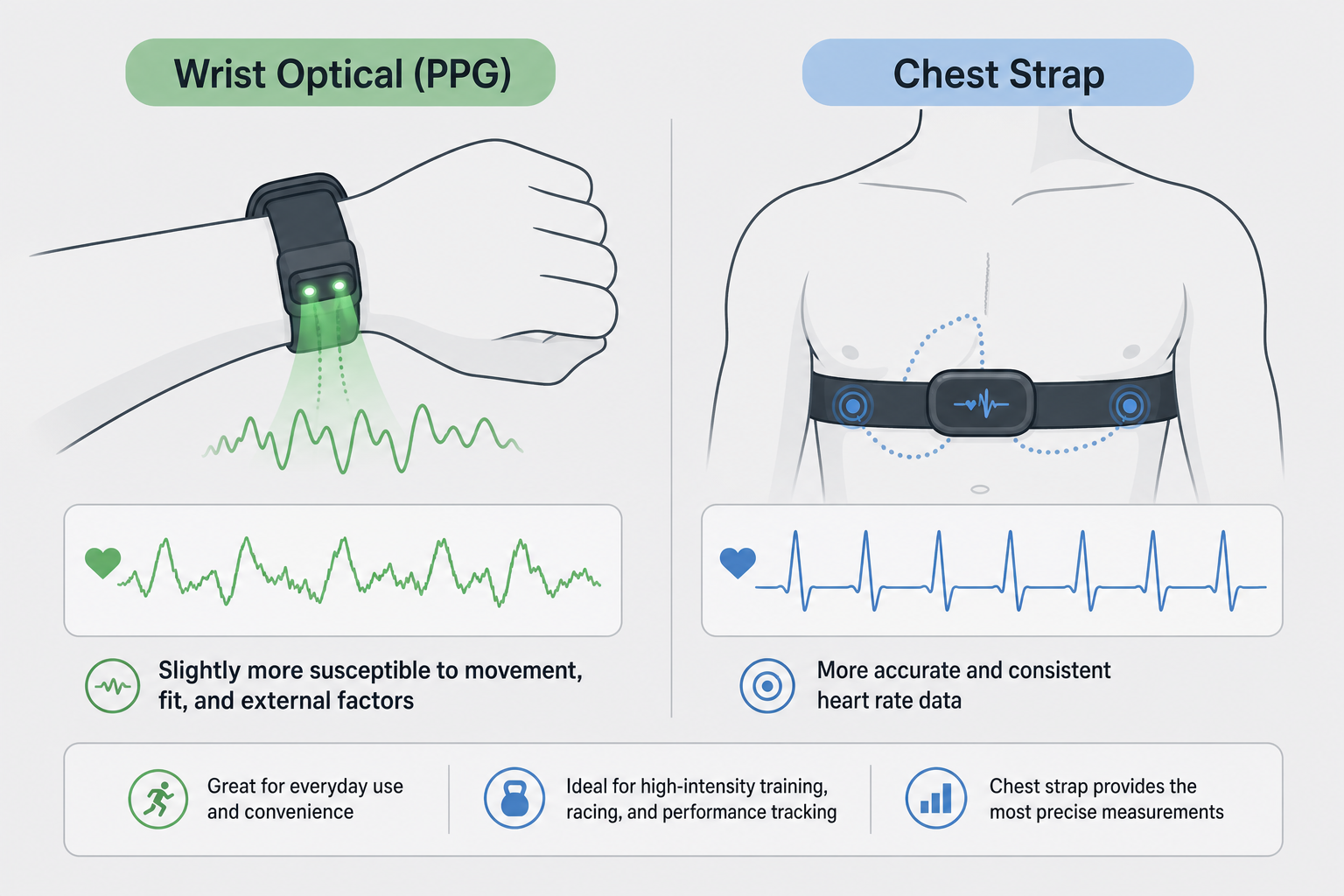
Optical sensors are also affected by darker skin tones and tattoos on the wrist, which can interfere with the LED's ability to detect blood flow. This is an acknowledged limitation across all consumer wearable brands, not specific to any one device.
Sleep Tracking
Consumer trackers can estimate total sleep time and sleep fragmentation (how often you wake up) with reasonable reliability. What they cannot do reliably is measure sleep stage architecture — specifically, how many minutes you spent in deep sleep or REM.
Battery Life
For home fitness use, battery life matters in one specific way: can the tracker stay on your wrist overnight, every night, for sleep tracking, without requiring a daily charging cycle? A smartwatch that needs charging every evening will miss your sleep data on the nights you forget. A band with 8–21 days of battery eliminates this problem.
App Quality and Paywall Structure
The app is as important as the hardware. A tracker that produces good data but presents it through a confusing or paywalled app is functionally less useful than a simpler tracker with a clear, free interface. Garmin Connect provides all core stats for free across all Garmin devices. Fitbit's free tier in Google Health covers the basics, but some metrics — detailed sleep analysis, guided programs — require a Google Health Premium subscription. Whoop and Oura lock most of their meaningful data behind mandatory subscriptions.
The Real Cost: Device Price Plus Subscription Over Three Years
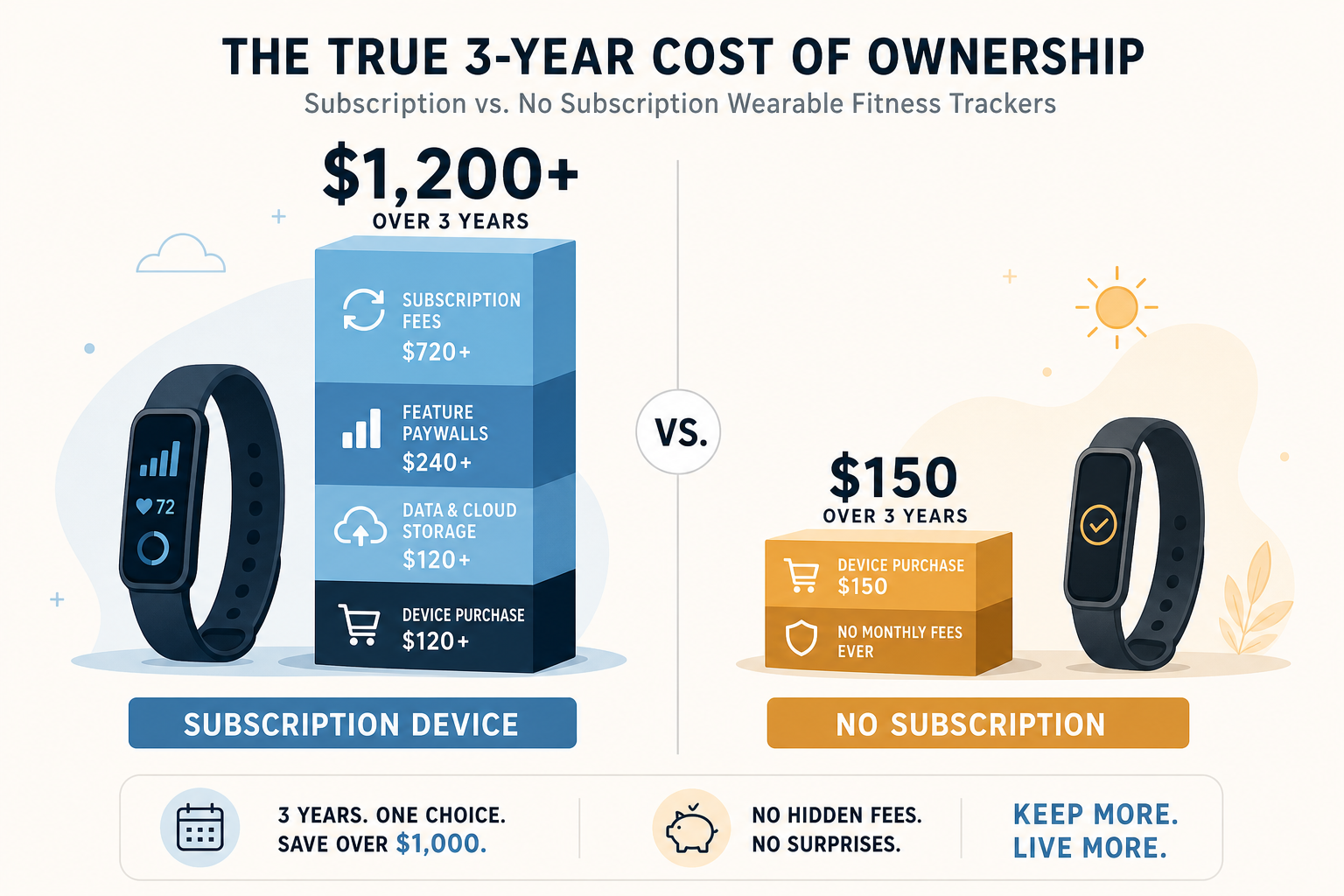
The sticker price of a tracker is often not the real cost. Subscription-based devices like Whoop and Oura have 3-year total costs that are 2–4x their device price alone. This table makes that math visible.
| Device | Upfront Cost | Annual Subscription | 3-Year Total Cost | Subscription Required? |
|---|---|---|---|---|
| Whoop 5.0 (One Membership) | $0 (bundled) | $199/yr | ~$597 | Yes — device unusable without it |
| Whoop 5.0 (Peak Membership) | $0 (bundled) | $239/yr | ~$717 | Yes |
| Whoop MG (Life Membership) | $0 (bundled) | $359/yr | ~$1,077 | Yes |
| Oura Ring 4 | ~$349 | $70/yr ($6/mo) | ~$559 | Yes — most features locked |
| Oura Ring 5 | ~$399 | $70/yr ($6/mo) | ~$609 | Yes — most features locked |
| Fitbit / Google Health Premium (new sub) | Varies by device | $100/yr ($10/mo) | Device + $300 | No — free tier available |
| Fitbit / Google Health Premium (existing sub) | Varies by device | $80/yr ($10/mo) | Device + $240 | No — free tier available |
| Apple Fitness+ | Device cost | $9.99/mo ($120/yr) | Device + $360 | No — optional add-on |
| Garmin Connect | Device cost | $0 | Device cost only | No — all core stats free |
| Fitbit Inspire 3 | ~$93 | $0 (free tier adequate) | ~$93 | No |
| Fitbit Air | ~$100 | $0 (free tier adequate) | ~$100 | No |
| Garmin vívosmart 5 | ~$150 | $0 | ~$150 | No |
| Samsung Galaxy Fit3 | ~$44 | $0 | ~$44 | No — Android only |
| Xiaomi Smart Band 10 | ~$50 | $0 | ~$50 | No |
Budget-Tiered Recommendations for Home Fitness Users
The following recommendations are organized by total budget, with OS compatibility and subscription status noted for each. These are not ranked by prestige — they're matched to real home fitness use cases.
Under $100
| Device | Price | OS Compatibility | Subscription | Best For |
|---|---|---|---|---|
| Fitbit Inspire 3 | ~$93 | iOS and Android | No (free tier) | Cross-platform users wanting reliable step and sleep tracking; tested step accuracy of 0.32% error |
| Samsung Galaxy Fit3 | ~$44 | Android only | No | Android users on a tight budget; do not buy for iPhone |
| Xiaomi Smart Band 10 | ~$50 | iOS and Android | No | Budget-first buyers who want 21-day battery; limited HRV and sleep stage depth |
A fitness band under $100 covers 90% of what most home fitness users actually need: resting and active heart rate, sleep duration, step count, and basic workout logging. The accuracy difference between a $93 Fitbit Inspire 3 and a $400+ device is smaller than most buyers expect for these core metrics.
$100–$200
| Device | Price | OS Compatibility | Subscription | Best For |
|---|---|---|---|---|
| Fitbit Air | ~$100 | iOS and Android (Google Health app) | No (free tier) | Screenless comfort, sleep tracking, no subscription; requires Google account |
| Garmin vívosmart 5 | ~$150 | iOS and Android | No — all features free via Garmin Connect | Users who want no subscription ever; solid HR and stress tracking |
| Fitbit Charge 6 | ~$127–$150 | iOS and Android | No (free tier adequate) | Users wanting a slim band with more workout detail than the Inspire 3; Google account required |
$200–$400
| Device | Price | OS Compatibility | Subscription | Best For |
|---|---|---|---|---|
| Garmin Venu Sq 2 | ~$250 | iOS and Android | No — Garmin Connect free | Cross-platform users wanting a smartwatch with multi-day battery and no subscription |
| Apple Watch SE 3 | ~$239 | iOS only | No (Apple Fitness+ optional at $9.99/mo) | iPhone users wanting a full smartwatch with strong HR accuracy; 1–2 day battery requires daily charging |
| Oura Ring 4 or Ring 5 | $349–$399 + $70/yr | iOS and Android | Yes — required for most features | Sleep-focused users comfortable with subscription; less workout detail than wrist trackers |
$400 and Above
| Device | Price | OS Compatibility | Subscription | Best For |
|---|---|---|---|---|
| Apple Watch Series 11 | $329–$399 | iOS only | No (Apple Fitness+ optional) | iPhone users wanting the most accurate wrist-based HR monitor tested; lowest HR error in CNET lab testing |
| Samsung Galaxy Watch 8 | ~$300+ | Android only (best on Samsung) | No | Android users wanting a full smartwatch; limited iOS functionality |
| Whoop 5.0 | $0 upfront + $199–$359/yr | iOS and Android | Yes — device is useless without it | Users who want recovery-focused coaching and are willing to pay $200–$360/yr for it; overkill for most home users |
What Fitness Trackers Cannot Reliably Measure
Understanding the limitations of consumer wearables is as important as understanding their capabilities. These are not brand-specific weaknesses — they apply across the category.
- Calorie burn: A systematic review of 65 studies published in JMIR found that no tested brand came close to accurately measuring energy expenditure, with mean absolute percentage error (MAPE) exceeding 30% across all devices. Do not use calorie burn estimates from any wearable for nutrition planning or caloric deficit calculations.
- Sleep stage architecture: Consumer trackers can estimate total sleep time and how often you wake up with reasonable reliability. Minutes in deep sleep or specific REM duration are less reliable. Clinical-grade sleep stage measurement requires polysomnography, not a wrist sensor.
- Active heart rate during HIIT and weightlifting: Optical PPG sensors on the wrist lose accuracy during high-intensity intervals and resistance training, where wrist movement and muscle tension interfere with the reading. Resting heart rate measurements are more reliable than active HR readings during intense effort.
- Readings on darker skin tones and tattooed wrists: Optical sensors use light absorption to detect blood flow. Darker skin pigmentation and tattoo ink can interfere with the LED's signal, reducing accuracy. This affects all optical sensor-based wearables regardless of brand or price.
Common Questions About Fitness Trackers for Home Workouts
Fitbit vs. Garmin for home fitness — which is better?
Both work cross-platform. The practical difference: Garmin Connect is entirely free — no features locked behind a subscription, ever. Fitbit's free tier in Google Health covers the basics, but some features require Google Health Premium. Garmin also offers more detailed workout metrics for strength and cardio sessions. Fitbit's edge is a slightly simpler interface and the newer screenless Fitbit Air option. For home fitness users who don't want to think about subscriptions, Garmin is the cleaner long-term choice.
Do I need built-in GPS for home workouts?
No. Built-in GPS tracks outdoor routes and distance. For treadmill runs, stationary bike sessions, dumbbell workouts, or bodyweight training, GPS provides no useful data. It drains battery and adds cost. Skip it.
Is Whoop worth the subscription for home fitness users?
For most home fitness users, no. Whoop's value proposition — continuous recovery coaching and strain scoring — is most useful for athletes training at high volume who need to manage fatigue systematically. At $199–$359 per year with no display and limited real-time workout feedback, it's a significant ongoing cost for data that a $93 Fitbit Inspire 3 partially covers. If recovery metrics are important to you, the Oura Ring 4 at $70/year is a lower-cost subscription alternative. If you want no subscription at all, Garmin's free Garmin Connect platform covers HRV and recovery data on devices starting at $150.
What's the best tracker with no subscription at all?
The Garmin vívosmart 5 (~$150) unlocks all features permanently with the upfront device cost — no subscription, ever. For under $100, the Fitbit Inspire 3 covers core tracking with a free tier that's adequate for most home fitness users, though some advanced features require Google Health Premium. The Xiaomi Smart Band 10 (~$50) has a 21-day battery and no subscription, though its sleep tracking depth and HRV data are limited compared to Garmin or Fitbit options.
What does the Google account requirement mean for Fitbit buyers?
Since Google acquired Fitbit in 2021, all new Fitbit devices — including the Fitbit Air and Charge 6 — require a Google account to set up and use. Your health data (heart rate, sleep, activity) is governed by Google's privacy policy, which covers how data is stored, analyzed, and potentially shared. If you're comfortable with Google's data practices, this is not a barrier. If data privacy under Google's terms is a concern, Garmin is the strongest cross-platform alternative with its own independent platform and no Google account requirement.
Does a cheap band cover the same basics as an expensive smartwatch?
For the core home fitness use case — heart rate, sleep, steps, activity logging — yes, largely. A $93 Fitbit Inspire 3 was found to be the most accurate step counter of all trackers tested by Wirecutter, with a 0.32% error rate over two days of testing. The accuracy gap between a budget band and a premium smartwatch for resting heart rate and sleep duration is smaller than the price gap suggests. Where premium devices genuinely add value: more detailed workout metrics, richer app ecosystems, real-time display during workouts, and features like ECG or blood oxygen monitoring. Whether those additions are worth $200–$400 more depends on how deeply you engage with that data.
This result comes from one real apartment under the stated conditions — it is a strong signal, not a guarantee your space will measure identically.
Builds this evidence supports
No build currently links to this specific test. Browse all builds with a matching tag.
Spot something off?
If this result didn't match your own space, let us know — floor-damage and noise claims carry real deposit-risk consequences if we get them wrong.