
How Oura Ring Tracks Recovery: Readiness Score, HRV Accuracy, and What the Science Says
Home fitness athletes often rely on wearables to guide training decisions, but most devices optimize for activity, not recovery. This article explains how Oura Ring's Readiness Score works, examines the independent scientific validation behind its HRV and sleep tracking accuracy, and provides a practical framework for using Oura's recovery data to train smarter — while being honest about where the device falls short for strength training and step tracking.
The Recovery Gap in Home Fitness: Why Most Trackers Miss the Point
Walk into any home gym and you will see the same pattern: a wrist-worn device counting steps, logging workout duration, and buzzing to close a ring. These devices are built for output. They reward movement, measure calories burned, and celebrate streaks. What they rarely do is tell you when to stop.
That is the recovery gap. Training adaptation does not happen during the workout — it happens during rest, sleep, and the physiological rebound that follows a stimulus. Most wearables optimize for the stimulus side of the equation. The Oura Ring was designed from the ground up to fill the other side.
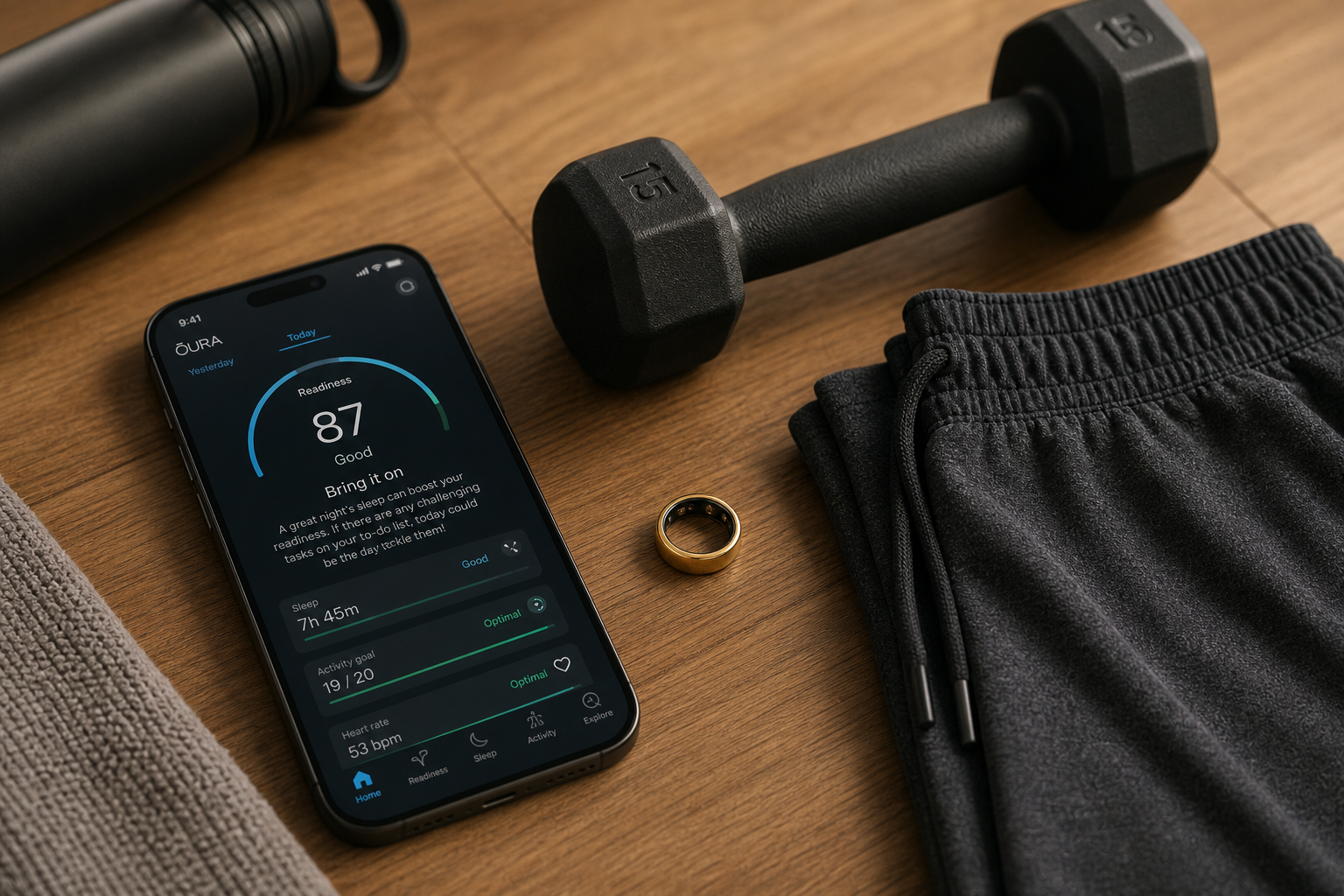
Oura is a finger-worn device that prioritizes passive monitoring over active tracking. It does not have a screen, does not buzz you to move, and does not gamify step counts the way a fitness band does. Instead, it collects physiological data while you sleep and while you go about your day, then synthesizes that data into a single question: How ready is your body to train today?
For home fitness athletes who train without a coach, this question is critical. Without an objective signal, it is easy to push through fatigue on a day when the body needs rest — or to skip a session because subjective motivation is low even though recovery is complete. Oura's value proposition is that it provides a data-driven answer, grounded in peer-reviewed research, that helps you make that call with more confidence.
How Oura's Readiness Score Works: The 7 Contributors Explained
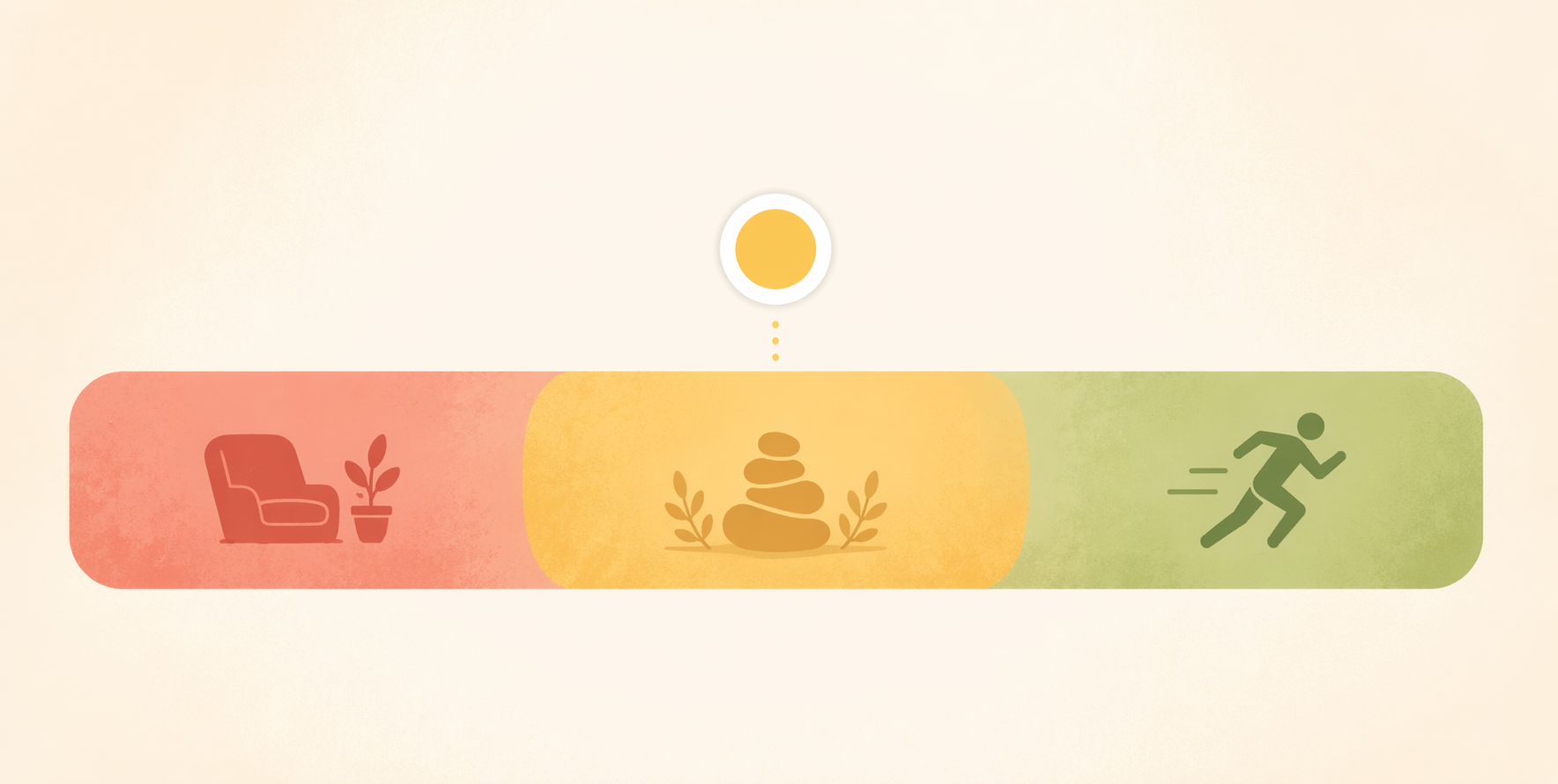
The Readiness Score is Oura's flagship metric — a 0-to-100 number that appears on your dashboard each morning and is designed to guide your training decision for the day. According to Oura's documentation, scores of 85 or higher indicate optimal readiness for high-intensity work, scores between 70 and 84 suggest you can maintain your current load, and scores under 70 signal that recovery should take priority.
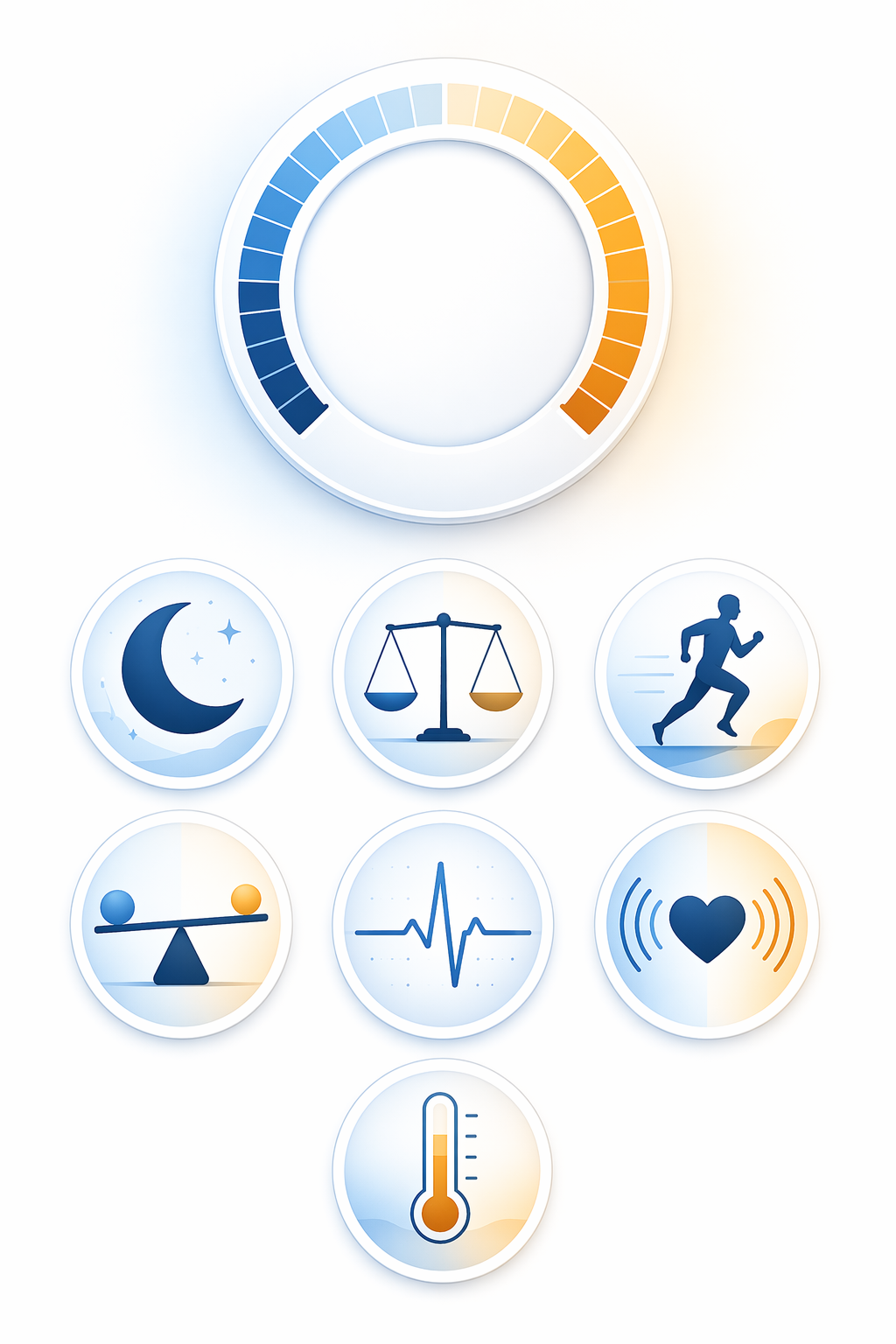
The score is not a black box. It is synthesized from seven daily contributors organized across three pillars: sleep, activity, and body stress. Understanding what each contributor measures — and how they interact — is the difference between blindly following a number and actually using the data to train smarter.
Sleep Pillar
- Sleep: Measures total sleep time, sleep efficiency, and the balance of light, deep, and REM stages against your personal baseline. This is the most straightforward contributor — did you get enough quality sleep?
- Sleep Balance: Compares your sleep over the past several nights against your long-term average. A single bad night is less concerning than a downward trend. Sleep Balance captures the trajectory, not just the snapshot.
Activity Pillar
- Previous Day Activity: Evaluates how much movement and exercise you logged yesterday. High training volume or intensity will lower this contributor, signaling that your body is still processing the load.
- Activity Balance: Looks at your activity levels over the past week. If you have been training hard every day without a rest day, Activity Balance will reflect that cumulative fatigue.
Body Stress Pillar
- Resting Heart Rate (RHR): Your overnight low heart rate. A rising RHR trend can indicate incomplete recovery, illness onset, or accumulated stress. Oura measures this with high accuracy — a MAPE of just 1.94% against ECG reference.
- HRV Balance: Heart rate variability measured during sleep. This is arguably the most important recovery metric Oura tracks. Higher HRV generally indicates a well-recovered, adaptable nervous system. Lower HRV suggests the body is under stress. Oura's nocturnal HRV accuracy is industry-leading — more on that in the next section.
- Body Temperature: Tracks your overnight skin temperature deviation from your personal baseline. A sustained elevation can signal illness or overtraining before you feel symptoms.
- Recovery Index: A composite of overnight heart rate, HRV, and temperature trends that provides a quick read on how well your body recovered during the night.
Oura recommends wearing the ring for a two-week baseline period before the Readiness Score becomes personalized. During this time, the device learns your individual ranges for each contributor. After that, the score adjusts dynamically as your physiology changes.
The Science Behind the Scores: What Independent Studies Actually Found
Oura's recovery tracking is backed by a growing body of peer-reviewed research. The data that matters most for home fitness athletes falls into three categories: nocturnal HRV accuracy, resting heart rate accuracy, and sleep staging agreement. Here is what the studies found.
Nocturnal HRV: The Standout Metric
A 2025 study published in Physiological Reports (Dial et al.) evaluated Oura Ring Gen 3 and Gen 4 against a Polar H10 chest strap ECG reference across 13 participants and over 500 nights of sleep. The results were striking: Oura Ring 4 achieved a concordance correlation coefficient (CCC) of 0.99 for HRV and a mean absolute percentage error (MAPE) of just 5.96%. A CCC of 0.99 is essentially perfect agreement with the gold-standard ECG measurement.
To put that in context, the same study found that WHOOP achieved a MAPE of 8.17% for nocturnal HRV, Garmin came in at 10.52%, and Polar — the company that makes the reference chest strap — measured 16.32%. Oura's advantage was not marginal; it was substantial.
Resting Heart Rate: Near-ECG Accuracy
The same Dial et al. study found that Oura Ring 4 achieved a CCC of 0.98 for resting heart rate with a MAPE of 1.94%. Oura Gen 3 was close behind at CCC 0.97. For comparison, WHOOP scored 0.91 and Polar scored 0.86. This level of accuracy means that when Oura reports your overnight RHR, you can trust that number within roughly two beats per minute of what an ECG would show.
Sleep Staging: Substantial Agreement with Polysomnography
A 2024 study from Brigham and Women's Hospital (Robbins et al., published in Sensors) compared Oura Ring Gen 3, Fitbit Sense 2, and Apple Watch Series 8 against polysomnography (PSG) — the clinical gold standard for sleep measurement — in 35 healthy adults. Oura was not significantly different from PSG for 7 of 8 sleep summary measures, including total sleep time, time in light sleep, deep sleep, REM, wake after sleep onset, and sleep efficiency.
For overall sleep staging, Oura achieved a Cohen's kappa coefficient of κ=0.65, which is classified as "substantial agreement" with PSG. Fitbit scored κ=0.55 (moderate agreement) and Apple Watch scored κ=0.60 (moderate-to-substantial). More importantly, Oura's deep sleep sensitivity was 79.5%, compared to 61.7% for Fitbit and 50.5% for Apple Watch. The Apple Watch also underestimated deep sleep by an average of 43 minutes per night — a significant error for anyone relying on that data to assess recovery.
Accuracy Comparison: Oura vs. Other Wearables
| Metric | Oura Ring 4 | WHOOP | Garmin | Polar |
|---|---|---|---|---|
| Nocturnal HRV (MAPE) | 5.96% | 8.17% | 10.52% | 16.32% |
| Resting HR (CCC) | 0.98 | 0.91 | N/A | 0.86 |
| Sleep Staging (κ) | 0.65 | N/A | N/A | N/A |
| Deep Sleep Sensitivity | 79.5% | N/A | N/A | N/A |
It is worth noting that Oura Ring 5 was released on June 4, 2026, and features redesigned sensor domes with 12 signal pathways for improved accuracy across more finger types and skin tones. However, independent validation studies for the Gen 5 sensors are not yet available. The accuracy data above comes from Gen 3 and Gen 4 testing, and Oura's own data suggests algorithmic and hardware performance has been stable across generations.
What the Scores Mean in Practice: A Framework for Home Gym Athletes
A Readiness Score is only useful if you know how to act on it. Here is a practical framework for translating Oura's 0–100 scale into daily training decisions for a home gym athlete.
| Readiness Score | Zone | Training Recommendation |
|---|---|---|
| 85–100 | Green — Optimal Readiness | Push hard. This is the day for your heaviest compound lifts, highest intensity intervals, or longest cardio session. Your nervous system is recovered and ready to handle high training stress. |
| 70–84 | Amber — Maintain | Stick to your planned session but avoid pushing beyond your prescribed reps or adding extra volume. This is a good day for technique work, moderate strength training, or steady-state cardio. Do not chase PRs. |
| Below 70 | Red — Prioritize Recovery | Your body is signaling that recovery is incomplete. Consider a deload session, active recovery (walking, mobility work, light yoga), or a full rest day. If you do train, reduce volume by 40–50% and keep intensity low. |
The framework above is a starting point, but real-world application requires nuance. Here are three scenarios where the overall Readiness Score may conflict with individual contributors — and how to resolve them.
- High Readiness but low HRV Balance: If your Readiness Score is 82 but HRV Balance is in the red, trust the HRV signal. HRV is a leading indicator of nervous system recovery, and a low HRV Balance often precedes a drop in Readiness by a day or two. Train in the amber zone even if the overall score says green.
- Low Readiness but excellent sleep: If your Readiness Score is 68 but you slept 8 hours with great sleep stages, check Previous Day Activity and Activity Balance. You may simply be carrying fatigue from a heavy training block. A light active recovery session is appropriate — do not take a full rest day unless other contributors (RHR, temperature) also look off.
- High Readiness but elevated body temperature: A sustained temperature deviation of +0.5°F or more above your baseline can signal the onset of illness, even if you feel fine. Err on the side of caution and take a rest day. Training through a brewing infection rarely ends well.
Where Oura Falls Short: Strength Training Discomfort and Step Count Inaccuracy
Oura's recovery tracking is excellent, but the device has real limitations that home fitness athletes need to understand before buying. These are not dealbreakers — they are constraints that inform how you use the device.
Strength Training Discomfort
The most frequently reported issue among lifters is physical discomfort during grip-heavy exercises. Reviewers at Garage Gym Reviews noted that the ring is "uncomfortable when used in that environment" — referring to barbell work, dumbbell rows, pullups, and any exercise that requires a tight grip. Olympian Caine Wilkes, who used Oura for 10 months, reported that he did not recommend wearing it for Olympic lifting because it felt "in the way."
The practical solution is simple: take the ring off during strength sessions. Oura's automatic activity detection will not log the workout, but you can manually add a strength training session afterward. The ring's primary value is in passive recovery monitoring — you do not need to wear it during training to get that benefit.
Step Count Inaccuracy
Oura's step tracking is rated as "Poor" in independent analyses, with a 50.3% error rate in real-world settings. This is not surprising — a finger-worn accelerometer has a fundamentally harder time detecting steps than a wrist-worn or hip-worn device. If step count is an important metric for you, Oura is not the right primary device for that purpose.
Activity Detection Bias Toward Cardio
Oura automatically detects over 40 activities, but reviewers have noted that it often mislabels strength training or requires manual correction. The device is better suited for runners, cyclists, and cardio-focused athletes than for lifters who want automatic workout logging. The new Live Activity Tracking feature (released June 2026) improves this by allowing real-time heart rate monitoring during workouts, but it still requires you to start a session manually in the app.
Using Oura Alongside Other Tools: A Practical Stack for Home Fitness
The most effective approach for home fitness athletes is not to treat Oura as a single-device solution, but to build a complementary tool stack that covers its gaps while leveraging its strengths.
- Oura Ring: Use for passive recovery monitoring — sleep tracking, nocturnal HRV, resting heart rate, Readiness Score. Wear it 24/7 except during strength training sessions. This is your recovery command center.
- Polar H10 or similar chest strap: Oura's new Live Activity Tracking feature (released June 2026) allows pairing a Bluetooth heart rate monitor for real-time HR during workouts. A chest strap is the gold standard for heart rate accuracy during exercise — far more reliable than any optical wrist or finger sensor during movement. Use this for your structured training sessions.
- Optional — Apple Watch or Garmin: If you want automatic workout detection, GPS tracking for outdoor runs, or a screen-based training interface, a wrist-worn device complements Oura well. Many users wear Oura for recovery and a Garmin or Apple Watch for activity tracking, syncing both to Apple Health or a similar hub.
This stack approach acknowledges that no single wearable excels at everything. Oura wins on passive recovery monitoring. A chest strap wins on exercise HR accuracy. A wrist device wins on workout logging and GPS. Using them together gives you the best of each without forcing a compromise.
Practical Protocols for Improving Your Readiness Score
Improving your Readiness Score is not about chasing a number — it is about addressing the underlying behaviors that drive each contributor. Here are evidence-based protocols tied to specific Readiness contributors.
Improving HRV Balance
HRV is influenced by both acute and chronic factors. The most effective interventions for improving nocturnal HRV are behavioral and circadian, not pharmacological.
- Consistent sleep schedule: Going to bed and waking up at the same time — within 30 minutes — has a stronger effect on HRV than total sleep duration alone. The circadian system regulates autonomic nervous system balance, and irregular timing disrupts that regulation.
- Evening wind-down routine: Reduce exposure to bright light and screens 60–90 minutes before bed. Blue light suppresses melatonin production and shifts the autonomic nervous system toward sympathetic dominance, which lowers HRV.
- Avoid late heavy meals: Eating a large meal within two hours of bedtime increases heart rate and reduces HRV during the first half of the night. If you train in the evening, ensure your post-workout meal is finished at least 90 minutes before sleep.
Optimizing Sleep and Sleep Balance
- Temperature: Keep your bedroom cool — between 65–68°F (18–20°C). Core body temperature drops during sleep initiation, and a cool room facilitates that drop. Oura tracks skin temperature deviation, and a consistently warm sleeping environment will show up in your data.
- Light exposure: Get 10–30 minutes of morning sunlight exposure within an hour of waking. This sets your circadian clock and improves sleep onset and sleep quality at night. It is one of the highest-leverage interventions for sleep health.
- Consistency over duration: Seven hours of consistent sleep is more restorative than nine hours of erratic sleep. Sleep Balance in Oura tracks the trend over several nights — prioritize regularity over occasional long sleeps.
Managing Previous Day Activity and Activity Balance
- Deliberate rest days: Schedule at least one full rest day per week. Activity Balance in Oura reflects cumulative load over seven days, and skipping rest days will show up as a declining trend even if each individual session feels manageable.
- Active recovery sessions: On days when Readiness is below 70 but you feel well enough to move, choose active recovery: a 20–30 minute walk, light mobility work, or foam rolling. These activities promote blood flow and recovery without adding meaningful training stress.
- Deload weeks: Every 4–6 weeks, reduce training volume by 40–60% while maintaining intensity. This is a structured way to manage cumulative fatigue and will show up as improved Readiness scores in the following week.
Oura Ring is not a perfect device, and it is not for every athlete. But for home fitness enthusiasts who want to train smarter — not just harder — its recovery tracking capabilities are backed by the strongest independent scientific validation available in a consumer wearable. The Readiness Score, anchored by industry-leading HRV accuracy and substantial sleep staging agreement, provides a data-driven answer to the question that matters most: Am I recovered enough to push today, or should I pull back? Understanding what the scores mean, where the device falls short, and how to build a complementary tool stack turns Oura from a passive data collector into an active training partner.
This is general fitness education, not medical advice. For diagnosis or treatment of pain or injury, consult a qualified clinician.
Pick your next session
Browse all routines to find an appropriately-spaced next session.
Spot something off?
This content sits adjacent to health guidance — tell us if a citation or figure needs a correction.