
The Complete Science-Backed Guide to the 7-Minute Workout
This guide explains what the 7-minute workout actually is, what the research says about its effectiveness, who it works best for, and — most importantly — how to build it into a sustainable routine with proper recovery scheduling, modifications, and active recovery options.
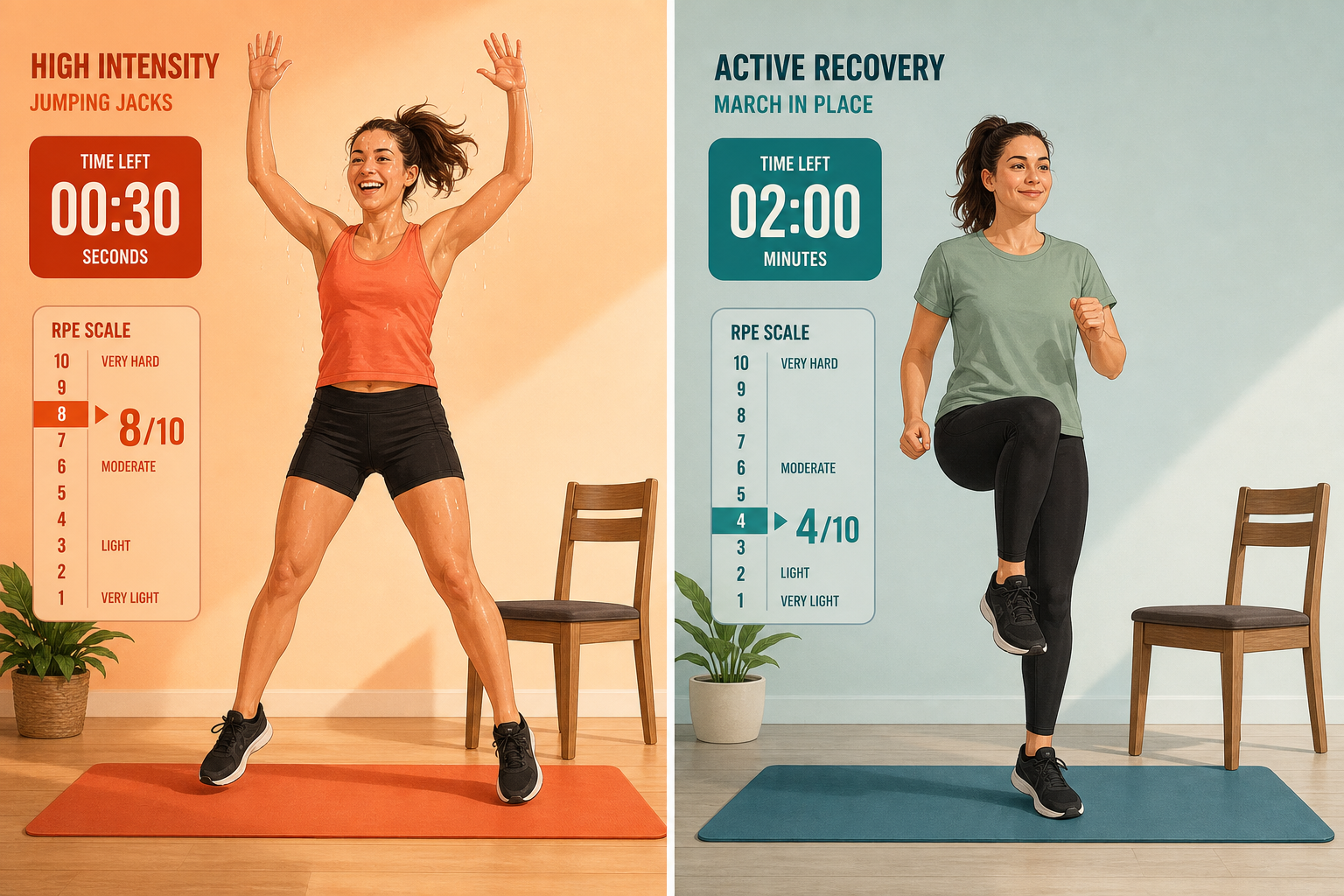
What the 7-Minute Workout Actually Is (and Why Its Name Is Misleading)
The 7-minute workout was introduced in 2013 in the ACSM's Health & Fitness Journal by exercise scientists Brett Klika and Chris Jordan. It is a high-intensity circuit training (HICT) protocol consisting of 12 bodyweight exercises performed in sequence: 30 seconds of work followed by 10 seconds of rest per exercise. The full circuit takes about 7 minutes to complete.
Here is the detail most articles get wrong: Klika and Jordan never intended for you to stop after one round. Their original recommendation was to repeat the circuit 2 to 3 times, bringing the total workout time to 14–21 minutes. The name "7-minute workout" stuck because it is catchy, but the actual prescription is a 14- to 21-minute session that meets the ACSM guidelines for high-intensity exercise of at least 20 minutes when performed for three rounds.
Each exercise is chosen to work multiple muscle groups in sequence — from jumping jacks (full body) to wall sits (lower body) to push-ups (upper body) — so that one muscle group rests while another works. This design keeps your heart rate elevated throughout the entire circuit without requiring any equipment.
What the Science Says: Key Research Findings
The 7-minute workout has been studied more rigorously than most home fitness trends. Here is what the data actually shows, not what the headlines claim.
Physiological Intensity: It Is Genuinely High-Intensity
A 2023 study by Poon et al. published in PMC tracked 14 physically inactive adults (average age 28.4 years, VO2peak 31.0 mL·kg⁻¹·min⁻¹) through the 7-minute workout, comparing it to ergometer-based HIIT and moderate-intensity continuous training (MICT). The results are striking:
- Peak heart rate reached 87.4% of HRmax — solidly in the vigorous-intensity zone.
- Blood lactate hit 7.2 mmol/L, significantly higher than the 5.1 mmol/L produced by ergometer HIIT (p=0.008) and more than double the 3.1 mmol/L from MICT (p<0.001).
- Mean session heart rate was 78.5% of HRmax.
A 2017 study by Riegler et al. confirmed that the workout yields bursts approaching 90% of HRmax and causes significant blood lactate accumulation, representing vigorous exercise. However, that same study noted that the 7-minute workout sits on the low end of the true high-intensity interval exercise (HIIE) spectrum, with lower peak VO2 and mean heart rate (140.7 bpm) compared to cycling HIIT (159.0 bpm). This is an important nuance: it is vigorous, but it is not the most intense HIIT protocol available.
Measurable Outcomes: Waist Reduction and Muscle Endurance
A 6-week study (PubMed PMID 28085122) in which participants performed the 7-minute workout daily found an average 4 cm decrease in waist circumference in normal-weight adults, along with reduced fat mass and slight weight loss. An 8-week study with 96 participants showed significant improvements in muscle endurance, including measurable push-up gains, in both the 7-minute and 14-minute groups.
Enjoyment and Adherence: A Key Advantage
One of the most practical findings from the Poon 2023 study is about adherence. Participants rated the 7-minute workout significantly higher in enjoyment (PACES score 97.6 vs. 82.4 for MICT, p<0.01) and self-efficacy (68.4 vs. 53.3 for MICT, p=0.015). 50% of participants chose the 7-minute workout as their first preference among the three protocols. For home exercisers, enjoyment is not a nice-to-have — it is the difference between sticking with a program and quitting after two weeks.
What It Does Not Do Well
The original authors acknowledged that the 7-minute workout "may be inferior to create absolute strength and power, specific endurance, and other specific performance variables." If your primary goal is building maximal strength, increasing your squat or deadlift one-rep max, or improving sport-specific performance, this protocol is not the right tool. It is a general fitness and conditioning circuit, not a strength or performance program.
| Metric | 7-Minute Workout | Comparison | Source |
|---|---|---|---|
| Peak HR (%HRmax) | 87.4% | — | Poon 2023 |
| Blood lactate (mmol/L) | 7.2 | 5.1 (ergometer HIIT) | Poon 2023 |
| Mean HR (bpm) | 140.7 | 159.0 (cycling HIIT) | Riegler 2017 |
| Enjoyment (PACES) | 97.6 | 82.4 (MICT) | Poon 2023 |
| Waist reduction (6 weeks) | ~4 cm | — | PMID 28085122 |
| Muscle endurance (8 weeks) | Significant gains | — | 8-week study |
Who It Works Best For (and Who Should Be Cautious)
The 7-minute workout is not a one-size-fits-all solution. Its effectiveness and safety depend heavily on your current fitness level, health status, and goals.
Best Candidates
- Time-constrained exercisers: People who struggle to fit in 30–60 minute workouts and need an efficient, evidence-based option.
- General fitness seekers: Those looking to improve cardiovascular fitness, body composition, and muscular endurance without specialized equipment.
- Travelers and home exercisers: Anyone who needs a reliable, no-equipment workout they can do in a hotel room or living room.
- Conditioned exercisers: People who already exercise regularly and can handle the high-intensity demands. Per the Cleveland Clinic, if you are a regular exerciser, this workout "is OK to do every day."
Who Should Be Cautious
The workout is genuinely high-intensity. The Intermountain Health blog warns that individuals who are overweight or obese, untrained, elderly, or have joint or heart issues should be cautious and seek medical clearance before starting. WebMD notes that the workout can be hard on joints — knees from jumps, wrists and shoulders from push-ups, and the back from planks.
How Often to Do It: Recovery Scheduling for Results
Because the 7-minute workout produces blood lactate levels of 7.2 mmol/L and pushes your heart rate to nearly 90% of its maximum, your body needs time to recover between sessions. Recovery is not optional — it is when your body adapts to the stress and gets stronger.
Recovery Guidelines by Experience Level
| Experience Level | Recommended Frequency | Rest Between Sessions | Notes |
|---|---|---|---|
| Beginner | 2–3 times per week | 48–72 hours | Start with 1–2 rounds; prioritize form over speed |
| Intermediate | 3–4 times per week | 24–48 hours | Can do 2–3 rounds; listen to your body |
| Advanced / Conditioned | Up to daily | As needed | Cleveland Clinic: 'OK to do every day' for regular exercisers |
For beginners, the 48–72 hour window is critical. Your muscles, joints, and nervous system need time to adapt to the high-intensity demands. Jumping into daily sessions too soon increases injury risk and can lead to overtraining. The Cleveland Clinic recommends that if you are starting out, "give yourself a rest in between, with some days of walking or another type of light exercise instead."
Using a heart rate tracker can help you gauge when you are ready for your next session. For a deeper look at how to monitor recovery metrics like HRV and resting heart rate, see our guide on how heart rate fitness trackers measure recovery.
Active Recovery Options for Off-Days
On days when you are not doing the 7-minute workout, active recovery is more effective than complete rest. The NASM defines active recovery as low-intensity movement at 30–60% of your maximum heart rate — an intensity where you can hold a conversation (the "talk test").
Active recovery helps clear lactate from the bloodstream, reduces muscle soreness, and maintains movement patterns without adding significant training stress. For a HIIT program like the 7-minute workout, active recovery on off-days is superior to complete rest because it keeps blood flowing to recovering muscles without taxing your central nervous system.
Sample Active Recovery Activities
- Walking: 20–40 minutes at a comfortable pace. The most accessible and effective active recovery option.
- Light cycling: 15–30 minutes on a stationary bike at low resistance, keeping your heart rate in zone 1 or low zone 2.
- Mobility work: Foam rolling, dynamic stretching, or yoga. Focus on the muscle groups you worked in your last session.
- Active stretching: Gentle, held stretches for major muscle groups (hamstrings, quads, chest, back).
The NASM recommends 6–10 minutes of active recovery immediately after a workout for best results. For off-day active recovery, 20–40 minutes at conversational intensity is sufficient.
How to Modify the Workout for Any Fitness Level
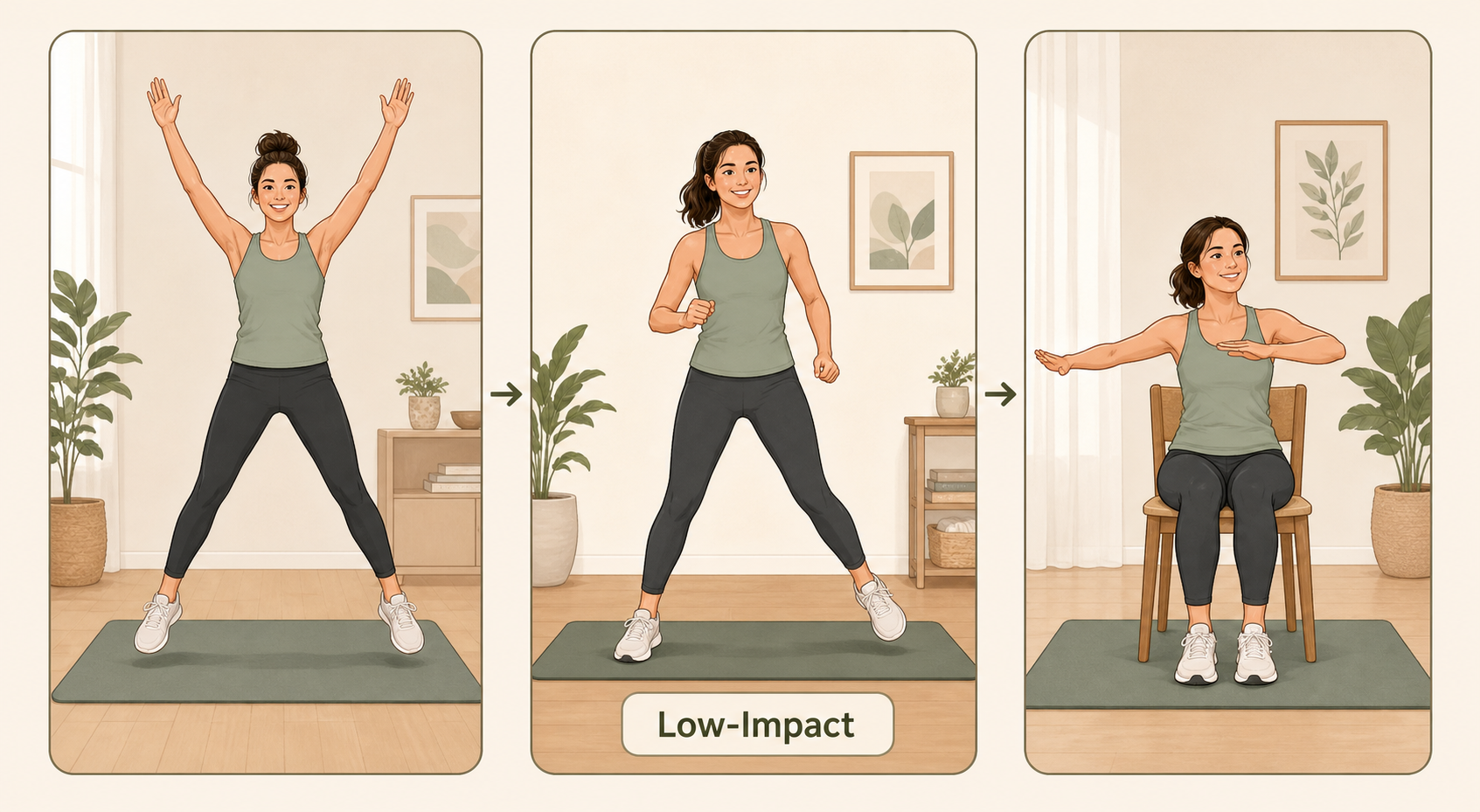
The 7-minute workout can be modified for nearly any fitness level. The key is to match the intensity to your current capacity without sacrificing the overall structure. Chris Jordan, the original developer, created a low-impact version in collaboration with the Washington Post that replaces high-impact moves with gentler alternatives.
Modifications for Key Exercises
| Exercise | Standard Version | Low-Impact Version | Chair-Based Version |
|---|---|---|---|
| Jumping Jacks | Full jump with arms overhead | Step feet out to sides, arms overhead (no jump) | Seated: step feet out to sides, arms overhead |
| Wall Sit | Standard wall sit | Hold for 20 sec, rest 10 sec | Seated in chair, hold position |
| Push-Ups | Full push-up | Knee push-ups | Wall push-ups (standing, leaning into wall) |
| Abdominal Crunch | Full crunch | Crunches with feet on floor | Seated: lean back slightly and contract abs |
| Step-Ups | Onto a sturdy chair | Step onto low step or floor | Seated: alternate lifting knees |
| Squats | Full squat | Partial squat (half range) | Seated: stand up and sit back down slowly |
| Triceps Dips | On a chair | Bent-knee dips | Seated: press palms into chair arms |
| Plank | Full plank on toes | Plank on knees | Seated: lean forward with straight back |
| High Knees / Running in Place | High knees | Marching in place | Seated: alternate lifting knees |
| Lunges | Full lunge | Reverse lunge (shorter step) | Seated: alternate extending legs forward |
| Push-Up and Rotation | Full push-up with rotation | Knee push-up with rotation | Wall push-up with torso rotation |
| Side Plank | Full side plank on feet | Side plank on knees | Seated: lean to one side with arm support |
The low-impact version — with marching instead of high knees, step jacks instead of jumping jacks, and no jumping at all — is designed to be doable by almost everyone who is not physically disabled. A 2023 study cited by the Washington Post found that just a few minutes of low-impact, bodyweight exercises increased young people's heart rates enough to rapidly improve aerobic fitness.
Building a Sustainable Weekly Schedule
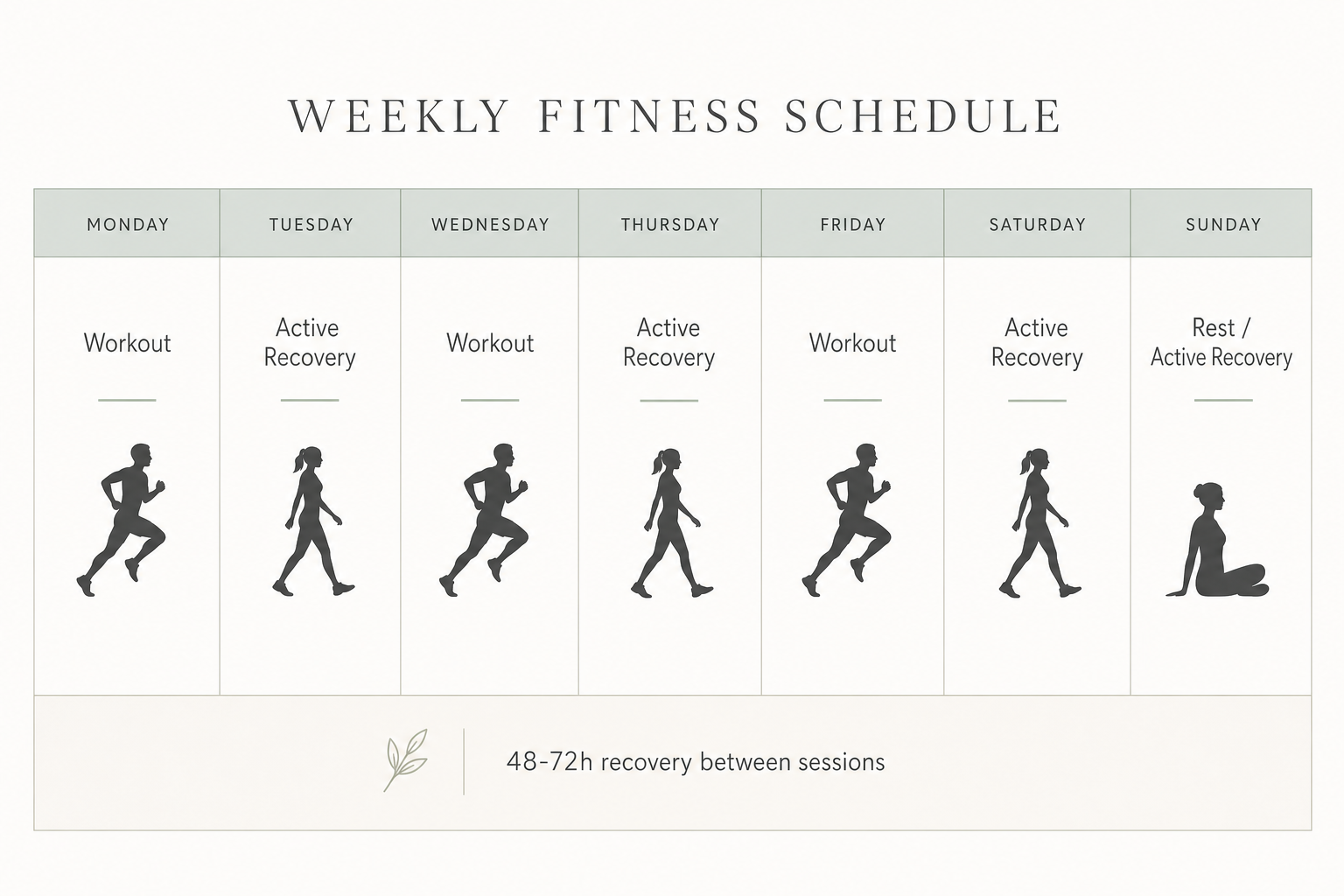
The most common mistake people make with the 7-minute workout is doing it too often without enough recovery. Here is a sustainable weekly schedule that builds in proper recovery from the start.
Beginner Schedule (Weeks 1–4)
| Day | Activity | Details |
|---|---|---|
| Monday | 7-Minute Workout | 1–2 rounds, low-impact modifications as needed |
| Tuesday | Active Recovery | 20–30 min walking or mobility work |
| Wednesday | Rest | Complete rest or gentle stretching |
| Thursday | 7-Minute Workout | 1–2 rounds, focus on form |
| Friday | Active Recovery | 20–30 min light cycling or yoga |
| Saturday | 7-Minute Workout | 2 rounds, gradually increase intensity |
| Sunday | Rest | Complete rest |
Intermediate Schedule (Weeks 5+)
| Day | Activity | Details |
|---|---|---|
| Monday | 7-Minute Workout | 3 rounds (21 min total) |
| Tuesday | Active Recovery | 30–40 min walking or light cycling |
| Wednesday | 7-Minute Workout | 3 rounds, standard intensity |
| Thursday | Active Recovery | Mobility work or yoga |
| Friday | 7-Minute Workout | 3 rounds, push intensity |
| Saturday | Active Recovery or Rest | Listen to your body |
| Sunday | Rest | Complete rest |
To progress from the beginner to intermediate schedule, add one round per session every 2–3 weeks. If you feel persistent fatigue, decreased performance, or joint discomfort, drop back to the previous level and prioritize recovery. For a broader overview of home cardio options and how the 7-minute workout compares, see our complete guide to cardio at home.
The Bottom Line: Making the 7-Minute Workout Work for You
The 7-minute workout is a legitimate, science-backed training protocol — but only when you use it correctly. The key takeaways are straightforward:
- Do 2–3 rounds, not 1. The original authors intended 14–21 minutes total. One round is a warm-up, not a workout.
- Respect the recovery. 48–72 hours between sessions for beginners. Active recovery on off-days. Your body adapts during rest, not during the workout.
- Modify as needed. Use the low-impact or chair-based versions if you have joint concerns or are new to exercise. Progress gradually.
- Know what it is and is not. It is excellent for cardiovascular fitness, muscular endurance, and body composition. It is not a strength or performance program.
The 7-minute workout is not a magic solution, but it is a valuable tool — especially for time-constrained home exercisers. Used correctly, with proper recovery and modifications, it can deliver real, measurable improvements in fitness and body composition. For a deeper look at common misconceptions about this workout, see our related article on 7-minute workout myths vs. facts.
This is general fitness education, not medical advice. For diagnosis or treatment of pain or injury, consult a qualified clinician.
Pick your next session
Browse all routines to find an appropriately-spaced next session.
Spot something off?
This content sits adjacent to health guidance — tell us if a citation or figure needs a correction.