
The Complete Guide to Cardio at Home: A Constraint-Based Framework for Choosing the Right Routine
Most home cardio fails not from lack of options but from mismatched routines. This guide replaces flat exercise lists with a four-axis decision framework — space, noise tolerance, equipment, and time — to route you to the right protocol for your situation.
- Duration
- 20 min
Why Constraint-Mapping Beats Another Exercise List
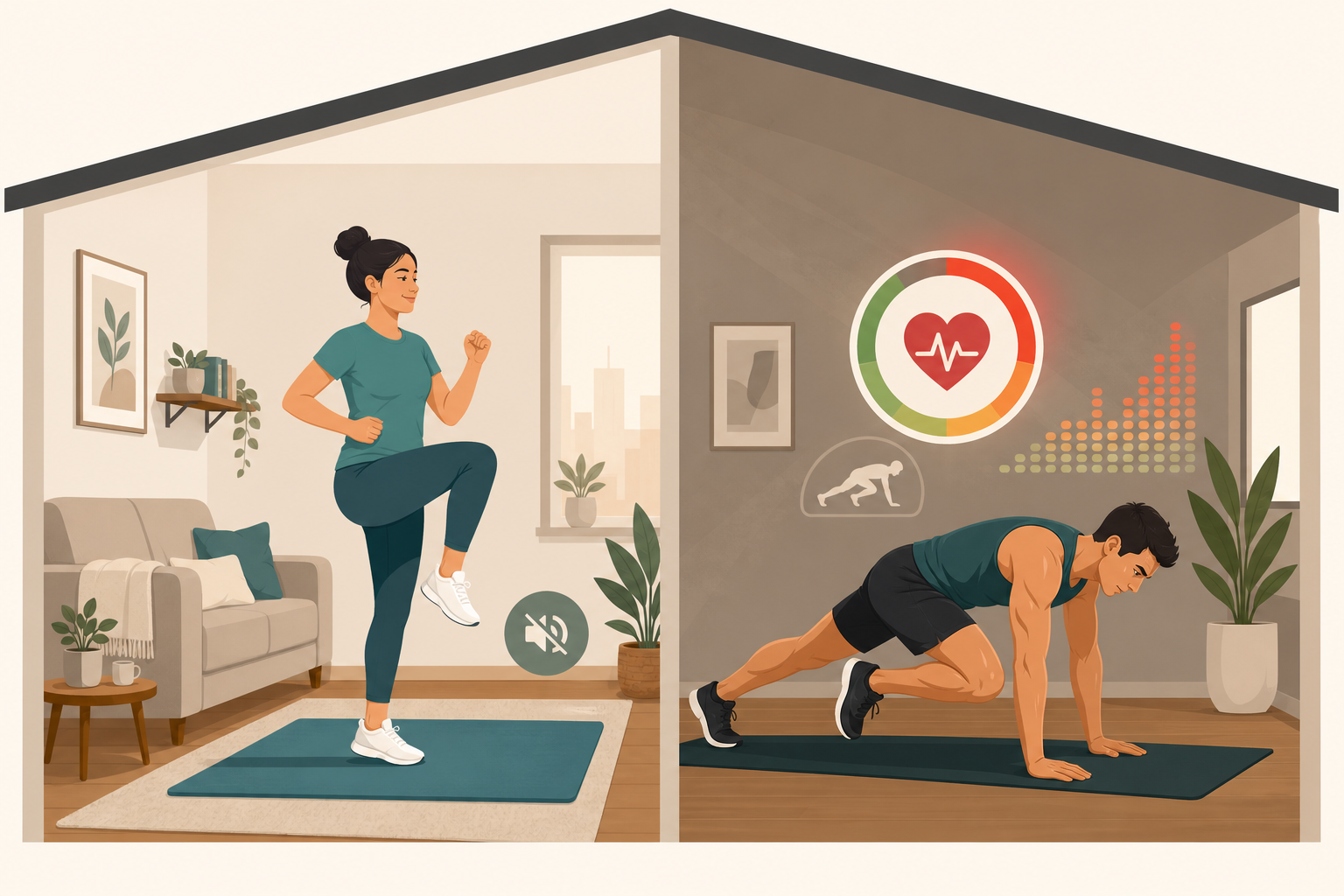
Search for "cardio at home" and you'll find the same pattern: a list of 15 to 20 moves — mountain climbers, burpees, high knees, squat jumps — followed by a generic prescription to do them for 30 seconds each. These lists aren't wrong, but they are incomplete in a way that matters. They treat every reader as if they have the same ceiling height, the same floor construction, the same tolerance for noise, and the same block of uninterrupted time.
The result is a mismatch problem. A person in a second-floor apartment who clicks on a "best home cardio" article and tries to follow a routine built around burpees and tuck jumps will either quit because of noise complaints or modify so heavily that the intended intensity is lost. A beginner who needs a 10-minute entry point is handed a 30-minute circuit and never starts. The routine itself is fine. The match to the reader's situation is broken.
This guide replaces the flat list with a decision framework. Instead of asking "what exercises should I do?" it starts with a different question: what are your real constraints? The answer routes you to a specific routine profile — not a random collection of moves — that you can actually follow in your space, at your level, with your available time.
The Four Constraint Axes: Space, Noise, Equipment, and Time
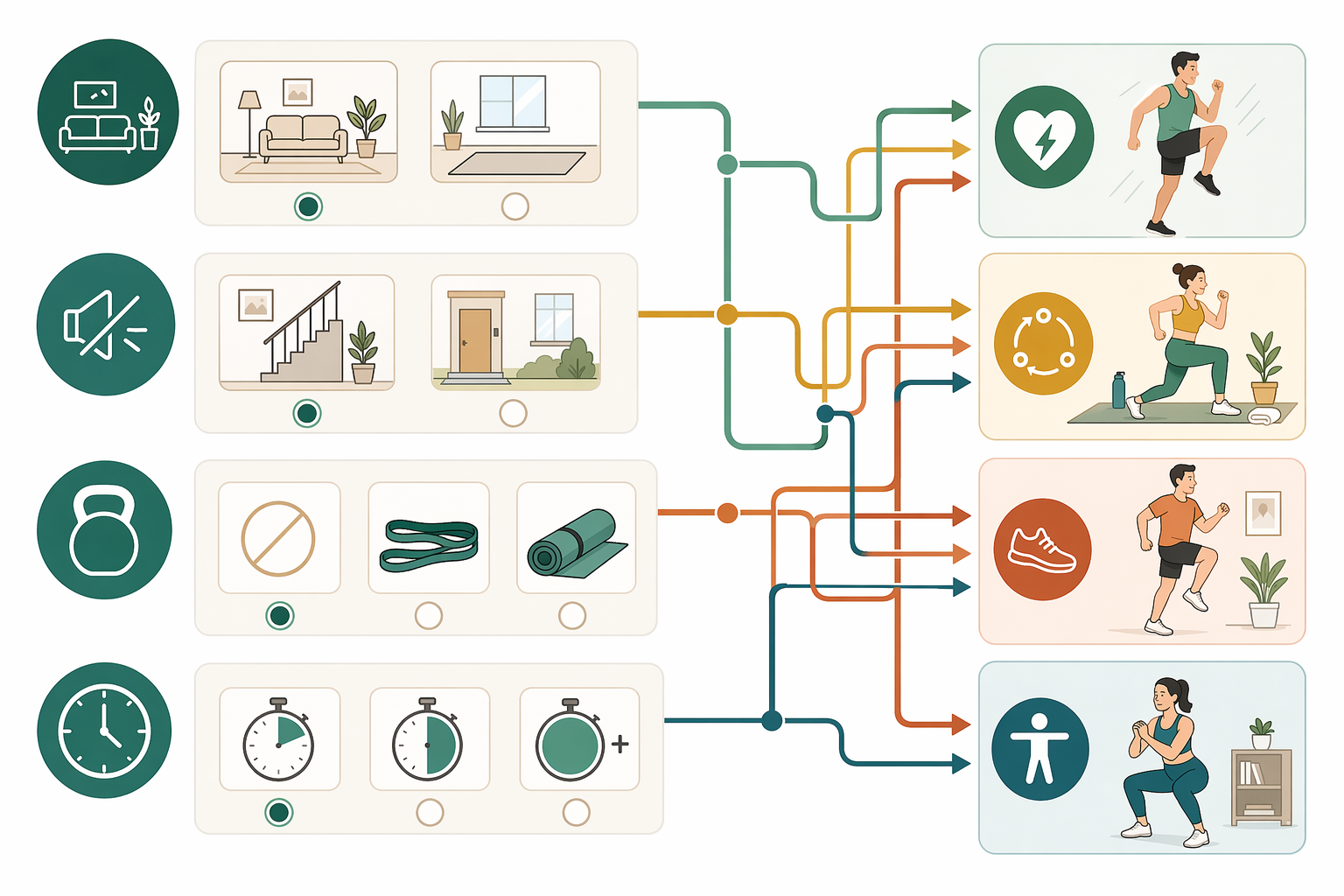
Every home cardio setup can be described along four independent axes. Your combination of these four factors determines which routines are realistic and which are likely to fail.
Space
The critical question is not square footage of your home but the clear floor area available for movement. A 6x6 foot space — roughly the size of a yoga mat with a foot of clearance on each side — is enough for most bodyweight cardio, as noted in Nerd Fitness's small-space workout guide. If you can extend your arms in all directions without touching furniture or walls, you have enough room for marching, stepping, and controlled lunges. If you have space to jump laterally or forward, your routine options expand significantly.
Noise Tolerance
This is the axis most home cardio guides ignore. Noise tolerance is determined by your floor construction (concrete slab vs. wooden joists), your unit's position (ground floor vs. upstairs), and your relationship with neighbors. A ground-floor house with a basement gym has near-total noise freedom. A second-floor apartment above a bedroom means every jump, stomp, and drop sends impact vibration through the structure. Centr's HILIT (high-intensity low-impact training) approach specifically addresses this by replacing jumps with controlled, no-impact alternatives that still elevate heart rate into the training zone.
Equipment
The equipment axis is simpler than most people assume. Effective home cardio requires surprisingly little. The options are: nothing at all (bodyweight only), a yoga or exercise mat for joint comfort, resistance bands for added upper-body work, or light dumbbells for weighted movements. A mat is the only purchase that meaningfully expands your options — it makes floor-based moves like mountain climbers and plank jacks comfortable on any surface.
Time
Time is the most variable axis. A 10-minute session is a very different proposition from a 30-minute session, and each requires a different approach to intensity and structure. The CDC's guideline of 150 minutes of moderate aerobic activity per week can be accumulated in 10-minute daily blocks — a fact that makes short-duration routines a legitimate strategy, not a compromise.
Your Constraint Profile: Find Your Match in the Decision Matrix
The table below maps common constraint combinations to specific routine profiles. Find the row that matches your situation, then jump to the corresponding routine section below.
| Space | Noise Tolerance | Equipment | Time | Recommended Profile |
|---|---|---|---|---|
| 6x6 ft or less | Low (apartment, upstairs) | None or mat | 10–20 min | Quiet & Compact — Low-Impact Bodyweight Circuit |
| Room to jump | High (ground floor, house) | None or mat | 10–15 min | Ground Floor & Ready to Move — Low-Volume HIIT |
| Any | Any | None | 10–30 min | Any Space, Any Level — Steady-State Marching & Walking |
| 6x6 ft or less | Low (apartment, upstairs) | Mat + bands or light dumbbells | 15–20 min | Quiet & Compact — Low-Impact Bodyweight Circuit (with added resistance) |
| Room to jump | High (ground floor, house) | Mat | 20–30 min | Ground Floor & Ready to Move — Low-Volume HIIT (extended rounds) |
Routine Profile 1: Quiet & Compact — Low-Impact Bodyweight Circuit
This profile is for readers whose primary constraints are limited space and low noise tolerance — typically apartment dwellers on upper floors, or anyone sharing a wall with a bedroom or quiet space. The goal is to elevate heart rate into the moderate-to-vigorous zone without a single jump or stomp.
The routine below is a 20-minute circuit. Perform each exercise for 45 seconds, then rest for 15 seconds. Complete all six exercises to finish one round. Rest for 60 seconds between rounds. Aim for two to three rounds total.
Warm-Up (3 minutes)
- March in place with arm swings — 90 seconds
- Standing torso twists (feet planted, arms loose) — 60 seconds
- Ankle rolls and wrist circles — 30 seconds
Main Circuit (6 exercises, 45 sec work / 15 sec rest)
- Marching in place with high knees (controlled, no bounce)
- Standing oblique crunches (alternating sides)
- Lateral shuffles (short steps, stay low)
- Low-impact scissor jacks (step out to side, arms overhead, no jump)
- Squat with overhead punch (sink into squat, punch up as you rise)
- Standing hamstring curls (alternating legs, controlled tempo)
Cool-Down (3 minutes)
- Slow marching with deep breathing — 60 seconds
- Standing quad stretch (hold each side 30 seconds)
- Standing hamstring stretch (feet together, hinge forward) — 60 seconds
Research from Centr's HILIT programming and Nourish Move Love's beginner workout data confirms that these no-jump movements can sustain heart rate in the moderate-to-vigorous zone. The Nourish Move Love 10-minute standing circuit, for example, was measured at over 1,000 steps per session with participants reaching aerobic intensity without leaving the ground.
For readers who want to combine this cardio approach with a structured strength program, the 4-Week Beginner Home Workout Plan provides a complete weekly schedule that pairs cardio days with strength sessions.
Routine Profile 2: Ground Floor & Ready to Move — Low-Volume HIIT
If you have room to jump and noise is not a concern, low-volume HIIT offers the highest cardiovascular return per minute of any home cardio method. "Low-volume" in this context means under 15 minutes of active work per session — a time commitment that fits into a lunch break or early morning window.
A 2021 peer-reviewed review by Atakan et al. in the International Journal of Environmental Research and Public Health documented that low-volume HIIT protocols can improve VO2max by 10–15% over 4–6 weeks. The classic Tabata protocol — 8 rounds of 20 seconds of maximal effort followed by 10 seconds of rest — requires only 4 minutes of active work per session and has been shown to produce these gains with a weekly time commitment of roughly 43 minutes, compared to 300 minutes per week for moderate-intensity continuous training.
Warm-Up (3 minutes)
- Marching in place with arm circles — 60 seconds
- Walking lunges (alternating legs, no weight) — 60 seconds
- Light jogging in place — 60 seconds
Main Set: Tabata-Style Intervals (4 minutes active work)
Perform 8 rounds of 20 seconds of work followed by 10 seconds of rest. Choose one exercise per round or alternate between two. The goal is near-maximal effort during each work interval.
- Mountain climbers (hands on mat, drive knees to chest)
- Squat jumps (land softly, absorb impact through legs)
- Burpees (with low-impact option: step back instead of jumping)
- High knees (drive knees to hip height, quick cadence)
Optional Extended Set (adds 4 minutes active work)
If you have 15 minutes total, repeat the 8-round Tabata set with a different exercise selection. This brings total active work to 8 minutes — still well within the low-volume definition.
Cool-Down (3 minutes)
- Slow walking in place — 60 seconds
- Standing quad stretch (hold each side 30 seconds)
- Forward fold (hinge at hips, let arms hang) — 60 seconds
Readers interested in the scientific origins of the Tabata protocol and how it compares to other HIIT formats can read The 7-Minute Workout: Separating Science From Hype, which examines the evidence behind popular short-duration protocols.
Routine Profile 3: Any Space, Any Level — Steady-State Marching & Walking
Steady-state cardio at home is the most accessible option because it requires zero equipment, zero jumping, and virtually any floor area. It is also the most underrated. The CDC's recommendation of 150 minutes of moderate-intensity aerobic activity per week can be met entirely through brisk walking or marching in place — no gym, no special gear, no complex programming.
The key to making steady-state work at home is progressive variation. Marching in place at a single pace for 20 minutes is boring and loses its training effect quickly. The routine below uses pace changes, arm variations, and knee lifts to maintain intensity without requiring more space.
20-Minute Progressive Marching Circuit
Perform each segment for the time listed. Move immediately to the next segment without rest.
| Segment | Duration | Action |
|---|---|---|
| 1 | 3 min | Easy march, arms swinging naturally — establish rhythm |
| 2 | 3 min | Moderate pace, drive elbows back — increase arm range of motion |
| 3 | 3 min | Brisk pace, alternate knee lifts to hip height every 4 steps |
| 4 | 3 min | Moderate pace, add overhead arm reaches on every 4th step |
| 5 | 3 min | Brisk pace, knee lifts every 2 steps — maintain upright posture |
| 6 | 3 min | Easy march, deep breathing — gradual cool-down |
| 7 | 2 min | Slow march with arm circles — transition to cool-down |
This routine works for all fitness levels. Beginners can stay at the easy-to-moderate pace throughout. Intermediate users can push the brisk segments to a jogging-in-place cadence. The 10-minute daily version of this routine — segments 1 through 4 only — accumulates 70 minutes of moderate activity per week, nearly half the CDC target.
Progression Logic: How to Advance Over 4–8 Weeks
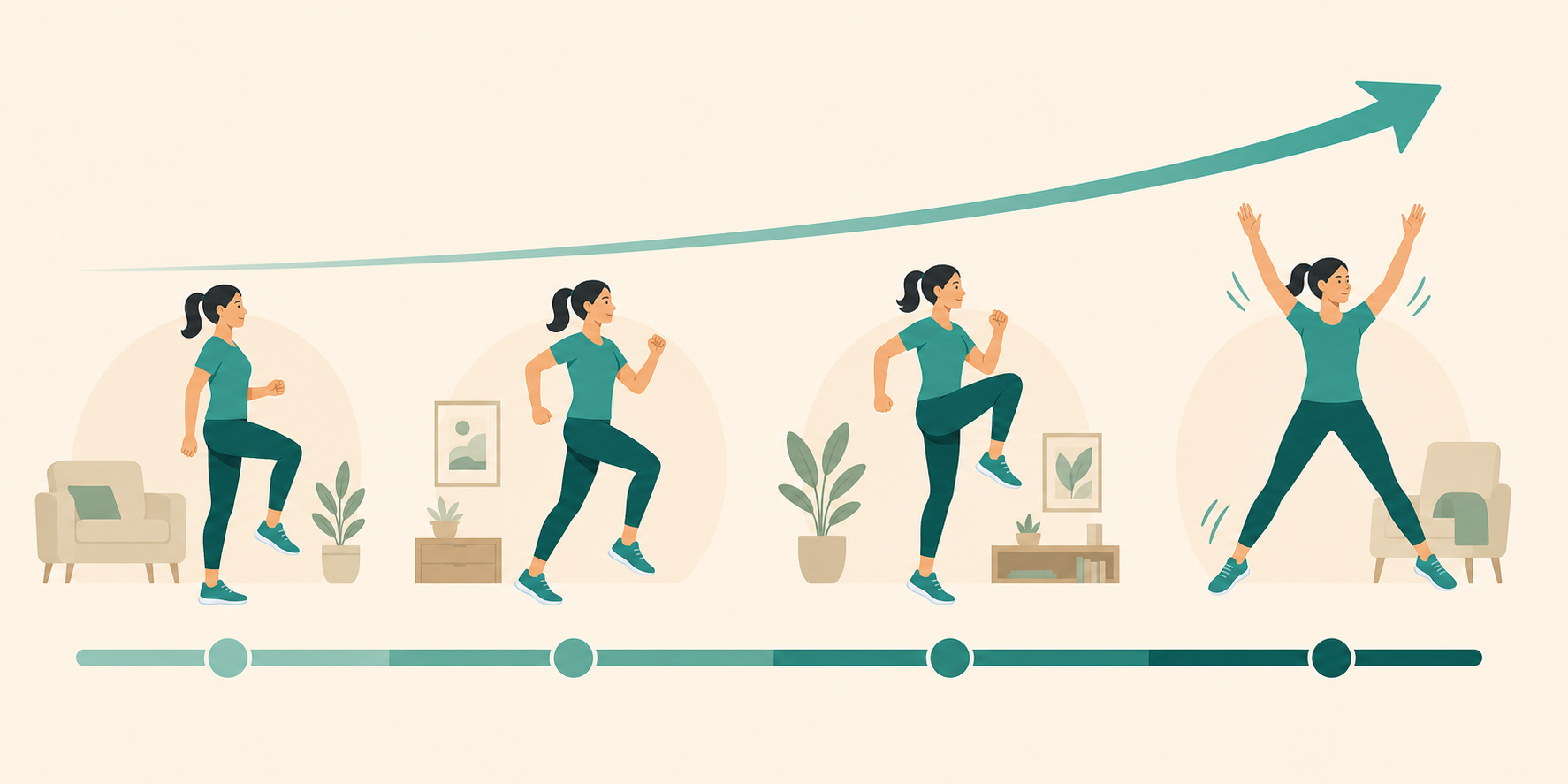
Each routine profile above has a progression path. The principle is the same across all three: increase one variable at a time — duration, intensity, or complexity — while holding the others constant. Attempting to increase all three simultaneously leads to burnout or injury.
Quiet & Compact Progression (Low-Impact Circuit)
| Week | Change | Details |
|---|---|---|
| 1–2 | Establish baseline | 2 rounds, 45 sec work / 15 sec rest |
| 3–4 | Increase duration | 3 rounds, same work/rest ratio |
| 5–6 | Reduce rest | 3 rounds, 45 sec work / 10 sec rest |
| 7–8 | Add controlled movement | 3 rounds, introduce low-impact scissor jacks and lateral shuffles at full range |
Low-Volume HIIT Progression
| Week | Change | Details |
|---|---|---|
| 1–2 | Establish baseline | 1 Tabata set (4 min active work), 2–3 sessions per week |
| 3–4 | Add rounds | 2 Tabata sets (8 min active work), same session frequency |
| 5–6 | Increase exercise demand | 2 sets, progress to more demanding exercises (burpees, squat jumps) |
| 7–8 | Maintain or extend | 2–3 sets, or 1 set at maximal effort with heavier exercise selection |
Steady-State Marching Progression
- Weeks 1–2: 15-minute session at moderate pace (can speak comfortably)
- Weeks 3–4: 20-minute session with pace variation (alternate 2 min brisk / 2 min moderate)
- Weeks 5–6: 25-minute session with arm drive and knee lifts throughout
- Weeks 7–8: 30-minute session with sustained brisk segments (can speak in short sentences only)
For readers who prefer a structured weekly schedule that combines cardio progression with strength work, the 4-Week Beginner Home Workout Plan provides a ready-made framework with built-in progression.
Frequency, Recovery, and the CDC Guideline
The CDC recommends at least 150 minutes of moderate-intensity aerobic activity or 75 minutes of vigorous-intensity aerobic activity per week, spread across most days. For home cardio, this translates to the following session structures:
| Intensity | Weekly Target | Sample Schedule |
|---|---|---|
| Moderate (steady-state marching, quiet circuit at conversational pace) | 150 min | 5 sessions of 30 min, or 7 sessions of ~22 min |
| Vigorous (HIIT, quiet circuit at breathless pace) | 75 min | 3 sessions of 25 min, or 4 sessions of ~19 min |
| Combined (mix of moderate and vigorous) | Proportional | 2 vigorous sessions (20 min each) + 3 moderate sessions (25 min each) = 115 min moderate-equivalent |
Session Frequency by Profile
- Quiet compact circuit: 3–4 sessions per week. This profile is moderate-to-vigorous depending on pace. Beginners should start at 3 sessions and add a fourth after 3–4 weeks.
- Low-volume HIIT: 2–3 sessions per week. HIIT is vigorous by definition. The Atakan et al. review notes that HIIT interventions show lower dropout rates among previously sedentary individuals compared to moderate-intensity continuous training, but the sessions themselves are demanding. Do not perform HIIT on consecutive days.
- Steady-state marching: 4–7 sessions per week. This profile is moderate-intensity and can be performed daily. It is also the best option for active recovery days.
Recovery and Rest Day Guidance
Cardio does not require the same recovery structure as strength training, but it is not recovery-free. Signs that you need a rest day or an active recovery session include: persistent fatigue that does not resolve after warming up, elevated resting heart rate, poor sleep quality, and lack of motivation that lasts more than two consecutive sessions.
- Active recovery: 10–15 minutes of easy marching or walking at a pace where you can sing. This promotes blood flow without adding training stress.
- Full rest day: Take one day per week with no structured cardio. Light walking for daily steps is fine.
- Deload week: Every 4–6 weeks, reduce session volume by 30–50% for one week before resuming progression.
The framework in this guide — match your constraints to a profile, follow the routine, progress methodically — replaces the guesswork that causes most home cardio programs to fail. You do not need more exercises. You need the right one for your situation.
What a small equipment investment adds
We don't have a build tagged to this exact tier yet. Browse all builds.
How often should you repeat this?
See our recovery and rest reference for citation-anchored rest-interval guidance.
Spot something off?
Tell us if a movement, tier assumption, or duration didn't match your experience.