
Why the Best Fitness Band Setup for Home Gym Users Is Two Devices (Not One)
A contrarian guide for home fitness enthusiasts frustrated with the 'one device for everything' compromise. Learn how pairing a smart ring (Oura Ring 4/5) with a screenless AI-coach band (Fitbit Air or Whoop 5.0) can deliver better data across sleep, recovery, and activity tracking than any single device — often at a lower total cost.
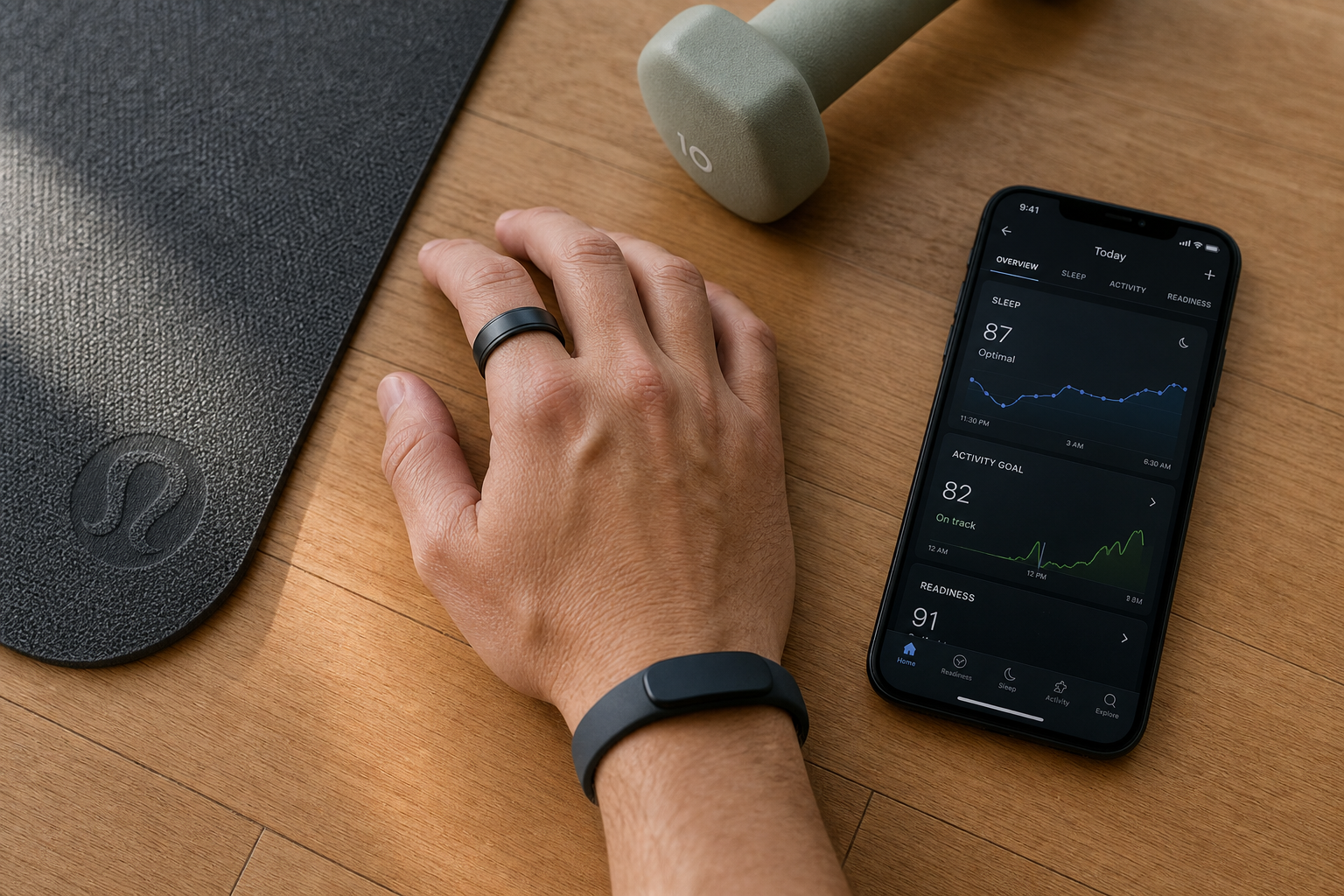
The 'One Device' Problem: Why Smartwatches, Rings, and Bands All Compromise
The fitness wearable market has spent a decade selling a single promise: one device on your wrist can track your sleep, log your workouts, monitor your heart rate, and keep you connected. The reality is that every form factor makes a different set of trade-offs, and no single device excels across all the domains a home fitness user actually cares about.
Consider the three main categories:
- Smartwatches (Apple Watch, Samsung Galaxy Watch, Pixel Watch): Excellent workout tracking and GPS, but their size and weight make them uncomfortable for overnight wear. Data from a January 2026 comparison by Jointcorp shows that only 67% of smartwatch users wear their device consistently overnight, compared to 98% for ring users. That compliance gap means you are missing sleep data one out of every three nights.
- Smart rings (Oura Ring 4/5): Designed for 24/7 comfort, rings achieve 92–95% sleep stage accuracy against polysomnography, the gold standard for sleep measurement. But they are fundamentally limited for exercise tracking. The same Jointcorp data rates ring step accuracy at 85–92%, and rings are simply not designed for active heart rate monitoring during workouts.
- Screenless fitness bands (Fitbit Air, Whoop 5.0): These split the difference. They are lighter than a smartwatch and more comfortable for sleep than a bulky wrist device, but they still cannot match a ring's overnight compliance or sleep-stage precision. A February 2026 study in JMIR Formative Research found that Fitbit's optical heart rate accuracy (mean absolute error of 4.5 bpm during activity) meaningfully exceeds Oura's (MAE of 9–14 bpm during irregular movement), but the band's sleep tracking accuracy (88–91%) still trails the ring's 92–95%.
| Metric | Smart Ring (Oura 4/5) | Screenless Band (Fitbit Air) | Smartwatch (Apple Watch) |
|---|---|---|---|
| Overnight wear compliance | 98% | ~85% (estimated) | 67% |
| Sleep stage accuracy vs PSG | 92–95% | 88–91% | 84–88% |
| Step accuracy | 85–92% | 96–98% | 95–98% |
| Active HR accuracy (MAE) | 9–14 bpm | 4.5 bpm | ~5 bpm |
| Battery life | 4–7 days | 7 days | 18–36 hours |
| Comfort for 24/7 wear | Excellent | Very good | Moderate |
The pattern is clear: a ring gives you best-in-class sleep and recovery data but fails during exercise. A band gives you excellent activity tracking and coaching but cannot match the ring's overnight precision. A smartwatch does both reasonably well but at the cost of comfort, battery life, and sleep compliance. The industry assumption that you must pick one is what creates the compromise.
The Pairing Philosophy: How Specialized Devices Complement Each Other
The solution is not a better single device. It is a deliberate division of labor between two specialized wearables worn simultaneously. The ring handles the domains where it excels — sleep tracking, recovery monitoring, skin temperature, and resting HRV — while the screenless band handles daytime activity, workout heart rate, and AI-powered coaching. Each device does what it does best, and the data converges in a single dashboard.
This is not a theoretical concept. Google's own Fitbit Air, launched in May 2026, is explicitly designed as a second device. Android Central reports that the Google Health app now supports pairing a Fitbit Air and a Pixel Watch simultaneously for the first time, with device-level filtering to separate data sources. On Android, Oura data flows into Google Health via Health Connect, making the ring-plus-band combo a unified dashboard experience today.
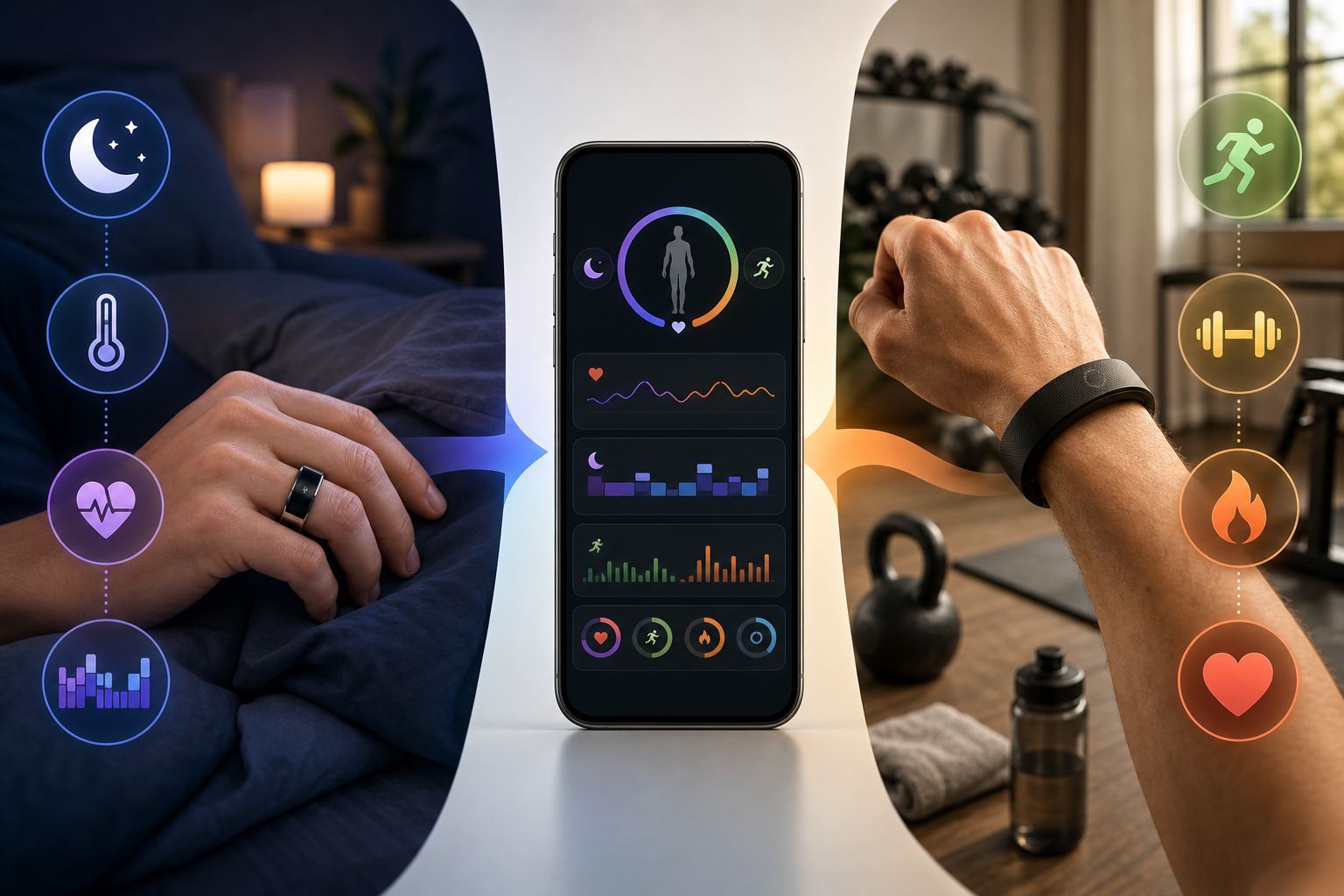
The practical workflow looks like this: you wear the ring 24/7. It tracks your sleep stages, overnight HRV, skin temperature, and readiness score. During the day, the band on your wrist tracks your steps, active calories, and workout heart rate. When you exercise, the band captures the high-fidelity HR data the ring cannot. When you sleep, the ring captures the precision the band cannot. Both devices feed into Google Health (or Apple Health on iOS), and you see a single, complete picture of your training load and recovery status.
The result is better data across every domain than any single device can deliver — often at a lower total cost than a premium smartwatch.
Pairing Strategy 1: Oura Ring + Fitbit Air — The Recovery-First Home Gym Setup
This is the most accessible and cost-effective pairing strategy, and it is the one most home fitness users should consider first. The Oura Ring 4 costs $349 with a $69.99 annual subscription for full features. The Fitbit Air costs $99.99 with no mandatory subscription — you can use it indefinitely without paying for Google Health Premium, though Premium adds the AI Health Coach for $10/month or $100/year.
| Component | Upfront Cost | Annual Subscription | 5-Year Total |
|---|---|---|---|
| Oura Ring 4 | $349 | $69.99 | $698.95 |
| Fitbit Air (no Premium) | $99.99 | $0 | $99.99 |
| Fitbit Air + Premium | $99.99 | $100 | $599.99 |
| Total (no Premium) | $448.99 | $69.99 | $798.94 |
| Total + Premium | $448.99 | $169.99 | $1,298.94 |
Here is how the division of labor works in practice:
- Oura Ring handles: sleep stage tracking (validated against polysomnography with no statistically significant difference for total sleep time, sleep efficiency, or sleep stage distribution, per a November 2025 OTO Open meta-analysis of 388 participants), overnight HRV, skin temperature, readiness score, and resting heart rate.
- Fitbit Air handles: daytime step counting (96–98% accuracy), active heart rate monitoring (MAE 4.5 bpm during activity per JMIR Formative Research), workout detection, AI coaching via Gemini (with Premium), and passive AFib detection (FDA-cleared at the $99.99 price point — a feature Whoop reserves for its $359/year Life tier).
On Android, the two devices sync seamlessly. Oura data flows into Google Health via Health Connect, and the Fitbit Air pairs natively with the Google Health app. The Google Health app now supports multi-device pairing, so you can see ring and band data in a single view with device filtering. On iOS, the pipeline is functional but less seamless — Oura syncs to Apple Health, and Fitbit Air syncs to the Fitbit app, which then writes to Apple Health.
A real-world test by Heal Nourish Grow over six nights found that total sleep time averaged within 13 minutes between the Oura Ring and Fitbit Air, but deep sleep differed by as much as 58 minutes on a single night. This variance underscores why the ring's validated sleep-stage accuracy matters for recovery-focused users, while the band's activity tracking fills the gap the ring cannot cover.
Pairing Strategy 2: Oura Ring + Whoop 5.0 — The Athlete's Dual Setup
For performance-focused home fitness users who train with specific intensity targets and want the most granular training load data available, the Oura Ring paired with a Whoop 5.0 is the premium option. This setup costs significantly more — Whoop's membership tiers range from $199/year (One) to $359/year (Life) — but it delivers a level of physiological insight that the Fitbit Air cannot match.
| Feature | Fitbit Air | Whoop 5.0 (One) | Whoop 5.0 (Life) |
|---|---|---|---|
| Upfront cost | $99.99 | $0 (membership only) | $0 (membership only) |
| Annual cost | $0 (or $100 with Premium) | $199 | $359 |
| HR sampling rate | 0.5 Hz | 26 Hz | 26 Hz |
| Battery life | 7 days | 14+ days | 14+ days |
| FDA-cleared AFib detection | Yes (included) | No | Yes |
| ECG / blood pressure | No | No | Yes (Whoop MG) |
| Strain / Recovery metrics | Basic | Advanced | Advanced + Healthspan |
Whoop's key advantage is its 26 Hz heart rate sampling rate, which is 52 times higher than the Fitbit Air's 0.5 Hz. This matters for interval training, HIIT, and any workout with rapid heart rate changes. The Whoop 5.0 also offers 14+ days of battery life (CNET's 11-month review confirms this), improved processors that are 60% quicker than the previous generation, and the proprietary Strain and Recovery metrics that serious athletes rely on for training load management.
The Oura + Whoop pairing gives you:
- Oura's validated sleep and recovery data (the ring stays on your finger overnight with 98% compliance, delivering the best sleep-stage accuracy available in a consumer device)
- Whoop's high-fidelity workout tracking (26 Hz HR sampling, Strain score, recovery score, and sleep coach — all optimized for performance athletes)
- Whoop's cycle insights, which CNET notes are more performance-oriented than Oura's reproductive health focus, giving athletes a more complete picture of how their physiology changes across training cycles
The data integration story is less seamless here than with the Fitbit Air. Whoop does not natively sync to Google Health, so you will need to rely on Apple Health or a third-party integration platform to see Oura and Whoop data in a single view. For users who are comfortable managing two apps, the data quality trade-off is worth it.
Pairing Strategy 3: Fitbit Air + Pixel Watch — Google's Own Recommended Dual Setup
Google has quietly built the infrastructure for a dual-device strategy that does not require a ring at all. The Fitbit Air is explicitly positioned as a companion to the Pixel Watch, not a replacement. Android Central confirms that the Google Health app now supports pairing both devices simultaneously, with device-level filtering so you can see which data came from which wearable.
This pairing is ideal for Android users who want a smartwatch for notifications, GPS, and on-wrist interactions, but also want the lighter, longer-lasting Fitbit Air for sleep tracking and continuous HR monitoring. The Pixel Watch handles:
- GPS workout tracking, on-wrist coaching, notifications, and app interactions during the day
- Higher-fidelity workout HR tracking (the Pixel Watch 4 uses a more advanced sensor than the Fitbit Air, per CNET)
The Fitbit Air handles:
- Overnight sleep tracking (the 5.2-gram pod is comfortable enough for 98% compliance, unlike the bulkier Pixel Watch)
- Continuous daytime HR and activity tracking without draining the Pixel Watch's battery
- Passive AFib detection (FDA-cleared at $99.99, a feature the Pixel Watch also offers but benefits from redundant monitoring)
The integration is the most seamless of any pairing strategy because both devices are Google products. The Google Health app treats them as a single ecosystem, and you can set which device takes priority for which metric. This is the only pairing strategy where you do not need to manage two separate apps or worry about cross-platform data sync issues.
When One Device Is Enough: Standalone Screenless Band Options
The dual-device strategy is not for everyone. If your primary concern is daytime activity tracking and you are less interested in sleep-stage precision or recovery metrics, a single screenless band may be all you need. Both the Fitbit Air and Whoop 5.0 are excellent standalone devices.
The Fitbit Air at $99.99 is the most rational choice for 70–80% of buyers, according to Truescho's analysis. It includes FDA-cleared AFib detection, 7-day battery life, and the option to add Google Health Premium for AI coaching. No subscription is required for core tracking, making it the lowest total cost of ownership of any serious fitness tracker on the market.
The Whoop 5.0 remains the best-in-class option for athletes who actively use Strain and Recovery data to guide their training. Its 26 Hz HR sampling rate, 14+ day battery, and advanced metrics like Healthspan and Whoop Age (available in the Peak tier at $239/year) provide a level of physiological insight that the Fitbit Air cannot match. But the subscription cost — $199 to $359 per year — makes it a significant ongoing investment.
3-Year Cost Comparison: Pairing Strategies vs. Premium Smartwatch Alone
The financial argument for the pairing strategy is surprisingly strong. When you compare the total cost of ownership over three years, the Oura Ring + Fitbit Air combo can be cheaper than a single premium smartwatch while outperforming it in both sleep and activity tracking.
| Setup | Year 1 | Year 2 | Year 3 | 3-Year Total |
|---|---|---|---|---|
| Oura Ring 4 + Fitbit Air (no Premium) | $448.99 | $69.99 | $69.99 | $588.97 |
| Oura Ring 4 + Fitbit Air + Premium | $548.99 | $169.99 | $169.99 | $888.97 |
| Oura Ring 4 + Whoop 5.0 (One) | $548.00 | $268.99 | $268.99 | $1,085.98 |
| Oura Ring 4 + Whoop 5.0 (Life) | $708.00 | $428.99 | $428.99 | $1,565.98 |
| Apple Watch Series 11 | $399.00 | $0 | $0 | $399.00 |
| Garmin Fenix 8 | $999.00 | $0 | $0 | $999.00 |
| Garmin Venu 3 | $449.00 | $0 | $0 | $449.00 |
The key insight: the Oura + Fitbit Air combo (without Premium) costs $588.97 over three years — more than an Apple Watch Series 11 ($399) but less than a Garmin Fenix 8 ($999). And it delivers better sleep tracking than either smartwatch (92–95% sleep stage accuracy vs. 84–88%), better activity tracking than the ring alone (96–98% step accuracy vs. 85–92%), and the unique benefit of FDA-cleared AFib detection at no extra cost.
The Oura + Whoop pairing is the most expensive option, but it is also the only setup that gives you both validated sleep tracking and 26 Hz workout HR sampling. For athletes who train with specific heart rate zones and recovery targets, the data quality may justify the cost.
Decision Framework: Which Pairing Strategy Fits Your Home Fitness Profile?
Not every pairing strategy suits every user. The right choice depends on your workout type, sleep priority, budget, and platform allegiance. Use the table below to match your profile to the recommended setup.
| Your Profile | Recommended Setup | Why This Fits | 3-Year Cost |
|---|---|---|---|
| Recovery-focused home gym user who values sleep data and does moderate cardio/strength | Oura Ring 4 + Fitbit Air (no Premium) | Best sleep tracking + excellent activity tracking at the lowest total cost | $588.97 |
| Performance athlete doing HIIT, intervals, or zone-based training | Oura Ring 4 + Whoop 5.0 (One) | 26 Hz HR sampling for intervals + validated sleep recovery data | $1,085.98 |
| Android user who wants a smartwatch + dedicated sleep tracker | Pixel Watch + Fitbit Air | Seamless Google Health integration, best ecosystem experience | $498.99 (Pixel Watch 3 + Fitbit Air) |
| Budget-conscious user who wants maximum data per dollar | Fitbit Air alone | Best value: $99.99, no subscription needed, FDA-cleared AFib detection | $99.99 |
| Serious athlete who wants medical-grade insights | Oura Ring 4 + Whoop 5.0 (Life) | ECG, AFib detection, blood pressure insights + validated sleep tracking | $1,565.98 |
| User who hates wearing devices at night | Fitbit Air or Whoop 5.0 alone | No ring needed; band is comfortable enough for most users overnight | $99.99–$597.00 |
A few additional considerations:
- Platform allegiance matters. The Oura + Fitbit Air combo works best on Android via Health Connect. On iOS, the data pipeline is functional but requires managing two apps. The Pixel Watch + Fitbit Air combo is Android-only.
- Willingness to wear two devices is the biggest adoption barrier. If you find a ring uncomfortable or dislike having anything on your wrist during sleep, the dual-device strategy may not be for you. In that case, a single Fitbit Air or Whoop 5.0 is a reasonable compromise.
- The Oura Ring 5 launched in June 2026 with updated hardware and algorithms. Most published validation data is for the Ring 3 and Ring 4, so the Ring 5's accuracy improvements have not yet been independently verified. If you want the most validated sleep tracking, the Ring 4 remains a safe choice.
The 'one device for everything' assumption served the wearable industry well for a decade, but the technology has matured to the point where specialization outperforms generalization. A smart ring and a screenless AI-coach band, worn together, deliver better data across sleep, recovery, and activity tracking than any single device on the market — often at a lower total cost. For home fitness users who want the complete picture of their training and recovery, the best fitness band setup is two devices, not one.
This result comes from one real apartment under the stated conditions — it is a strong signal, not a guarantee your space will measure identically.
Builds this evidence supports
No build currently links to this specific test. Browse all builds with a matching tag.
Spot something off?
If this result didn't match your own space, let us know — floor-damage and noise claims carry real deposit-risk consequences if we get them wrong.