
Best Fitness Trackers for Recovery in 2026: Ranked by Sleep, HRV, and Readiness Accuracy
Most fitness tracker guides evaluate devices by step count and GPS. This guide re-frames the criteria for recovery-focused users, ranking the top trackers by nocturnal HRV accuracy, sleep staging precision, stress detection, and readiness scoring — backed by peer-reviewed data.
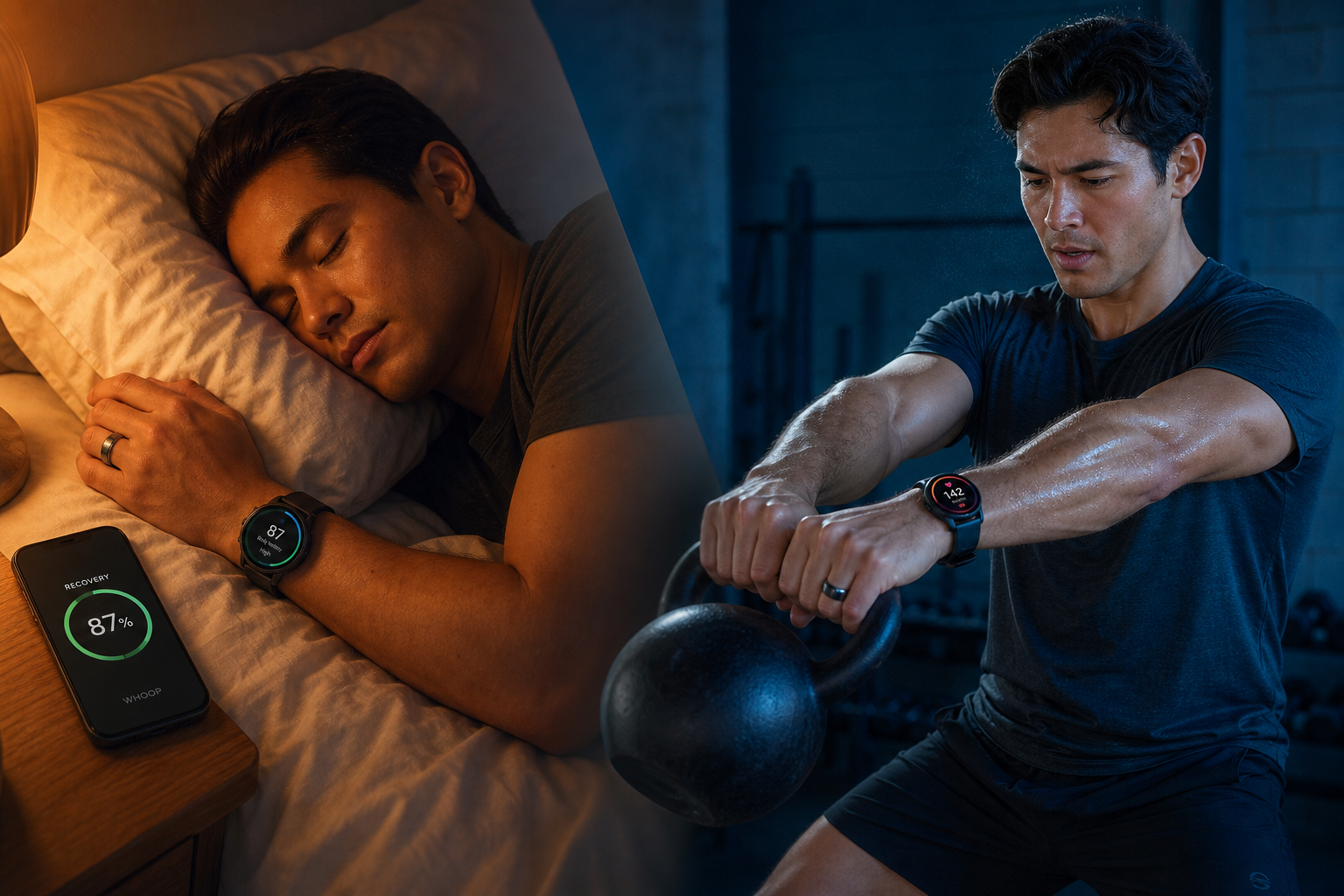
Why Recovery-Focused Tracking Requires Different Criteria
Most fitness tracker buying guides evaluate devices using a standard set of criteria: step count accuracy, GPS signal strength, battery life, and screen quality. These are reasonable metrics for a general-purpose activity tracker, but they miss the point entirely if your primary goal is optimizing recovery. When you are trying to decide whether to train hard, take an easy day, or rest completely, you need a device that can accurately measure nocturnal heart rate variability (HRV), stage your sleep precisely, detect physiological stress, and translate that raw data into a clear, actionable readiness score.
This guide re-frames the evaluation criteria for recovery-focused users. We rank devices not by how many steps they count or how long the battery lasts, but by how well they answer the question that matters most for recovery: "Should I train or should I rest today?" If you are looking for a general roundup organized by budget or phone OS, our Best Fitness Trackers of 2026 article covers that ground. Here, we are focused on a different job entirely.
How We Evaluated: The Recovery-First Criteria
Every device in this guide was assessed against five criteria that directly impact recovery optimization. Accuracy data is drawn from two key peer-reviewed sources: a 536-night study by Dial et al. (2025) for nocturnal HRV accuracy, and a 62-participant independent study by Schyvens et al. (2025) for sleep staging precision. Where possible, we distinguish between independent research and device-funded studies.
- Nocturnal HRV Accuracy: HRV measured during sleep is the most reliable indicator of autonomic nervous system recovery. We prioritize devices with the highest concordance correlation coefficient (CCC) and lowest mean absolute percentage error (MAPE) against a medical-grade ECG reference.
- Sleep Staging Precision: Accurate detection of deep sleep, light sleep, and REM is critical for understanding sleep quality. We use Cohen's kappa (κ) for overall staging agreement and sensitivity percentages for deep sleep detection.
- Stress Detection Methodology: Devices use different approaches to measure physiological stress—some rely on minute-by-minute HRV and heart rate, others add skin temperature and movement data. We evaluate the sophistication and transparency of each method.
- Readiness Scoring Quality: A raw HRV number is not useful unless the device translates it into a clear recommendation. We assess how each device combines HRV, sleep, stress, and activity data into a single, actionable readiness score.
- Subscription Cost: Many recovery-focused features are locked behind monthly or annual subscriptions. We factor total cost of ownership over one and two years into every recommendation.
Best Overall for Recovery: Garmin Venu 3
The Garmin Venu 3 earns the top spot because it delivers the most complete recovery tracking package without requiring a subscription. Its core recovery feature, Body Battery, combines HRV, stress, sleep, and activity data into a single 0–100 energy metric that shows how your energy reserves change throughout the day. Body Battery charges during rest and drains during activity, giving you a clear visual signal of when you are recovered enough to train and when you need to back off.
The Venu 3 also includes Sleep Coach and nap detection, which automatically logs daytime sleep and provides personalized sleep recommendations based on your recent sleep history and activity levels. It uses Garmin's latest Elevate heart rate sensor, which includes skin temperature sensing—an additional data point that can signal early illness or overtraining.
- Recovery Features: Body Battery, Sleep Coach, nap detection, stress tracking, HRV Status, Training Readiness
- Subscription Required: No — all recovery features are included with the device purchase
- HRV Accuracy (Proxy): Garmin Fenix 6 (2+ generations older) scored CCC 0.87, MAPE 10.52% in Dial et al. (2025). The Venu 3's newer sensor may perform better, but no independent data is available yet.
- Best For: Users who want the best no-subscription readiness score combined with a full smartwatch experience
Best for Serious Athletes: Whoop 5.0
Whoop 5.0 is designed for athletes who want to optimize the balance between training load and recovery. Its core framework—Strain (daily cardiovascular load) and Recovery (readiness based on HRV, resting heart rate, and sleep)—is the most sophisticated no-screen system available. Whoop's sleep debt tracking is unmatched for athletes who need to understand how accumulated sleep deficits affect performance and injury risk.
In independent testing, WHOOP 4.0 (the previous generation) led all devices in deep sleep detection with a sensitivity of 69.6% (Schyvens et al., 2025). The Whoop 5.0 uses an updated sensor array, so performance may be improved, but independent validation is not yet available. Whoop's Stress Monitor provides a 0–3 scale based on real-time HRV and heart rate, though stress insights now require the Peak or Life membership tier.
- Recovery Features: Strain/Recovery balance, sleep debt tracking, Stress Monitor, sleep staging
- Subscription Required: Yes — $239/year (Peak) to $359/year (Life). Stress insights require Peak or Life.
- Deep Sleep Sensitivity: 69.6% (WHOOP 4.0, Schyvens et al., 2025) — highest among tested devices
- Form Factor: Screenless band — no display, no distractions, but no at-a-glance data either
- Best For: Serious athletes who want to optimize training load and are willing to pay a recurring subscription
Best for Minimalists: Oura Ring 4
The Oura Ring 4 is the most accurate device for nocturnal HRV measurement in this guide. In a 536-night study by Dial et al. (2025), Oura Gen 4 achieved a concordance correlation coefficient (CCC) of 0.99 and a mean absolute percentage error (MAPE) of just 5.96% (±5.12%) when compared to a Polar H10 ECG chest strap. This is nearly perfect alignment with medical-grade equipment, making Oura the gold standard for anyone who wants to track HRV trends with confidence.
Oura's recovery ecosystem has matured significantly. The Daytime Stress feature provides minute-by-minute stress detection using HRV, motion, and temperature data. Resilience grades your two-week balance of daily stress and overnight recovery on a scale from Limited to Exceptional. Cumulative Stress offers a 31-day view of physiological strain. The October 2025 app revamp unified these into a single Stress Management dashboard, making it easier to see the big picture.
- Recovery Features: Readiness Score, Daytime Stress, Resilience, Cumulative Stress, sleep staging, HRV, RHR
- Subscription Required: Yes — $5.99/month or $70/year
- Nocturnal HRV Accuracy: CCC 0.99, MAPE 5.96% (Dial et al., 2025) — best in class
- Form Factor: Ring — discreet, comfortable for sleep, but limited activity tracking
- Best For: Users who prioritize sleep and HRV accuracy above all else and want a minimal, unobtrusive device
Best Entry-Level: Fitbit Charge 6
The Fitbit Charge 6 is the most affordable entry point for recovery tracking, with a price under $150. It offers a Daily Readiness Score that tells you whether you are ready to exercise or should prioritize recovery, and a Stress Management Score that tracks physiological stress signals throughout the day. These features are useful for beginners who are just starting to pay attention to recovery metrics.
However, there is a significant catch: full access to recovery features requires a Fitbit Premium subscription at $10/month or $80/year. Without Premium, you get basic sleep tracking and heart rate data, but the Readiness Score, Stress Management Score, and detailed sleep breakdown are locked. Over two years, the total cost of ownership (device + subscription) approaches $350, which is comparable to the Garmin Venu 3 that includes all recovery features with no subscription.
- Recovery Features: Daily Readiness Score, Stress Management Score, sleep tracking, heart rate
- Subscription Required: Yes — Fitbit Premium at $10/month or $80/year for full recovery features
- Device Price: Under $150
- Best For: Budget-conscious users who want to dip their toes into recovery tracking without a large upfront investment
Head-to-Head Accuracy Comparison: HRV, Sleep, and Readiness
The table below summarizes the key accuracy metrics for each device. Data is drawn from Dial et al. (2025) for HRV and Schyvens et al. (2025) for sleep staging. Note that the tested devices may be 1-2 generations older than current models.
| Device | Nocturnal HRV (CCC) | Nocturnal HRV (MAPE) | Deep Sleep Sensitivity | Sleep Staging (κ) | Readiness Score | Subscription Cost |
|---|---|---|---|---|---|---|
| Oura Ring 4 (Gen 4 tested) | 0.99 | 5.96% | Not reported | Not reported | Readiness Score | $5.99/mo or $70/yr |
| WHOOP 5.0 (4.0 tested) | 0.94 | 8.17% | 69.6% | Not reported | Recovery % | $239–$359/yr |
| Garmin Venu 3 (Fenix 6 tested) | 0.87 | 10.52% | Not reported | Not reported | Body Battery | None |
| Fitbit Charge 6 (Sense tested) | Not reported | Not reported | Not reported | 0.42 | Daily Readiness Score | $10/mo or $80/yr (Premium) |
Decision Framework: Which Recovery Tracker Fits Your Needs?
Use the framework below to match a device to your specific recovery priorities. This is not about which device is "best" in absolute terms—it is about which device is best for your specific needs.
- Choose Garmin Venu 3 if: You want the best no-subscription readiness score (Body Battery) combined with a full smartwatch experience, Sleep Coach, and nap detection. Best for users who want recovery tracking without ongoing costs.
- Choose Whoop 5.0 if: You are a serious athlete optimizing training load and recovery, and you are willing to pay a recurring subscription for the most sophisticated Strain/Recovery framework and sleep debt tracking.
- Choose Oura Ring 4 if: You prioritize sleep and HRV accuracy above all else, want a minimal form factor that is comfortable to wear 24/7, and are comfortable with a modest subscription fee. Best for users who value nocturnal data quality over activity tracking.
- Choose Fitbit Charge 6 if: Budget is your primary constraint and you want to explore recovery tracking at the lowest possible entry price. Be aware that full recovery features require a Premium subscription, which changes the long-term value equation.
Subscription Cost Analysis: The True Cost of Recovery Tracking
Subscription costs can significantly change the total cost of ownership over time. The table below shows the full cost picture for each device over one and two years, including the device purchase price and any required or recommended subscription fees.
| Device | Device Price (Approx.) | Subscription Cost | 1-Year Total | 2-Year Total | Subscription Required for Recovery Features? |
|---|---|---|---|---|---|
| Garmin Venu 3 | $450 | $0 | $450 | $450 | No |
| Whoop 5.0 | $0 (included with membership) | $239–$359/yr | $239–$359 | $478–$718 | Yes |
| Oura Ring 4 | $349 | $5.99/mo or $70/yr | $419 | $489 | Yes |
| Fitbit Charge 6 | $150 | $10/mo or $80/yr (Premium) | $230 | $310 | Yes (for full features) |
The Garmin Venu 3 is the clear winner in long-term value: after two years, it costs less than the Whoop 5.0 and only slightly more than the Fitbit Charge 6 with Premium, while offering a more comprehensive recovery feature set with no subscription. The Oura Ring 4's subscription is modest, but it adds up over time. The Fitbit Charge 6's low entry price is appealing, but the subscription requirement means it is not the bargain it first appears to be.
Final Thoughts
Choosing a fitness tracker for recovery is fundamentally different from choosing one for general activity tracking. The device that counts steps most accurately is not necessarily the one that will tell you whether you are ready to train. By shifting the evaluation criteria to nocturnal HRV accuracy, sleep staging precision, stress detection, and readiness scoring, you can find a device that genuinely supports your recovery goals rather than just counting your activity.
The Garmin Venu 3 is our top pick because it delivers the most complete recovery package without a subscription. But the right choice depends on your specific priorities: Oura Ring 4 for HRV accuracy, Whoop 5.0 for training load optimization, or Fitbit Charge 6 for a budget-friendly entry point. Whichever you choose, remember that these devices are wellness tools, not medical devices. Recovery readiness scores are useful guides, but they do not diagnose conditions or replace advice from a healthcare provider.
This is general fitness education, not medical advice. For diagnosis or treatment of pain or injury, consult a qualified clinician.
Pick your next session
Browse all routines to find an appropriately-spaced next session.
Spot something off?
This content sits adjacent to health guidance — tell us if a citation or figure needs a correction.