
Which Fitness Tracker Works Best for Your Home Workout Type? Yoga, Pilates, HIIT, Bodyweight Strength, and Recovery
Not all fitness trackers are equally good for every home workout. This guide helps you match a tracker to your primary modality — whether you do yoga, Pilates, HIIT, bodyweight strength, or prioritize recovery — so you buy a device that actually tracks what matters to you.
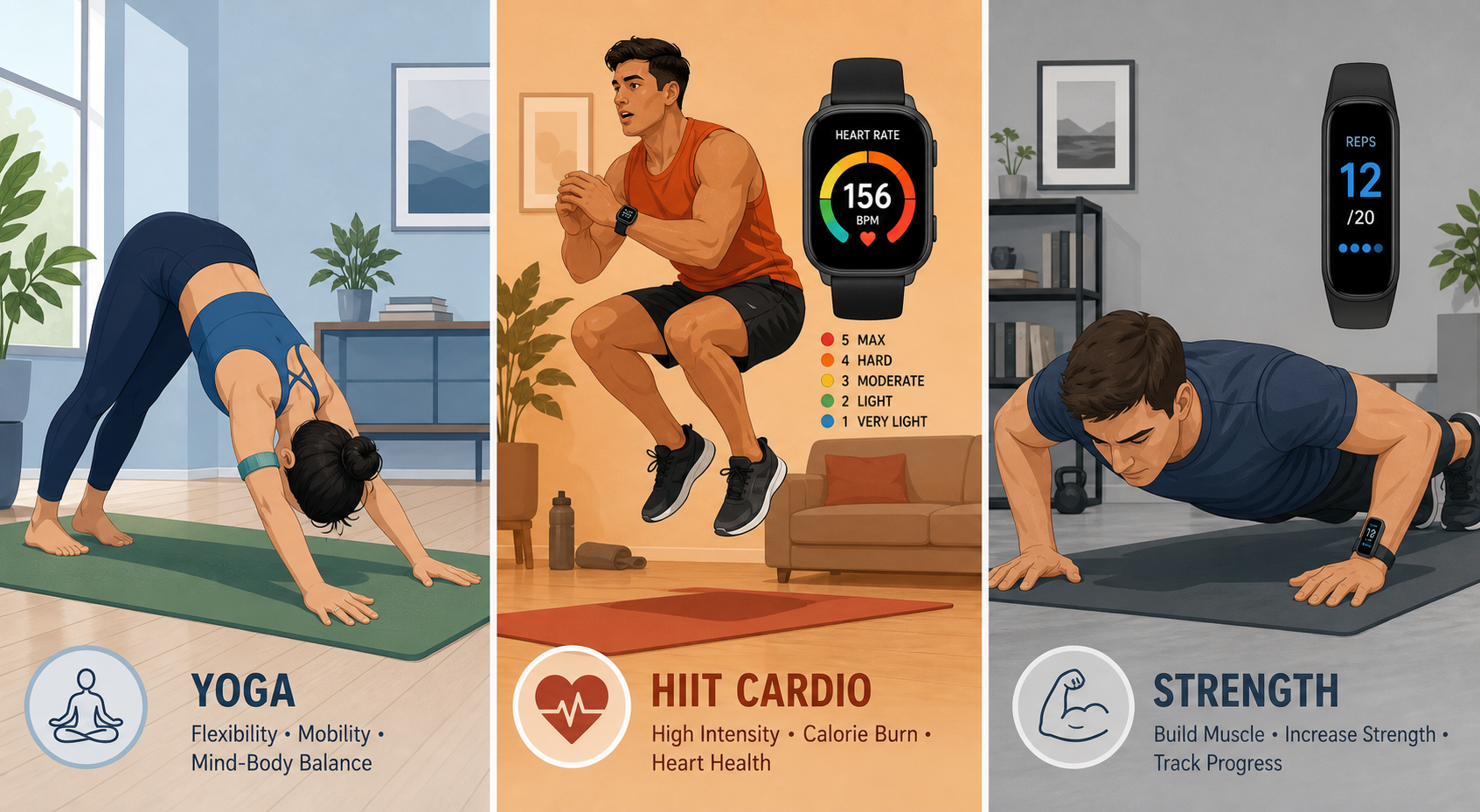
Why a Generic 'Best Fitness Tracker' Pick Won't Work for Your Home Workouts
Most fitness tracker buying guides treat 'fitness' as a single, monolithic activity. They rank devices by overall score, battery life, or step-counting accuracy, then declare a winner. But if your home workouts are a mix of yoga flows, HIIT intervals, bodyweight strength circuits, and recovery-focused rest days, that generic approach fails you. A tracker that excels at rapid heart rate response for burpees may be completely useless for detecting whether you held a Pilates plank with proper form. Another that counts reps during a bench press might miss the subtle strain of a 60-minute yin yoga session.
The core problem is that different home workout modalities demand different sensor priorities. Yoga and Pilates require minimal wrist movement and screen-free focus. HIIT needs millisecond-accurate heart rate capture during explosive intervals. Bodyweight strength training needs reliable rep and set counting without a barbell. Recovery tracking requires sleep staging and HRV analysis, not GPS or step counts. No single device does all of these equally well.
This guide flips the standard approach. Instead of starting with the device, we start with your primary home workout modality. Identify which type of training you do most — yoga, Pilates, HIIT, bodyweight strength, or a mix — and we'll match you to the tracker that actually tracks what matters for that activity. If you need a broader framework first, our decision-matrix guide by user type covers the full landscape.
Yoga and Pilates: Why Wrist-Based Trackers Have Limits (and What Works Instead)
Yoga and Pilates present a unique challenge for wearable trackers. The movements are slow, controlled, and often involve wrist flexion or weight-bearing on the hands — positions that can throw off optical heart rate sensors. More importantly, no wrist-based device can detect whether you're holding a proper downward dog, engaging your core in a Pilates hundred, or maintaining the correct spring resistance on a reformer.
As TechRadar notes, 'no watch has the ability to do this with yoga poses.' The practical value of a wrist tracker for these modalities is limited to logging heart rate, duration, and workout history — useful for trend tracking, but not for form feedback or pose detection. Form Fitness, which specializes in Pilates equipment, confirms that neither Apple Watch nor Garmin can track 'specific exercises performed, spring load or resistance level, movement quality or range of motion.'
Best Options for Yoga and Pilates
- Oura Ring 4: A screen-free ring that sits on your finger, not your wrist. It won't interfere with wrist flexion in chaturanga or plank. It tracks heart rate, HRV, sleep, and readiness — all useful for understanding how your yoga practice affects your recovery. Garage Gym Reviews gave it a score of 4.2, naming it 'Best Fitness Tracker Ring.'
- Whoop 5.0 with a bicep band: Whoop's screenless design is ideal for distraction-free practice. The bicep band placement avoids the wrist movement issues that plague wrist-based optical sensors during weight-bearing poses. Whoop scored 4.25 from Garage Gym Reviews and was named 'Best for Sleep.'
- Garmin Vivoactive 6: This is the only mainstream tracker that offers animated on-watch yoga and strength workout guidance — a unique feature for home practitioners who want visual cues without a phone or tablet. Garage Gym Reviews named it 'Best Overall Fitness Tracker' with a score of 4.69, noting it 'can do any kind of cardio, strength training, yoga, and more.'
- Apple Watch Series 11: watchOS 8 introduced a dedicated Pilates workout type that tracks active calories, heart rate, and duration. It's a solid option for Pilates practitioners who already own an iPhone, but its wrist-based form factor still limits its usefulness for yoga.
- Fitbit Charge 6: Supports a yoga mode for heart rate and duration logging, but its automatic exercise recognition has known limitations. Garage Gym Reviews reported that its SmartTrack feature 'thought I was dirt biking when I was actually driving a truck down a dirt road.' It's a budget-friendly option, but don't rely on it for automatic yoga detection.
HIIT and Cardio: Heart Rate Accuracy Is Everything
High-Intensity Interval Training (HIIT) demands rapid, accurate heart rate response. During a 30-second sprint or a set of burpees, your heart rate can spike from 120 BPM to 170 BPM in seconds. A tracker that lags behind or averages out these peaks will give you a misleading picture of your effort and calorie burn. For HIIT, heart rate accuracy isn't a nice-to-have — it's the primary requirement.
CNET's lab testing provides the most concrete data on this. In a controlled 30-mile test against the Polar H10 chest strap — widely considered the gold standard for consumer heart rate monitoring — the Apple Watch Series 11 had the lowest average heart rate error of any device tested: just 0.98%, or about 1.4 BPM. That's an exceptionally small margin of error for an optical wrist sensor. The Garmin Venu 4, by comparison, had a higher error rate of 3.89% (5.5 BPM), though it recorded data nearly every second compared to Apple's every five seconds.
Forbes Vetted, in its own testing, named the Garmin Venu 3 the best overall fitness tracker and noted it was the most accurate in heart rate testing against a Polar H10 chest strap. The Venu 3's interval detection was specifically praised, making it a strong contender for HIIT-focused home exercisers.
| Device | Heart Rate Error (vs. Polar H10) | Key Strength for HIIT | Source |
|---|---|---|---|
| Apple Watch Series 11 | 0.98% (~1.4 BPM) | Lowest HR error in lab testing | CNET lab test (30+ miles) |
| Garmin Venu 4 | 3.89% (~5.5 BPM) | High-frequency data recording (every ~1 second) | CNET lab test (30+ miles) |
| Garmin Venu 3 | Not specified numerically | Best interval detection per Forbes testing | Forbes Vetted testing |
| Polar H10 Chest Strap | Gold standard reference | Maximum accuracy for HIIT | Industry standard |
Bodyweight Strength and Calisthenics: Rep Counting and Muscular Load
Bodyweight exercises — push-ups, squats, pull-ups, lunges, planks — pose a different tracking challenge. There's no barbell to measure load, no machine to track resistance. The key metrics are rep count, set count, and the muscular strain of each movement. Two devices stand out for addressing this gap, though neither is perfect.
Garmin's Strength Mode
Garmin's strength training mode uses the device's accelerometer to detect movement patterns and count reps and sets automatically. You can select the specific exercise from a library, and the watch will attempt to count your reps as you perform them. Garage Gym Reviews and Forbes have both noted this feature as a differentiator for bodyweight and free-weight training. The Garmin Vivoactive 6, in particular, offers animated on-watch guidance for strength exercises, showing you the movement before you start.
Whoop's Strength Trainer
Whoop's Strength Trainer, available since April 2023, takes a different approach. Instead of just counting reps, it calculates 'muscular load' separately from cardiovascular strain. As Wareable explains, the feature uses data from the gyroscope and accelerometer to assess exercises, sets, reps, and weight, then calculates a Strain score that reflects the muscular demand of the workout — distinct from the cardiovascular strain measured by heart rate. This is the only mainstream wearable feature that 'truly grasps the concept of muscular load and places it neatly within the context of your wider training and recovery,' according to Wareable's long-term testing.
Recovery and Sleep: The Trackers That Prioritize Rest
For home exercisers who train hard — whether through HIIT, strength, or long yoga sessions — recovery tracking is a critical secondary consideration. Understanding when your body is ready for another intense session versus when it needs a rest day can prevent overtraining and improve long-term progress. Three devices lead this category.
| Device | Key Recovery Feature | What It Measures | Best For |
|---|---|---|---|
| Whoop 5.0 | Strain/Recovery balance | Daily Strain score, Recovery percentage, sleep staging, HRV | Athletes who want to balance training intensity with recovery needs |
| Oura Ring 4 | Readiness Score & Resilience Score | HRV, resting heart rate, body temperature, sleep stages, daily stress levels | Users who want a screen-free, 24/7 recovery monitor |
| Garmin Body Battery | Body Battery energy metric | Heart rate variability, stress, sleep quality, activity load | Garmin users who want a simple, at-a-glance recovery gauge |
The Oura Ring 4, named 'Best for Stress Tracking' by Forbes, provides a 'Resilience score' based on a two-week accumulation of stress levels, recovery, and sleep quality. This is particularly useful for multi-modality readers who need to understand how their varied workouts affect their overall recovery capacity.
Multi-Modality Readers: The Best All-Rounders for Varied Home Workouts
If you don't have a single primary workout modality — if you do yoga on Monday, HIIT on Wednesday, and bodyweight strength on Friday — you need a tracker that covers multiple bases reasonably well. Two devices stand out as the best all-rounders for varied home workouts.
- Garmin Vivoactive 6: Garage Gym Reviews named it 'Best Overall Fitness Tracker' with a score of 4.69, noting its ability to handle 'any kind of cardio, strength training, yoga, and more.' Its animated on-watch guidance for yoga and strength exercises is unique. Battery life of up to 11 days means you don't have to charge it every night, which is important for sleep tracking continuity. It's the best single-device solution for home exercisers who do a mix of modalities.
- Apple Watch Series 11: The best heart rate accuracy of any wrist-based tracker (0.98% error in CNET's lab test) makes it excellent for HIIT. It has a dedicated Pilates workout type, extensive app ecosystem for guided workouts, and strong sleep tracking capabilities. Its main drawbacks are shorter battery life (typically 18-36 hours) and the requirement of an iPhone.
- Fitbit Charge 6: A more affordable option with 40+ exercise modes including yoga, HIIT, and strength training. Garage Gym Reviews gave it a score of 4.3 and named it 'Best for Everyday Use.' However, its automatic exercise recognition can be unreliable, and it lacks the advanced recovery metrics of Whoop or Oura.
For readers deciding between a screenless band and a smartwatch, our screenless vs. smartwatch comparison covers the trade-offs in form factor, battery life, and workout tracking capabilities.
Decision Framework: Match Your Primary Workout to the Right Tracker
The table below summarizes the key recommendations from this guide. Find your primary home workout modality, then review the recommended device, its key strength for that modality, and its most important limitation.
| Your Primary Workout | Recommended Device(s) | Key Strength for This Modality | Key Limitation |
|---|---|---|---|
| Yoga | Oura Ring 4, Whoop 5.0 (bicep band), Garmin Vivoactive 6 | Screen-free design (Oura/Whoop); animated on-watch guidance (Garmin) | No pose detection or form feedback; wrist sensors can be inaccurate during weight-bearing poses |
| Pilates | Apple Watch Series 11, Oura Ring 4 | Dedicated Pilates workout type (Apple Watch); screen-free (Oura Ring) | Cannot track spring resistance, movement quality, or neuromuscular demand |
| HIIT / Cardio | Apple Watch Series 11, Garmin Venu 3/4 | Lowest HR error (Apple Watch 0.98%); best interval detection (Garmin Venu 3) | Optical HR sensors can lag during rapid intensity changes; chest strap is more accurate |
| Bodyweight Strength | Garmin Vivoactive 6, Whoop 5.0 | Rep/set counting via accelerometer (Garmin); muscular load calculation (Whoop) | Wrist-based rep counting is not perfectly accurate; no form quality assessment |
| Recovery / Sleep | Whoop 5.0, Oura Ring 4, Garmin Body Battery | Strain/recovery balance (Whoop); Readiness & Resilience scores (Oura); at-a-glance energy (Garmin) | Recovery metrics are estimates, not medical-grade data |
| Multi-Modality (Mix of Above) | Garmin Vivoactive 6, Apple Watch Series 11 | Broadest exercise mode coverage; good cross-modality accuracy | No single device excels at every modality; trade-offs are inevitable |
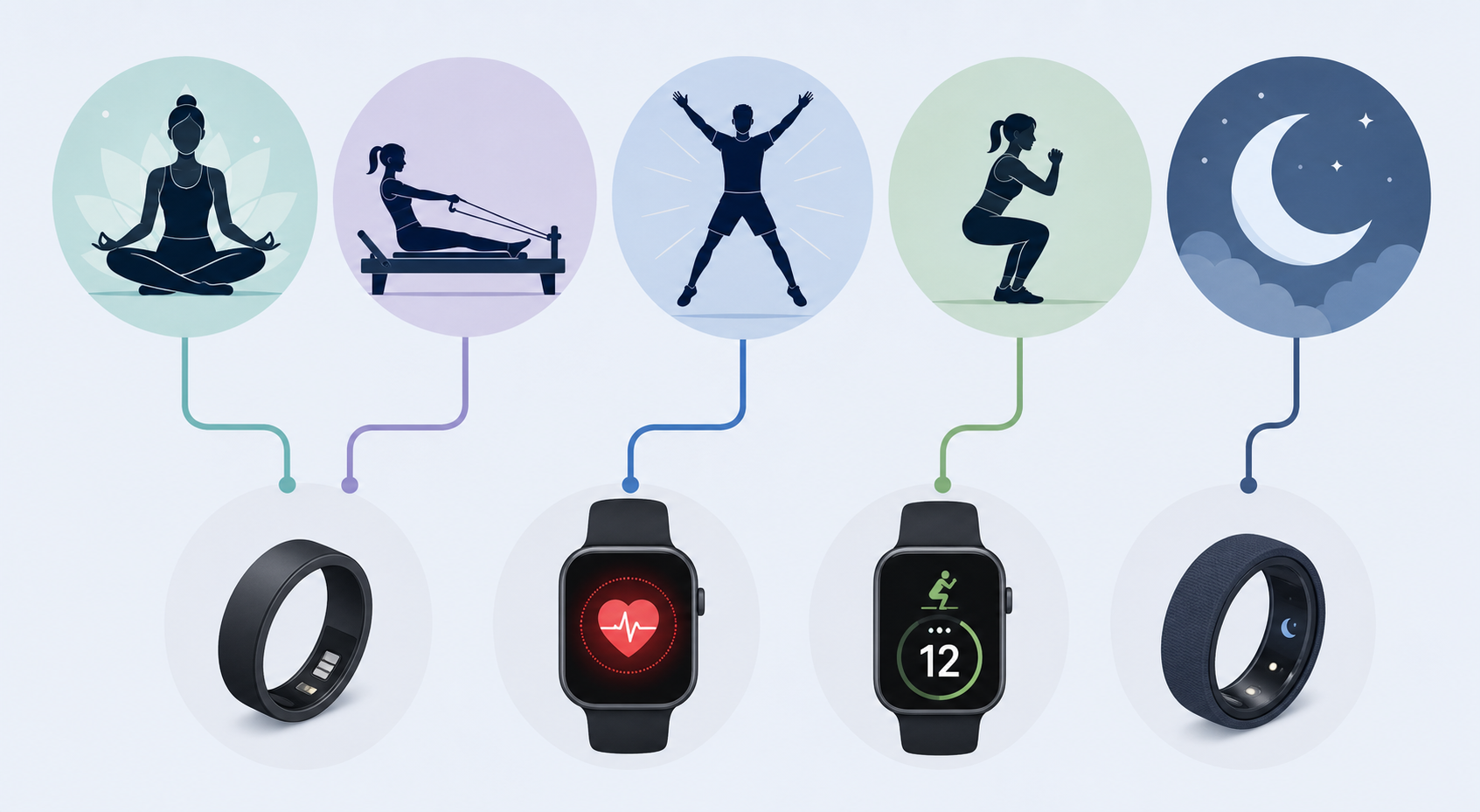
Final Take: Choose by Your Primary Workout, Not by Generic Ratings
The 'good fitness tracker' is not the one with the highest overall score from a review site. It's the one that matches your primary home workout modality. A yoga practitioner needs a screen-free ring or bicep band, not a smartwatch with GPS. A HIIT enthusiast needs the most accurate heart rate sensor available, not a device with 40+ exercise modes. A bodyweight strength athlete needs rep counting and muscular load analysis, not step counting.
Be honest about which workout you do most. If you're a multi-modality home exerciser, accept that no single device will be perfect for everything — the Garmin Vivoactive 6 and Apple Watch Series 11 come closest, but they still have trade-offs. Use the decision framework above to identify your priorities, then choose the device that best serves your primary need.
This result comes from one real apartment under the stated conditions — it is a strong signal, not a guarantee your space will measure identically.
Builds this evidence supports
No build currently links to this specific test. Browse all builds with a matching tag.
Spot something off?
If this result didn't match your own space, let us know — floor-damage and noise claims carry real deposit-risk consequences if we get them wrong.