
Smart Ring Workout Accuracy Tested: Which Rings Actually Track Exercise Well?
We analyze independent test data on five leading smart rings to determine how accurately they track heart rate, steps, and cardio metrics during active workouts. The results challenge common assumptions about which models perform best for exercise tracking.
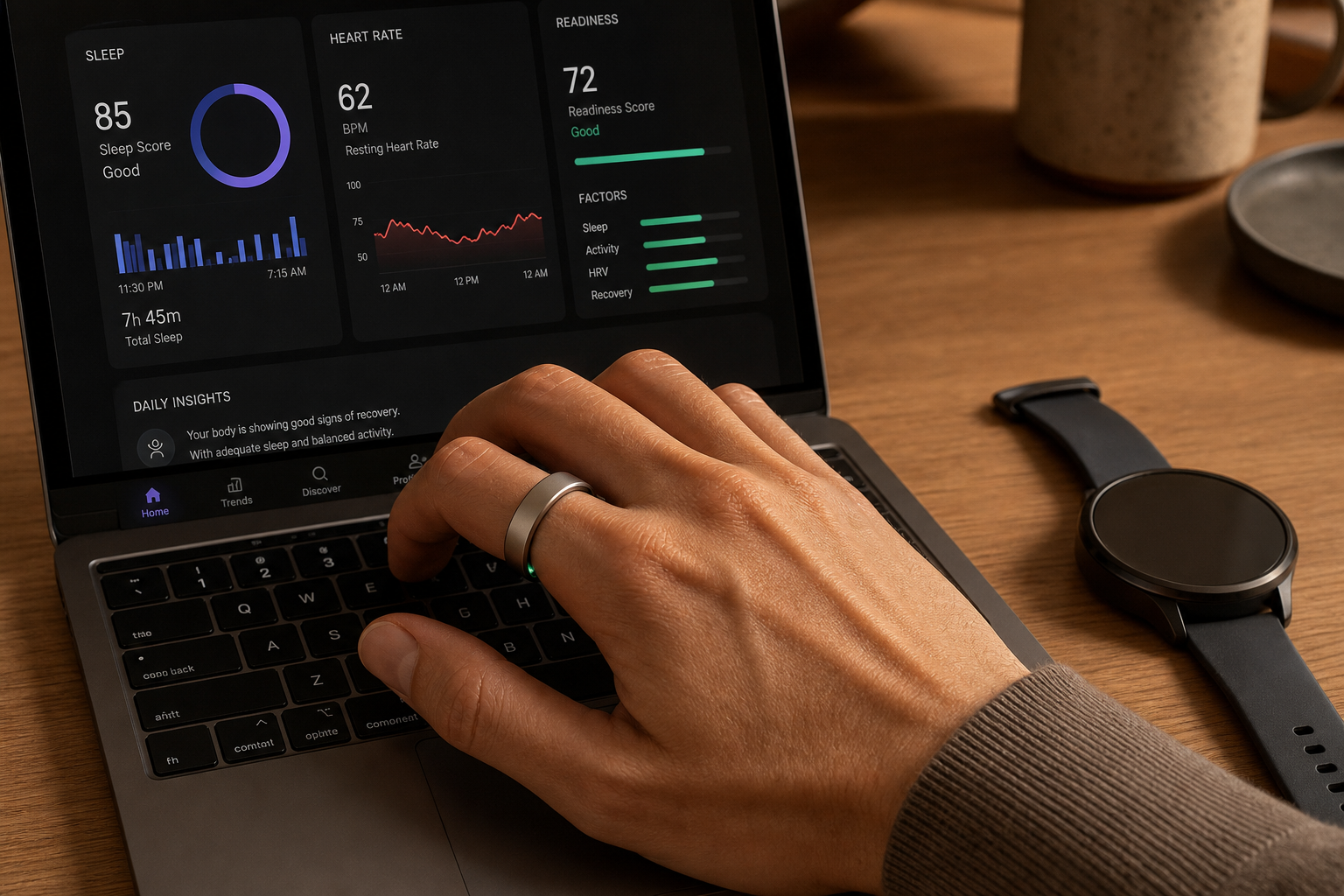
Why Smart Rings Struggle With Active Workout Tracking
The fundamental challenge with finger-based optical heart rate (HR) sensors isn't a lack of engineering effort — it's physics and anatomy. A wrist-based tracker benefits from being strapped firmly in place, with the sensor pressed against a relatively stable surface of skin over bone. A ring, by contrast, sits on a finger that bends, grips, and rotates throughout a workout. The sensor can shift, lose skin contact, or pick up movement artifacts that the device's algorithms cannot fully filter out.
Several specific factors degrade ring-based HR accuracy during exercise:
- Loose fit during dynamic movement: When you grip a dumbbell, a pull-up bar, or a handle, the finger changes shape. A ring that fits perfectly at rest can develop a small gap during exertion, allowing ambient light to reach the optical sensor and corrupting the reading.
- Movement artifacts: High-intensity activities like sprinting, jumping, or kettlebell swings produce rapid acceleration forces on the finger. These mechanical signals can overwhelm the photoplethysmography (PPG) sensor's ability to isolate the pulse waveform from noise.
- Reduced blood flow to the fingers: During intense exercise, the body redirects blood flow away from extremities toward large muscle groups. This vasoconstriction reduces the pulse signal amplitude at the finger, making it harder for the sensor to detect each heartbeat reliably.
- Sensor rotation: Unlike a watch that stays oriented on the top of the wrist, a ring can rotate around the finger. If the sensor shifts away from the pad of the finger — where blood flow is strongest — accuracy drops.
This doesn't mean rings are useless for fitness. It means the data they produce during a workout must be interpreted with an understanding of where and why errors occur. The test results below show exactly how wide those error margins can be — and which manufacturers have found ways to narrow them.
How We Tested: Methodology and Benchmarks
The accuracy data in this analysis comes primarily from independent testing conducted by Android Central, which evaluated five leading smart rings against two benchmark wrist devices: the Garmin Venu 3 and the Pixel Watch 3. These benchmarks were chosen because both devices use mature optical HR sensor arrays and have demonstrated strong correlation with chest-strap ECG monitors in prior testing.
The test protocol included multiple workout types across different intensity zones: steady-state runs, high-intensity interval sessions, gym-based strength circuits, and a timed obstacle course race (Spartan Race). Each ring was worn simultaneously with a benchmark watch on the opposite wrist, and HR data was recorded at consistent intervals throughout each session.
The five rings tested were:
- Oura Ring 4 (the current flagship from the market leader)
- Amazfit Helio Ring (a budget-friendly option at $149.99)
- Samsung Galaxy Ring (the tech giant's first-generation entry)
- RingConn Gen 2 (a well-reviewed no-subscription alternative)
- Ultrahuman Ring Air (a popular subscription-free competitor)
For readers who want broader context on how these results compare to wrist-based trackers and chest straps, our Fitness Tracker Accuracy Report 2026 covers accuracy across all form factors. This analysis focuses specifically on the ring category and the workout scenarios where these devices are most likely to be used.
Smart Ring Heart Rate Accuracy: Side-by-Side Results
The table below summarizes the core findings from the Android Central tests. The "average gap" represents the mean difference between the ring's HR reading and the benchmark device's reading across the entire workout session. A positive gap means the ring under-reported HR relative to the benchmark; a negative gap means it over-reported.
| Ring Model | Workout Type | Ring Avg HR (bpm) | Benchmark Avg HR (bpm) | Average Gap (bpm) | Max Gap (bpm) |
|---|---|---|---|---|---|
| Oura Ring 4 | Mixed workout | 95 | 151 (Garmin Venu 3) | 56 | 77 |
| Amazfit Helio Ring | Gym circuit | 148–150 | 151–152 (Garmin Venu 3) | 2–5 | Not reported |
| Samsung Galaxy Ring | Spartan Race | Under 150 | 169–170 (Pixel Watch 2 / OnePlus Watch 2) | ~20 | Not reported |
| RingConn Gen 2 | Gym workout | 83–88 | 100–151 (benchmark range) | 12–63 | Not reported |
| Ultrahuman Ring Air | Track workout | 182 | 168 (Garmin benchmark) | -14 (over-report) | Not reported |
This result comes from one real apartment under the stated conditions — it is a strong signal, not a guarantee your space will measure identically.
Builds this evidence supports
No build currently links to this specific test. Browse all builds with a matching tag.
Spot something off?
If this result didn't match your own space, let us know — floor-damage and noise claims carry real deposit-risk consequences if we get them wrong.