If you are losing weight quickly on a GLP-1 medication and suddenly wondering whether your strength is leaving with it, a short resistance band routine at home is a legitimate place to start. You do not need to join a gym, buy heavy weights, or become the kind of person who says “training block” before breakfast. You need a repeatable way to give your muscles a reason to stay useful while your body weight is changing.
The concern is real, but it should be stated carefully. Mayo Clinic notes that, without resistance training, about 25% to 40% of weight lost on GLP-1 medications may come from lean body mass; that category includes water, bone, and connective tissue, not only skeletal muscle.[1][2] So no, that does not mean “40% of your lost weight is automatically muscle.” It does mean strength training deserves a place in the plan early, especially if everyday tasks already feel harder.
Resistance training is the part of the routine that tells your body, in practical terms, “this tissue is still needed.” For a beginner on a GLP-1 medication, bands are one of the least dramatic ways to send that message. Cleveland Clinic specifically names resistance bands as an appropriate starting point for people using GLP-1 medications who are new to strength training, and Mass General’s guidance for GLP-1 users emphasizes starting slowly and increasing gradually.[3][4]
Why Resistance Bands Fit This Exact Problem
The early weeks on a GLP-1 medication can make a normal beginner workout feel oddly mismatched. Appetite may be lower. Energy may be uneven. A full gym can feel like too much friction for a person who is already adjusting to a medication, food changes, and a new body rhythm. Bands remove several of those barriers at once.
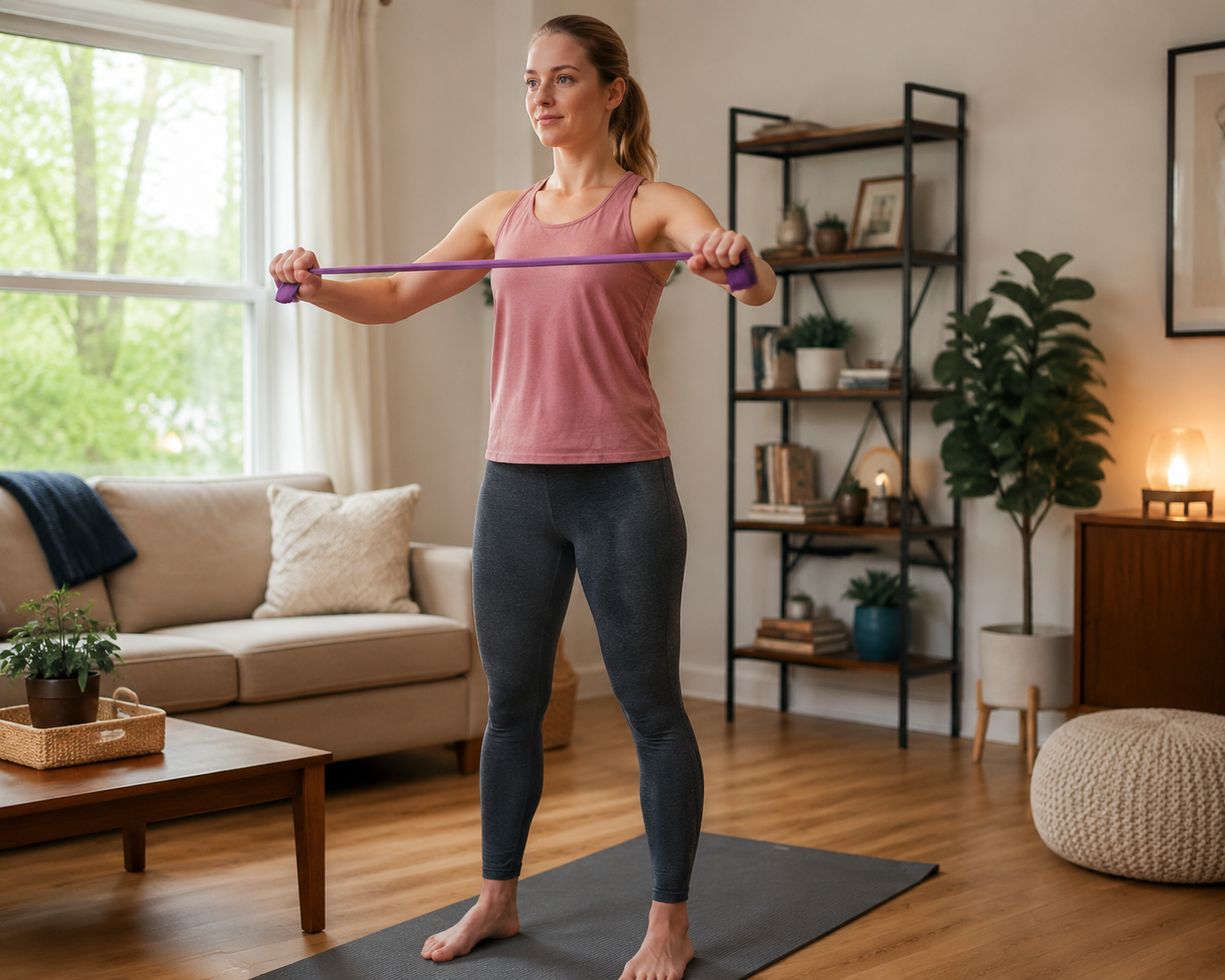
A long loop band or handled band set usually costs little compared with dumbbells, fits in a drawer, and lets you train in a living room. The resistance also changes as the band stretches. That can feel friendlier on joints than trying to control a fixed weight from the first inch to the last, especially when you are new to the movement.
Bands are not magic. They are not a permanent replacement for every kind of loading. But the evidence is good enough for the job at hand: research cited in FormBlends reports that resistance band training can produce muscle activation and strength gains comparable to traditional weight training for beginners and intermediate lifters.[2] That is the useful standard here. A beginner needs an accessible first tool that can be made challenging, not a perfect tool for every future goal.
One caution before choosing a band: do not trust the color or pound rating too much. Band resistance is not standardized across brands. A “medium” band in one package may feel like a “heavy” band in another. For this workout, the right band is the one that makes the last 2 to 3 reps of a set feel challenging while your form still looks controlled.
The Beginner Resistance Band Workout for GLP-1 Users
Do this routine 2 to 3 times per week on nonconsecutive days. Mayo Clinic’s general strength guidance for beginners is reassuring here: one controlled set of 12 to 15 reps taken to fatigue can build strength efficiently for many beginners, and strength training 2 to 3 times per week can target the major muscle groups.[1] You can start with one set per exercise. Add a second set only when the first version feels steady.
| Exercise | Reps or Time | Rest | Main Area |
|---|---|---|---|
| Banded squat | 8-12 reps | 45-75 seconds | Legs and hips |
| Seated or standing band row | 10-15 reps | 45-75 seconds | Back and arms |
| Banded glute bridge | 10-15 reps | 45-75 seconds | Glutes and hamstrings |
| Banded chest press or wall push-up | 8-12 reps | 45-75 seconds | Chest, shoulders, triceps |
| Banded overhead press | 8-12 reps | 60-90 seconds | Shoulders and arms |
| Banded pull-apart | 10-15 reps | 45-60 seconds | Upper back and posture muscles |
| Pallof press | 8-12 reps per side | 45-60 seconds | Core |
Keep the whole session short at first. Cleveland Clinic advises people beginning GLP-1 medications to start with just 10 to 15 minutes a day of light activity during the first weeks, then increase intensity as the dose increases during week 5 and beyond.[3] If that means you do only the first four exercises today, that still counts as a useful start.
How Hard Each Set Should Feel
Use effort instead of band color. On a scale from 1 to 10, where 10 means you could not complete another clean rep, most sets should land around a 6 or 7 during the first two weeks. The last few reps should require attention. They should not require breath-holding, twisting, rushing, or bargaining with your joints.
- Too easy: you finish the set and feel like you could do 10 more reps with the same form.
- About right: the last 2 to 3 reps slow down, but you still control the band.
- Too hard: you shorten the range of motion, hold your breath, shrug your shoulders, or lose balance.
1. Banded Squat
Stand with your feet about hip-width to shoulder-width apart. Place a long loop band under both feet and hold the other end at chest height, or use a mini band above your knees if that feels easier to set up. Bend your knees and hips as if sitting back toward a chair, then stand tall again.
- Form cue: keep your feet planted and let your knees track in the same direction as your toes.
- Make it easier: squat to a chair, pause lightly, then stand.
- Make it harder: slow the lowering phase to 3 seconds or use a thicker band.
2. Seated or Standing Band Row
For the seated version, sit tall with your legs extended and loop the band around the middle of your feet. Hold one end in each hand, start with your arms extended, then pull your elbows back toward your ribs. For the standing version, anchor the band at about chest height in a secure door anchor or around a stable post, then row from there.
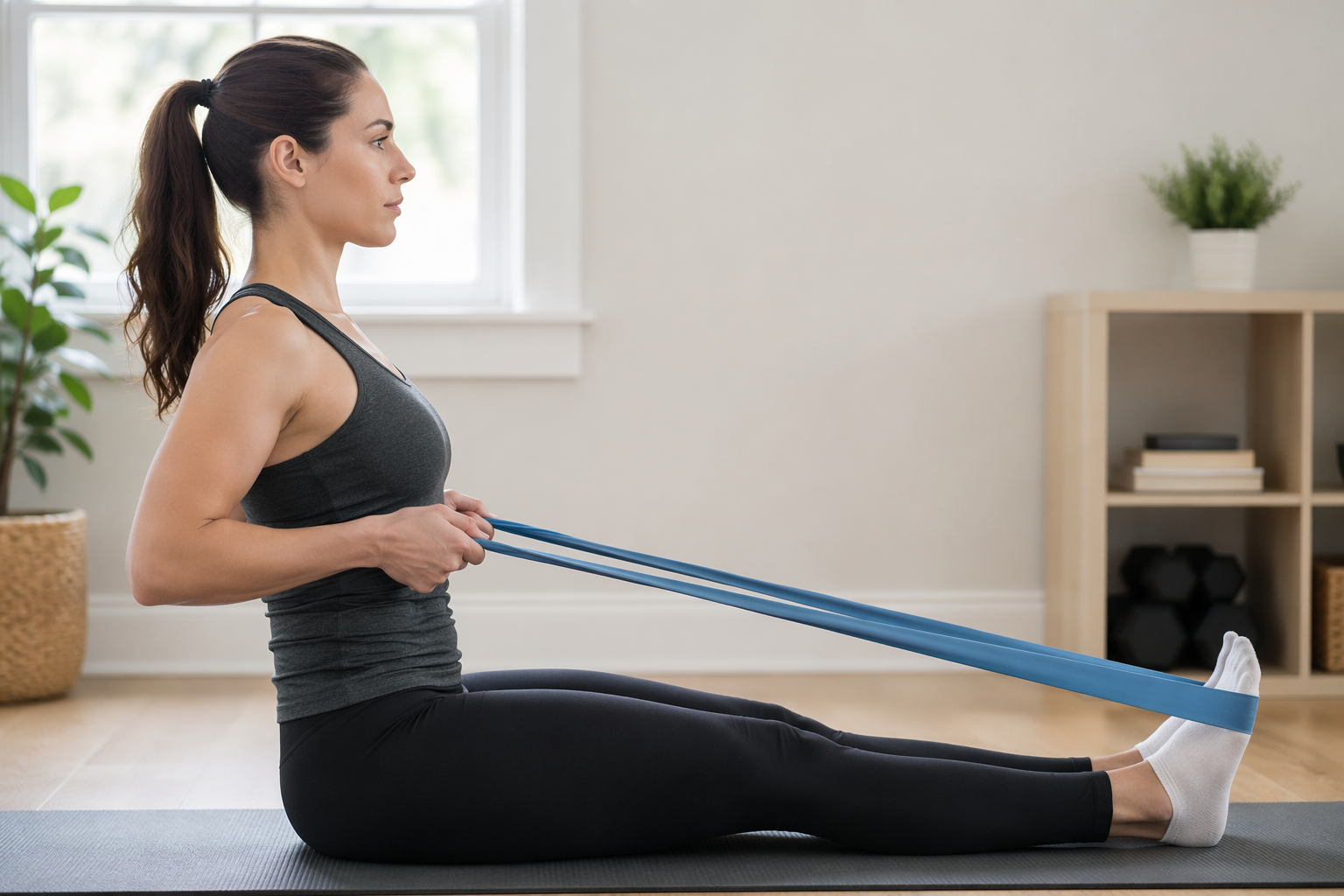
- Form cue: pull with your elbows, not your wrists, and stop before your shoulders creep toward your ears.
- Make it easier: sit closer to the band anchor or use a lighter band.
- Make it harder: pause for 1 second with your elbows back.
3. Banded Glute Bridge
Lie on your back with your knees bent and feet flat on the floor. Place a mini band above your knees, or hold a long band across your hips with both ends pinned to the floor by your hands. Press through your feet and lift your hips until your body forms a line from shoulders to knees, then lower with control.
- Form cue: finish by squeezing your glutes, not by arching your lower back.
- Make it easier: skip the band and practice the bridge with body weight.
- Make it harder: hold the top position for 2 seconds on each rep.
4. Banded Chest Press or Wall Push-Up
For a banded chest press, wrap the band around your upper back and hold one end in each hand. Start with your elbows bent, then press your hands forward until your arms are nearly straight. If the band setup feels awkward, do wall push-ups instead: hands on a wall, body in a straight line, elbows bending and straightening under control.
- Form cue: keep your ribs stacked over your hips instead of flaring your chest upward.
- Make it easier: use wall push-ups or a lighter band.
- Make it harder: press more slowly or step into a slightly stronger band tension.
5. Banded Overhead Press
Stand on the middle of a long band with one or both feet, depending on how much tension you need. Hold the ends at shoulder height with your palms facing forward or slightly inward. Press overhead until your arms are nearly straight, then lower to shoulder height with control.
- Form cue: keep your neck long and avoid leaning back to finish the rep.
- Make it easier: press one arm at a time or sit in a chair for more stability.
- Make it harder: use a slower lowering phase or stand with both feet on the band.
6. Banded Pull-Apart
Hold a light band at chest height with your hands about shoulder-width apart. Keep your elbows soft and pull the band apart until your hands move wider than your shoulders. Return slowly instead of letting the band snap back.
- Form cue: think about moving your shoulder blades gently toward each other.
- Make it easier: place your hands farther apart before you start.
- Make it harder: pause at the widest point for 1 second.
7. Pallof Press
Anchor the band at chest height to something secure. Stand sideways to the anchor and hold the band with both hands at the center of your chest. Step away until you feel gentle tension. Press your hands straight forward, pause, then bring them back to your chest without letting your torso rotate toward the anchor.
- Form cue: your job is to stay still while the band tries to turn you.
- Make it easier: stand closer to the anchor.
- Make it harder: step farther from the anchor or pause longer with your arms extended.
How to Place the Workout Around Your Injection Week
A GLP-1 workout plan should respect the week you are actually having. Some users report that workouts feel better on days 3 through 6 after an injection, when side effects may be less intrusive; this timing is noted in GLP-1 fitness guidance from FormBlends and Cleveland Clinic.[2][3] Treat that as a planning clue, not a rule. Your prescribing clinician’s guidance and your own side-effect pattern matter more than a calendar template.
| If Your Injection Is On... | Try Strength Training On... | Keep It Flexible By... |
|---|---|---|
| Monday | Thursday and Saturday | Making Tuesday or Wednesday a short walk or mobility day |
| Wednesday | Saturday and Monday | Keeping Thursday very light if side effects are stronger |
| Friday | Monday and Wednesday | Using the weekend for gentle movement if needed |
If the day after your injection is rough, do not spend that day proving anything. Walk, stretch, or skip training. If days 3 to 6 feel more stable, put your band workouts there. The best schedule is the one that gives you enough energy to move well and enough recovery to repeat the session next week.
Progress Without Turning This Into a Second Job
For the first two weeks, keep the goal almost boring: learn the exercises, stop before your form breaks, and finish feeling like you could come back in two days. After that, progress one variable at a time.
- Add reps first: move from 8 reps toward 12 or from 10 reps toward 15.
- Add a set next: go from 1 set to 2 sets for the exercises that feel stable.
- Add band tension last: use a thicker band, shorten the band slightly, or step farther from the anchor.
- Add control anytime: slow the lowering phase or pause at the hardest point of the rep.
Do not upgrade everything in the same week. If you add a second set to squats and rows, leave the band tension alone. If you switch to a harder band for presses, keep the reps lower until the movement feels clean again.
A Short Note on Protein
Training is only one part of preserving lean tissue. Protein matters too, and appetite suppression can make it harder to get enough. Princeton Medicine cites a general target of 1.2 to 2.0 grams of protein per kilogram of body weight per day for people building or preserving muscle while taking GLP-1 medication, while Mayo Clinic discusses a lower range of 1.2 to 1.6 grams per kilogram per day.[5][1]
That range is a general wellness guide, not a personal prescription. If you have kidney disease, a history of disordered eating, digestive side effects, or uncertainty about how much protein fits your medication plan, ask your healthcare provider or a registered dietitian. The useful training takeaway is simpler: do not let lower appetite quietly turn into under-fueling every strength session.
When to Scale Down or Pause
A beginner routine should make you feel worked, not wiped out. Scale down if nausea, dizziness, unusual fatigue, joint pain, or poor sleep is making the session feel worse as it goes. Use a lighter band, do fewer exercises, or stop after one set. If symptoms are severe, new, or medication-related, contact your healthcare provider rather than trying to solve it with workout adjustments.
This routine is not a guarantee against all lean-mass loss, and it is not a substitute for medical guidance. It is a credible first strength plan for the person who wants to start today: a few bands, a small space at home, controlled reps, and enough consistency to remind the body that strength still has a job.
References
- GLP-1 Medications and Muscle Loss: What To Know About Nutrition and Supplements, Mayo Clinic
- Resistance Bands on GLP-1: Full Body Workout, FormBlends
- Exercise for GLP-1 Use, Cleveland Clinic
- Fitness for People Taking GLP-1 Agonists, Mass General
- Building Muscle While Taking a GLP-1 Medication? Yes, It’s Possible, Princeton Medicine
Comments
Join the discussion with an anonymous comment.