
Garmin Cirqa vs Fitbit Air Fitness Tracker Comparison
A side-by-side spec comparison of Garmin Cirqa and Fitbit Air for home gym athletes, covering footprint, noise, subscription costs, heart rate accuracy during strength training, and equipment compatibility.
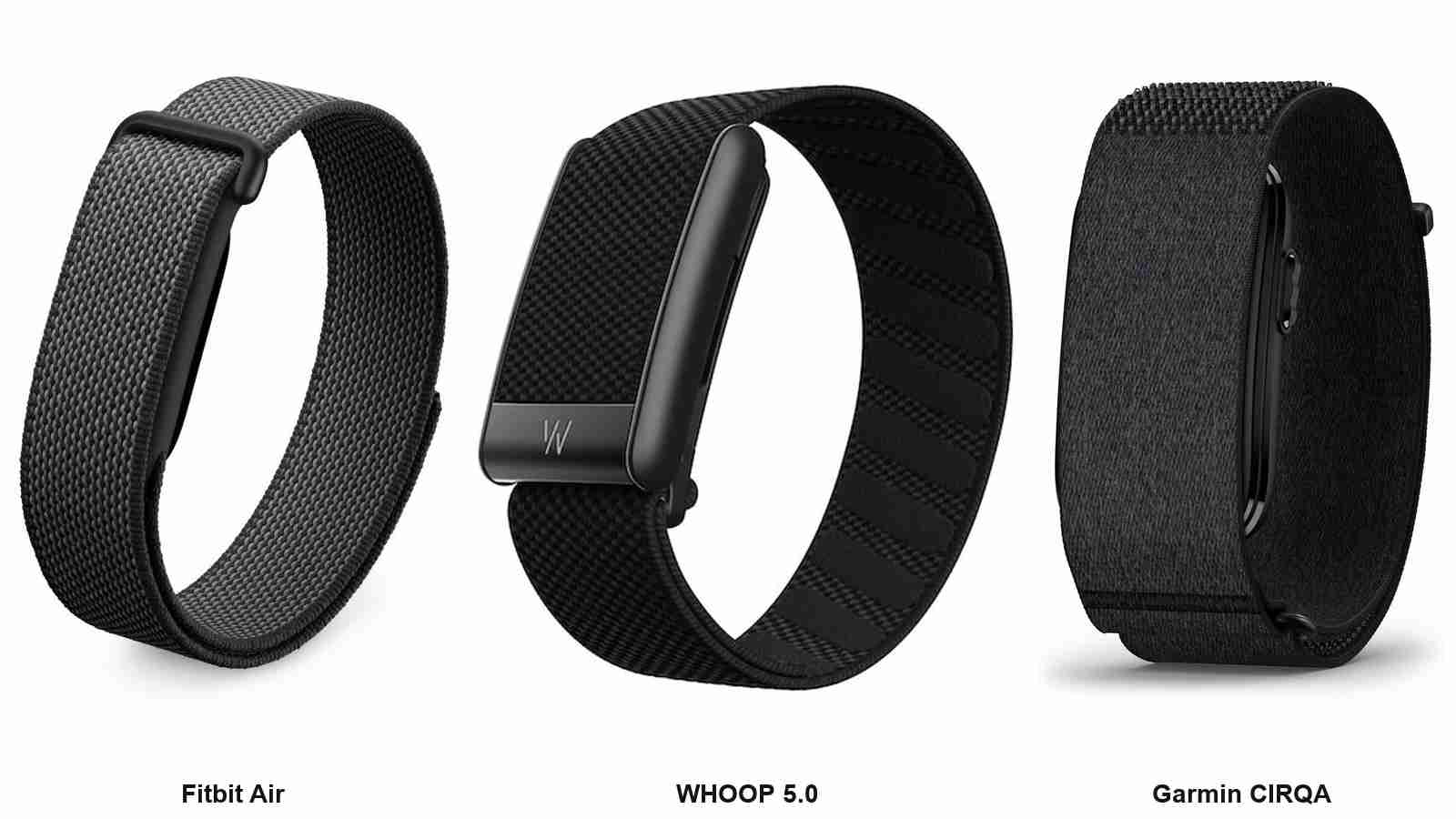
| Category | wearable |
|---|---|
| Folded / stored footprint | Garmin Cirqa: 27×47×9 mm; Fitbit Air: 34.9×17×8.3 mm |
For a home gym, the choice between Garmin Cirqa and Fitbit Air comes down to what you expect the band to do after the workout starts. Garmin Cirqa is the better fit if you follow programmed training and want recovery and readiness metrics without paying for a plan. Fitbit Air is the cleaner value if you want the lowest price, the lightest body, AFib detection, and basic tracking that does not take over your wrist. If your main requirement is sending reliable heart rate to Peloton, Zwift, a treadmill, a rower, or a bike computer, neither one should be your first pick.
| Decision point | Garmin Cirqa | Fitbit Air | Home gym read |
|---|---|---|---|
| Price | $199.99 confirmed at launch [1] | $99 launch price [2] | Fitbit starts $100 cheaper before any subscription math. |
| Paid plan exposure | Usable without Connect+; Connect+ is $6.99/month [1] | Usable without Premium; Premium is $9.99/month after trial [2] | Both avoid a mandatory subscription, but paid extras change year-two cost. |
| First-year cost with paid plan | $269.98 if Connect+ is paid monthly [1] | $198.99 if Premium is paid monthly after purchase [2] | Fitbit remains cheaper even after adding Premium. |
| Module size | 27 × 47 × 9 mm [3] | 34.9 × 17 × 8.3 mm [4] | Fitbit is much narrower; Garmin is shorter but wider. |
| Weight | 14.8 g [3] | 5.2 g [4] | Fitbit is less than half the weight. |
| Battery life | Up to 10 days [3] | Up to 7 days [4] | Garmin wins if you hate charging another thing. |
| Wear location | Wrist; optional upper-arm band accessory [1][3] | Wrist; no official bicep band at launch [4] | Garmin has the better strength-training placement option. |
| Activity profiles | 80+ activity profiles [3] | Auto-detection limited to 6 workouts in DC Rainmaker testing [5] | Garmin is better for people who actually label sessions. |
| Training metrics | Body Battery, Training Readiness, and core Garmin metrics without subscription [1][3] | Cardio Load and health metrics; some coaching features sit behind Premium [2][5] | Garmin gives more structured training context out of the box. |
| AFib / ECG | No ECG reported in Garmin Wiki specs [3] | AFib detection supported [2][4] | Fitbit wins if AFib detection is a major reason to buy. |
| GPS | No onboard GPS reported in IMDA-linked coverage [6] | Connected GPS only in DC Rainmaker testing [5] | Neither replaces a GPS watch. |
| Controls | Single-button control [3] | No physical button [5] | Garmin is less dependent on taps and app flow during a sweaty session. |
| Heart-rate broadcast | Bluetooth only; no ANT+ reported from IMDA filing coverage [6] | Heart-rate sharing works with supported fitness equipment via Fitbit’s system [7] | Neither is the simple universal broadcast device many home gyms need. |
| Independent HR accuracy evidence | No independent Cirqa HR accuracy testing available yet at the time of writing; product was just launched [1] | DC Rainmaker found steady-state HR generally good but interval overshoots of 20–40 bpm in some workouts [5] | Fitbit has known interval limits; Garmin has unverified Cirqa-specific accuracy. |
The quick split
Choose Garmin Cirqa if your home training already has structure: strength days, conditioning days, recovery decisions, and enough repeat sessions that readiness metrics matter. The draw is not that Cirqa is smaller or cheaper. It is that Garmin puts more of the training layer in the base experience, including Body Battery and Training Readiness, and supports more than 80 activity profiles without making the core device feel like a subscription demo [3].
Choose Fitbit Air if the tracker needs to disappear until something is worth checking. It is $99, weighs 5.2 g, supports AFib detection, and fits the casual home gym user who wants health tracking with a few workout signals rather than a training dashboard [2][4]. That is not a small advantage in an apartment setup where every extra charger and proprietary strap has to justify its place.
Choose neither as your main heart-rate bridge if your setup depends on equipment pairing. A cheap ANT+ chest strap is still the cleaner answer for broadcasting heart rate across Peloton, Zwift, treadmills, rowers, bike computers, and gym consoles. Cirqa’s Bluetooth-only limitation removes the Garmin advantage many buyers would reasonably expect, and Fitbit’s sharing support is tied to selected compatible equipment rather than a broad ANT+ broadcast [6][7].
Subscription cost is where the cheap tracker can stop being cheap
The cleanest budget comparison is the no-subscription version. Fitbit Air is $99 and Garmin Cirqa is $199.99, so the Fitbit buyer keeps about $100 for plates, bands, a mat, or a better fan before the first workout starts [1][2]. Both devices remain usable without a paid plan, which matters more than any trial splash screen.
| Ownership scenario | Garmin Cirqa | Fitbit Air |
|---|---|---|
| Device only | $199.99 [1] | $99 [2] |
| Device + 1 year of monthly paid plan | $269.98 with Connect+ at $6.99/month [1] | $198.99 with Premium at $9.99/month [2] |
| Device + 2 years of monthly paid plan | $353.86 if Connect+ continues monthly [1] | $318.76 if Premium continues monthly [2] |
| Device + 3 years of monthly paid plan | $437.74 if Connect+ continues monthly [1] | $438.64 if Premium continues monthly [2] |
That third-year line is the trap. Fitbit starts much cheaper, but Premium’s higher monthly price narrows the gap over time. If you want Fitbit Air mainly for AFib detection, light wear, and basic workout logging, the value case is strongest when you skip Premium. If you expect coaching features to carry the product, you are no longer comparing a $99 band against a $199.99 band; you are comparing two multi-year software relationships.
Garmin’s math is different. Cirqa costs more up front, but the core training metrics are the reason to buy it in the first place. Paying for Connect+ may still make sense for some users, but Cirqa does not need that payment to justify itself as a structured training tracker.
Footprint: Fitbit wins the drawer test, Garmin wins the charging gap
Fitbit Air is the easier object to live with. Its module is 34.9 × 17 × 8.3 mm and weighs 5.2 g, compared with Garmin Cirqa at 27 × 47 × 9 mm and 14.8 g [3][4]. The Garmin module is not huge, but it is visibly broader, and the weight difference is large enough to matter if you are wearing it through sleep, work, and training.
Cirqa gives some of that back with up to 10 days of battery life versus up to 7 days for Fitbit Air [3][4]. In a small setup, battery life is not just convenience; it decides whether another cable lives permanently on the counter. Garmin also has the optional upper-arm band, which is more important for lifting than the extra battery days if wrist flexion keeps confusing optical heart rate [1][3].
There is not enough sourced comparative material here to rank vibration strength, LED distraction, or real-world on-wrist noise. The useful supported point is simpler: Fitbit is lighter and narrower; Garmin is bulkier but lasts longer and can move off the wrist with the accessory.
Heart-rate accuracy: Fitbit has a known interval problem, Cirqa has an evidence gap
This is the part of the comparison that deserves less brand confidence and more caution. DC Rainmaker’s Fitbit Air testing found heart rate generally good during steady-state work, but with overshoots of 20–40 bpm in some interval workouts [5]. For easy rides or steady incline treadmill sessions, that may be tolerable. For short HIIT blocks, kettlebell intervals, or mixed circuits, it can distort the part of the workout where intensity data is supposed to help most.
That does not automatically make Cirqa better. Garmin Wiki lists Cirqa with Elevate Gen 4 optical heart-rate hardware, but Cirqa was just launched, and there is no independent Cirqa-specific accuracy testing available yet in the provided research [1][3]. Elevate Gen 4 tells us the sensor family. It does not prove how this band behaves on a wrist during burpees, curls, loaded carries, or a hard bike interval.
Garmin’s upper-arm accessory is still meaningful. Wrist optical HR can struggle when grip pressure, wrist bend, and forearm tension interrupt clean readings. Moving the sensor to the upper arm can be a better placement for strength work, even though that is a placement advantage rather than proof that Cirqa is accurate under every lifting condition.
Equipment compatibility is the deal-breaker for connected home gyms
If the band only needs to record workouts in its own app, both devices are usable. If it needs to act like a heart-rate transmitter for the equipment in front of you, the picture gets worse quickly.
Fitbit’s real-time heart-rate sharing works with supported fitness equipment through its documented system, including named compatibility rather than universal broadcast behavior [7]. That is fine if your exact bike, app, or machine is on the list. It is annoying if you only find out after setup that your rower, console, or bike computer is not.
Cirqa does not get a pass because it says Garmin on the box. Tech Advisor’s June 2026 coverage of an IMDA filing reported Bluetooth only, with no ANT+ and no GPS [6]. For home gym users, no ANT+ is the missing line item that changes the recommendation. Garmin buyers often expect generous sensor interoperability; this band should not be treated like a full Garmin watch or a chest strap transmitter.
| Pairing need | Garmin Cirqa | Fitbit Air | Better practical answer |
|---|---|---|---|
| Record workout in the brand app | Yes | Yes | Either |
| Broadcast HR by ANT+ | No ANT+ reported [6] | No broad ANT+ broadcast support in the provided research [7] | ANT+ chest strap |
| Use with selected supported equipment | Bluetooth-only limitation applies [6] | Supported equipment list applies [7] | Check exact equipment before buying |
| Use as a universal home-gym HR bridge | Not supported by the evidence here | Not supported by the evidence here | Chest strap |
Health tracking and workout control
Fitbit Air has the cleaner health-feature win because AFib detection is supported, while Cirqa’s listed specs do not include ECG [2][3][4]. If AFib detection is the reason you are buying a screenless band instead of just using a chest strap during workouts, Fitbit is the more direct answer.
Garmin has the cleaner workout-control win. A single physical button is not exciting on a spec sheet, but it is useful when hands are sweaty or a session has already started [3]. Fitbit Air’s no-button design keeps the band simple and low-profile, but it gives you fewer tactile options during training [5].
Auto-detection also favors the user who does not care about clean workout labels. DC Rainmaker found Fitbit Air auto-detection limited to 6 workouts [5]. That is acceptable for casual logging. It is weaker for someone rotating lifting, intervals, rowing, cycling, mobility, and conditioning sessions and expecting the device to sort the week correctly.
Which one should you buy?
- Buy Garmin Cirqa if you want structured workout profiles, Body Battery, Training Readiness, longer battery life, and the option to wear the sensor on the upper arm.
- Buy Fitbit Air if you want the lower purchase price, the lighter and narrower module, AFib detection, and basic tracking without turning your home gym into another dashboard.
- Skip the paid plan at first on either device unless you already know which feature you are paying for; both are usable without a subscription.
- Do not buy either band as your main equipment-connectivity solution if real-time heart-rate broadcasting is central to your setup.
For a $200–$800 home gym, the best answer may be split: use Cirqa or Fitbit Air for daily tracking, recovery context, and health features, then use a simple ANT+ chest strap when the machine, app, or bike computer needs dependable live heart rate. That is less elegant, but it avoids paying for a band that still cannot connect to the workout in front of it.
References
- Garmin Cirqa Smart Band launch, Tom's Guide, July 2026.
- Introducing the all-new Fitbit Air, Google Blog.
- Garmin CIRQA Smart Band, Garmin Wiki.
- Fitbit Air — Review 2026, PCMag.
- Fitbit Air In-Depth Review, DC Rainmaker, May 2026.
- Garmin Cirqa May Give Fitbit Air Early Win, Tech Advisor, June 2026.
- Share your real-time heart rate with fitness equipment, Google Health Support.
Verify further before you buy:
Price or spec changed since we checked? Report it below.
Comments
Join the discussion with an anonymous comment.