
Is a Free Fitness App Enough? A Practical Guide to When Free Works and When You Need to Pay
Not sure if you need to pay for a fitness app? This guide helps you decide based on your experience level, goals, and consistency — not the app's feature count.
The Real Problem Isn't Free vs. Paid — It's Abandonment
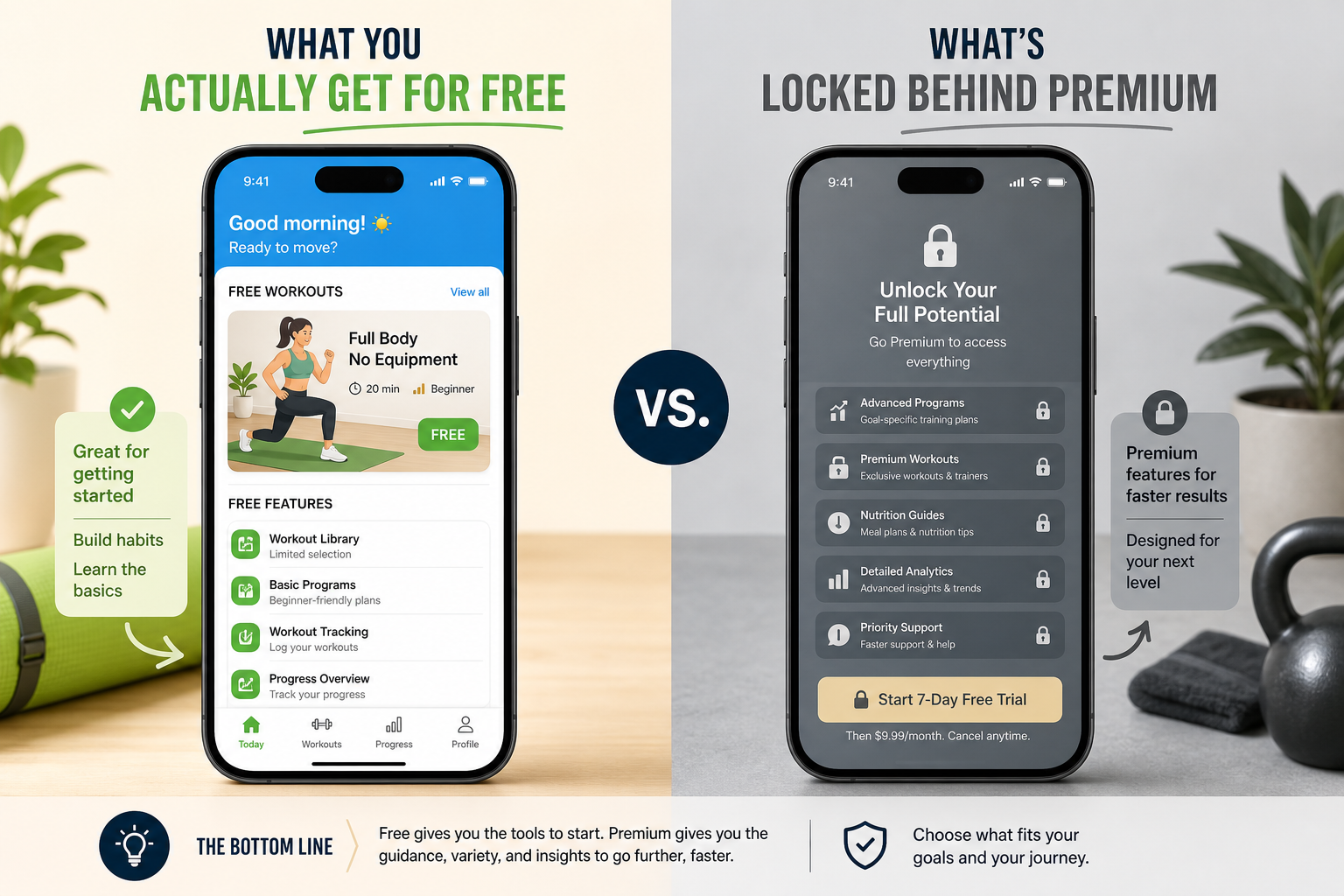
Every week, someone downloads a free fitness app, logs one workout, and never opens it again. The numbers back this up: industry data from Business of Apps (2026) indicates that 73% of free fitness app users abandon the app within 30 days. That is not a failure of the app. It is a failure of fit — between the person, the tool, and the moment they are in.
The fitness app market is crowded with options that range from completely free to aggressively priced subscriptions. But the question most people ask — "Is this app worth paying for?" — skips a more important one: "Is a free app enough for me, right now?" The answer depends almost entirely on your experience level, your goal, and your track record with consistency, not on how many features the app packs into its free tier.
This guide is not another roundup of the best free apps. It is a decision framework. By the end, you should know whether your situation calls for a free app, a paid subscription, or something else entirely — and you will have a clear set of criteria to make that call for yourself.
When a Free Fitness App Is Genuinely Enough
Free fitness apps have a bad reputation in some circles, but that reputation is often undeserved. For a large segment of exercisers, a free app is not just adequate — it is the right tool for the job. The key is knowing whether you fall into that segment.
You Have Been Consistent for Six Months or More
If you have already built a workout habit that survives travel, busy weeks, and low motivation, you do not need an app to keep you accountable. You need a tool that logs your work and maybe provides a little structure. The free tiers of apps like Hevy or Caliber do exactly that: they track sets, reps, and weights, and they let you build a library of your own routines. No subscription required.
The research supports this. Subscription fitness apps show roughly 30% higher engagement rates than free alternatives, according to industry data. But that average is driven by users who need the engagement boost in the first place. If you are already engaged, the gap narrows to near zero.
You Know How to Program Progressive Overload
The single biggest value a paid fitness app offers is programming — telling you exactly what to do each session, how much weight to use, and when to increase. If you already understand progressive overload, periodization, and how to structure a training week, you are paying for something you already own.
A free strength-tracking app gives you the logging infrastructure. You bring the programming knowledge. That combination works well for intermediate and advanced lifters who have outgrown the need for guided instruction but still want clean data.
Your Goal Is Basic Activity Tracking or Following Guided Videos
Not every fitness goal requires a sophisticated training plan. If your objective is to walk more, do a few yoga sessions per week, or follow along with a 20-minute HIIT video a few times a week, a free app like Nike Training Club (NTC) or FitOn gives you a complete library of guided workouts at no cost. These apps offer hundreds of sessions in their free tiers — enough variety to keep you busy for months without repeating a workout.
The same applies to running. Apps like Strava's free tier track distance, pace, and route data. If you are not following a structured run program (intervals, tempo runs, periodized mileage), the free version is all you need.
- You are consistent without external accountability.
- You can design your own workouts or follow a simple progression.
- Your goal is general fitness, not a specific performance target.
- You just need a logbook or a video player with a timer.
When Paying for a Fitness App Makes Sense
For every person who can thrive with a free app, there is someone who will quit within a week without the structure and accountability a paid app provides. The decision to pay is not about the app being "better" — it is about whether your situation requires features that free tiers do not offer.
You Have Quit Free Apps Repeatedly
If you have downloaded three free fitness apps in the past year and abandoned each one within two weeks, the problem is not the app selection. It is that free apps, by design, lack the friction that keeps you coming back. Paid apps invest in retention mechanics — personalized workout adjustments, progress milestones, gamification, and sometimes even human coaching — because they need to justify the monthly charge.
Industry data suggests that paid apps with AI personalization and gamification features can achieve up to 50% higher retention rates than their free counterparts. That is not a coincidence. When you have money in the game, you are more likely to show up. And when the app adapts to your performance, you are less likely to get bored or stuck.
You Do Not Know What Workouts to Do
This is the most common reason beginners pay for fitness apps, and it is a valid one. If you walk into a gym — or open the app at home — and have no idea which exercises to do, how many sets and reps to use, or when to increase weight, a free logging app will not help you. You need programming.
Paid apps like Caliber's premium tier, Future (which pairs you with a real coach), or JEFIT's pro version provide structured programs that remove the decision burden. You open the app, it tells you what to do, and you execute. For someone who has never followed a structured training plan, that guidance is worth the monthly fee.
You Have Hit a Plateau
Plateaus happen when your body adapts to your training stimulus. Breaking through them requires changes in volume, intensity, exercise selection, or rest periods — adjustments that a good programming algorithm can make automatically. Free apps generally do not do this. They log what you did last session and let you try to beat it, but they do not prescribe strategic changes.
If you have been running the same routine for three months with no progress, a paid app that auto-regulates your training load based on your performance history may be the nudge you need.
You Need External Accountability
Some people thrive on social accountability — knowing that a coach will check their log, or that missing a session will trigger a notification. Paid apps that include human coaching (like Future or Trainerize) or strong social features (like Strava Summit) provide this layer. Free apps generally do not.
- You have a history of abandoning fitness routines within weeks.
- You need someone or something to tell you exactly what to do each session.
- Your progress has stalled and you do not know how to adjust.
- You respond well to coaching, check-ins, or social competition.
Best Free App for Each Use Case
If you have decided that a free app is the right starting point, the next question is which one. The answer depends on what you actually need to do. Below is a quick-reference guide for the most common home fitness scenarios.
| Use Case | Recommended Free App | What You Get for Free | Key Limitation |
|---|---|---|---|
| Guided workout library (HIIT, yoga, strength) | Nike Training Club (NTC) | Hundreds of video-guided workouts, filterable by equipment and duration | No personalized programming; workouts are pre-set |
| Guided workout library with variety | FitOn | Full workout library, celebrity trainers, social challenges | Premium unlocks nutrition tracking and advanced filters |
| Strength training logbook | Hevy | Unlimited exercise logging, set/rep tracking, progress charts | Limited to 4 custom routines on free tier |
| Strength training with basic programming | Caliber | Full workout logging, basic program recommendations, community | Advanced programming and coaching require paid tier |
| Beginner linear progression (strength) | StrongLifts 5x5 | Complete 5x5 program with auto-progression, built-in timer | Only one program; no variety for advanced lifters |
| Running and cycling tracking | Strava (free tier) | GPS tracking, route mapping, segment leaderboards, social feed | No training plans, no live segments, no beacon safety feature |
A few notes on these recommendations. Nike Training Club and FitOn are the strongest options if you want a library of guided workouts without paying. Hevy and Caliber are the best free strength-tracking apps because their free tiers are genuinely usable — they do not hide core logging functionality behind a paywall. StrongLifts 5x5 is the simplest option for a beginner who wants to run a proven program without any decision-making.
Free App vs. Paid App vs. Personal Trainer: Cost Comparison
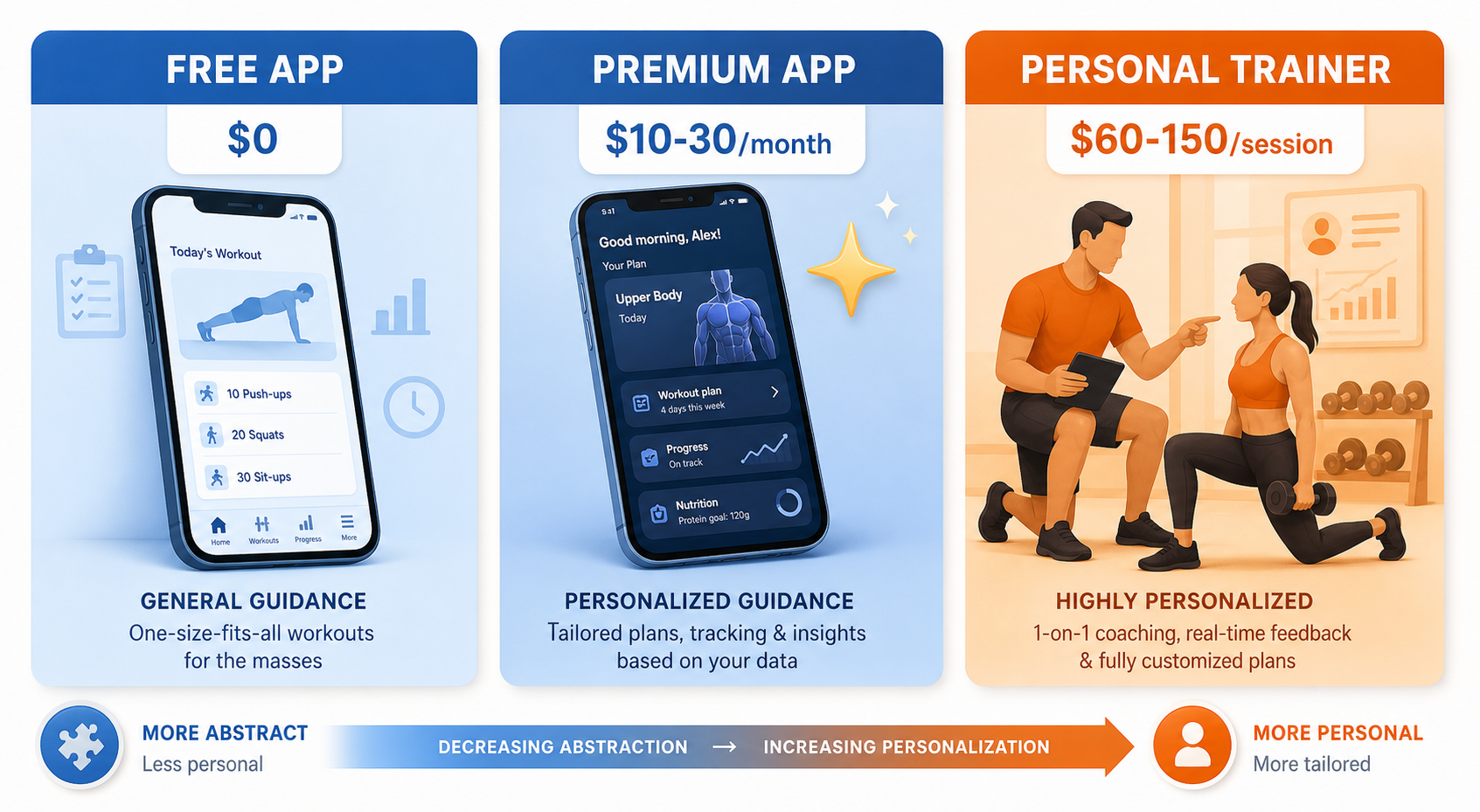
The cost gap between a free app and a personal trainer is enormous, but the value gap is not always proportional. The table below lays out the typical monthly costs and what each option delivers.
| Option | Typical Monthly Cost | What You Get | Best For |
|---|---|---|---|
| Free fitness app | $0 | Workout library, basic logging, community features | Consistent exercisers who need a logbook or video library |
| Premium fitness app | $10 – $30/month | Personalized programming, AI adjustments, advanced analytics, coaching (varies) | Beginners needing guidance, plateaued lifters, accountability seekers |
| Personal trainer (in-person or online) | $60 – $150 per session | Custom programming, real-time form correction, full accountability, nutrition guidance | Anyone with specific goals, injury history, or need for hands-on coaching |
The math is straightforward. A premium app at $20/month costs $240 per year. A personal trainer at $80 per session, twice per week, costs over $8,000 per year. The app is dramatically cheaper, but it cannot watch your form, adjust a lift in real time, or push you through a tough set the way a human can. The right choice depends on whether you need programming or coaching — they are not the same thing.
Your Decision Tree: Free or Paid?
Rather than guessing, work through the following questions. Your answers will point you toward the right decision.
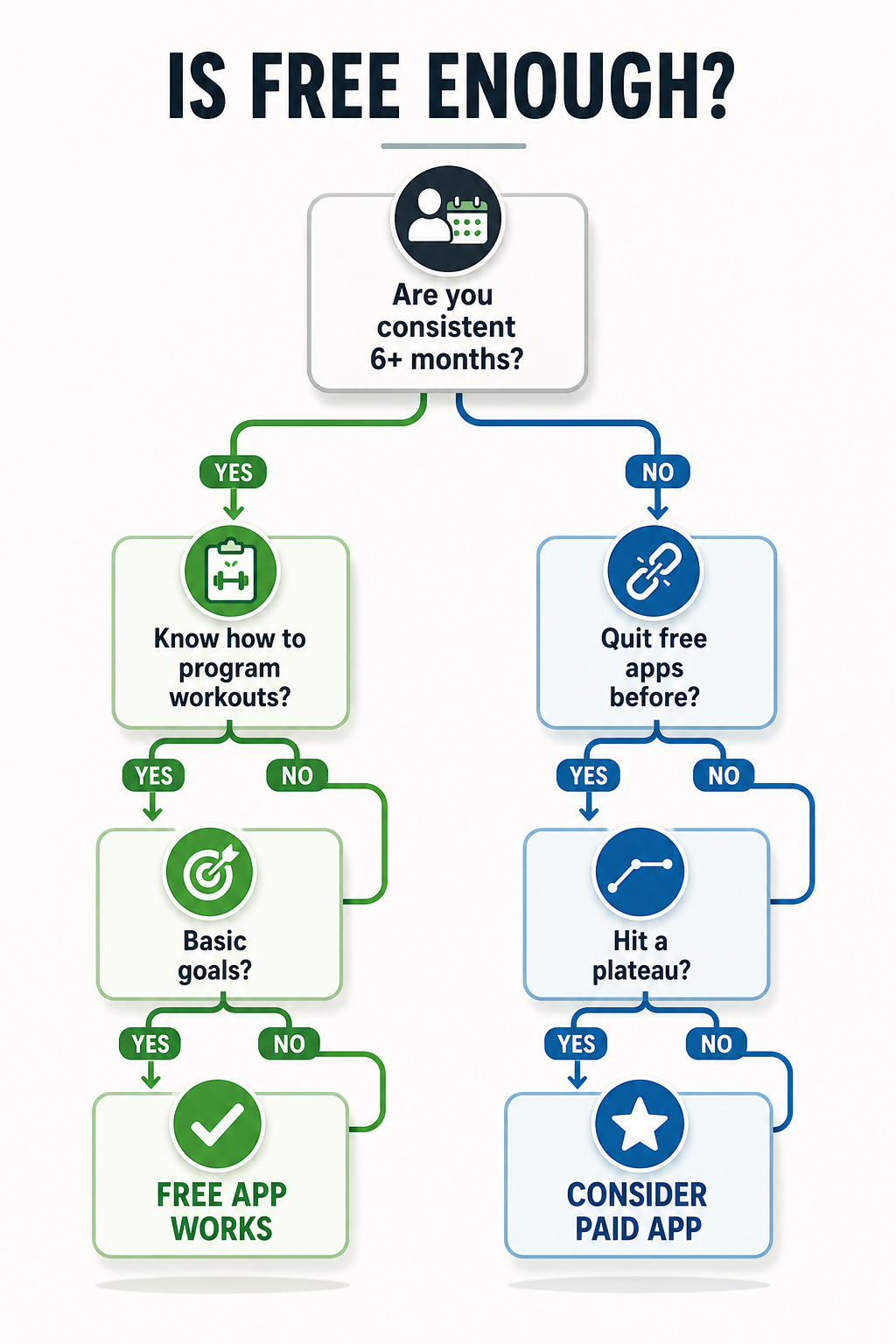
- Have you been exercising consistently (at least 2–3 times per week) for the past six months? If yes, proceed to question 2. If no, skip to question 3.
- Do you know how to structure your own workouts — including exercise selection, set and rep schemes, and progressive overload? If yes, a free app is likely sufficient. If no, consider a paid app with programming.
- Have you downloaded free fitness apps before and abandoned them within a few weeks? If yes, a paid app with accountability features may be worth the investment. If no, start with a free app and see if you stick with it.
- Do you have a specific performance goal (e.g., run a 5K in under 25 minutes, bench press your bodyweight, complete a pull-up) that requires structured progression? If yes, a paid app with goal-specific programming is a strong option. If no, a free app likely covers your needs.
- Do you have the budget for a paid app without stress? If yes, and you answered "yes" to question 3 or 4, try a paid app. If budget is tight, start free and upgrade only when you hit a clear limitation.
The Bottom Line: The Tool Matters Less Than the Habit
A free fitness app used consistently for six months will produce better results than a premium app abandoned after two weeks. That is not a platitude — it is the logical conclusion of the retention data. The 73% abandonment rate for free apps is not an indictment of free apps. It is a reminder that the hardest part of fitness is not finding the right tool, but showing up long enough for the tool to matter.
If you are consistent and knowledgeable, a free app is all you need. If you are inconsistent or unsure, a paid app may provide the structure that keeps you engaged. But in either case, the app is a means, not an end. The end is the habit.
This result comes from one real apartment under the stated conditions — it is a strong signal, not a guarantee your space will measure identically.
Builds this evidence supports
No build currently links to this specific test. Browse all builds with a matching tag.
Spot something off?
If this result didn't match your own space, let us know — floor-damage and noise claims carry real deposit-risk consequences if we get them wrong.