
Fitness Tracker Rings vs. Wrist Trackers: Which Wearable Wins for Home Gym Users?
Smart rings excel at passive health monitoring like sleep and recovery, but they significantly underperform wrist trackers for active workout tracking. This guide helps home gym users decide whether a ring can replace or complement their Garmin, Apple Watch, Fitbit, or Whoop.
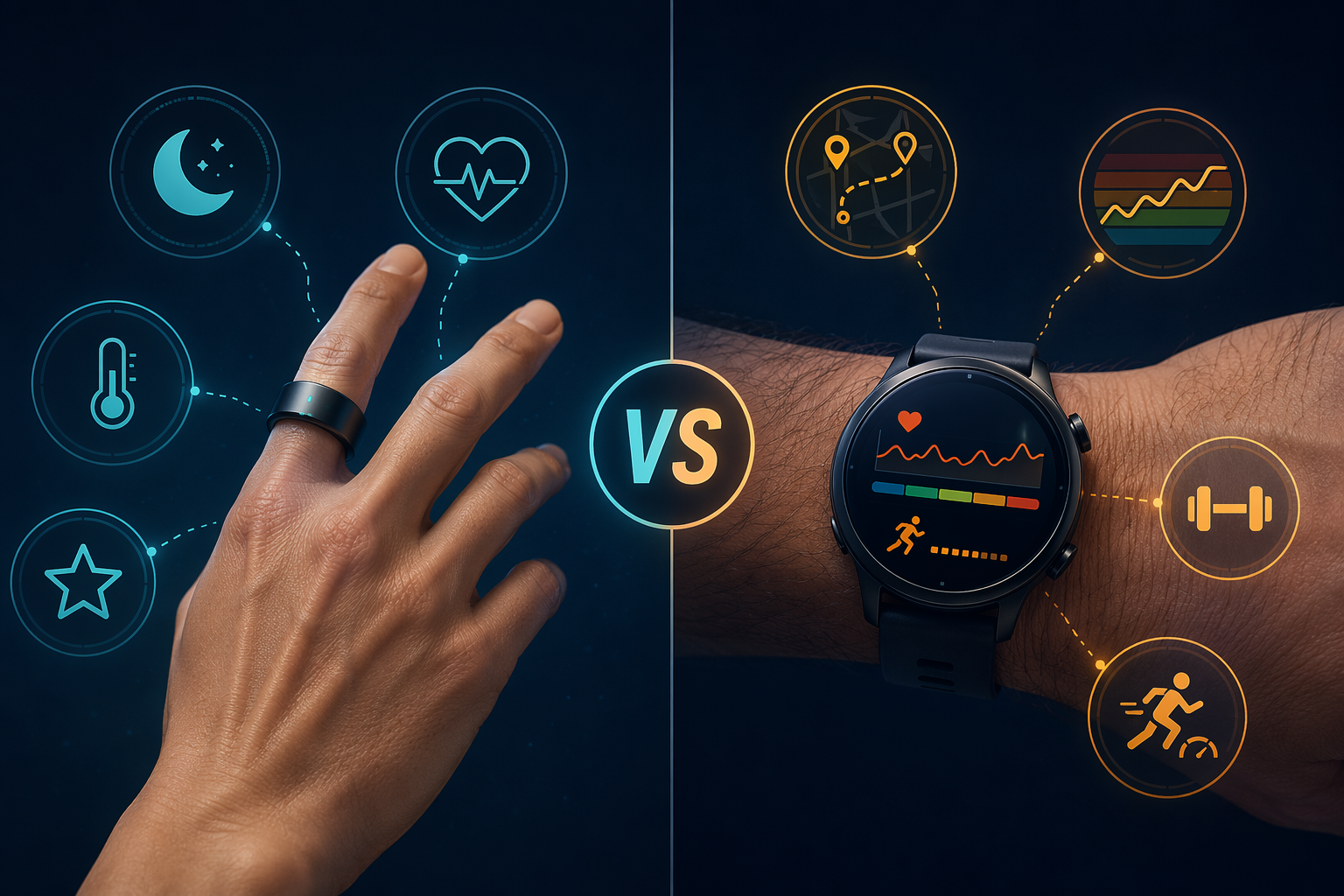
The Ring vs. Wrist Decision for Home Gym Athletes
If you train at home with a Garmin, Apple Watch, Fitbit, or Whoop strapped to your wrist, you have likely seen a smart ring ad promising deeper sleep insights and a readiness score that tells you exactly when to push and when to rest. The pitch is seductive: a tiny, jewelry-like device that tracks your recovery 24/7 without the bulk of a watch. But can a ring on your finger actually replace the wrist tracker you rely on for your workouts?
The short answer is no — not if your primary goal is tracking active training. The longer, more useful answer is that a smart ring can be a powerful complement to your existing wrist tracker, filling in the passive health data gaps that watches handle poorly. This guide breaks down exactly where rings excel, where they fall apart, and how to decide if adding one to your home gym setup makes sense.
What Fitness Tracker Rings Do Really Well
Smart rings were not designed to be workout companions. They were built for passive, longitudinal health monitoring — and on that front, they outperform wrist-worn devices in several key areas.
Sleep Tracking: The Ring's Killer Feature
Multiple reviewers across Wareable, ZDNET, and PCMag agree: smart rings are more comfortable to wear overnight than any wrist-based device. That comfort translates directly into better data. Because you are more likely to wear a ring every night without irritation, you get fewer data gaps and a more complete picture of your sleep architecture.
The finger is also a better site for photoplethysmography (PPG) sensors than the wrist. A 2022 review in Frontiers in Physiology, cited by Live Science, found that fingers have a more robust network of blood vessels closer to the skin, which can produce more accurate heart rate measurements. A 2023 study in Mayo Clinic Proceedings: Digital Health also suggested that rings may produce more accurate PPG readings in people with darker skin tones compared to wrist sensors.
Resting Heart Rate, HRV, and Temperature
During rest, smart rings are highly accurate. Dr. Bhaskar Semitha, a cardiologist interviewed by Live Science, noted that while a ring's smaller contact area makes it more susceptible to movement artifacts, it tends to be most accurate during rest. This makes rings excellent for tracking resting heart rate (often within 98-99% of clinical-grade sensors), heart rate variability (HRV), and overnight body temperature trends.
For a home gym athlete, this data is gold. Knowing your HRV trend and resting heart rate over weeks tells you whether your nervous system is recovering from training stress. The Oura Ring, for instance, packages this into a Readiness Score that Garage Gym Reviews describes as more about lifestyle and recovery than real-time workout tracking — which is exactly the point.
Where Smart Rings Fall Short for Active Workouts
The moment you start moving — especially with intensity — the smart ring's advantages evaporate. For home gym users doing strength training, HIIT, or any workout that involves gripping, lifting, or rapid movement, the ring becomes a liability rather than a tool.
Active Heart Rate: A 60-70 bpm Gap
The most damning data comes from Android Central, where tester Derrek Lee compared the Oura Ring 4, Amazfit Helio Ring, and RingConn Gen 2 against a Garmin Venu 3 and Pixel Watch 3 across five workouts. During high-intensity work in the final gym session, the Oura Ring 4 underestimated heart rate by 60-70 beats per minute. The RingConn Gen 2's stats were so far off that Lee speculated a fit issue on the ring finger. Only the Amazfit Helio Ring stayed consistently within 2-4 bpm of the wrist trackers.
This is not an isolated Oura problem. The Samsung Galaxy Ring, tested during a Spartan Race, averaged under 150 bpm while the Pixel Watch 2 and OnePlus Watch 2 both averaged around 170 bpm. The Ultrahuman Ring Air went in the opposite direction, overestimating heart rate: it reported an average of 182 bpm for a track workout when the Garmin said 168 bpm.
No GPS, No Screen, No Real-Time Feedback
As TechRadar points out, smart rings lack a screen, GPS, and detailed real-time workout metrics. You cannot glance at your wrist to see your current heart rate zone, check your pace on a run, or see how many reps you have completed. The ring passively records data and syncs it to your phone after the workout. For a home gym athlete doing interval training or trying to stay in zone 2, this is a dealbreaker.
Durability Risks from Weight Training
Every major review site — Wareable, TechRadar, CNET, and Garage Gym Reviews — warns that smart rings scratch easily from barbell knurling and dumbbell contact. CNET's reviewer explicitly stated they had to take the ring off during workouts because it was uncomfortable to hold a dumbbell and they did not want to scratch it. Even titanium-clad rings like the Oura Ring 4 and RingConn Gen 2 are not immune. Wareable states plainly: "We always suggest taking it off when doing activities like lifting weights, because it will get scratched."
Fitness Ring vs. Wrist Tracker: Head-to-Head Comparison
The table below compares the leading smart rings against a typical high-end wrist tracker (Garmin or Apple Watch) across the dimensions that matter most to home gym users.
| Feature | Oura Ring 4 | Samsung Galaxy Ring | RingConn Gen 2 Air | Garmin / Apple Watch (Typical) |
|---|---|---|---|---|
| Price | $349 + $5.99/mo subscription | $399, no subscription | $199, no subscription | $250–$800, no subscription (most models) |
| Annual cost (year 1) | $420.88 | $399 | $199 | $250–$800 |
| Battery life (tested) | 5–8 days (7.25 days PCMag) | 6–7 days | 10 days (10.5 days PCMag) | 1–14 days (varies by model) |
| Sleep tracking accuracy | Excellent (92-95% range) | Very good | Very good | Good (less comfortable to wear) |
| Active HR accuracy | Poor (60-70 bpm under during HIIT) | Poor (under by ~20 bpm during race) | Poor (inconsistent readings) | Excellent (within 2-5 bpm of chest strap) |
| GPS | No | No | No | Yes (built-in or connected) |
| Real-time display | No | No | No | Yes (heart rate zone, pace, etc.) |
| Weight training durability | Scratches easily | Scratches (titanium, but not immune) | Scratches easily | Durable (designed for impact) |
| Best for | Sleep & recovery monitoring | Samsung ecosystem users | Budget-conscious recovery trackers | Active workout tracking & GPS |
The Hybrid Approach: Wearing Both a Ring and a Watch
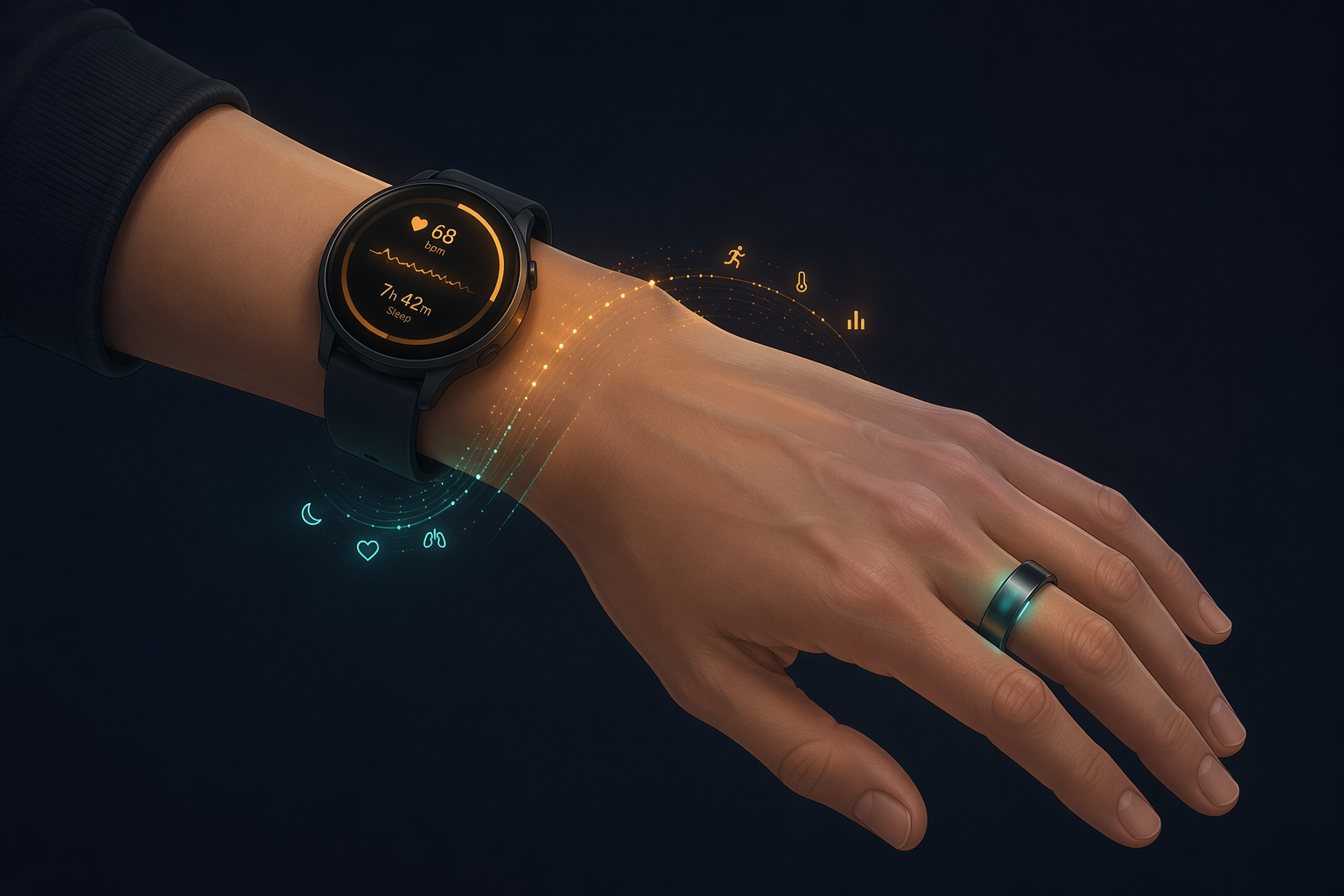
Given the complementary strengths and weaknesses, the optimal setup for a home gym athlete is not a choice between ring and watch — it is using both. This hybrid approach gives you the best of both worlds without compromise.
How the Data Fits Together
- The ring handles 24/7 passive monitoring: sleep stages, resting heart rate, HRV trends, body temperature, and readiness scores. You wear it to bed and keep it on during rest days.
- The wrist tracker handles active workouts: real-time heart rate zones, GPS for outdoor runs or bike rides, rep counting for strength training, and pace or distance metrics.
- During workouts, you take the ring off (to protect it from scratches and improve grip comfort) and rely entirely on the wrist tracker. After the workout, you put the ring back on.
- The ring's recovery data helps you interpret your training load. A low readiness score from the ring might tell you to take an easy day, even if your wrist tracker's training load metric looks fine.
This is the setup that multiple reviewers across TechRadar and PCMag implicitly endorse: the ring fills the gaps that watches leave (overnight comfort, uninterrupted HRV data) while the watch handles what rings cannot (real-time metrics, GPS, durability during exercise).
How to Choose: A Decision Framework for Your Home Gym
Not every home gym user needs both devices. Use the scenarios below to determine which setup fits your training style.
Scenario 1: Strength-Focused Lifter Prioritizing Recovery
If your primary training is barbell and dumbbell work and you care deeply about sleep quality, HRV trends, and knowing when to deload, a smart ring (like the Oura Ring 4 or RingConn Gen 2 Air) is a strong addition. You will still need a wrist tracker or a simple stopwatch for rest timers between sets, but the ring will give you recovery insights that most wrist trackers cannot match due to poor overnight wear compliance.
Scenario 2: HIIT and Cardio Enthusiast Needing Real-Time Metrics
If your home workouts involve burpees, battle ropes, jump squats, or indoor cycling intervals, a smart ring alone will not work. The active heart rate inaccuracy (60-70 bpm under during high-intensity work, per Android Central) means you cannot trust the data to guide your effort. You need a wrist tracker with a real-time display showing your current heart rate zone. A ring can still be useful for overnight recovery tracking, but it is a supplement, not a replacement.
Scenario 3: Runner or Cyclist Who Needs GPS
Smart rings have no GPS. If you run or cycle outdoors and need pace, distance, and route mapping, a ring cannot serve as your primary device. Stick with a Garmin, Apple Watch, or Coros. A ring could still add value for sleep and recovery analysis, but the wrist tracker remains essential.
Scenario 4: The Minimalist Who Only Does Bodyweight and Yoga
If your home practice is low-intensity bodyweight circuits, yoga, or Pilates, a smart ring might be sufficient as your only wearable. You do not need GPS, real-time heart rate zones, or rep counting. The ring will track your activity level, sleep, and recovery adequately. However, be aware that even during bodyweight work, gripping a yoga mat or using a foam roller can scratch the ring's exterior.
The Verdict
For the vast majority of home gym users who do strength training, HIIT, or cardio, a smart ring cannot replace a wrist-based fitness tracker. The active tracking limitations — especially the unreliable heart rate data during exercise and the lack of real-time feedback — are too significant. However, a ring can be an excellent companion device that fills the passive health monitoring gaps your wrist tracker leaves open, particularly for sleep and recovery.
If you already own a Garmin, Apple Watch, or Whoop and are curious about a ring, think of it as an upgrade to your recovery data pipeline, not a replacement for your workout tool. If you are buying your first wearable and do mostly low-intensity home workouts, a ring like the RingConn Gen 2 Air ($199, no subscription) is a reasonable starting point. But if you plan to train with any real intensity, buy a wrist tracker first and consider a ring later.
This result comes from one real apartment under the stated conditions — it is a strong signal, not a guarantee your space will measure identically.
Builds this evidence supports
No build currently links to this specific test. Browse all builds with a matching tag.
Spot something off?
If this result didn't match your own space, let us know — floor-damage and noise claims carry real deposit-risk consequences if we get them wrong.