
Recognize Heat Illness Stages to Keep Outdoor Workouts Safe
Learn to distinguish between normal heat discomfort and dangerous overheating during summer outdoor workouts. This guide explains the three stages of heat illness with clear symptoms and action steps for each.
- Evidence source
- CDC NIOSH
- Applies to
- general population
What the evidence says
A safe outdoor workout in heat can still feel uncomfortable. Sweat can run into your eyes, your pace can slow, and a hill that felt ordinary in spring can suddenly feel rude. The problem is the gray zone: the moment when normal summer effort starts turning into heat illness. That is the moment to stop negotiating with the workout and identify the stage you are in.
Heat illness during exercise is usually described as a progression: heat cramps, heat exhaustion, then heat stroke. The stages are not personality tests or proof that you trained badly. They are signals that your body is losing its ability to manage heat under load, and each stage requires a different response.[1]
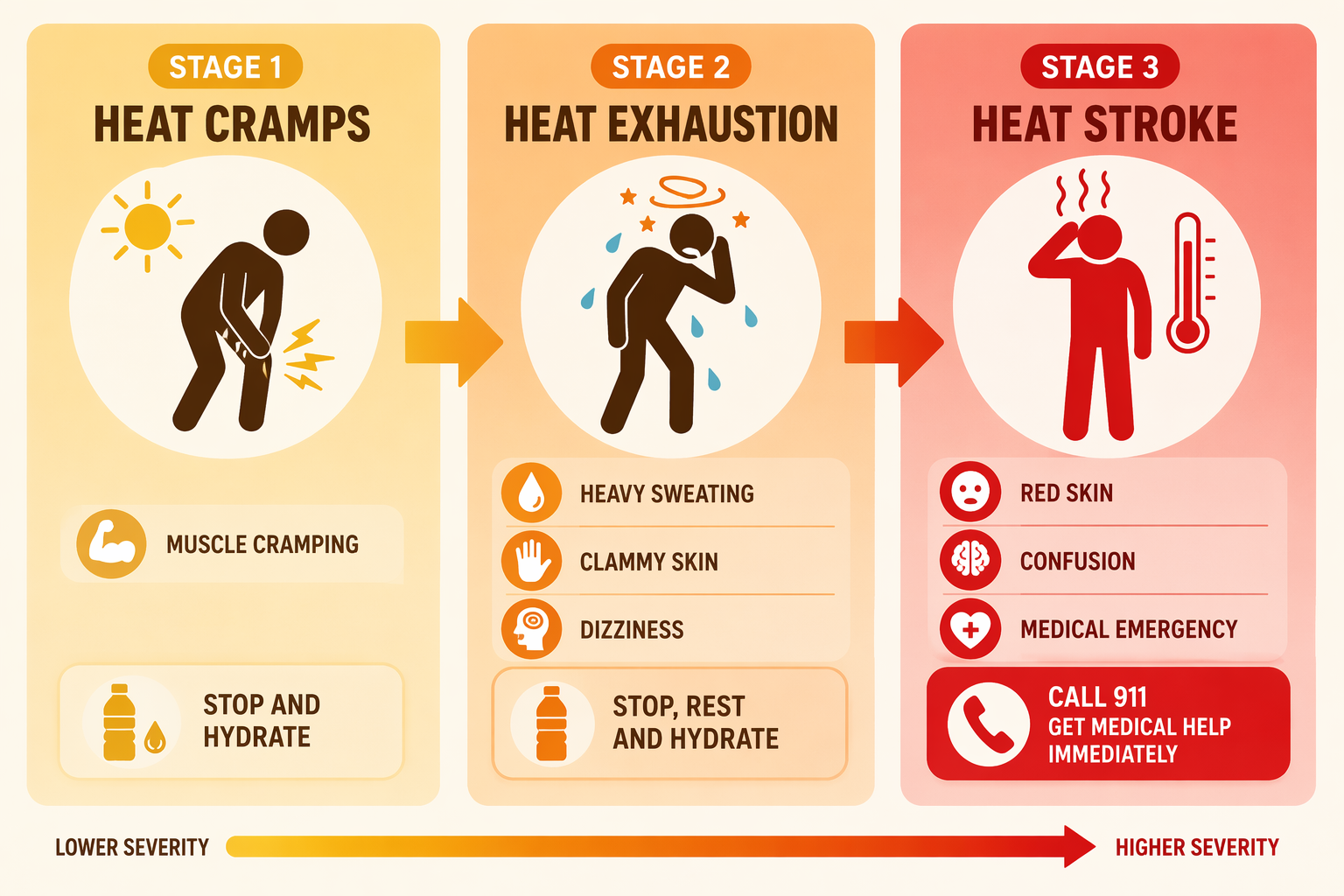
| Stage | What it can look like | What to do first |
|---|---|---|
| Heat cramps | Involuntary muscle spasms during or after exercise in heat | Stop, move to shade, sip water or an electrolyte drink, and gently stretch the cramped muscle.[1] |
| Heat exhaustion | Heavy sweating, cool or clammy skin, weak pulse, dizziness, nausea, headache, or feeling faint | Stop all activity, cool the body, sip cool water if alert, and seek medical attention if symptoms last longer than 1 hour.[1][2][3] |
| Heat stroke | Core temperature above 104°F, confusion or altered mental state, loss of consciousness, hot red dry skin or continued heavy sweating | Call 911 immediately and begin aggressive cooling while waiting for help.[1][4] |
Why heat can overtake a workout
During exercise in heat, your blood has two urgent jobs. It has to deliver oxygen to working muscles, and it has to move heat toward the skin so that sweating and air movement can cool you. When the body cannot satisfy both demands at the same time, core temperature rises.[2]
That is why “I’m sweating, so I must be fine” is not a reliable rule. Sweating is part of cooling, but it does not prove cooling is keeping up. It is also why neat outdoor-temperature cutoffs do not work for the first two stages. The usable boundary is symptom progression, not a perfect number on a weather app.
The question during the workout is not whether you are tough enough to finish the loop. It is whether your symptoms still fit ordinary exertion, or whether they have moved into cramps, exhaustion, or stroke.
Heat cramps: stop before the problem widens
Heat cramps are painful, involuntary muscle spasms that happen during or after exercise in heat. They can show up in a calf, thigh, abdomen, or another working muscle. They are often treated casually because the person is still alert and may otherwise feel able to continue.[1]
This is the first place to be boring and decisive: stop the workout. Move to shade or a cooler place. Sip water or an electrolyte drink. Gently stretch the cramped muscle once you are out of the heat and not pushing the session forward.[1]
Do not use salt tablets as a quick fix. CDC NIOSH warns against them because they can worsen nausea.[1] The point is not to prove that the cramp was “only” a cramp. The point is to keep it from becoming the warm-up act for something more serious.
Heat exhaustion is where people bargain
Heat exhaustion is the stage most likely to be mistaken for a hard workout, especially by someone who is used to finishing what they started. The symptoms can still sound like exercise: heavy sweating, dizziness, nausea, headache, weakness, faintness, a weak pulse, and skin that feels cool or clammy rather than hot and dry.[1]
That cool, clammy skin matters because it can mislead you. A person with heat exhaustion may not look dramatically overheated. They may look pale, soaked, annoyed, embarrassed, or simply done. Core temperature may be elevated but still below 104°F, which is one reason the decision has to be made from the whole symptom picture, not from one visible sign.[2]

Once heat exhaustion is on the table, the workout is over. Not paused. Not downgraded to a walk home in full sun. Over.
- Stop all activity immediately.
- Move to shade, air conditioning, or the coolest reachable place.
- Remove extra clothing, packs, hats, or layers that trap heat.
- Apply cold wet towels to the neck, groin, and armpits, and fan air over the person.
- Sip cool water if the person is alert and able to swallow normally.
Those cooling locations are not random. The neck, groin, and armpits sit near major blood vessels, so cooling there helps pull heat away more efficiently. Mayo Clinic gives the same basic response for heat-related symptoms during hot-weather exercise: stop, get out of the heat, cool the body, and drink fluids if appropriate.[3]
Mass General Brigham notes that heat exhaustion recovery typically occurs within 20 to 60 minutes with cooling and rehydration.[2] That time window is useful because it keeps “I’ll just sit here a while” from becoming open-ended. If symptoms persist beyond 1 hour, seek medical attention.[3]
After a heat-exhaustion episode, the next workout is not the next decision. Recovery is. Rest, keep cooling, and treat lingering dizziness, nausea, headache, or faintness as unfinished business. If you track post-exercise recovery, heart-rate trends can be one supporting signal that your body has returned closer to baseline before you train again; FitAtHome’s guide to using a heart-rate fitness tracker for recovery explains how to read that signal without treating it as a diagnosis.
Heat stroke: do not try to self-manage it
Heat stroke is a medical emergency. The red flags are different in kind, not just degree: confusion, altered mental state, loss of consciousness, a core body temperature above 104°F, hot red dry skin, or continued profuse sweating.[1][4]
The mental-status change is the line that should cut through every argument. If someone is confused, acting strangely, unable to answer normally, collapsing, or losing consciousness during a hot workout, call 911 immediately. Do not wait to see whether they can rally. Do not have them walk it off. Do not make finishing the route part of the plan.
While emergency help is on the way, begin aggressive cooling. CDC NIOSH and the American Heart Association identify cold-water immersion as the most effective field treatment when it is available.[1][4] In a real outdoor workout, that might not be neatly available, so use the strongest cooling option you can reach without delaying the emergency call.
- Move the person out of direct sun if you can do so safely.
- Immerse them in cold water if that is immediately possible.
- If immersion is not possible, apply ice packs or cold wet towels to the neck, groin, and armpits.
- Cover as much skin as possible with wetted cloth and keep air moving over the body.
- Do not give fluids to someone who is confused, has an altered mental state, or is unconscious.
That last point can feel counterintuitive because summer exercise advice often circles back to drinking. In heat stroke, swallowing safety and consciousness matter more than the urge to “get fluids in.” A confused or unconscious person can choke, aspirate, or be delayed from the care they need. Emergency services and clinicians own the treatment decision from here.
The quick check during a hot workout
If you are alone, you need a simple decision path because judgment gets worse as heat stress rises. Use symptoms to choose the action, not optimism.
- A muscle is cramping, but you are alert and otherwise stable: stop, shade, sip fluids or an electrolyte drink, stretch gently, and do not resume the session.
- You are dizzy, nauseated, faint, weak, headachy, clammy, or sweating heavily: stop all activity, cool the body, and treat it as heat exhaustion.
- Symptoms are not improving with cooling, or they last longer than 1 hour: seek medical attention.
- There is confusion, altered behavior, collapse, loss of consciousness, or other heat-stroke signs: call 911 immediately and cool aggressively.
If the safest choice is to skip the outdoor plan entirely, that is not a failure of discipline. It is the same kind of environmental call people make when smoke or air quality cancels a run. If you need a practical swap, these indoor workout alternatives can keep the training habit intact without forcing the heat to be part of the workout.
Lower margin: medications and health conditions
Some people have less room for error in outdoor heat. Mass General Brigham lists beta blockers, diuretics, antihistamines, and certain antidepressants as medications that can impair heat tolerance by affecting sweating, cardiovascular response, or fluid balance. Obesity, diabetes, and cardiovascular disease can also lower the threshold for heat-related problems.[2]
That does not mean everyone in those groups must avoid outdoor exercise. It does mean the plan should be discussed with a clinician, especially before hard sessions, long routes, or workouts where shade, cooling, and help are not close by. General education cannot replace individualized medical advice.
Outdoor workouts stay safer when symptoms are treated as stage signals, not inconveniences. End the session early for cramps. Cool seriously for heat exhaustion. Call emergency services when mental status changes or heat-stroke signs appear.
References
- Heat-related Illnesses, CDC NIOSH
- Prevent Overheating During Workouts, Mass General Brigham
- Mayo Clinic Q and A: Hot weather exercise, Mayo Clinic News Network
- How to Stay Active in Warm Weather, American Heart Association
Have a question this doesn’t answer?
This page stays within general education and does not diagnose or prescribe. If your question is about a specific injury or symptom, please see a clinician rather than continuing to search this site for an answer.