What Is the Safe Daily Coffee Limit for Heart Health and Fitness?
Learn the safe daily coffee limit for heart health and how it affects post-workout recovery. Moderate caffeine under 400 mg is generally safe, but timing and preparation method matter for optimal recovery.
You probably do not have to quit coffee for heart health or fitness recovery. For most healthy adults, the practical upper limit is still about 400 mg of caffeine per day, which is roughly 3 to 4 cups of brewed filtered coffee depending on cup size and strength.[1][2] That amount is a ceiling, not a target, and it does not mean coffee cancels out the benefits of strength training, cardio, or regular movement.
The part that gets missed is timing. A day that stays under 400 mg can still feel wrong if a large dose lands right before squats, intervals, or a hard dumbbell session. The question is less “Is coffee healthy?” and more “When does caffeine make my heart rate, blood pressure, HRV, or recovery score harder to read?”
The 400 mg Limit Is Useful, But It Is Only the First Filter
The FDA’s consumer guidance says 400 mg of caffeine per day is an amount “not generally associated with dangerous, negative effects” for healthy adults.[1] A large safety review reached the same general threshold for adults, while still noting that caffeine sensitivity, pregnancy, health conditions, and other factors can change the equation.[2]
That makes 400 mg a decent starting point for a home-training routine. It gives a daily guardrail without turning one mug of coffee into a medical event. But the number does not know whether you drank it at 6 a.m. with breakfast, at 4 p.m. before a garage workout, or across the whole day while trying to finish work after training.
| Coffee habit | What it usually means for a healthy adult |
|---|---|
| Filtered coffee, morning or early day, under 400 mg caffeine | Generally fits within the usual heart-health safety guidance |
| A 300 mg dose shortly before resistance training | May delay early post-workout autonomic recovery even if the total day stays under 400 mg |
| More than 400 mg per day | Moves beyond the common healthy-adult ceiling and deserves a dose check |
| Coffee late in the day or spread across morning, afternoon, and evening | More likely to interfere with sleep timing, next-day recovery, or perceived recovery |
| Unfiltered or boiled coffee as the daily default | May raise a separate cholesterol-related concern because of diterpenes |
Population data also do not suggest that moderate coffee intake is automatically bad for longevity or cardiovascular outcomes. A 2019 meta-analysis including 3,852,651 participants found a J-shaped association: the lowest all-cause mortality was seen around 3.5 cups per day, and the lowest cardiovascular disease mortality around 2.5 cups per day.[3] That is not permission to chase more caffeine for “health,” but it does argue against treating moderate filtered coffee as the enemy.
The Recovery Problem Shows Up When Caffeine Sits Too Close to Training
The cleanest fitness-recovery signal comes from a controlled trial published in 2021. In that study, 30 participants took either 300 mg of caffeine or placebo 45 minutes before resistance exercise performed at 75% of one-repetition maximum. Compared with placebo, caffeine delayed recovery of heart-rate variability markers, including RMSSD, SDNN, and high-frequency power, for 30 minutes after exercise.[4]
That matters because HRV is one of the main signals used by recovery trackers. RMSSD and high-frequency HRV are commonly interpreted as markers related to parasympathetic, or “downshifting,” activity. If caffeine keeps those markers suppressed after training, your watch or band may show a rougher recovery window even when the workout itself was reasonable.
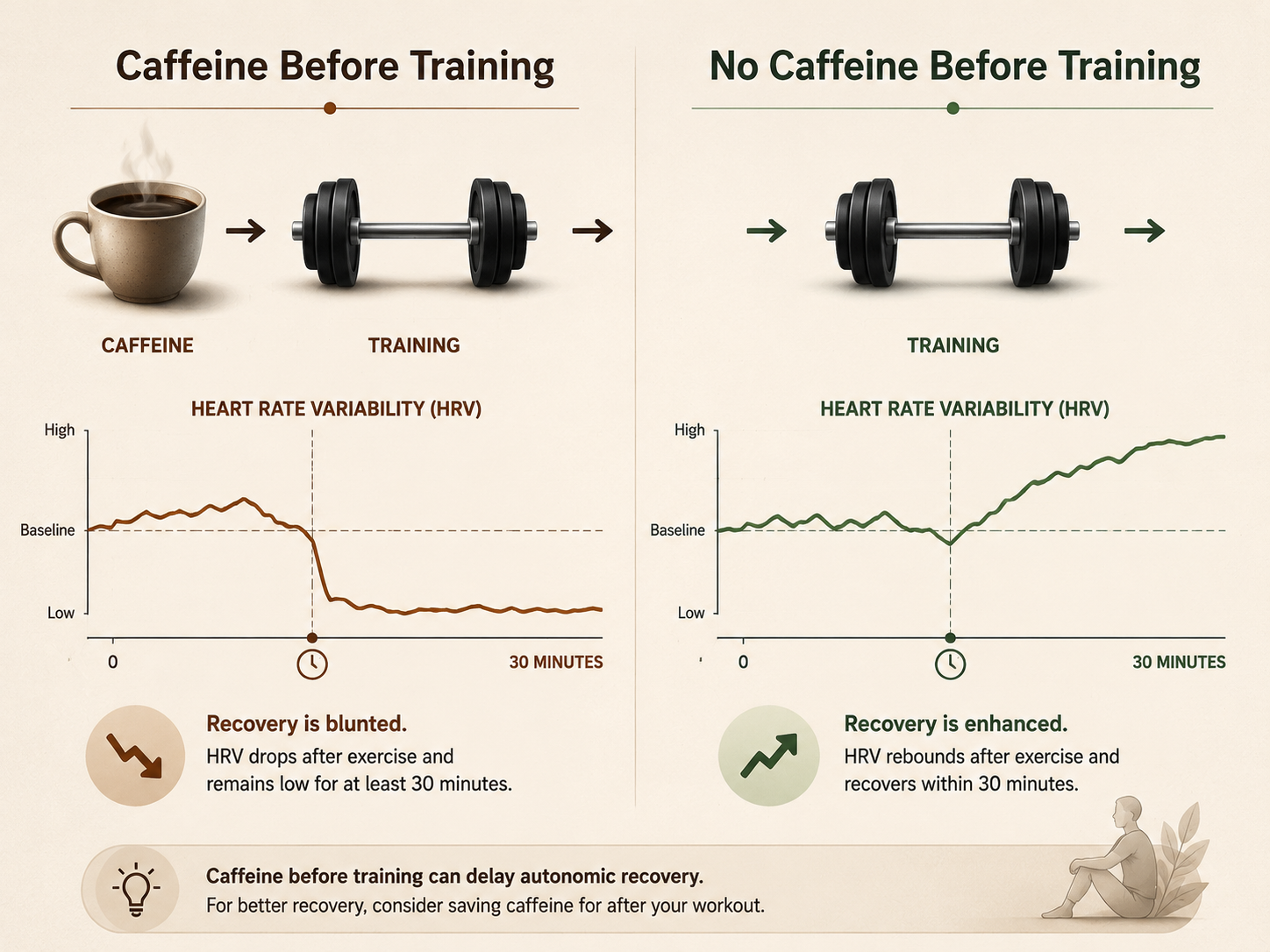
The dose in that trial was not tiny. Three hundred milligrams is close to several cups of brewed coffee or a strong pre-workout caffeine serving. It was also taken deliberately before exercise, not casually at breakfast hours earlier. So the narrow conclusion is the useful one: a substantial pre-workout caffeine dose can delay early autonomic recovery after resistance training. The study does not prove that every moderate coffee drinker will recover poorly, and it does not show that coffee ruins strength gains.
For someone training at home, the practical issue is often the 30 to 60 minutes after the session. You finish a dumbbell workout, shower, open a laptop, and your heart still feels more switched on than expected. Or your recovery tracker logs lower HRV and a higher resting heart rate later than you hoped. If the workout was hard and the coffee was close, caffeine is one of the first variables worth checking before assuming your program is broken.
Heart Health and Recovery Scores Are Related, Not Identical
A safe daily coffee limit for heart health is about risk over time. A recovery score is a short-term reading of how your body is responding now. Those two can point in the same direction, but they are not the same measurement.
A higher heart rate after exercise is normal. So is a temporary HRV drop after a demanding session. Caffeine can add more sympathetic drive to that picture, which may make the post-workout period look more stressed. That does not automatically mean damage is happening; it means the signal is noisier and the body may be taking longer to settle.
If you use Whoop, Oura, Garmin, or another tracker, the most useful comparison is not one bad reading. It is a pattern: similar workouts, similar sleep, similar hydration, but worse HRV or higher resting heart rate on days when caffeine is closer to training. FitAtHome’s guide to using a recovery tracker to spot overtraining is a better place to sort those longer patterns from one-off noise.
There is also a medical boundary here. Chest pain, fainting, irregular heartbeat, unusual shortness of breath, diagnosed hypertension, arrhythmia, known cardiac disease, or medication interactions are not tracker-optimization problems. Those belong with a clinician, not a caffeine experiment.
Filtered Coffee Is the Easier Daily Default
Caffeine timing affects recovery signals. Coffee preparation affects a different heart-health issue: cholesterol. A 2023 Ochsner Journal review highlights the difference between paper-filtered and boiled coffee. Paper-filtered coffee contains about 0.02 mg of cafestol and kahweol per cup, while boiled coffee contains about 7.2 mg per cup.[5] Those diterpenes are the reason unfiltered coffee can matter for LDL cholesterol.
This is one of the simplest adjustments because it does not require quitting coffee or buying anything elaborate. Drip coffee with a paper filter, many pour-over setups, and other paper-filtered methods remove much more of those compounds than boiled styles. French press, Turkish coffee, and some other unfiltered methods may be worth limiting if LDL cholesterol is already a concern.
This distinction often gets buried under caffeine talk, but it is a separate lever. A person can stay under 400 mg and still choose a preparation method that is less ideal for their lipid profile. Another person can drink filtered coffee and still take too much caffeine too close to training. The fixes are different.
Why One Person Feels Fine and Another Feels Wired
The 400 mg limit is a population guideline, not a personal diagnosis. Genetics, tolerance, body size, sleep debt, anxiety, medications, and training stress all change how caffeine feels. Two people can drink the same mug and have very different afternoons.
One reason is CYP1A2, an enzyme involved in caffeine metabolism. In a 2006 JAMA study, slow caffeine metabolizers who drank more than 4 cups of coffee per day had increased risk of nonfatal myocardial infarction, while fast metabolizers did not show the same pattern.[6] About half of people may be slow metabolizers, but that does not make a home genetic label a simple green light or red light.
The useful version is more modest: if caffeine lasts too long for you, respect that. If a noon coffee affects sleep, if pre-workout caffeine makes your heart feel jumpy after lifting, or if your morning HRV repeatedly drops after late-day caffeine, your personal limit may sit below the general ceiling.
Timing May Matter Beyond the Workout Window
A 2025 European Heart Journal study of about 40,000 adults reported that morning coffee drinkers had 16% lower all-cause mortality and 31% lower cardiovascular disease mortality compared with non-drinkers, while all-day coffee drinkers did not show a significant reduction.[7] Because access in the research brief comes through coverage and press materials rather than a full-text analysis here, this should not be stretched into a precise rule about the perfect hour to drink coffee.
Still, it lines up with the most conservative recovery advice: put most caffeine earlier in the day unless you have a specific reason not to. Morning coffee is less likely to collide with evening training, sleep onset, or overnight recovery metrics. All-day sipping makes it harder to know whether a bad recovery score came from the workout, the caffeine, the late bedtime, or all three.
What to Change First
The first move is not usually elimination. It is a cleaner experiment. Keep the workout similar, keep sleep and hydration as steady as real life allows, and change the caffeine variable that is most likely to matter.
- Count total caffeine for a few normal days, including coffee, espresso drinks, energy drinks, pre-workout powders, tea, and caffeine pills.
- If the total is above 400 mg, reduce the daily dose before fine-tuning anything else.
- If the total is under 400 mg but recovery feels poor, move caffeine farther away from training, especially hard resistance sessions.
- If sleep is affected, move the last caffeinated drink earlier rather than blaming the workout first.
- If LDL cholesterol is a concern, favor paper-filtered coffee over boiled or unfiltered methods.
For a morning exerciser, this might mean drinking a smaller coffee before training or saving the larger mug until after the session. For an evening exerciser, it may mean separating coffee from the workout completely and using food, hydration, a warm-up, or music instead of caffeine as the training cue. The right answer is the one that improves the next few hours without making the routine miserable.
Post-workout recovery is also bigger than coffee. Protein, carbohydrate, hydration, cooldowns, and sleep all change the signal. If you are sorting the whole recovery stack, FitAtHome’s comparisons of post-workout recovery drinks and active recovery for home gym training can help separate caffeine from the rest of the routine.
The High-Intake Warning Is Real, But the Evidence Is Narrow
A small ACC Asia 2024 conference presentation reported that, among 92 participants, 19.6% consumed more than 400 mg of caffeine per day. Participants consuming more than 600 mg per day showed heart rate above 100 beats per minute and blood pressure above 140/90 mmHg persisting 5 minutes after a 3-minute step test.[8]
That is an interesting warning signal, especially for very high intake. It is not proof that ordinary filtered coffee under the usual limit is dangerous. The sample was small, the finding came from a conference presentation, and the exercise test was not the same as a full home strength session. The sensible takeaway is simply that pushing well past 400 mg, and especially toward very high daily intake, makes the heart-rate and blood-pressure conversation less casual.
A Practical Limit for Coffee, Heart Health, and Fitness
For most healthy adults, filtered coffee under 400 mg of caffeine per day fits within the usual heart-health guidance and is compatible with a regular fitness routine. The more specific recovery caveat is that a large caffeine dose right before training can keep autonomic recovery markers suppressed for at least the first 30 minutes after resistance exercise.
So if coffee is working for your life, keep the ritual and adjust the timing first. Use the daily limit as the outer fence, filtered coffee as the easier default, and your post-workout heart rate, HRV, sleep, and symptoms as the feedback that decides whether your personal limit needs to be lower.
References
- Spilling the Beans: How Much Caffeine is Too Much? — U.S. Food and Drug Administration. https://www.fda.gov/food/information-consumers-using-dietary-supplements/spilling-beans-how-much-caffeine-too-much
- Systematic review of the potential adverse effects of caffeine consumption in healthy adults, pregnant women, adolescents, and children — Food and Chemical Toxicology, 2017. https://pmc.ncbi.nlm.nih.gov/articles/PMC5445139/
- Coffee consumption and all-cause and cause-specific mortality: a meta-analysis by potential modifiers — European Journal of Epidemiology, 2019. https://pubmed.ncbi.nlm.nih.gov/31055709/
- Caffeine delays autonomic recovery following acute resistance exercise in strength-trained men — Revista Portuguesa de Cardiologia, 2021. https://www.revportcardiol.org/en-caffeine-delays-autonomic-recovery-following-articulo-S2174204921001010
- Coffee and Health: A Review of Recent Human Research — Ochsner Journal, 2023. https://pmc.ncbi.nlm.nih.gov/articles/PMC10262944/
- Coffee, CYP1A2 genotype, and risk of myocardial infarction — JAMA, 2006. https://pubmed.ncbi.nlm.nih.gov/16522833/
- Coffee drinking timing and mortality in US adults — European Heart Journal, 2025. https://academic.oup.com/eurheartj/article/46/9/767/7926891
- High Coffee Consumption Linked to Increased Cardiovascular Disease Risk — American College of Cardiology, 2024. https://www.acc.org/About-ACC/Press-Releases/2024/08/15/08/53/High-Coffee-Consumption-Linked-to-Increased-Cardiovascular-Disease-Risk
Have a question about this guidance?
This is a question and correction channel, not an open discussion thread — recovery topics sit close to a medical-advice boundary, so we review submissions rather than publishing them instantly.