
How to Use the 7-Minute Workout as Active Recovery
The 7-minute workout doesn't have to be a high-intensity grind. This article explains how to dial it down into an effective active recovery session for rest days, using lower intensity and modified movements to boost blood flow without adding fatigue.
The 7 minute workout is famous because it is supposed to feel hard. In the original high-intensity circuit training model, the work bouts are short, the rests are brief, and the effort is meant to climb near an 8 out of 10 on a discomfort scale, with the ACSM authors noting that two to three circuits are recommended when the goal is a more meaningful fitness stimulus rather than a single quick exposure.[1]
That is not the version you want on a recovery day. A recovery version uses the same useful container, but it changes the job: 4 to 5 out of 10 effort, conversational breathing, no racing the clock, and movement choices that leave you looser when the timer ends. If the session turns into another hidden training day, it has failed its purpose.
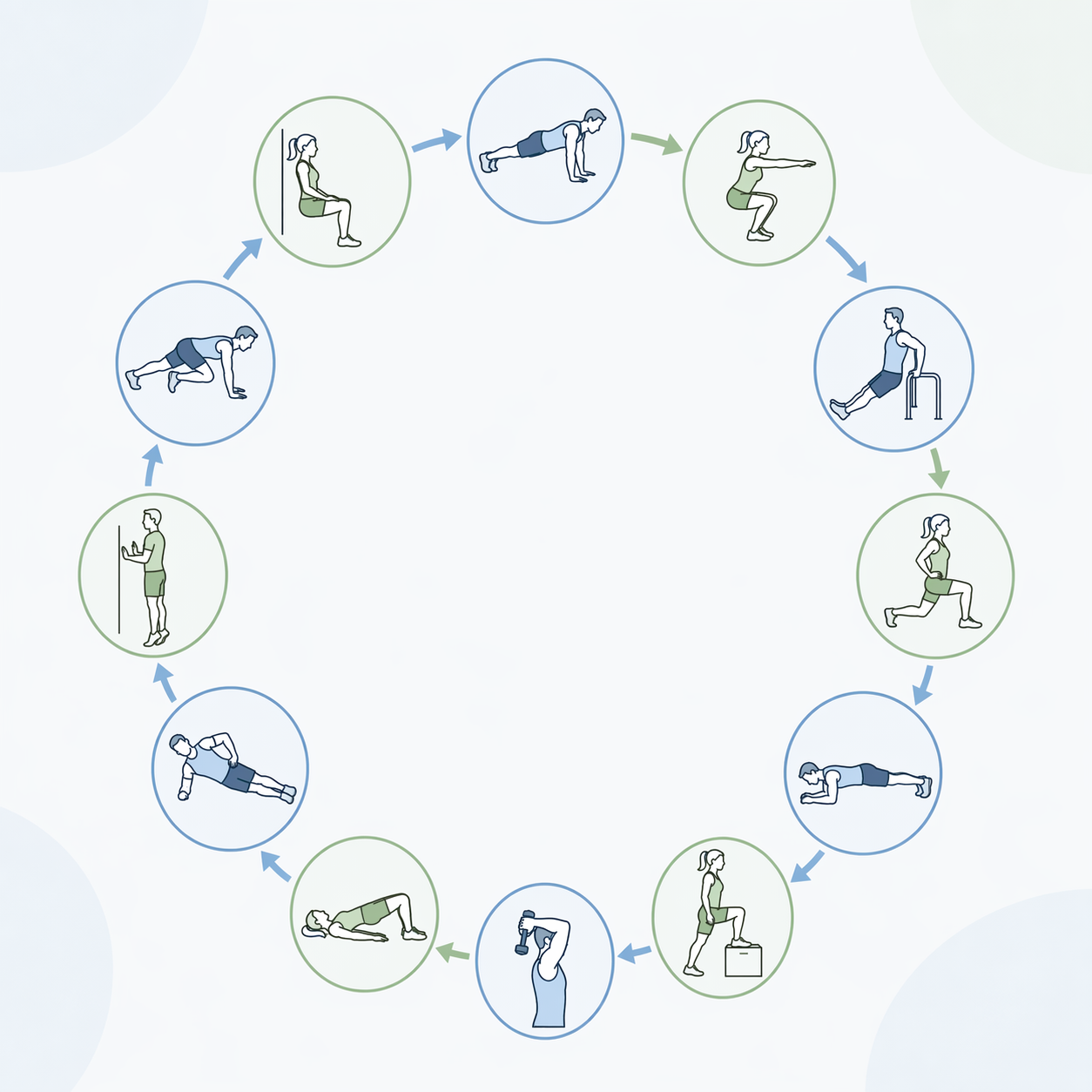
The reason this can work is not that seven minutes has magical recovery power. It works because the original circuit already has a smart internal structure. Klika and Jordan designed the sequence to alternate upper and lower body movements and opposing muscle groups, so cardiac output could stay elevated while individual muscle groups got small local breaks between efforts.[1] Lower the effort and remove the impact, and that same architecture becomes useful for keeping blood moving without repeatedly loading the same sore area.
What Changes When It Becomes Recovery
A recovery 7 minute workout should look recognizable, but it should not feel like the classic test. You are borrowing the timer and the alternating sequence, not the original intensity target. The standard format asks you to push. The recovery format asks you to move, loosen, and stop before the effort starts demanding recovery of its own.
| Classic 7 minute workout | Active recovery version |
|---|---|
| About 8/10 perceived effort | About 4-5/10 perceived effort |
| Breathing hard, short rests feel necessary | Conversational breathing throughout |
| Jumping and faster transitions may appear | Low-impact choices, controlled transitions |
| Designed as high-intensity circuit training | Used to increase movement and blood flow without adding much fatigue |
| Often repeated for 2-3 circuits for broader fitness stimulus | Usually one gentle circuit on a rest or low-readiness day |
NASM describes active recovery as low-intensity work around 30% to 60% of maximum heart rate and connects it with increased blood flow, metabolic waste removal, and reduced delayed-onset muscle soreness, citing research by Corder et al. and Monedero and Donne within that discussion.[2] Cleveland Clinic gives the same practical frame: active recovery is light movement used after hard exercise or on rest days, with the aim of supporting circulation and easing soreness rather than creating another workout stress.[3]
For someone who trains four or five days a week, that distinction matters. You may not need another interval session. You may need a short, bounded sequence that keeps you from drifting into twenty extra minutes of “just a little more” work.
Keep the Architecture, Soften the Demands
The cleanest way to adapt the 7 minute workout is to preserve its alternating rhythm while changing the movements inside each slot. A lower-body slot still asks the legs to move. An upper-body slot still brings the shoulders, chest, arms, or trunk into the pattern. What changes is impact, range, tempo, and tension.
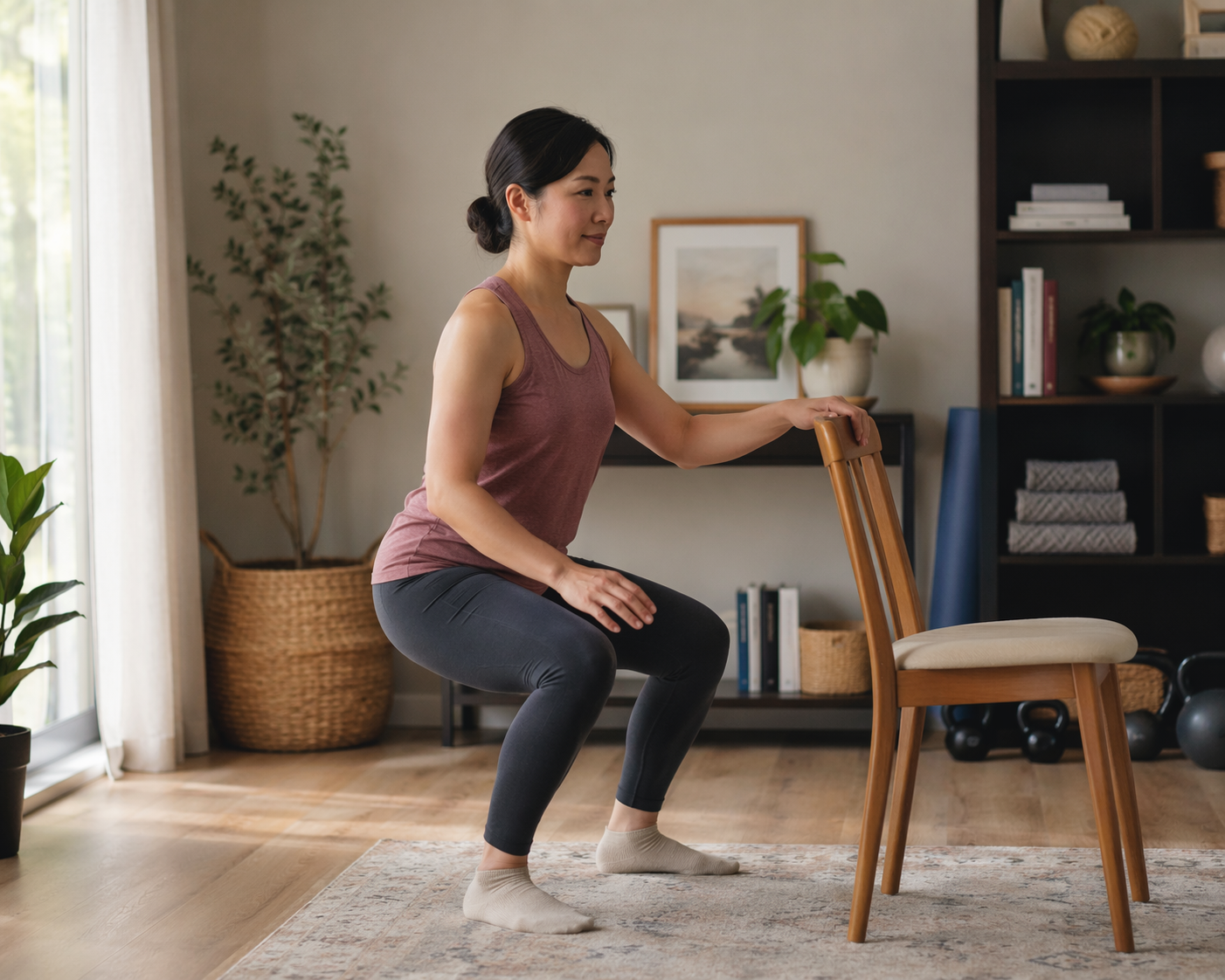
Chris Jordan’s 2025 Gentle Workout is useful here because it shows this adaptation from the person associated with the original protocol. The Washington Post version keeps the 12-exercise architecture while removing jumping, using lower-impact choices, and adding chair-based modifications.[4] That is the useful kind of modification: not random stretching pasted onto a famous name, but the same circuit logic adjusted for a different training purpose.
A recovery circuit might use 30 seconds of movement and 10 seconds to transition, as in the familiar format, but the movement quality should change immediately. Jumping jacks become step jacks or side steps. A wall sit becomes an easy wall-supported squat hold or a slow sit-to-stand pattern. Push-ups move to a wall, counter, or elevated surface. Step-ups become low step taps or controlled marching. Squats become chair-supported squats with a smaller range. Triceps dips can become a light chair-supported press pattern or be replaced with an easier upper-body movement if the shoulders dislike dips.
The plank family needs the same treatment. A hard plank, fast mountain climber, or long side plank can turn a recovery circuit into trunk conditioning very quickly. Use an elevated plank, a slow standing mountain climber with hands on a wall or chair, or a short side plank from the knees. If your breathing changes from calm to braced and clipped, you are no longer doing recovery work.
| Original-style slot | Recovery-day substitution | What to watch |
|---|---|---|
| Jumping jack | Step jack or side step | No bouncing; arms can stay below shoulder height |
| Wall sit | Easy wall squat hold or slow chair squat | Thighs should not burn hard |
| Push-up | Wall or counter push-up | Stop well before strain |
| Abdominal crunch | Dead bug arms-only, heel taps, or easy curl-up | No breath-holding |
| Step-up | Low step tap or slow march | Use support if balance changes effort |
| Squat | Chair-supported squat | Keep range comfortable |
| Triceps dip | Very shallow supported dip or easy wall press | Skip if shoulders feel pinchy |
| Plank | Elevated plank | Keep it easy enough to talk |
| High knees | March in place | No sprint rhythm |
| Lunge | Supported reverse step or split-stance weight shift | Short range is fine |
| Push-up with rotation | Wall push-up with gentle reach | No twisting under fatigue |
| Side plank | Knee side plank or standing side bend reach | Choose the version that feels restorative |
The substitutions do not need to be impressive. On a recovery day, a smaller range of motion is often the correct range. The standard is whether the area feels warmer and easier to move afterward, not whether the exercise looked like a difficult variation from a training-day video.
The Intensity Cap Is the Whole Point
The timer is helpful, but it can also trick consistent exercisers. Thirty seconds starts to feel like a challenge, then the challenge becomes a score, then the score becomes the workout. For active recovery, cap the session before that happens.
- Use a 4-5/10 effort ceiling. You should feel like you are doing something, but you should not feel tested.
- Keep breathing conversational. If you cannot speak a full sentence, reduce range, speed, or complexity.
- Stay roughly in the 30-60% max heart rate zone if you use a heart-rate monitor, matching NASM’s active recovery range.[2]
- Take extra transition time when needed. The 10-second rest is not a moral test.
- Finish feeling like you could comfortably do more, then do not do more.
That last point is where many rest-day workouts go wrong. The useful feeling arrives at minute five or six, and the next thought is to add another circuit. Sometimes that is fine on a normal low-intensity day. But if the purpose is recovery between harder sessions, one gentle circuit is often the advantage. It gives you a defined dose of movement without letting the session expand until it competes with tomorrow’s training.
When Seven Minutes Is Enough, and When It Is Not
A single gentle circuit is enough when the goal is to break stiffness, create a little circulation, and leave the body better prepared for normal movement. It is not enough to replace a broader aerobic base, a strength program, or a longer recovery walk when what you really want is more total low-intensity movement. Even in the original ACSM article, the authors point toward two to three circuits when the goal is a more substantial fitness effect.[1]
That trade-off is not a flaw. A 30- to 60-minute easy walk or bike ride may provide more total low-intensity circulation. A seven-minute circuit gives you less total volume, but it is easier to contain. On a busy rest day, or on a morning when your legs are heavy but your back feels better after moving, the smaller dose may be exactly why it works.
If you are deciding how often this belongs in your week, place it around your hard sessions rather than treating it as a daily obligation. For broader scheduling, a frequency guide such as How Often Should You Do the 7-Minute Workout? is the better place to sort training days, recovery days, and full rest.
The Beginner Question Is Not a Technicality
There is a real disagreement in public guidance around the 7 minute workout. Cleveland Clinic says the workout can be modified for beginners or less fit people, while WebMD’s July 2025 update says the 7-minute workout is not suitable for beginners.[5][6] Both positions make sense once you separate the standard high-intensity version from a deliberately scaled version.
The unmodified circuit can be too aggressive for someone new, fatigued, sore, or returning after time off. Fast transitions, floor work, jumping, and bodyweight strength moves add up quickly. A modified circuit with chair support, low-impact steps, elevated pushing, and a strict intensity cap is a different exposure. It still needs judgment, but it is not the same demand as asking a beginner to perform the classic version at high effort.
For readers who want to learn the standard-intensity version for actual training days, The 7-Minute Workout for Beginners: A Complete Guide to Doing It Right is a cleaner starting point than trying to make a rest-day circuit carry every training goal.
A Simple Recovery-Day Version
Use the familiar 12-move flow if you like having a script. Set a timer for 30 seconds of movement and 10 seconds of transition. Before you start, decide that you are allowed to make any move easier mid-round. That decision should not wait until you are already pushing too hard.
- Step jacks or side steps
- Easy wall squat hold or supported chair squat
- Wall or counter push-up
- Heel taps, dead bug arms-only, or easy curl-up
- Low step taps or slow march
- Chair-supported squat
- Shallow supported dip or easy wall press
- Elevated plank
- March in place
- Supported reverse step or split-stance weight shift
- Wall push-up with gentle reach
- Knee side plank or standing side bend reach
Move at a pace that lets you breathe through your nose or speak comfortably. Use a chair when it keeps the effort where you want it; support is a way to lower balance cost so the session can stay easy. If a move feels awkward or sharp, replace it immediately with walking in place, a supported squat, or a gentle reach.
When to Skip It
Active recovery is still activity. If soreness changes your movement, if joint pain is present, if you feel ill, or if your readiness signals are clearly poor, full rest may be the better choice. Wearables can help some people notice those patterns, but the useful decision is still practical: will this movement make the next few hours feel better, or are you trying to earn permission to rest?
Use one gentle 7 minute workout when you want blood flow without fatigue. Choose a longer low-intensity walk, ride, or mobility session when you want more total movement. Take the full rest day when the body is telling you that movement is not the right tool today.
References
- High-Intensity Circuit Training Using Body Weight: Maximum Results With Minimal Investment, ACSM's Health & Fitness Journal, 2013
- Active Recovery: Benefits & Best Practices, NASM
- Active Recovery: Workouts and Exercises To Try, Cleveland Clinic
- The 7-Minute Gentle Workout, Washington Post, 2025
- Should You Try the 7-Minute Workout?, Cleveland Clinic, 2023
- The 7-Minute Workout, WebMD, July 2025
This is general fitness education, not medical advice. For diagnosis or treatment of pain or injury, consult a qualified clinician.
Pick your next session
Browse all routines to find an appropriately-spaced next session.
Spot something off?
This content sits adjacent to health guidance — tell us if a citation or figure needs a correction.