
Aaron Judge Rib Fracture Recovery Exercises You Can Do at Home
Recovering from a broken rib? Follow this staged at-home exercise program — inspired by Aaron Judge's 2026 rib fracture rehab — to safely progress from breathing exercises to full activity.
- Citation source
- NHS
- Evidence level
- general guideline
If you came here looking for Aaron Judge rib fracture recovery exercises at home, the most useful lesson from his 2026 injury is restraint. Public reporting said Judge was diagnosed in early June with a first-rib stress fracture and initially ordered to avoid baseball activity for 10 days; by July 25, reporting still described him as limited to lower-body work, not cleared for baseball activity or upper-body work. [1][2]
That does not tell us his private Yankees-supervised rehab plan. It does tell us something safer and more transferable: even an elite athlete with medical staff, equipment, and every incentive to return quickly was publicly still in a holding pattern rather than inventing clever upper-body substitutions. [2][3]
This article is general fitness education, not diagnosis or personalized medical treatment. A rib fracture can affect breathing mechanics and can become more complicated if symptoms worsen. If you have trouble breathing, increasing chest pain, fever, dizziness, coughing up blood, pain that is not improving, or unclear activity clearance, stop guessing and contact a clinician.

The at-home progression, in plain terms
A rib fracture recovery plan is not a normal home workout with lighter weights. It is a staged return to movement. The early goal is to keep the lungs expanding and avoid irritating the injury. Fitness maintenance comes later.
| Phase | Usual time window | What you can usually focus on | What still stays out |
|---|---|---|---|
| Phase 1 | Weeks 1–3 | Breathing exercises, posture, necessary daily movement as tolerated | Upper-body training, twisting, impact, loaded carries, pushing, pulling |
| Phase 2 | Weeks 3–6 | Walking, gentle lower-body movement, continued breathing work | Upper-body loading, trunk rotation, heavy lifting, workouts that spike rib pain |
| Phase 3 | Weeks 6–8+ | Gradual upper-body reintroduction only if pain and clearance allow | Fast progression, contact, max-effort lifting, painful ranges |
Those weeks are not guarantees. The NHS describes uncomplicated broken or bruised ribs as often healing in about 4 to 6 weeks, while Cleveland Clinic gives a broader 6 to 12 week range for rib fracture recovery. [4][5] Age, fracture location, severity, coughing, sleep, other injuries, and your clinician’s instructions can all shift the timeline.
Weeks 1–3: breathing is the exercise
The first phase is frustrating because it feels too small to count. It counts. Broken ribs can make people breathe shallowly because full expansion hurts. Shallow breathing is exactly what recovery guidance tries to prevent: the NHS specifically advises regular deep breathing and coughing when needed to help reduce the risk of chest infection or pneumonia. [4]
WebMD’s rib fracture exercise guidance gives the kind of instruction that belongs in this phase: sit upright, take slow deep breaths, and repeat deep breathing hourly while awake. [6] That does not sound athletic. It is still the work. You are trying to keep air moving into the lungs without turning the rib cage into a pain contest.
Hourly deep breathing
- Sit upright in a chair or supported on pillows.
- Relax your shoulders instead of bracing them up toward your ears.
- Breathe in slowly through your nose, letting the ribs expand only as far as tolerable.
- Pause briefly if comfortable.
- Exhale slowly through your mouth.
- Stop if pain sharply increases, breathing feels difficult, or symptoms change.
The word “tolerable” matters. A little awareness around the injured area is different from forcing a breath through sharp pain. If you cannot take a deeper breath without alarming pain, or if breathing itself feels restricted, that is not a cue to toughen up at home.
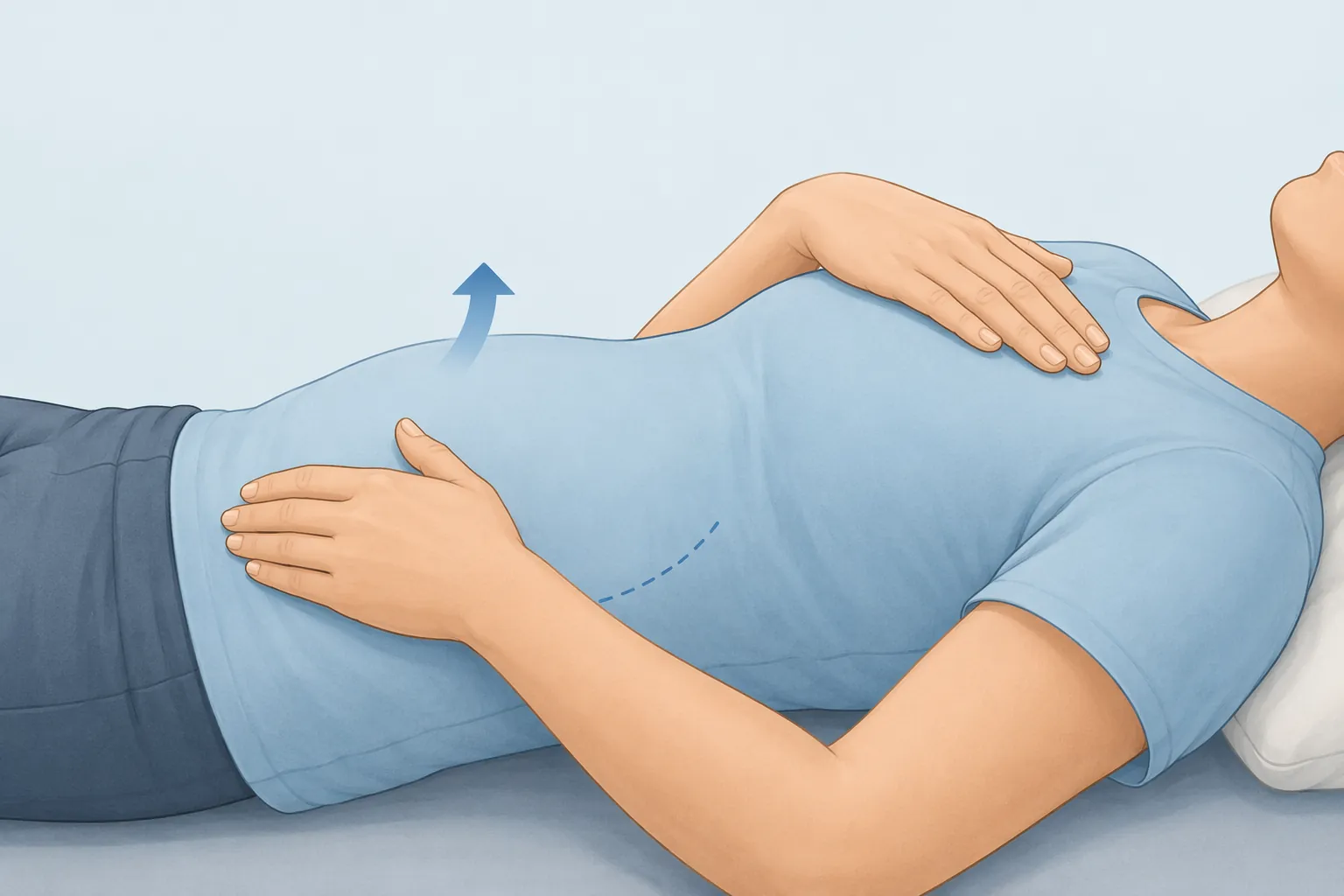
Diaphragmatic breathing
WebMD also lists diaphragmatic breathing for rib fracture recovery, with 5 to 10 repetitions performed 3 to 4 times per day. [6] This version is useful because it gives you a repeatable task without asking the injured rib area to lift weight, rotate, or absorb impact.
- Lie on your back with knees bent, or sit reclined if lying down is uncomfortable.
- Place one hand on your upper chest and the other on your belly just below the rib cage.
- Inhale slowly through your nose and let the belly hand rise more than the chest hand.
- Exhale gently and let the belly fall.
- Keep the effort quiet. Do not strain, arch, twist, or hold your breath.
In this first phase, “doing more” usually means doing the breathing work consistently, not adding sit-ups, push-ups, yoga flows, planks, bands, dumbbells, rowing, boxing, or rotational core work. The rib cage is involved in more movements than people realize, which is why ordinary exercise categories can be misleading here.
Weeks 3–6: add walking and gentle lower-body movement, not upper-body training
Around weeks 3 to 6, many people are eager to turn recovery into conditioning. This is the phase where that eagerness needs rules. Walking can return gradually if it does not increase rib pain. Gentle lower-body movement can help reduce the stale, deconditioned feeling of recovery. The breathing exercises should continue.
The important boundary is what has not changed yet. Healthline’s guidance separates safer activity from movements to avoid and includes avoiding lifting more than 10 pounds during rib fracture recovery. [7] That restriction rules out more than obvious gym lifts. It can include loaded laundry baskets, heavy grocery bags, small children, suitcases, yard tools, and “just one quick” furniture move.
A reasonable walking progression
Start with short, easy walks on flat ground. Keep your arms relaxed instead of pumping aggressively. If the walk increases pain during the session or leaves the rib area more irritated afterward, shorten the next walk or return to breathing-only work until symptoms settle.
- Choose flat, predictable surfaces.
- Walk at a pace that lets you breathe comfortably.
- Avoid hills, intervals, jogging, and carrying weights.
- Stop if pain sharpens, breathing changes, or you start guarding your trunk.
Lower-body movement that does not ask the ribs to help
If walking is tolerated, lower-body movement can stay simple: sit-to-stands from a chair, easy bodyweight mini-squats, gentle heel raises, or slow step-ups to a low step. These are not mandatory exercises. They are options for someone who can move without bracing, twisting, holding the breath, or using the arms for force.
- Keep hands light or supported; do not grip and pull yourself through the movement.
- Use a small range of motion at first.
- Breathe continuously; no breath-holding.
- Stop the set before fatigue makes your trunk tighten.
What stays out during this phase is just as important: push-ups, planks, pull-ups, loaded carries, overhead reaching with load, kettlebell swings, burpees, running, jump rope, medicine-ball work, heavy housework, and any twisting drill. If you need your ribs to stabilize the movement, it is not a workaround.
Weeks 6–8+: reintroduce upper-body movement only after the checkpoint
The phrase “weeks 6 to 8 plus” is deliberately cautious. It does not mean everyone is ready for upper-body work at week 6. It means this is the earliest general window when some people may begin testing light, controlled upper-body movement if pain has settled and medical clearance allows it.
This is where Judge’s public timeline is a useful guardrail again. Reporting on July 25 still described him as not cleared for baseball activity or upper-body work, even though his diagnosis had been reported in early June. [1][2] A professional athlete’s first-rib stress fracture is not the same as every home reader’s fracture, but the caution is worth noticing.
The checkpoint before upper-body work
- You can breathe deeply without sharp rib pain.
- Walking does not increase symptoms during or after.
- Daily tasks are no longer provoking the injury.
- You are not using pain medication to push through activity you otherwise could not tolerate.
- Your clinician has not told you to continue avoiding upper-body work.
If any of those are not true, the next step is not a tougher exercise. It is more time, a smaller movement menu, or medical guidance.
What cautious reintroduction can look like
Begin with unloaded range of motion before resistance. Think shoulder rolls, gentle shoulder blade squeezes, easy arm slides on a wall, or relaxed arm swings during walking. Keep the movement slow enough that you can notice the rib response while it is happening.
- Use no weight at first.
- Avoid end-range stretching that pulls hard across the chest.
- Avoid twisting the trunk to create more range.
- Keep sessions brief enough that symptoms do not build.
- Wait before adding load; do not add range, resistance, and speed at the same time.
Yoga sometimes gets mentioned because it can emphasize breathing and controlled movement. Everyday Health notes a 2021 randomized controlled trial in which yoga improved pulmonary function after chest trauma. [8] That is not a blanket permission slip for general yoga classes during rib fracture recovery. Many common poses load the arms, rotate the trunk, or stretch the rib cage aggressively. If yoga enters the plan, it belongs later, modified, and clinician-cleared.
Pain rules that decide whether you progress or back off
Pain tolerance guides each phase, but that phrase is easy to misuse. It does not mean proving you can endure pain. It means using symptoms as feedback about whether the current dose is appropriate.
| Signal | What it means for home exercise |
|---|---|
| Mild discomfort that settles quickly | You may be within a tolerable range, but keep the dose conservative. |
| Sharp pain during a movement | Stop that movement and return to the last tolerated activity. |
| Pain that increases later the same day or the next day | The session was probably too much; reduce time, range, or intensity. |
| Breathing difficulty, fever, worsening cough, dizziness, or concerning chest symptoms | Stop home progression and seek medical advice. |
| No clear medical clearance after a significant fracture or persistent symptoms | Do not use an online routine to self-clear upper-body work. |
The hardest part for active people is often not the exercise selection. It is accepting that a rib injury punishes impatience. A walk that is too long, a bag that is too heavy, or a stretch that feels harmless in the moment can make the next day’s breathing and sleep worse.
What to avoid until you are clearly cleared
Rib fracture recovery is one of the few times when a short avoid list may be more useful than a long exercise menu. The movements below create the exact problems the early phases are trying to avoid: pressure through the arms, trunk rotation, impact, breath-holding, or sudden rib expansion.
- Push-ups, dips, pull-ups, rows, presses, and planks
- Crunches, sit-ups, Russian twists, mountain climbers, and rotational core work
- Running, jumping, burpees, boxing, throwing, or contact drills
- Heavy lifting at home, including chores that exceed your restriction
- Deep chest-opening stretches or strong yoga poses that load the arms
- Any movement that makes you hold your breath to brace
A useful home program during rib fracture recovery may look unimpressive from the outside: breathing, short walks, careful lower-body movement, then cautious upper-body range only when the injury stops objecting. That order is the program.
References
- Aaron Judge first-rib stress fracture report, MLB.com, June 2026
- Aaron Judge July 25 rib fracture rehab update, New York Post, July 25, 2026
- Aaron Judge injury holding-pattern update, CBS Sports, July 2026
- Broken or bruised ribs, NHS, reviewed January 2024
- Rib Fracture, Cleveland Clinic
- 4 Exercises for Broken Ribs Recovery, WebMD, medically reviewed November 2024
- Exercises for Broken Ribs: Safe and Unsafe Activities, Healthline
- Yoga for Chest Trauma and Pulmonary Function, Everyday Health
This is general fitness education, not medical advice. For diagnosis or treatment of pain or injury, consult a qualified clinician.
Pick your next session
Browse all routines to find an appropriately-spaced next session.
Spot something off?
This content sits adjacent to health guidance — tell us if a citation or figure needs a correction.