
Aaron Judge's 7 Lower-Body Home Exercises for Rib Recovery
When an upper-body injury sidelines you, maintaining fitness without aggravating the injury is the challenge. This article outlines a 7-exercise lower-body home workout based on Aaron Judge's current rehab routine, using minimal equipment and focusing on glute activation, leg strength, and cardio — safe for most rib and shoulder recoveries.
- Citation source
- Cleveland Clinic, Healthline, WebMD
- Evidence level
- General guideline
What Judge’s current limits actually allow
The useful part of Aaron Judge’s recovery story is not that a 6-foot-7 outfielder has access to better rehab than the rest of us. Of course he does. The useful part is the constraint. As of late July 2026, current reporting still has Judge limited to lower-body exercises, neck work, and incline treadmill walking, with no upper-body lifting, no baseball activity, and no overhead work cleared yet.[1][2][3]
That is a clean training boundary. If the rib cage, shoulder area, or upper body cannot be loaded, the session has to move through the hips, legs, calves, controlled walking or biking, and breathing work. It also has to leave out the tempting gray-area exercises: no chest press, no pushups, no overhead pressing, no loaded twisting, and no “just a light dumbbell” experiment that quietly turns into a setback.
The timeline helps explain why this matters. Cleveland Clinic notes that broken ribs commonly take at least six weeks to heal, while broader rib-fracture recovery can stretch longer depending on the injury and the person.[4] Judge’s case has been reported as more complicated because it involves the same location as a prior first-rib fracture, and sports-medicine commentary on first-rib stress fractures in rotational athletes has described recovery windows that can run from one to three months.[2][5] That does not mean your injury matches his. It means a lower-body-only plan is not filler. For several weeks, it may be the whole plan.
The part of Judge’s normal training that still translates
Judge’s current rehab limits sit neatly beside something he has said about his regular training: glute activation comes first. In a 2024 GQ interview, he described the logic this way: “if your glutes, abs, and core are primed, then everything else is in alignment.”[6] That is not a celebrity workout trick. It is a useful way to build a constrained session when the upper body has to stay quiet.
Older training coverage has described Judge using full-body work, Pilates, planks, sled pushes, and an apartment gym setup.[6][7] That does not give the public his exact rehab plan, and it definitely does not mean a home exerciser should try to recreate his private setup. The borrowable idea is narrower: wake up the hips, keep the trunk controlled, train the legs without loading the rib cage, and use low-impact cardio that does not make the upper body brace or swing hard.

Before the workout: the rib rules that matter
Get medical clearance before doing this or any other workout during rib, shoulder, chest, neck, or post-surgical recovery. The point here is not to train through symptoms. It is to choose movements that are less likely to demand upper-body loading once a clinician has told you movement is appropriate.
- Make breathing work non-negotiable. Broken-rib recovery guidance commonly emphasizes deep breathing to help prevent lung complications, including pneumonia; WebMD describes taking deep breaths every two hours and holding for 10 seconds during recovery exercises.[8][4]
- Keep the rib cage quiet. Avoid loaded torso rotation, aggressive crunching, heavy bracing, and anything that makes you protectively hold your breath. Rib Injury Clinic guidance places strong emphasis on breathing control, gradual mobility, and rehab progression rather than forcing painful movement.[9]
- Do not turn lower-body training into upper-body loading. Healthline and Cleveland Clinic recovery guidance caution against heavy lifting during broken-rib recovery, and Healthline specifically references avoiding lifting more than 10 pounds while healing.[10][4]
- Skip chest press, overhead press, pushups, pullups, loaded carries, loaded rotation, kettlebell swings, heavy deadlifts, and any exercise where the rib area hurts during the movement or later that day.
The 7-exercise lower-body home template
Use this as a low-drama template, not a test of toughness. Start with one easy pass through the movements. If the rib area stays calm during the session and later in the day, you can build gradually. Keep your hands relaxed, avoid gripping weights, and stop any exercise that makes you brace through the chest.
| Exercise | Home version | Keep it rib-friendly by |
|---|---|---|
| 1. Glute bridges | Lie on your back with knees bent and feet flat. Lift the hips, pause briefly, lower under control. | Letting the hips do the work. Do not arch hard through the ribs or hold your breath. Glute bridges are commonly included in lower-body-friendly recovery exercise lists.[11] |
| 2. Bodyweight squats | Stand in front of a chair or couch. Sit the hips back, tap the chair if needed, then stand tall. | Keeping arms relaxed or lightly crossed. Do not hold a weight at the chest. Bodyweight squats are a common low-equipment lower-body option in rib-recovery exercise guidance.[11][10] |
| 3. Forward or reverse lunges | Step forward or backward, bend both knees to a comfortable depth, then return to standing. | Using a wall or chair for balance if needed, without leaning heavily through the arms. Healthline includes lunges among lower-body exercises that can be used during recovery when appropriate.[10] |
| 4. Bodyweight single-leg deadlifts | Stand tall, soften one knee, hinge at the hips, let the other leg reach behind you, then return to standing. | Making it a balance and hip-control drill, not a hamstring max-out. No dumbbells, no twisting, no reaching across the body. |
| 5. Calf raises | Stand near a wall or chair, rise onto the balls of the feet, pause, and lower slowly. | Using fingertip balance only. Calf raises give the lower leg work without needing upper-body load and appear in rib-safe exercise recommendations.[11] |
| 6. Incline treadmill walking or low-resistance cycling | Walk on an incline if you have a treadmill, walk outside on a gentle hill, or pedal an easy stationary bike. | Choosing a pace where breathing is controlled. Everyday Health includes low-resistance stationary biking among exercise options that can be appropriate during fractured-rib recovery.[11] |
| 7. Neck isometrics, only if prescribed | Gently press the head into the hand without moving the neck, using very light effort. | Treating this as Judge-specific rehab work, not a generic leg-day finisher. Reporting says Judge is doing neck exercises, but your neck work should come from your clinician.[2] |
1. Glute bridges: start with the hips, not the ribs
The bridge earns its place first because it matches the training idea Judge has talked about: prime the glutes before harder work. Set up on a mat with your feet flat and close enough that you feel the back of the legs and glutes, not the low back. Exhale gently, lift the hips until your body forms a clean line from shoulders to knees, then lower without dropping.
For a rib recovery session, the mistake is turning a bridge into a full-body strain. Your shoulders should not drive into the floor like you are setting up for a heavy barbell lift. Your hands can rest palms-down, but they are not there to shove. If you feel the rib area flare, shorten the range or stop.
2 and 3. Squats and lunges: train the legs without carrying load
Bodyweight squats are the obvious next step because they let you train quads, glutes, and basic leg endurance without putting a dumbbell on the shoulders or holding a kettlebell at the chest. A chair makes them more controlled. Sit the hips back, touch the chair lightly, then stand. If you need more support, use a higher chair rather than grabbing weights.
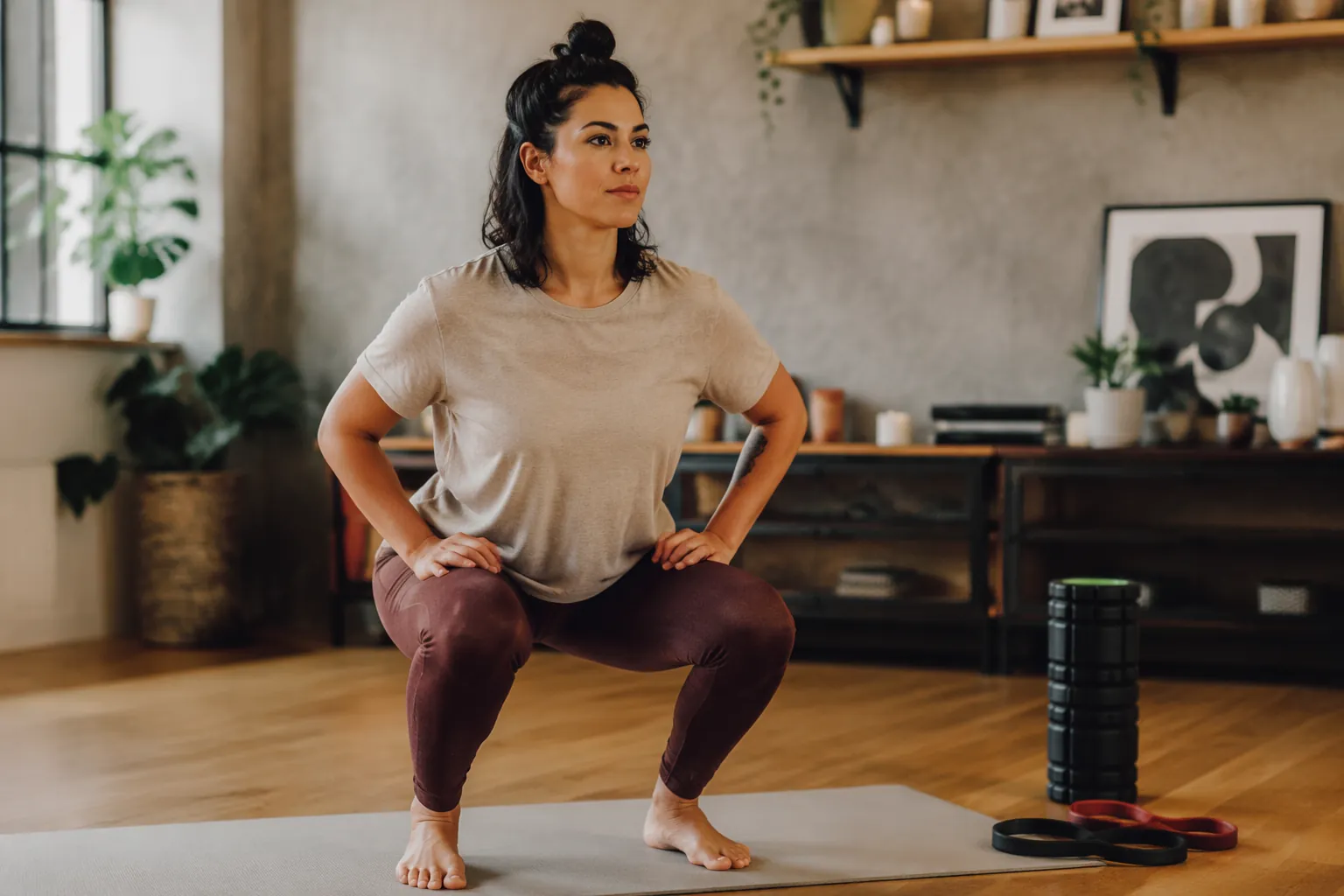
Lunges add single-leg work, which is useful when you cannot make the workout harder by loading the upper body. Reverse lunges are often easier to control in a small room because you can step back, find the floor, and return to standing without the forward momentum of a walking lunge. If balance is shaky, keep one hand near a wall. The hand is there for emergency steering, not for pushing your body up.
4 and 5. Single-leg deadlifts and calf raises: quiet strength work
A bodyweight single-leg deadlift is a hinge, not a circus trick. Stand on one leg, soften the knee, send the hips back, and let the free leg drift behind you. Your torso does not need to reach parallel to the floor. In rib recovery, a smaller range done cleanly is better than a long reach that makes you rotate, wobble, and brace through the chest.
Calf raises are almost boring enough to be underrated, which is why they fit this kind of session. They add lower-leg work, ankle stiffness, and circulation without asking much from the upper body. Stand tall, rise, pause, lower slowly. If you want more challenge, slow the lowering before you add equipment.
6. Incline walking or easy cycling: the cardio piece
Judge’s reported incline treadmill walking is the most directly transferable cardio detail, because it does not require swinging a bat, throwing, pressing, rowing, or loading the arms.[1][2] At home, the equivalent is simple: incline treadmill walking if you have it, a gentle hill walk if you do not, or low-resistance stationary biking if walking bothers the injury less than pedaling.
Keep the intensity conversational. You should be able to breathe without guarding the rib cage. If you start gripping the treadmill rails, hunching the shoulders, or taking shallow breaths to get through the interval, the cardio setting is too aggressive for the purpose of this workout.
7. Neck isometrics: include only with a reason
This is the one item in the template that should not be casually copied. Judge has been reported as doing neck exercises during this phase, but that does not make neck isometrics a standard add-on for everyone with a rib injury.[2] If a clinician has given you neck isometrics, keep them gentle and exact. If nobody has prescribed them, skip them and spend that time on breathing work or easy walking.
A simple way to run the session
A practical home version can look like this: breathing work first, glute bridges, squats, lunges, single-leg deadlifts, calf raises, then low-impact cardio. Neck isometrics only belong in the session if they are part of your own rehab instructions. Keep the first round deliberately easy. The goal is to finish feeling like you preserved momentum, not like you proved something.
- Do your prescribed or clinician-approved deep breathing before training.
- Move through the five bodyweight strength exercises slowly, with no external load.
- Add incline walking or easy cycling only if breathing stays controlled.
- Stop the session if pain increases, breathing becomes guarded, or you feel yourself compensating through the chest, neck, or shoulder.
If your clinician has cleared basic core control, quiet floor drills such as supine marches, dead bugs, or bird dogs may fit better than planks or loaded rotation. They should feel like coordination practice, not abdominal punishment. During rib recovery, the useful core exercise is usually the one that lets you breathe normally while the pelvis and spine stay organized.
What equipment you actually need
This workout does not need a pro-style gym. A mat, a sturdy chair, a little walking space, and possibly a stationary bike cover most of it. Resistance bands can be useful later, but early on they are optional and easy to misuse if they encourage pulling, twisting, or bracing through the upper body.
For apartment training, the best recovery gear is quiet, stowable, and boring: bands that fit in a drawer, a foldable mat, a stable chair, and cardio equipment you will use at low resistance. FitAtHome’s small-space equipment guidance is the natural next stop if you are building around limited floor space, shared walls, or a recovery phase that may expand later.
What to borrow from Judge, and what to leave alone
Borrow the discipline of the constraint. Lower body means lower body. Cardio means controlled breathing, not a sneaky upper-body workout. Glute activation means waking up the hips, not chasing soreness. That is the part of Judge’s current rehab status that is actually useful for a home exerciser staring at a mat and wondering what is still allowed today.
Leave alone the parts nobody outside his medical and performance staff can know: his exact loading, his clearance criteria, his private equipment, and his return-to-play timeline. Lower-body training and low-impact cardio can help maintain fitness while the upper body recovers, but they do not replace medical clearance, imaging decisions, or a personalized rehab plan.
References
- Aaron Judge current status — MLB.com.
- Aaron Judge injury update on “some healing” and lower-body/neck limitations — New York Daily News, July 17, 2026.
- Aaron Judge “encouraged” but in holding pattern injury update — New York Post, July 25, 2026.
- Rib Fracture (Broken Rib) — Cleveland Clinic.
- Sports medicine commentary from Dr. Jesse Morse on first-rib stress fracture timeline — Heavy.com.
- Aaron Judge interview on training philosophy — GQ, 2024.
- Aaron Judge full-body training routine and apartment gym coverage — Muscle & Fitness.
- 4 Exercises for Broken Ribs Recovery — WebMD.
- Rib injury physical therapy and rehabilitation guidance — Rib Injury Clinic.
- Broken Rib Treatment: Exercises and Other Tips for Recovery — Healthline.
- Safe exercises for fractured ribs — Everyday Health.
This is general fitness education, not medical advice. For diagnosis or treatment of pain or injury, consult a qualified clinician.
Pick your next session
Browse all routines to find an appropriately-spaced next session.
Spot something off?
This content sits adjacent to health guidance — tell us if a citation or figure needs a correction.