
How long ACL recovery takes with home rehab workouts
ACL recovery at home is backed by randomized evidence, but full return to activity typically takes 6–12 months. This guide pairs each rehab phase with its recovery window, the minimal-gear exercises that work in a living room, and the two areas where home-only rehab falls short of supervised care.
- Citation source
- AOSSM, StatPearls, EFORT Open Reviews
- Evidence level
- General guideline
- Recommended frequency
- 6–12 months to full activity; ≥9 months before pivoting sports
If most of your ACL rehab is happening at home, the honest answer is: it can still be a serious, evidence-supported recovery plan, but it is not a six-month countdown you complete by doing knee exercises on the living-room floor. A 2025 systematic review and meta-analysis of 12 studies and 711 participants found that home-based ACL rehabilitation produced outcomes comparable to supervised rehabilitation for functional recovery. The same review also found a small but significant hamstring-strength advantage for supervised rehab, and one included 2024 study reported return to pre-injury sport in 76.6% of the supervised group versus 53.3% of the home-based group.[1]
That is the bargain. A large share of ACL recovery can be done at home: the repeated quad sets, heel slides, straight-leg raises, balance work, step-ups, and bike sessions that move the knee from swollen and guarded toward usable again. The parts that should not be home-declared are the harder ones: whether your hamstrings have caught up, whether swelling is telling you the knee is not tolerating load, and whether you are ready for running, cutting, pivoting, or sport.
The recovery clock is real, but it is not the clearance test
Patient-facing protocols often describe ACL recovery in phases because the knee changes quickly in the first weeks and much more slowly later. Emory’s ACL rehabilitation timeline, for example, describes early phases of 0–2 weeks, 2–6 weeks, 6 weeks to 3–4 months, and 4–6 months; it also notes that crutches are typically used for about 7–10 days and that driving is often possible around 2 weeks, depending on the leg involved, pain medicine, control, and clinician clearance.[2]
The wider recovery window is longer than those early milestones suggest. StatPearls describes average return to full activity after ACL reconstruction as 6–12 months and notes that graft incorporation may take up to 18 months or more.[3] AOSSM’s Winter 2025 return-to-play discussion points to clearance at 9 months or later combined with objective measures, including at least 90% quadriceps strength symmetry and at least 90% hop-test limb symmetry.[4]
So if a protocol says “six months,” read it as a possible phase marker, not a promise. Some people may be doing fuller activity around that point. Pivoting sports are a different matter. For cutting, landing, contact, and unpredictable direction changes, the question is less “What month is it?” and more “What does the knee prove under testing, load, fatigue, and sport-specific demand?”

A phase-by-phase home rehab map
The exercises below are the kind that appear consistently in PT-reviewed and research-group ACL rehab materials: quad sets, straight-leg raises, heel slides, hamstring sets, mini or wall squats, step-ups, single-leg balance, and side-lying hip abduction.[5][6] They are not a substitute for your surgeon’s protocol. They are a way to understand what the home portion usually looks like and why the same exercise may be helpful in one phase and premature in another.
| Phase | Typical window | What home rehab is trying to do | Home exercises that usually fit | Useful gear | Do not rush |
|---|---|---|---|---|---|
| Early protection and swelling control | 0–2 weeks | Calm the knee, regain extension, begin gentle quad activation, protect the graft and any repaired tissue | Quad sets, heel slides within allowed range, straight-leg raises if you can keep the knee straight, gentle hamstring sets if allowed | Mat, towel, ice/compression setup if prescribed | Forcing range of motion, walking without control, adding resistance because the exercises feel boring |
| Range of motion and basic control | 2–6 weeks | Improve knee bend and straightening, normalize gait, reduce dependence on crutches when cleared, build repeatable quad control | Quad sets, straight-leg raises, heel slides, side-lying hip abduction, gentle stationary bike when range allows | Mat, stationary bike, light resistance band if cleared | Driving, stairs, or longer walks just because the calendar says two weeks |
| Strength base and balance | 6 weeks to 3–4 months | Build leg strength, balance, and tolerance for daily activity without swelling flare-ups | Mini squats or wall squats, step-ups, balance work, bike, hip abduction, continued quad and hamstring work | Step or stairs, mat, band, stationary bike | Deep loaded squats, jumping, running before strength and swelling criteria are met |
| Higher strength, running preparation, fuller activity | 4–6 months and beyond | Progress strength, endurance, single-leg control, and running readiness under professional guidance | Progressed squats, step-ups, balance work, bike conditioning, clinician-directed running preparation | Step or stairs, bike, band; testing access matters more than more gadgets | Treating jogging, agility, or sport drills as automatic because the knee feels normal |
| Return-to-sport decision period | Often 6–12 months; pivoting-sport clearance rarely framed before 9 months | Prove strength symmetry, hop performance, landing control, confidence, and sport-specific tolerance | Home work can maintain strength and consistency, but clearance needs supervised testing and sport-specific progression | Home gear is secondary; objective testing and professional review matter | Self-clearing for cutting, pivoting, contact, or competition |
Weeks 0–2: protect the knee and wake the quad back up
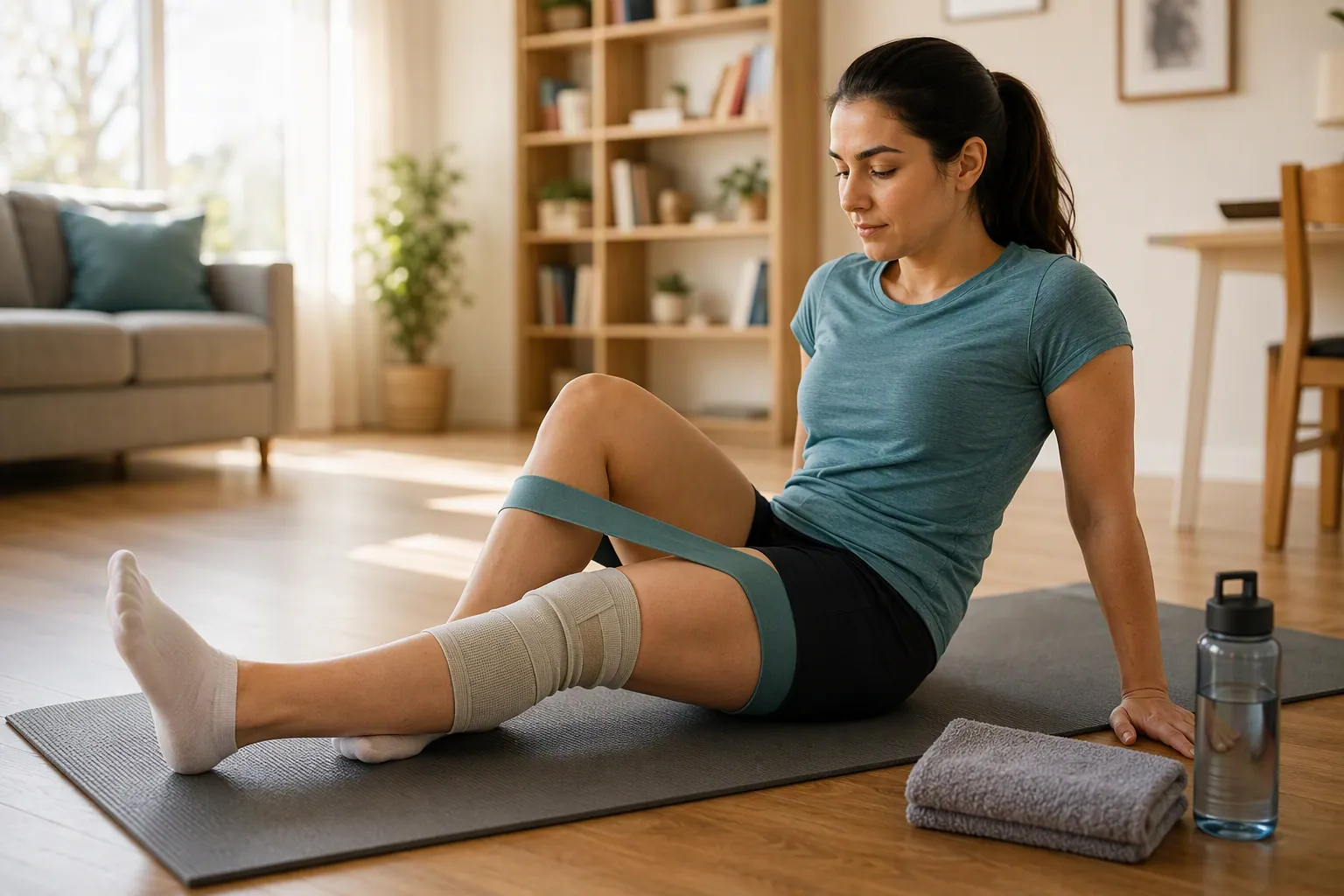
The first phase is not glamorous, and it is easy to underestimate because the exercises look too small to matter. But this is where a home program earns trust: swelling is watched, extension is protected, and the quadriceps start responding again. A quad set is simply tightening the front thigh with the leg supported and the knee straight or nearly straight. A heel slide is bending the knee by sliding the heel toward you within the range your protocol allows. A straight-leg raise belongs here only if you can lift the leg without the knee sagging into a bent position.
Crutches around 7–10 days can be typical, but “typical” is doing important work in that sentence.[2] Meniscal repair, weight-bearing restrictions, pain, swelling, graft type, and surgeon preference can all change the plan. The safer home rule is to progress walking when the knee is quiet enough, the quad can control the leg, and your clinician has cleared the change.
Weeks 2–6: make motion and gait boring again
By this phase, many people are doing more around the house, which is exactly when rehab can become sloppy. The goal is not to collect exercises. It is to make basic movement reliable: knee extension, controlled bending, a cleaner walking pattern, and enough quad control that daily tasks are not a series of compensations.
Home work usually still includes quad sets, straight-leg raises, heel slides, and hip work such as side-lying hip abduction. A stationary bike can become useful once you have enough knee bend to pedal comfortably and your protocol allows it. Resistance bands may help later in this window, but they are not the point; the point is clean reps without swelling increasing afterward.
Driving is often discussed around the two-week mark, but it depends on which leg had surgery, whether you are still using narcotic pain medication, whether braking is safe, and whether your surgeon has cleared it.[2] That is a practical example of why ACL recovery time is not just tissue healing. It is also reaction time, control, medication status, and legal responsibility.
Six weeks to 3–4 months: strength work starts to look like exercise again
This is the phase where home rehab can feel more satisfying. Mini squats, wall squats, step-ups, balance work, bike sessions, and hip strengthening are easier to understand than early quad setting. They also make it easier to overdo things. A knee that tolerates three good step-up sets on Tuesday may still object to errands, stairs, and a long standing workday layered on top.
A small step or normal staircase is enough for step-ups. A mat is enough for hip abduction. A stationary bike is useful because it gives repeatable motion and conditioning without turning every workout into impact. If you are trying to build a home setup, those items matter more than buying unstable gadgets or trying to imitate late-stage sport drills too early.
For a related way to think about staged home recovery after surgery, FitAtHome’s guide to foot surgery recovery exercises uses the same basic principle: match the exercise to the healing phase rather than treating home rehab as one long list.
Four to six months and beyond: running is a criteria conversation
The later middle phase is where the calendar starts to tempt people. The knee may look normal. Stairs may be easier. The bike may feel fine. That does not automatically mean the leg is ready for running, and running does not automatically mean the knee is ready for sport.
StatPearls places average return to full activity in the 6–12 month range, while AOSSM emphasizes return-to-play decisions at 9 months or later with strength and hop-test criteria.[3][4] Emory’s patient-facing protocol describes sport return as usually at six months, which shows the real-world spread in how timelines are communicated.[2] The safest way to read those sources together is not to pick the fastest number. It is to treat six months as a possible transition point for some activities and nine months or later as the more cautious minimum framing for pivoting-sport clearance.
Home workouts still have a role here: maintaining strength volume, doing bike conditioning, repeating balance work, and keeping the operated leg from quietly becoming the leg you avoid. But the decision to run, jump, cut, or return to competition needs outside eyes and objective testing.
The two places home-only ACL rehab is most likely to fall short
Hamstring strength is not a detail
The hamstring-strength finding in the 2025 review is easy to skip past because the review’s larger message is encouraging for home rehab. It should not be skipped. Supervised rehabilitation showed a small but significant advantage in hamstring strength, with a standardized mean difference of −0.48 and P=0.02.[1]
That matters because hamstrings are not just “back of thigh” muscles you strengthen when everything else is done. They help control the knee, and after ACL reconstruction they can be affected by the surgery, the graft choice, inhibition, pain, or simple underloading. A printed home sheet may tell you to do hamstring sets. It will not always show whether you are protecting the movement, shifting effort to the other leg, or never progressing the load enough to close the gap.
This is where scheduled PT check-ins are not a luxury add-on. They are how a home-heavy plan gets corrected before “I did all my exercises” turns into “one leg is still clearly weaker.” If your graft involved the hamstring tendons, this deserves even more specific guidance from your surgeon or PT.
Late-stage rehab needs intensity, judgment, and testing
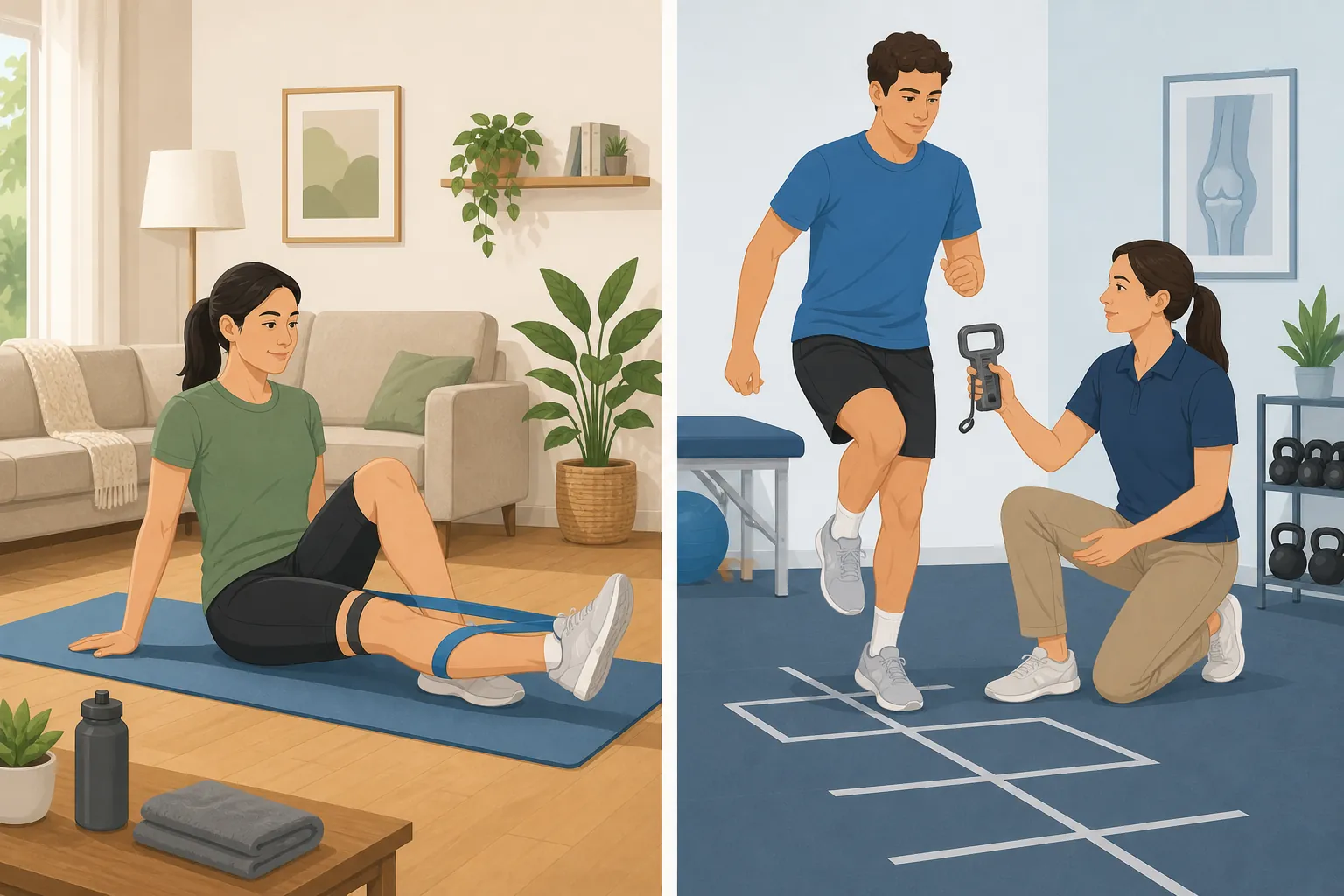
Living-room rehab is good at repetition. It is less good at reproducing the demands of sport: accelerating when tired, decelerating on one leg, reacting to another player, landing from awkward positions, or cutting without planning the angle in advance. That is one plausible reason the home-vs-supervised evidence becomes less comfortable when sport return is the outcome. In one study included in the 2025 review, 76.6% of the supervised group returned to pre-injury sport compared with 53.3% of the home-based group; the review also reported that supervised programs longer than 6 months were associated with a higher chance of meeting return-to-sport criteria.[1]
For a runner returning to straight-line jogging, the late-stage problem may be strength symmetry, swelling response, and gradual load. For basketball, soccer, football, tennis, skiing, or other pivoting sports, the problem is larger. AOSSM’s criteria-based discussion includes at least 90% quadriceps strength symmetry and at least 90% hop-test limb symmetry, with timing at 9 months or later.[4] Those are not things most people can measure well by guessing in a hallway.
If you like home readiness checks, FitAtHome’s ankle sprain return-readiness guide is a useful parallel: home tests can sharpen your attention, but they do not turn a complex return-to-sport decision into a private yes-or-no vote.
A minimal home setup is enough for the repeatable work
You do not need a clinic’s equipment closet to do the home portion well. The useful list is short:
- A mat or firm floor space for quad sets, straight-leg raises, heel slides, hamstring sets, and hip abduction.
- A towel or strap to assist gentle positioning when your protocol allows it.
- A light resistance band for later hip and leg strengthening, when cleared.
- A step or staircase for step-ups once that phase is appropriate.
- A stationary bike for controlled range, conditioning, and repeatable low-impact work.
The equipment you cannot replace with a purchase is feedback. A PT can see whether your knee caves inward during a step-up, whether you are unloading the surgical side, whether your swelling pattern changed after a progression, and whether your strength testing supports the next step. That is the difference between home-based rehab and home-only guessing.
Adherence fails quietly, especially on stressful days
A home plan can be medically sound and still fail because the person doing it is tired, stressed, bored, worried, or back at work too soon. Brewer and colleagues’ daily-diary study found that patients completed fewer prescribed home exercises on days with higher stress and negative mood, independent of personality.[7]
That finding feels ordinary because it is ordinary. The missed session is not always dramatic. It is the heel slides skipped after a bad meeting, the bike session shortened because the knee is stiff and you are irritated, the strength work postponed until tomorrow often enough that the week disappears.
The practical answer is not to invent a personality transplant. Put the exercises where they can actually happen. Keep the mat visible if that helps. Pair short early-phase sessions with existing routines. Use PT appointments as accountability, not just technique checks. If training consistency is the sticking point, FitAtHome’s guide on when to do an indoor workout can help you think through timing without pretending motivation is the whole solution.
What to ask your surgeon or PT before progressing
A good home rehab plan should make your clinic visits more useful. Instead of asking only “Am I on track?”, bring the questions that change decisions:
- What are my current restrictions based on graft type and any meniscal repair or additional procedure?
- What swelling or pain response means I should reduce load or call the clinic?
- What criteria do I need before stopping crutches, driving, biking, running, jumping, or changing direction?
- How are we measuring quadriceps and hamstring strength symmetry?
- Will I need hop testing or limb-symmetry testing before return to sport?
- If I am doing most sessions at home, when should supervised visits become more frequent again?
Nutrition, sleep, and muscle retention also become more relevant than people expect during a long rehab window. If your appetite or protein intake drops while activity is limited, FitAtHome’s piece on building muscle on less protein may be a useful companion, especially during the long strength-rebuilding months.
So how long does ACL recovery take with home rehab workouts?
Expect months, not weeks. Early practical milestones may arrive quickly: crutches are often around 7–10 days and driving is often discussed around 2 weeks, if the right conditions are met.[2] Strength, running preparation, and fuller activity usually stretch across the 6–12 month range.[3] Pivoting-sport clearance should rarely be framed before 9 months and should be tied to objective criteria such as strength and hop-test limb symmetry, not just confidence or the absence of pain.[4]
Home workouts are the right place for much of the volume: the careful repetitions, the bike work, the progressive step-ups, the balance practice, the unglamorous strengthening that makes the next clinic test better. They are not the right place to self-clear for sport, ignore a hamstring-strength gap, or pretend graft maturation ends when the knee starts feeling normal. Graft incorporation may continue for 18 months or more.[3]
Use the living room for what it does well. Keep the professional checkpoints for what they do better: adjusting the protocol when swelling, graft type, meniscal repair, pain, or sport demands change the timeline; measuring strength; deciding when running makes sense; and clearing the knee for the loads you cannot honestly recreate on a rug between work calls.
References
- Home-based versus supervised rehabilitation following anterior cruciate ligament reconstruction: a systematic review and meta-analysis, EFORT Open Reviews, https://pmc.ncbi.nlm.nih.gov/articles/PMC12412367/
- ACL Rehabilitation Timeline, Emory Healthcare, https://www.emoryhealthcare.org/centers-programs/acl-program/recovery/rehab-timeline
- Anterior Cruciate Ligament Knee Injuries, StatPearls, https://www.ncbi.nlm.nih.gov/books/NBK499848/
- Return to Play After ACL: Integrating Key Metrics, AOSSM, Winter 2025, https://www.sportsmed.org/membership/sports-medicine-update/winter-2025/return-to-play-after-acl-integrating-key-metrics
- ACL Rehab Exercises, Hinge Health, July 3, 2025, https://www.hingehealth.com/resources/articles/acl-rehab-exercises/
- ACL Prehab, MOON Knee Group, https://acltear.info/anterior-cruciate-ligament-rehabilitation/acl-prehab/
- Psychological Factors, Rehabilitation Adherence, and Rehabilitation Outcome After Anterior Cruciate Ligament Reconstruction, https://pmc.ncbi.nlm.nih.gov/articles/PMC4045843/
This is general fitness education, not medical advice. For diagnosis or treatment of pain or injury, consult a qualified clinician.
Pick your next session
Browse all routines to find an appropriately-spaced next session.
Spot something off?
This content sits adjacent to health guidance — tell us if a citation or figure needs a correction.