
How Long Do Bacteria Live on Home Gym Equipment?
Survival times for bacteria on home gym equipment aren't one alarming number — they depend on the germ, the surface material, and moisture. Get the evidence-backed ranges for staph, Gram-negatives, and respiratory viruses on steel, rubber, plastic, foam, and fabric, and what they mean for a realistic home cleaning routine.
- Citation source
- CDC
- Evidence level
- General guideline
- Recommended frequency
- After each use for mats and bench pads
If you came here for one number, the honest answer is that there is not one. How long bacteria live on home gym equipment depends on the organism, the surface, and whether the surface stays dry, damp, smooth, textured, porous, warm, or cool. The ranges below come from lab and hospital-fomite research, not from a study of a private apartment gym with rubber tiles and adjustable dumbbells. That gap matters, so treat these as evidence-backed survival ranges, not a prediction of what is alive on your exact mat tonight.
| Home gym surface | Staph / MRSA-family bacteria | Gram-negatives such as Klebsiella and E. coli | Respiratory viruses | Practical reading |
|---|---|---|---|---|
| Steel or chrome handles, bars, collars | S. aureus and MRSA have been reported on stainless steel from 6 hours to more than 6 weeks in dry-surface studies.[1] | Klebsiella and E. coli can persist far longer than a workout session in fomite studies; Porter reported a maximum observed Klebsiella pneumoniae survival of 600 days across reviewed studies, though that is an upper-bound lab finding, not a home-gym expectation.[3] | SARS-CoV-2 remained viable up to 72 hours on stainless steel in one controlled experiment, with viability declining over time; other respiratory viruses vary, but this is usually an hours-to-days problem rather than a months problem.[4] | Wipe high-touch handles when they are sweaty, shared, or used after cuts or skin irritation. A dry chrome dumbbell handle is not the same risk category as a sweat-wet mat. |
| Rubber grips and rubber flooring | Direct home-gym rubber data are limited. Dense, nonporous rubber is usually treated more like a hard surface, so staph-family survival can plausibly be days to weeks under favorable conditions, with longer survival possible when moisture and grime remain.[1][2] | Gram-negatives can persist on inanimate surfaces for extended periods in lab and healthcare studies, especially when conditions protect them from drying.[1][3] | Use an hours-to-days expectation for respiratory viruses on smooth rubber-like surfaces, with more uncertainty than for stainless steel or plastic because the best-known SARS-CoV-2 experiment tested plastic and stainless steel, not gym flooring.[4] | Rubber flooring deserves attention because shoes, sweat, dust, and floor exercises meet there. Cleaning the mat surface is more useful than obsessing over every plate. |
| Hard plastic shells, selector dials, clips, collars | Kramer reported S. aureus and MRSA persistence on plastics from 21 days to more than 3 years in dry-surface literature, a huge range that reflects study conditions more than everyday risk.[1] | Plastic can support long survival for several hospital pathogens; Porter also found very long maximum survival times across reviewed organisms and studies.[3] | SARS-CoV-2 remained viable up to 72 hours on plastic in the NEJM experiment, with an estimated median half-life of about 6.8 hours on plastic.[4] | Plastic adjustment knobs and collars are worth cleaning when hands repeatedly touch them, especially in a shared setup. The upper end of the lab range should not be read as a reason to disinfect every plastic part daily. |
| Foam mats and interlocking foam tiles | There is no clean, direct number for budget EVA foam gym tiles. Porous or textured materials can protect organisms from immediate drying, and Porter found generally longer survival on porous surfaces across reviewed studies.[3] | Gram-negative survival on soft or porous surfaces depends heavily on moisture and contamination load. The defensible answer is not a fixed day count, but potentially long enough that a sweaty foam mat should not be ignored.[1][3] | Respiratory-virus survival on foam gym tiles is uncertain from the cited evidence. If the surface dries quickly, think hours to days rather than weeks; if it stays damp or dirty, clean it rather than trying to calculate it. | This is the home-gym surface most likely to justify a regular routine because it contacts bare skin, sweat, shoes, pets, and apartment dust. |
| Fabric straps, lifting belts, bench upholstery, pads | Kramer reported S. aureus and MRSA persistence on cloths from 1 day to more than 70 days.[1] | Porter's review found generally longer survival on porous surfaces, and fabric can hold moisture, skin cells, and residue in a way smooth metal cannot.[3] | Respiratory viruses usually decline faster than hardy bacteria, but fabric-specific survival varies by virus, humidity, and material. Do not borrow the stainless-steel number and pretend it is exact. | Fabric and padding are harder to wipe perfectly. Let them dry fully, wash what can be washed, and avoid sharing straps or pads when there is broken skin. |
The main sources behind the table are Kramer et al.'s 2006 systematic review of hospital pathogens on dry surfaces, Wißmann et al.'s 2021 review of pathogen persistence, Porter et al.'s 2024 scoping review of 62 survival studies, and van Doremalen et al.'s controlled NEJM experiment on SARS-CoV-2 surface survival.[1][2][3][4]
Why the Range Runs From Hours to Months
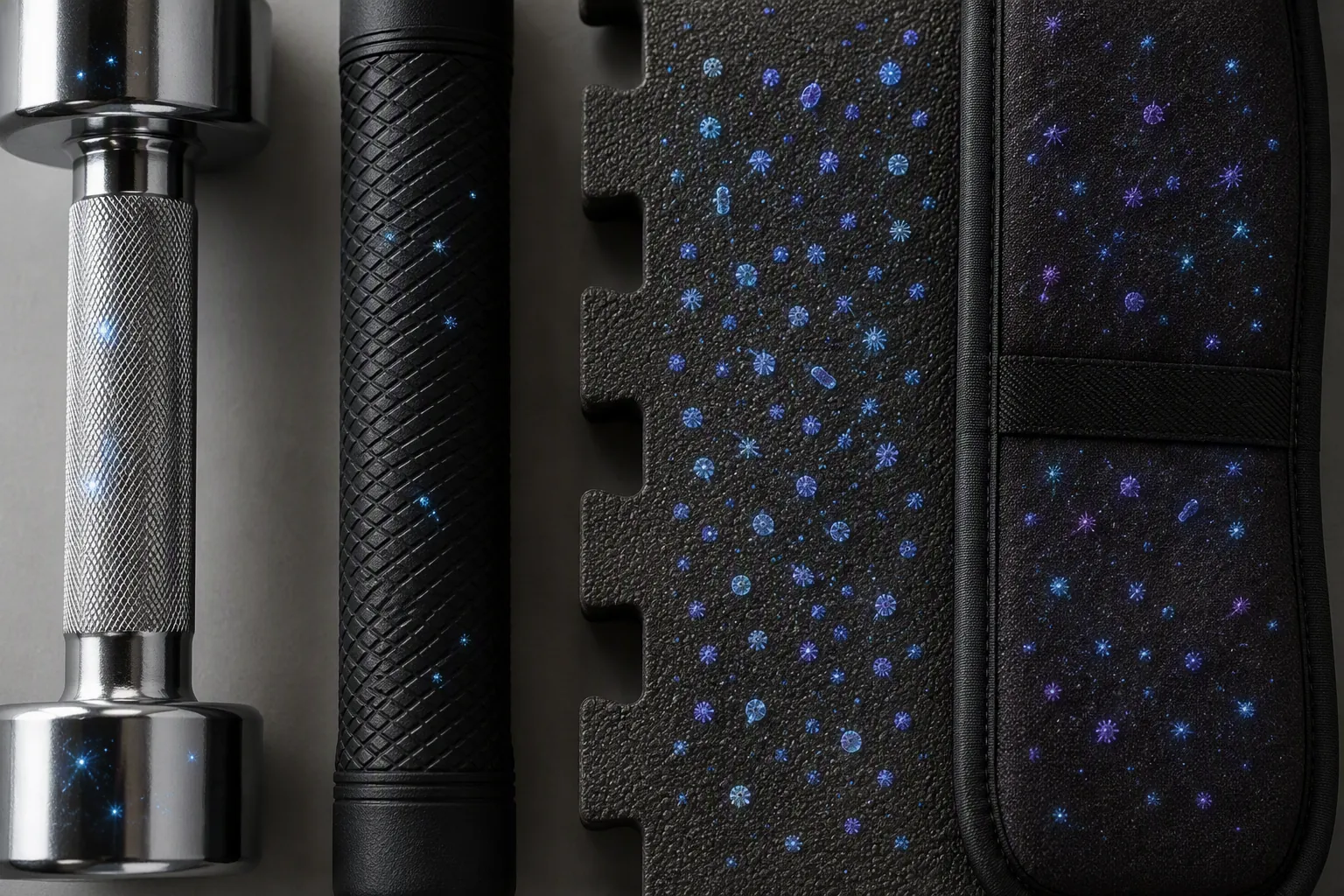
The table looks wide because the evidence is wide. “Bacteria on gym equipment” is not one category. Staph-family organisms, Gram-negative bacteria, and respiratory viruses do not dry out, remain viable, or transfer the same way.
Staph deserves more attention in a home gym than a vague cloud of “germs” because it is a skin-associated organism and because MRSA prevention guidance has long focused on athletic settings, shared equipment, towels, skin abrasions, and bare-skin contact. In the survival literature, S. aureus and MRSA can persist much longer than most people expect: Kramer reported ranges of 6 hours to more than 6 weeks on stainless steel, 21 days to more than 3 years on plastics, and 1 day to more than 70 days on cloths.[1] Porter’s later scoping review reported a maximum observed S. aureus survival of 318 days across included studies.[3]
Those long numbers are real observations, but they are not a forecast that your dumbbell handle is infectious for months. Lab survival means an organism remained viable under the study’s conditions. It does not tell you the dose left after drying, whether it transfers efficiently to your hand, whether it reaches broken skin, or whether your immune system fails to handle it. Survival is a starting point for judgment, not the whole risk calculation.
Gram-negative bacteria such as Klebsiella and E. coli can also persist on surfaces for surprisingly long periods in healthcare and laboratory literature. Porter’s review reported a maximum observed Klebsiella pneumoniae survival of 600 days, and the review also noted generally longer survival on porous surfaces.[3] That is useful for scale, especially when thinking about damp fabric or foam, but it still does not prove that a private home gym commonly carries viable Klebsiella for that long.
Respiratory viruses are usually a shorter-lived surface problem. In van Doremalen et al.’s NEJM experiment, SARS-CoV-2 remained viable up to 72 hours on plastic and stainless steel, with estimated median half-lives of about 6.8 hours on plastic and 5.6 hours on stainless steel.[4] That makes respiratory-virus residue on a dumbbell plausible for a while after someone sick uses it, but it is a different scale from the longest bacterial persistence findings.
Material Changes the Answer More Than Most Cleaning Advice Admits
A home gym is a pile of mismatched materials. A chrome handle, a textured rubber grip, a cracked foam tile, a vinyl bench pad, and a fabric suspension strap do not behave like one generic “surface.” That is why advice copied from commercial-gym cleaning signs often feels both too broad and not specific enough.
Smooth nonporous surfaces are easier to wipe because residue sits on top. Steel, chrome, and hard plastic handles can still support survival, but cleaning can actually reach the contact surface. This is the category where a quick wipe after sweaty use makes sense and where disinfecting after every solo set usually becomes more ritual than risk reduction.
Rubber and foam are messier. Some rubber flooring is dense and sealed; some budget tiles are textured, nicked, or slightly porous. Sweat collects in seams. Dust sticks to tacky surfaces. If you train barefoot, stretch on the floor, do push-ups, or lie down for core work, the mat becomes a skin-contact surface, not just flooring. That is the point where “I only use this myself” stops being a complete cleaning plan.
Fabric straps, wraps, and upholstered pads create a different problem: they hold moisture and are harder to fully contact with a disinfecting wipe. Kramer’s cloth range for S. aureus and MRSA, 1 to more than 70 days, is enough reason to avoid treating fabric as harmless just because it looks dry.[1] The better habit is to let fabric dry completely, launder what can be laundered, and avoid sharing items that rub against skin.
Moisture, Temperature, and Grime Do a Lot of the Work
Drying usually hurts microbes. Moisture usually helps them last. Kramer’s review noted that humidity, moisture, and lower temperature can extend survival for several pathogens on surfaces.[1] In a real home gym, that means the same organism may behave differently on a dry dumbbell in a ventilated room than on a mat that stays damp in a corner with poor airflow.
Grime also changes the practical picture. Sweat, skin oils, chalk, dust, pet hair, and old cleaner residue can make a surface harder to clean and can shield material in tiny grooves. This is one reason cleaning and disinfecting are not interchangeable words. Cleaning removes soil. Disinfecting uses a chemical to kill organisms on a surface. If a foam tile is sticky with sweat and dust, spraying disinfectant over the film is a weaker move than cleaning the surface first.
Ventilation matters in a quieter way. A small rental gym packed into a spare corner, like the setups in a compact home gym by space tier, often has less air movement around mats and pads than a larger room. That does not make the room unsafe by itself. It just makes drying time part of maintenance.
What to Clean First in a Solo Home Gym
CDC guidance for athletic facilities focuses on shared equipment and surfaces that contact bare skin, and it recommends cleaning shared equipment after each use, allowing surfaces to dry, and using EPA-registered products effective against MRSA when disinfection is needed.[5] A home gym does not need to pretend it has a locker-room cleaning crew, but that priority order transfers well.
- Clean mats after floor work, barefoot training, heavy sweating, or any session where skin has been pressed into the surface.
- Wipe bench pads, handles, grips, and adjustment points when they are sweaty or shared.
- Let rubber, foam, and fabric dry before stacking, folding, or covering them.
- Wash fabric straps, towels, wraps, and removable covers when the care label allows it.
- Use a disinfectant when the surface is shared, there is broken skin, someone is sick, or the equipment has been visibly contaminated.
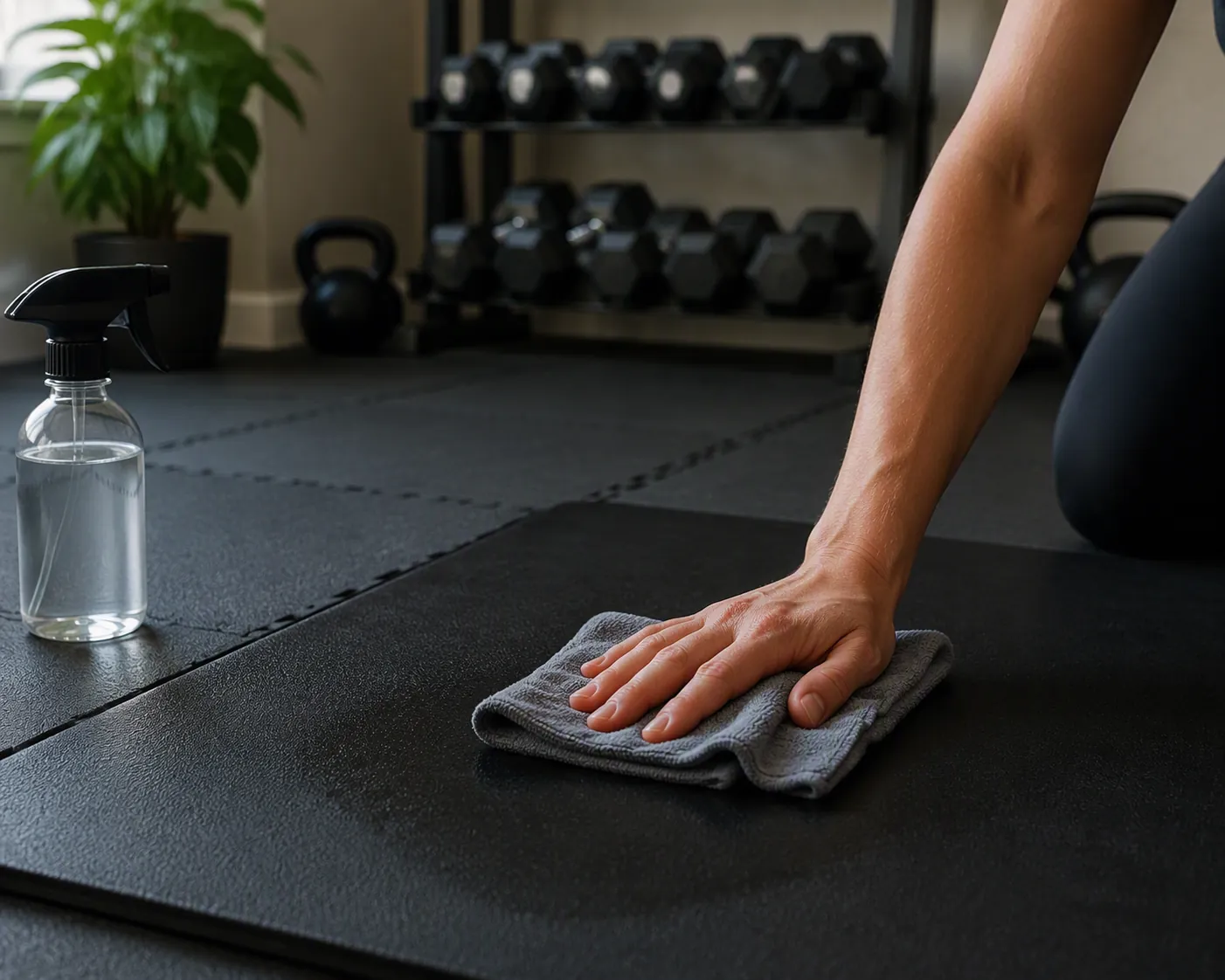
For one person training alone, that usually means the mat gets more attention than the dumbbell rack. A mat collects sweat, shoe residue, bare skin contact, floor dust, and sometimes pet traffic. A dumbbell handle gets touched often, but it is also small, nonporous, and easy to wipe when it actually needs it.
If you share the gym with a partner, roommate, client, or teenager rotating through the same bench, the cleaning threshold changes. Shared bare-skin-contact surfaces should be cleaned after use, and disinfected when the situation calls for it. That is especially true for benches, mats, handles, pull-up bars, cable attachments, and anything used while shirtless or with exposed skin.
When Disinfecting Makes Sense
Disinfection is useful, but it should have a job. Use it when someone else used the equipment, when a surface had bare-skin contact, when there is a known skin infection concern, when blood or drainage is involved, or when someone trained while sick. CDC athletic guidance points facilities toward EPA List H products for MRSA when that is the target organism.[5]
Follow the product label, especially the contact time. Many disinfectants need the surface to stay visibly wet for a specific period. Spraying and immediately wiping dry may smell clean without delivering the kill claim on the bottle. On the other hand, soaking foam tiles or cheap rubber with harsh chemicals can damage the material, leave residue, or make the floor slick. The boring middle ground is usually best: clean soil first, disinfect selected surfaces when needed, then let them dry.
There is no need to turn a strength session into a wipe-down ceremony after every set. If you are the only person using a steel bar, your hands are intact, and the handle is not sweaty, cleaning it on a regular schedule is reasonable. If you just did shirtless bench work on a vinyl pad or lay on a foam mat for mobility work after a hard session, clean that surface before you call the workout done.
Do Not Overread Colony-Count Headlines
Gym-germ articles often lean on colony-count comparisons, the kind that say one item is many times “dirtier” than a toilet seat. Those comparisons can be attention-grabbing, but they often measure growth under sampling conditions, not infection risk. They also rarely tell you whether the organisms were alive at a meaningful dose, whether they transfer to skin, or whether the surface was steel, rubber, foam, plastic, or fabric.
For deciding how often to clean a home gym, material-specific survival evidence is more useful than shock math. The question is not whether any microbe can be detected somewhere. The question is which surfaces repeatedly contact sweat and skin, which stay damp, which are shared, and which can be cleaned without damaging the equipment.
A Realistic Routine by Equipment Type
| Equipment | Clean after each use? | Disinfect when? | Why |
|---|---|---|---|
| Yoga mat, rubber mat, foam floor tile used for floor work | Yes, if bare skin, sweat, shoes, or pets contacted it | When shared, visibly soiled, used while sick, or used with broken skin | High skin contact, moisture, dust, and texture make mats the practical priority. |
| Bench pad or upholstered seat | Yes, after sweaty or bare-skin use | When shared or when skin irritation, cuts, or illness are involved | Pads touch large skin areas and may hold residue in seams. |
| Dumbbell, barbell, pull-up bar, cable handle | Wipe when sweaty, shared, or on a regular schedule | When shared, used by someone sick, or contaminated by blood or wound drainage | Hard handles can support survival but are easy to clean; prioritize actual contact conditions. |
| Resistance bands and rubber grips | Wipe after sweaty hand contact if the material tolerates it | When shared or used during illness | Rubber and textured grips hold hand residue better than smooth metal. |
| Fabric straps, wraps, towels, removable covers | Dry after use; wash regularly when washable | Use appropriate laundering or product guidance when shared or contaminated | Fabric can hold moisture and is harder to disinfect evenly. |
This routine fits better with normal training than a rule that everything must be disinfected every time. It also leaves room for the rest of recovery: sleep, food, programming, and consistency matter more than chasing a perfectly sterile corner of the apartment. If you are already thinking through recovery habits like protein foods for home workout muscle gain or a home exercise plan for healthy aging, hygiene should support the habit, not make the room feel unusable.
The evidence-backed distinction is simple enough to act on: some bacteria, especially staph-family organisms, can survive on dry surfaces far longer than a day. Respiratory viruses are usually shorter-lived on surfaces, often hours to a few days. But “survives” is not the same as “will infect you.” For a home gym owner, the useful response is consistent cleaning of mats, pads, grips, and shared bare-skin-contact surfaces, with targeted disinfection when risk is actually higher.
References
- How long do nosocomial pathogens persist on inanimate surfaces? A systematic review, BMC Infectious Diseases, 2006
- Persistence of Pathogens on Inanimate Surfaces: A Narrative Review, 2021
- The persistence of pathogens on inanimate surfaces: a scoping review, Journal of Hospital Infection, 2024
- Aerosol and Surface Stability of SARS-CoV-2 as Compared with SARS-CoV-1, New England Journal of Medicine, 2020
- Athletic Facilities: MRSA Prevention and Control, Centers for Disease Control and Prevention
This is general fitness education, not medical advice. For diagnosis or treatment of pain or injury, consult a qualified clinician.
Pick your next session
Browse all routines to find an appropriately-spaced next session.
Spot something off?
This content sits adjacent to health guidance — tell us if a citation or figure needs a correction.