
Which Pain Reliever Is Best for Home Workout Soreness?
A practical decision framework based on symptom type, training goals, and health factors — topical NSAIDs first, acetaminophen for routine soreness, oral NSAIDs only when inflammation is dominant.
- Citation source
- Cleveland Clinic, Houston Methodist, Harvard Health, Mayo Clinic Press
- Evidence level
- General guideline
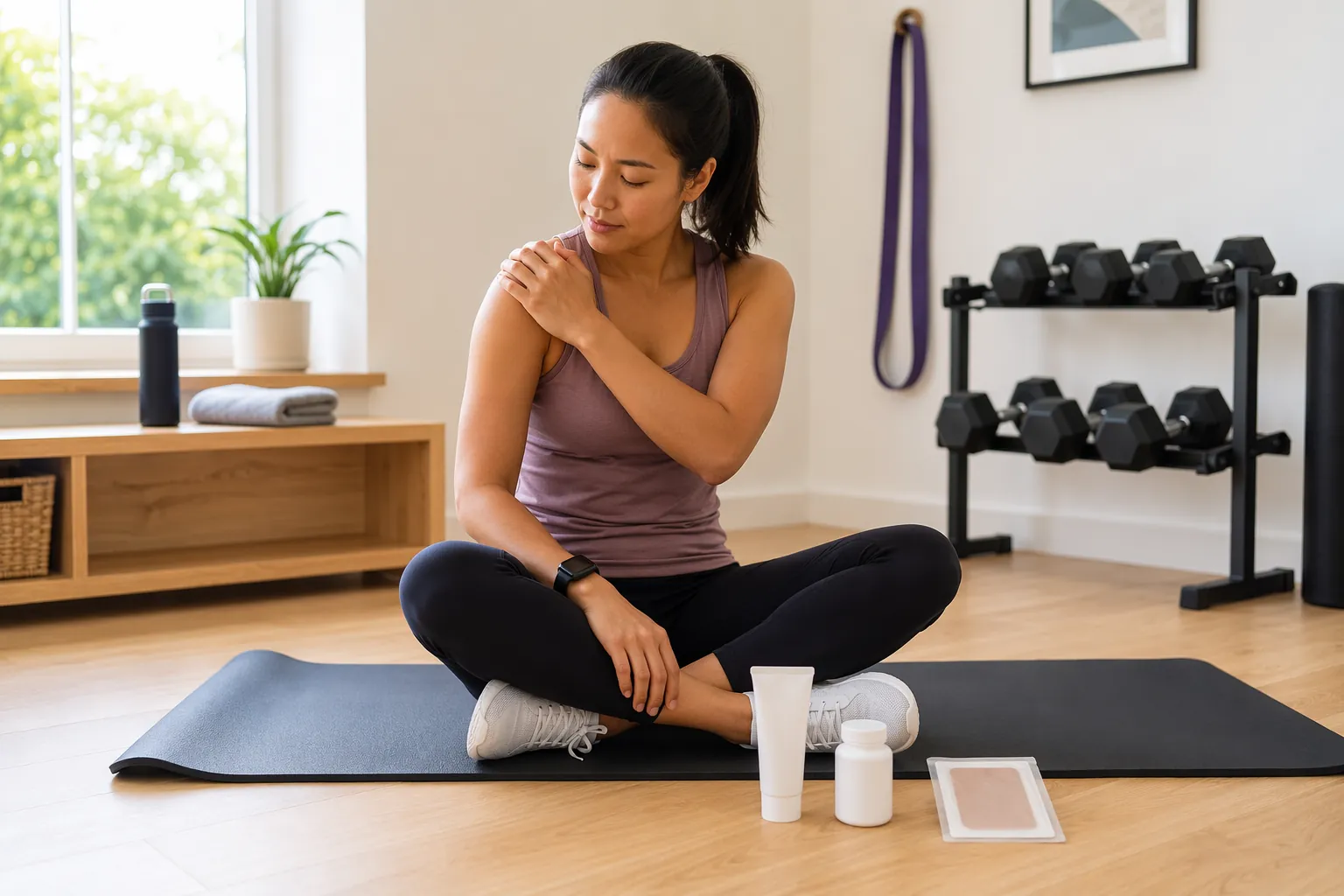
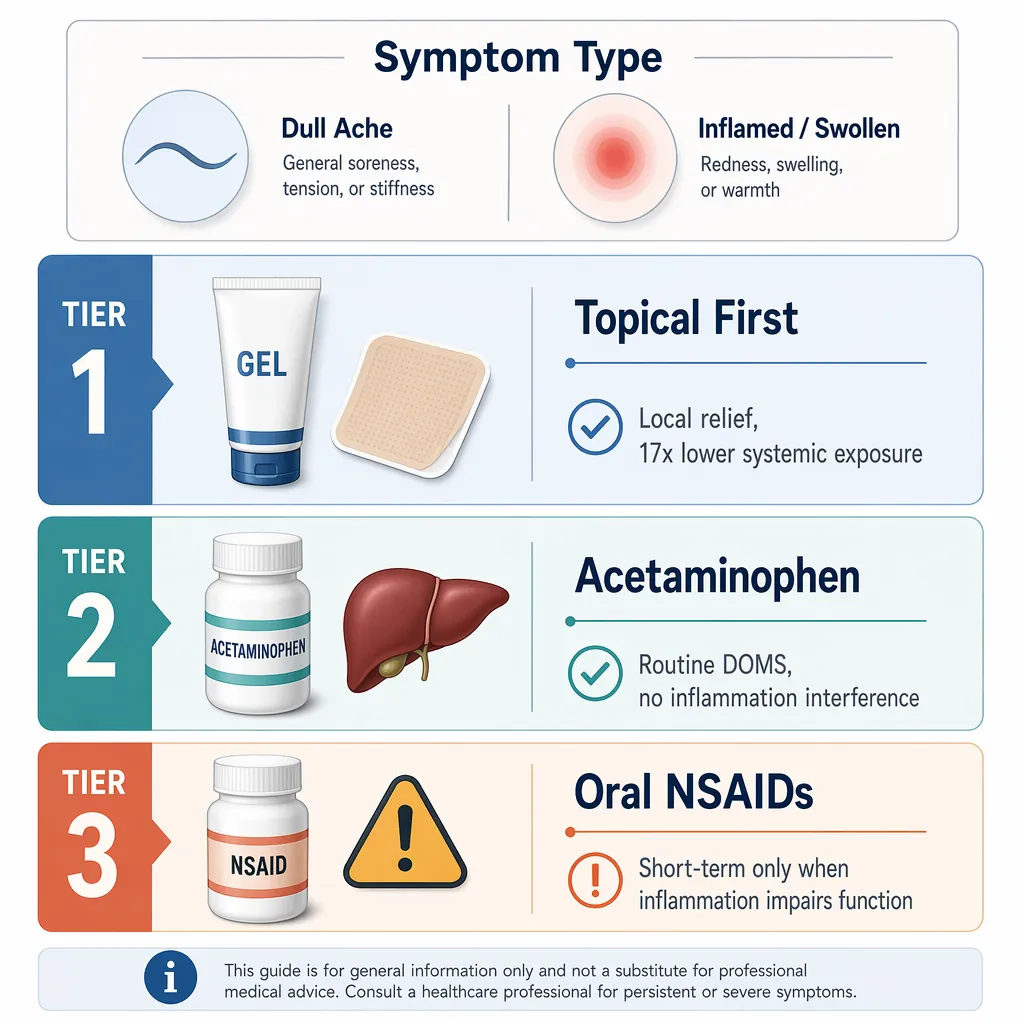
You finish a dumbbell session in the spare room, wake up the next morning, and the drugstore shelf suddenly looks too confident: acetaminophen, ibuprofen, naproxen, diclofenac gel, lidocaine patches, menthol rubs. The best pain reliever for home workout soreness is usually not the strongest anti-inflammatory on the shelf. For most routine soreness, start with local relief or acetaminophen. Save oral NSAIDs for the narrower situation where swelling, tenderness, or impaired function makes inflammation the main problem.
That sorting matters because delayed onset muscle soreness, or DOMS, is usually self-limited: Cleveland Clinic describes it as soreness that tends to peak 24 to 48 hours after exercise and resolve within 3 to 5 days without intervention.[1] If the thing you are treating is expected to fade on its own, the goal is not to erase every signal from your body. The goal is to reduce discomfort enough to sleep, move, and train intelligently without adding unnecessary risk.
The Quick Decision
| What you feel | Best first move | Why |
|---|---|---|
| Dull, symmetrical muscle ache after a new or harder workout | Topical analgesic or acetaminophen | Routine DOMS usually resolves on its own; you mainly need comfort without suppressing repair signals. |
| Localized soreness near a knee, shoulder, elbow, forearm, or other accessible area | Topical NSAID such as diclofenac gel, or a topical analgesic | Local relief can reduce systemic exposure compared with oral NSAIDs. |
| Visible swelling, marked tenderness, or soreness that disrupts sleep or daily function | Short course of oral NSAID if you can take it safely | Inflammation appears to be driving the problem, so the trade-off may be worth it. |
| Deep hip, low-back, or spine-area pain | Do not rely on topical products alone | Topicals may not penetrate deeply enough; persistent or unusual pain deserves a more cautious read. |
| Severe, sharp, worsening, one-sided, or persistent pain | Medical guidance | That is no longer ordinary post-workout soreness. |
This article is informational and does not replace medical care. Pain relievers can interact with health conditions, alcohol use, other medications, pregnancy, and surgery plans. If you have kidney disease, liver disease, ulcers or bleeding risk, cardiovascular disease, uncontrolled high blood pressure, or you take blood thinners, the “normal” over-the-counter choice may not be normal for you.
First, Decide Whether This Is DOMS or Inflammation-Dominant Pain
Ordinary DOMS usually feels broad and muscular. It shows up after unfamiliar volume, slower eccentrics, new exercises, longer ranges of motion, or simply doing more work than you have recently tolerated. Your quads complain when you sit down. Your chest is tight when you reach across your body. Both glutes feel like they voted against yesterday’s split squats.
Inflammation-dominant soreness is different. It is more likely to involve visible swelling, heat, sharper tenderness, a joint-area focus, or enough discomfort that normal walking, sleeping, gripping, or climbing stairs is clearly altered. That does not automatically mean something serious happened, but it does change the pain-reliever decision.
A home exerciser can get this wrong in both directions. Ignoring a cranky tendon or swollen joint because “pain is weakness leaving the body” is not discipline. Taking ibuprofen every time a muscle feels trained is not recovery strategy either. The useful question is smaller: what kind of discomfort are you trying to manage today?
Why Topical Relief Usually Belongs First
For localized soreness, a topical product is often the most sensible first move because it tries to solve a local problem locally. Harvard Health, discussing a 2013 trial of topical diclofenac applied to the knee, notes that blood levels from the topical NSAID were about 17 times lower than with oral diclofenac.[2] That number should not be stretched beyond what it measured; it was not every topical product on every body part. But it is still a useful reason to avoid making the whole body process a medication when one irritated area is the actual complaint.
Topical options are not all the same:
- Diclofenac gel, sold over the counter in products such as Voltaren, is a topical NSAID. It makes the most sense for localized joint-area or tendon-adjacent soreness where inflammation seems involved.
- Lidocaine patches or creams are numbing products. They can help when the problem is a contained painful spot, but they do not reduce inflammation.
- Menthol or camphor rubs create cooling or warming sensations that can make soreness more tolerable. They are comfort tools, not deep tissue repair tools.
Mayo Clinic Press notes that topical pain relievers vary in evidence and mechanism, and that penetration depth is a real limitation.[3] A sore forearm after rows, a cranky shoulder after push-ups, or a tender knee after step-ups is a better target than deep hip pain or spinal pain. If the sore structure is several layers down, the tube of gel may be asking too much of skin chemistry.
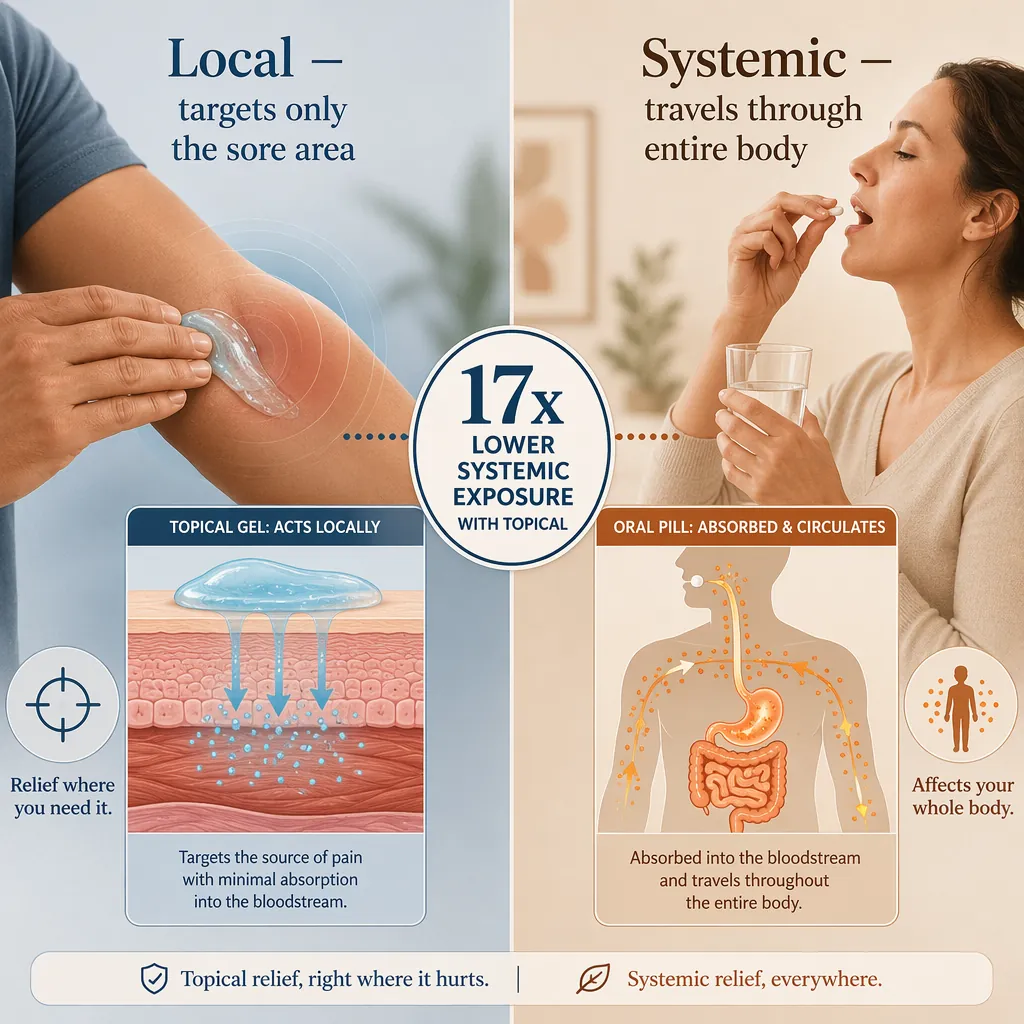
The practical appeal is not that topicals are magic. It is that they often provide enough relief while leaving fewer reasons to worry about systemic effects. For someone training at home several days a week, “enough relief” is usually the win. You need to get down the stairs, sleep normally, and avoid turning a small irritation into a week-long detour.
Where Acetaminophen Fits
If the soreness is general DOMS and you want an oral medication, acetaminophen is often the cleaner first choice. Houston Methodist sports medicine physicians recommend avoiding anti-inflammatories for routine post-workout soreness and reserving them for cases where discomfort significantly impairs function.[4] The reason is not that acetaminophen improves recovery. It is that it can reduce pain without directly targeting the inflammatory processes involved in muscle repair.
That makes acetaminophen a reasonable fit for the normal “I overdid lunges” situation: dull muscle ache, no obvious swelling, no sharp joint pain, no need to shut down inflammation. Tylenol is the familiar brand example, though generic acetaminophen is the same active ingredient.
The ceiling matters. For liver safety, keep total daily acetaminophen within the 3,000 to 4,000 mg range, and many clinicians prefer staying at the lower end unless a clinician has told you otherwise. Acetaminophen is also hidden in many cold, flu, sleep, and combination pain products, so stacking products is the easy way people exceed the limit without noticing.
Why Ibuprofen and Naproxen Should Not Be the Routine Soreness Default
Ibuprofen and naproxen are useful drugs. They reduce pain and inflammation, and there are days when that is exactly what you need. The mistake is treating them as the automatic answer to every sore muscle after training.
For hypertrophy-focused training, habitual high-dose NSAID use deserves extra caution. In a controlled resistance-training study reported by Karolinska Institutet and published in Acta Physiologica, young adults taking 1,200 mg of ibuprofen daily for 8 weeks gained roughly half as much muscle volume as a comparison group taking 75 mg of aspirin daily.[5] That study did not compare ibuprofen with no treatment, so it should not be turned into the lazy claim that one dose “kills gains.” It does support a more useful rule: do not make high-dose oral NSAIDs a routine companion to muscle-building blocks.
There are also ordinary health trade-offs. Scripps Health describes NSAID risks involving the stomach, kidneys, and cardiovascular system, especially with longer use or higher-risk health profiles.[6] Those risks are not theoretical enough to ignore, but they also do not mean a healthy adult can never take ibuprofen. They mean the reason should be better than “my shoulders feel like yesterday’s push-ups happened.”
Extreme endurance research illustrates why context matters. Harvard Health discussed a study of 89 ultramarathoners in which 44% had reduced kidney function by race end.[7] That is not a forecast for someone doing band rows in an apartment. It is a reminder that NSAID decisions get riskier when dehydration, long duration, heat, and heavy exertion enter the picture.
When an Oral NSAID Makes Sense
Oral NSAIDs are more defensible when inflammation is clearly part of the problem: visible swelling, pronounced tenderness, an irritated joint area, or soreness that prevents sleep or normal daily function. In that case, the medication is not being used to silence routine training feedback. It is being used because inflammation is limiting basic movement.
- Use the lowest effective dose listed on the product label unless a clinician gives different instructions.
- Keep use short, often in the 3 to 5 day range rather than as an open-ended recovery habit.
- Do not take NSAIDs preemptively before workouts just to train through pain.
- Avoid combining multiple NSAIDs, such as ibuprofen plus naproxen, unless specifically instructed by a clinician.
- Be more cautious if you are dehydrated, ill, drinking heavily, older, or managing kidney, stomach, blood pressure, or cardiovascular issues.
The point is not to be heroic about pain. It is to match the tool to the job. A short NSAID course for a swollen knee that keeps you from walking normally is a different decision from swallowing ibuprofen after every hard upper-body day because soreness feels inconvenient.
Pain Relief Should Not Hide a Bad Training Pattern
Medication can help you get through a rough day, but it cannot fix a program that keeps outrunning your recovery. If soreness repeatedly peaks hard enough to disrupt sleep, alter your form, or force you to skip sessions, the better intervention may be volume control, exercise substitution, protein and calorie adequacy, or more deliberate easy movement between sessions.
If you want the non-drug side of the same decision, start with foam rolling and active recovery for home gym training. If soreness seems tied to under-eating or poor post-workout fueling, compare Fairlife milk, chocolate milk, and whey for post-workout recovery or use a home gym athlete’s nutrition plan to check the basics. When the pattern is less “I trained hard” and more “I never feel ready,” a recovery tracker for overtraining symptoms is more useful than rotating pain relievers.
Plain-Language Rule Set
| Situation | Choose | Avoid |
|---|---|---|
| Routine DOMS after a hard home workout | Acetaminophen if you need an oral option; menthol/camphor or other topical comfort products if local | Making ibuprofen or naproxen automatic |
| Localized joint-area or tendon-adjacent soreness | Topical diclofenac gel first if appropriate; lidocaine patch for a contained painful spot | Assuming oral medication is required before trying local relief |
| Visible swelling or function-limiting tenderness | Short-term ibuprofen or naproxen if you can take NSAIDs safely | Pre-workout dosing or multi-day use without reassessing |
| Hypertrophy block where muscle gain is the priority | Use topicals or acetaminophen for routine soreness when possible | Habitual high-dose NSAID use |
| Kidney, liver, GI, cardiovascular, blood pressure, medication, or alcohol-related concerns | Ask a clinician or pharmacist before choosing | Treating OTC status as proof of safety |
| Sharp, severe, unusual, worsening, one-sided, or persistent pain | Medical evaluation | Training through it because a pill made it quieter |
So the practical answer is this: for most home workout soreness, use a topical product when the sore area is local, or acetaminophen when you want an oral pain reliever for routine DOMS. Use oral NSAIDs such as ibuprofen or naproxen only when inflammation is clearly dominating and only for a short window, after checking that your health situation makes them reasonable.
References
- Delayed Onset Muscle Soreness (DOMS), Cleveland Clinic
- Topical painkillers for sprains and strains, Harvard Health
- Understanding your options for topical pain relief, Mayo Clinic Press
- Sore Muscles After Workouts: Should You Take Pain Relievers?, Houston Methodist, 2024
- Anti-inflammatory drugs can inhibit muscle growth, Karolinska Institutet, 2017
- How to Choose Over-the-Counter Pain Medicine, Scripps Health
- Is it safe to take ibuprofen for the aches and pains of exercise?, Harvard Health, Aug. 9, 2017
This is general fitness education, not medical advice. For diagnosis or treatment of pain or injury, consult a qualified clinician.
Pick your next session
Browse all routines to find an appropriately-spaced next session.
Spot something off?
This content sits adjacent to health guidance — tell us if a citation or figure needs a correction.