
Best Protein Foods for Home Workout Muscle Gain
This evidence-based guide identifies the most cost-effective protein foods for home gym muscle gain, showing that eggs, Greek yogurt, lentils, and chicken thighs deliver the same muscle-building results as expensive supplements when total protein intake is sufficient. Learn how to rank foods by cost, DIAAS score, and leucine content to maximize every dollar spent at the grocery store.
- Citation source
- McMaster meta-analysis (2022)
- Evidence level
- general guideline
The cheapest useful answer for home workout muscle gain is also the least glamorous one: hit enough total protein first. In a 2022 McMaster meta-analysis of 74 randomized controlled trials, protein intake at or above 1.6 grams per kilogram of body weight per day was the key threshold associated with lean mass gain during resistance training, and whole-food protein worked as well as supplements when total intake was sufficient.[1]
That changes the grocery math. A tub of whey can be convenient, but it is not a requirement for building muscle after dumbbell rows in the spare room. The better question is whether a food helps you reach the daily target, gives a strong enough per-meal dose of leucine, has decent protein quality, and can be bought repeatedly without turning a budget home gym into a hidden subscription.
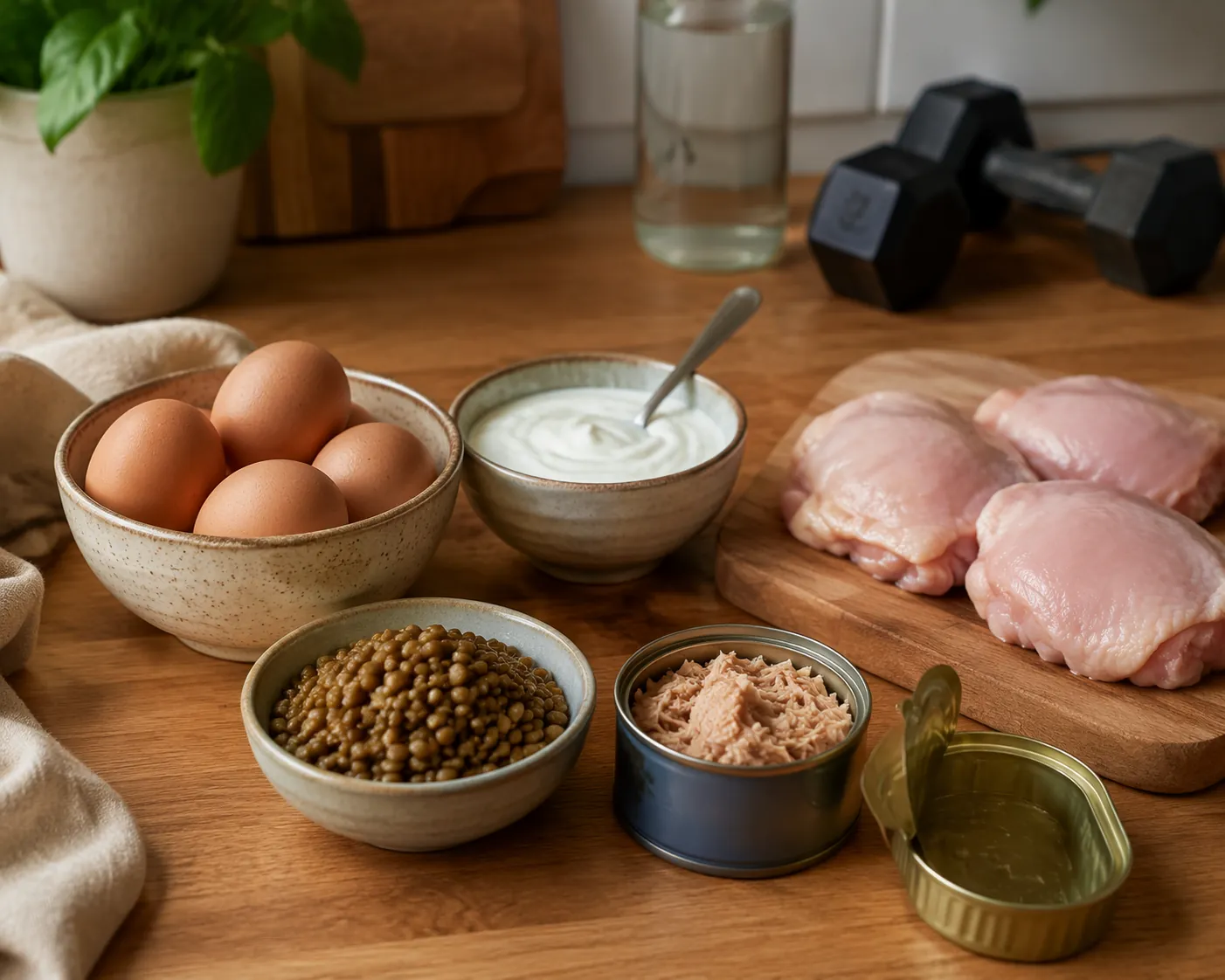
Start With the Protein Target, Not the Product
For a home-gym lifter, 1.6 g/kg/day is a practical sorting line. A 150-pound person is about 68 kilograms, so that target is roughly 109 grams of protein per day. A 180-pound person is about 82 kilograms, so the target is roughly 131 grams. Those numbers are not a prescription for every body or medical condition; they are a useful evidence-based benchmark for general resistance training nutrition.[1]
Once the target is visible, most “must-have” protein debates shrink. Whey isolate, chicken breast, salmon, beef, eggs, yogurt, tuna, lentils, and milk can all contribute. The winner is the food you can afford, tolerate, cook, store, and repeat often enough to make the weekly total happen.
The same constraint-based thinking applies to equipment. If you already compare benches, dumbbells, and floor space against your real budget, as in compact home gym budget builds, food should get the same treatment. A protein source that looks perfect on paper but never makes it into your cart is not really part of your program.
The Ranking System That Actually Helps at the Store
A useful protein ranking for home workout muscle gain has four checks. None of them needs to become a spreadsheet obsession, but ignoring all four is how people end up paying premium prices for the same result.
- Total protein: Does this food make it easier to reach about 1.6 g/kg/day?
- Leucine per meal: Can a normal serving help approach the roughly 2–2.5 g leucine threshold linked to muscle protein synthesis?
- Protein quality: Does the amino acid profile and digestibility support muscle-building needs?
- Repeatability: Is it affordable, available, and easy enough to eat several times a week?
DIAAS, or Digestible Indispensable Amino Acid Score, helps with the quality check. In the Levels 2026 guide, whey isolate is listed at 1.09, whole milk at 1.14, eggs around 1.0, beef around 1.0, soy around 1.0, legumes at 0.50–0.75, and grains at 0.40–0.55.[2] That does not mean legumes are useless. It means you should be more intentional with portions and pairings when plant foods carry more of the protein load.
Leucine is the next filter. Moore and colleagues identified a meal-level leucine threshold of roughly 2–2.5 grams for stimulating muscle protein synthesis.[3] In plain grocery terms, one egg is helpful but not a complete protein meal by itself; several eggs, yogurt, tuna, cottage cheese, milk, meat, or mixed meals can get closer to that trigger.
| Food | Why it ranks well | Main limitation |
|---|---|---|
| Eggs | High-quality protein, about 0.5 g leucine per egg, easy to cook | Usually need multiple eggs or another protein to anchor a full meal |
| Greek yogurt or cottage cheese | About 24–28 g protein per cup, casein-rich, no cooking required | Cost varies widely by brand and tub size |
| Canned tuna or sardines | About 22 g protein per 3 oz, complete protein, shelf-stable | Better as a rotation food than a mandatory daily staple |
| Lentils | Very low cost, shelf-stable dry, easy to batch cook | Lower DIAAS and incomplete amino acid profile; pair with other foods |
| Chicken thighs | Lower cost per pound than breast, similar usefulness for hitting protein | Needs cooking and portion planning |
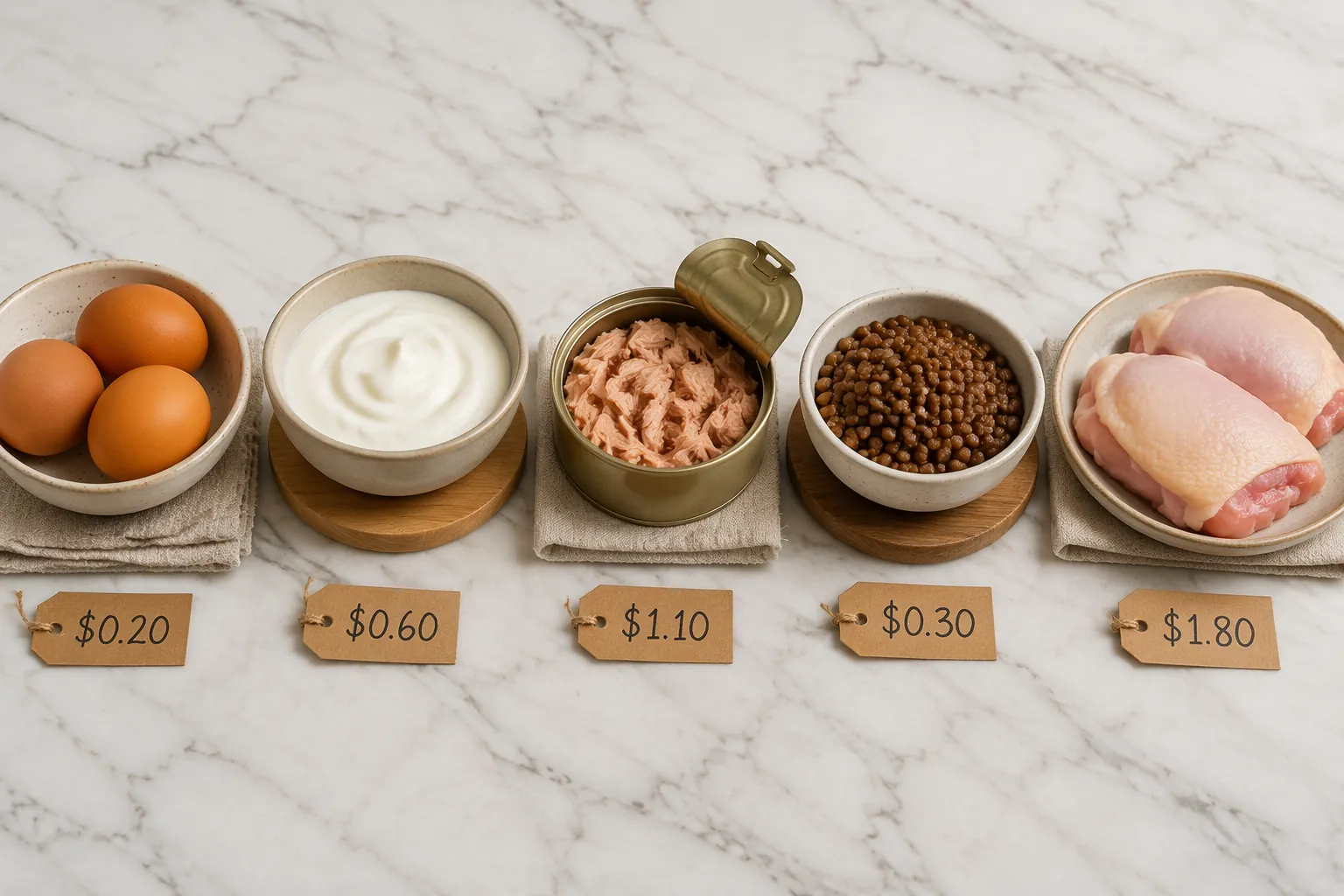
Eggs: The Baseline Food That Still Holds Up
Eggs earn their place because they are simple, high quality, and hard to waste. At about $2–4 per dozen, they give a budget lifter a dependable protein base without forcing a special trip to a supplement store. Their DIAAS sits around 1.0, and each egg provides about 0.5 grams of leucine.[2]
The leucine math matters. Two eggs are a useful addition to breakfast, but they usually do not reach the 2–2.5 gram leucine range alone. Three or four eggs get closer, and eggs become even more useful when paired with Greek yogurt, milk, cottage cheese, or a serving of meat later in the day.[3]
The case for whole eggs is also stronger than the old “just eat the whites” reflex suggests. A 2025 University of Illinois report on resistance training found that whole eggs outperformed egg whites in muscle-building response, and salmon outperformed processed mixtures, suggesting that the structure of whole foods can matter beyond matching isolated macronutrients.[4] The study should not be stretched into a universal law for every high-fat food; the related pork work had only 16 participants, so generalization should stay cautious.[4]
Greek Yogurt and Cottage Cheese: Low-Friction Meal Anchors
Greek yogurt and cottage cheese are boring in the best possible way. A cup can land around 24–28 grams of protein, with a casein-rich profile that digests more slowly than many fast proteins. That makes either one a useful anchor when cooking feels like too much after training.
They also solve a common home-gym problem: the meal after the workout is not always dinner. Sometimes it is 9 p.m., the pan is dirty, and the choice is between something cold from the fridge or drifting under the daily target. Yogurt with fruit, cottage cheese with toast, or either one beside eggs can turn a snack into a real protein serving.
This is where whey can still make sense. If the question is post-workout convenience, milk, chocolate milk, Fairlife-style higher-protein milk, and whey each have a place depending on cost, digestion, and preference. That comparison belongs more naturally in a recovery-specific discussion like Fairlife milk vs. chocolate milk vs. whey for post-workout recovery. For the grocery list here, yogurt and cottage cheese win because they are food, snack, and protein anchor at once.
Canned Tuna and Sardines: Complete Protein Without Fridge Space
Canned tuna and sardines are not exciting, but they are useful in exactly the way home training requires. A 3-ounce serving provides about 22 grams of complete protein, often at about $1–2 per serving, and the cans sit in a cabinet until the day your planned meal falls apart.
Sardines add an omega-3 upside, while tuna is usually easier for people to find in multi-packs. Neither has to become a daily ritual. They work better as backup protein: lunch on a busy workday, a no-cook dinner with rice and vegetables, or the emergency bridge between a hard session and a later full meal.
Lentils: The Budget Pick That Needs a Partner
Lentils deserve more respect than most muscle-building lists give them, but they also deserve honest handling. At about $1.50 per pound dry, they are one of the strongest cost-per-gram plays in the grocery store. They store well, cook in batches, and make it easier to add protein to meals that would otherwise be mostly starch.
The caveat is quality. Legumes are listed with DIAAS values around 0.50–0.75, below eggs, milk, beef, soy, and whey isolate.[2] They also have an incomplete amino acid profile compared with many animal proteins. That does not disqualify them; it changes how to use them.
The practical move is pairing. Lentils with rice, lentils with yogurt on the side, lentil soup followed by cottage cheese, or lentils under chicken thighs are all more defensible than pretending a small scoop of lentils is nutritionally identical to a complete animal-protein serving. Plant-forward muscle gain is possible, but the evidence base in the McMaster meta-analysis was about 80% animal-protein trials, so claims about plant proteins should stay narrower and more careful.[1]
Chicken Thighs Beat the Premium-Cut Trap
Boneless skinless chicken breast became the default fitness food partly because it is lean and easy to count. That does not make it the only sensible cut. Chicken thighs usually cost less per pound than breast and still do the main job: they add a dense, complete protein serving to meals you can repeat.
For a budget home gym user, repeat cooking matters more than cosmetic leanness. Thighs tolerate reheating, stay moister in batch cooking, and fit cheap meals with rice, potatoes, beans, lentils, or frozen vegetables. If the higher fat content fits your overall diet, they are often a better real-world choice than buying the “cleanest” cut and getting tired of it by Wednesday.
This is the same hidden-cost problem that shows up with equipment. A bargain rack that needs extra mats, shipping fees, and ceiling clearance is not always cheap; a protein plan built around premium cuts can quietly do the same thing. The grocery bill belongs in the same category of planning as hidden costs of home gym equipment.
Where Whey, Beef, and Salmon Fit
Whey isolate is not the enemy. With a DIAAS of 1.09, it is a high-quality benchmark, and it is useful when appetite, schedule, or cooking time gets in the way.[2] The mistake is treating it as proof that whole foods are second-rate. The McMaster analysis does not support that hierarchy when total protein is sufficient.[1]
Beef and salmon are also high-quality proteins. Beef sits around a DIAAS of 1.0, and salmon has supportive whole-food evidence in the University of Illinois work.[2][4] They simply do not need to dominate a budget list. If they fit your cart, use them. If they crowd out eggs, yogurt, lentils, tuna, and chicken thighs, the “optimal” food may be making the whole plan less repeatable.
A Defensible Grocery Hierarchy
If you are shopping for muscle gain on a home-gym budget, build the cart in layers rather than hunting for one perfect food.
- Choose two easy complete proteins: eggs, Greek yogurt, cottage cheese, canned fish, chicken thighs, milk, or whey if convenience justifies the price.
- Add one cheap volume protein: lentils are the obvious pick, especially when paired with grains, dairy, eggs, or meat.
- Check the daily total: aim near 1.6 g/kg/day if you are using the resistance-training evidence as your benchmark.
- Check the meal anchors: make sure at least a few meals contain enough high-quality protein to approach the 2–2.5 g leucine range.
- Keep the foods you will actually repeat: a cheaper food you cook twice a week beats an ideal food that spoils.
That hierarchy is more useful than a fixed meal plan because home training rarely happens in a perfect nutrition bubble. People train between work calls, after kids go to bed, beside a folding bench, or in the same garage where the laundry is running. The best equipment choices come from matching tools to constraints, as in a best home exercise equipment buying guide. Protein deserves the same realism.
No single food is essential. Eggs are a reliable baseline, Greek yogurt and cottage cheese are low-friction anchors, canned tuna and sardines are shelf-stable insurance, lentils are the budget extender that needs pairing, and chicken thighs are the reminder that premium cuts are optional. If those foods help you reach enough total protein with adequate leucine at a price you can keep paying, they are doing the job.
This is general fitness nutrition, not medical or individualized dietary advice. If you have kidney disease, food allergies, pregnancy-related needs, eating-disorder history, or any condition requiring a prescribed diet, get individualized guidance before using protein targets as a planning tool.
References
- The Effect of Protein Supplementation on Resistance Training-Induced Gains in Muscle Mass and Strength in Healthy Adults: A Systematic Review and Meta-Analysis, National Library of Medicine, 2022, https://pmc.ncbi.nlm.nih.gov/articles/PMC8978023/
- Levels Guide to Protein Sources, Levels, 2026, https://www.levels.com/blog/levels-guide-to-protein-sources
- Ingested protein dose response of muscle and albumin protein synthesis after resistance exercise in young men, PubMed, 2009, https://pubmed.ncbi.nlm.nih.gov/18996867/
- Muscle-building response to weight training differs among high-protein animal foods, University of Illinois Urbana-Champaign News Bureau, 2025, https://news.illinois.edu/study-muscle-building-response-to-weight-training-differs-among-high-protein-animal-foods/
This is general fitness education, not medical advice. For diagnosis or treatment of pain or injury, consult a qualified clinician.
Pick your next session
Browse all routines to find an appropriately-spaced next session.
Spot something off?
This content sits adjacent to health guidance — tell us if a citation or figure needs a correction.