
How Cannabis Affects REM Sleep and Your Home Workout Recovery
Home exercisers often turn to cannabis for better sleep, but research reveals a measurable tradeoff: more deep sleep at the cost of REM suppression. This guide explains the evidence so you can decide whether cannabis helps or hinders your recovery based on your training phase.
- Citation source
- Journal of Clinical Sleep Medicine
- Evidence level
- restrained inference
The home-gym version of recovery is brutally simple: you finish the last set, fold the bench back against the wall, rinse the shaker, and hope sleep does the job that a coach, massage table, or recovery staff is not going to do for you. If cannabis is part of that night routine, the useful question is not whether it is “good” or “bad” for sleep. It is whether the sleep it helps you get is the kind of sleep your current training actually needs.
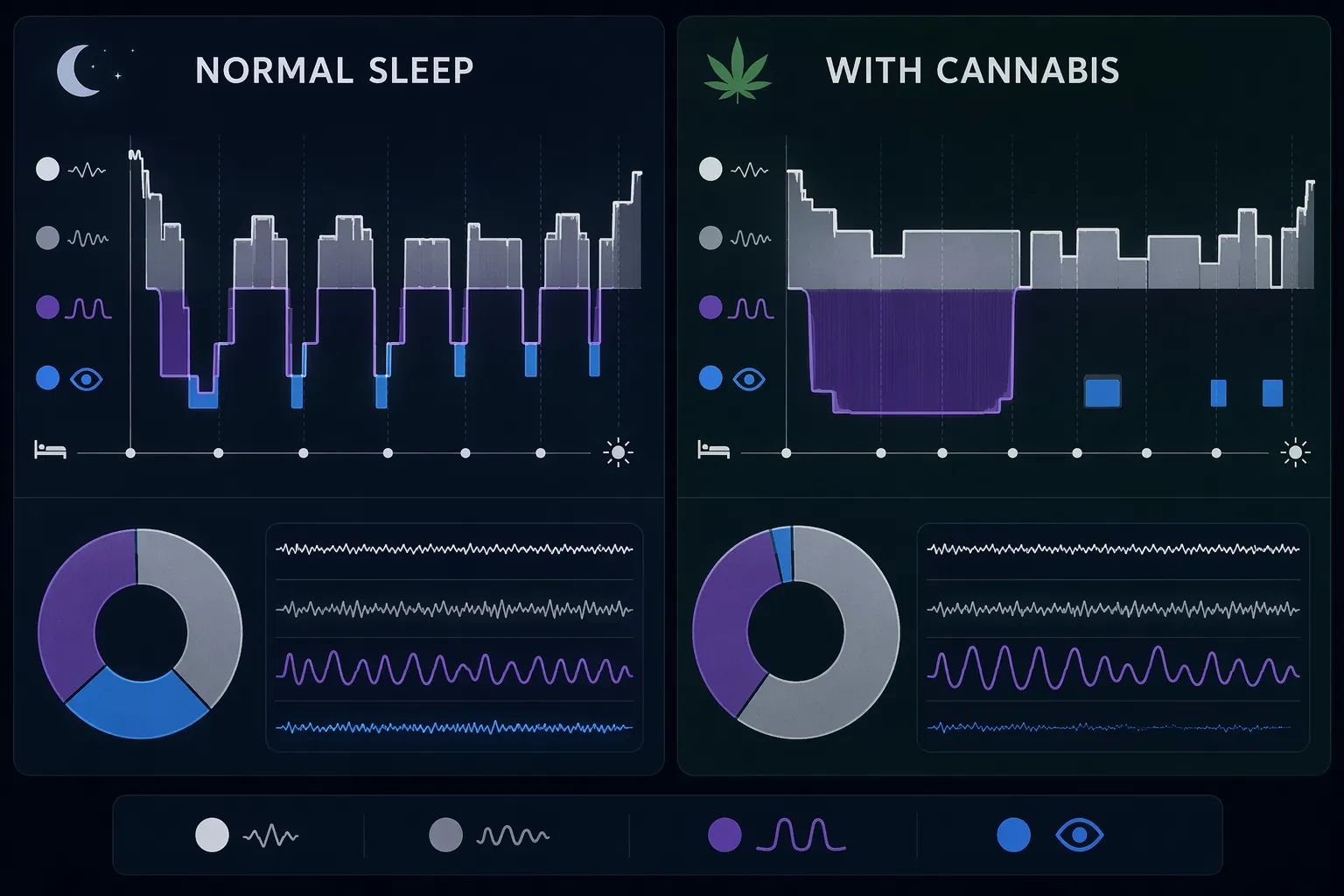
The tradeoff is measurable: cannabis can shift sleep toward more slow-wave sleep, the deep stage most associated with physical restoration, while reducing or delaying REM sleep, the stage tied to motor learning, emotional processing, and cognitive recovery. That matters for home workout recovery because a sore high-volume block and a technique-heavy strength progression do not stress the same recovery system.
The strongest human evidence does not come from people vaguely remembering whether they slept well. In a 2024 Journal of Clinical Sleep Medicine study of 177 adults using home sleep testing and mass-spectrometry metabolite verification, cannabis use close to sleep was associated with more wake after sleep onset, more light N1 sleep, and, among frequent users, longer REM latency and lower sleep efficiency. Wake after sleep onset was 60.5 minutes with cannabis exposure versus 45.8 minutes without, and N1 sleep was 15.2% versus 12.3%.[1]
A separate at-home EEG study from UT Dallas’ Center for BrainHealth tracked 339 nights in people with chronic pain and reported the same basic shape from a different angle: cannabis use increased slow-wave sleep at the functional cost of reduced REM sleep.[2] That is not a clean recovery win. It is a reallocation.

What changes when cannabis changes sleep architecture
Sleep quality is easy to flatten into one number: hours slept, score, readiness, recovery, body battery. Those dashboards are useful, but they hide the sequence. A night can be long and still fragmented. It can feel heavy and still lose REM. It can contain more deep sleep while also spending more time awake after initially falling asleep.
| Sleep measure | What it means for a home exerciser |
|---|---|
| Slow-wave sleep | Deep non-REM sleep linked with physical restoration and growth-hormone-related repair processes. |
| REM sleep | A sleep stage involved in motor learning, emotional regulation, and cognitive recovery. |
| WASO | Wake after sleep onset; more WASO means more time awake after initially falling asleep. |
| Sleep efficiency | The share of time in bed actually spent asleep; lower efficiency can make a long night less restorative. |
| REM latency | How long it takes to reach the first REM period; longer latency means REM is pushed later. |
| N1 sleep | Light sleep; more N1 can mean the night is less consolidated. |
That distinction matters after training because “recovery” is not one job. Muscle tissue repair, glycogen restoration, coordination, pain perception, motivation, and next-day decision-making all get bundled into the same word. A heavy goblet squat block in a small apartment asks different things from sleep than learning a new single-leg hinge pattern or reintroducing cleans with adjustable dumbbells after months away.
The slow-wave side of the tradeoff is tempting for lifters. Deep sleep is where a lot of the body’s repair signaling is usually discussed, especially around growth hormone. But even that story is not as simple as “more deep sleep equals more muscle repair.” A 2025 UC Berkeley Cell study in mice reported that growth hormone regulation required both NREM and REM, with somatostatin and GHRH neurons surging during REM to regulate growth hormone output.[3] That does not prove cannabis disrupts muscle repair in human home exercisers. It does make REM harder to dismiss as just dream sleep.
When the bottleneck is sore tissue
There are training weeks where the limiting factor is obvious. Your legs are cooked from high-rep split squats. Your pressing volume is up. You are not learning a new pattern; you are accumulating work and trying to show up again with less soreness and enough energy to repeat the plan.
In that situation, the possible slow-wave sleep increase is relevant. The Center for BrainHealth finding gives a plausible reason some people feel cannabis helps them recover: more deep sleep could align with a physical repair bottleneck.[2] The important caveat is population fit. That study involved people with chronic pain, not a clean sample of healthy apartment lifters running hypertrophy blocks. Pain itself changes sleep, arousal, and perceived recovery, so the result should not be stretched into a guarantee for every home workout routine.
For a home exerciser, the honest version is narrower: if cannabis helps you fall asleep on a night when soreness or discomfort would otherwise keep you awake, the subjective benefit can be real. Getting enough sleep to train tomorrow is not nothing. But the Althoff data keeps the guardrail in place: cannabis exposure close to sleep was also linked with more time awake after sleep onset and lower sleep efficiency among frequent users.[1] If the gummy gets you into bed but the night becomes more fragmented, the recovery math may not move the way it feels at 11 p.m.
When the bottleneck is skill, coordination, or readiness
REM suppression deserves more attention when the training problem is not just tissue stress. Home training often looks simple from the outside, but it can be coordination-heavy: learning a better hip hinge, controlling tempo without a coach watching, increasing load on unilateral work, or trying to keep bar path and bracing honest when nobody is there to catch the drift.
That is where reduced REM starts to matter. REM is involved in motor learning and emotional regulation, and both show up in training quality. Motor learning is the difference between repeating a movement and owning it. Emotional regulation is the difference between adjusting a session intelligently and turning every mediocre day into either a max-out or a skipped workout. Cognitive recovery is the quiet layer under load selection, warm-up patience, and whether you notice that your last reps look different from your first.
The Althoff study found longer REM latency among frequent users, meaning REM was pushed later into the night.[1] The at-home EEG data reported reduced REM with cannabis use in the chronic pain sample.[2] Those findings do not prove your dumbbell Romanian deadlift will get worse after one cannabis-assisted night. They do support a practical concern: if your current block depends on learning, coordination, mood stability, or careful self-regulation, regularly trading away REM may hide the exact bottleneck you need sleep to solve.

Why more sleep can still be the wrong headline
Wearable data makes this messier in a useful way. WHOOP reported that, across thousands of members in April 2026, logged marijuana use was associated with 11.4 more minutes of sleep, but also 1% lower sleep efficiency, 1 beat per minute higher resting heart rate, and 2.8 milliseconds lower HRV. WHOOP also reported no significant impact on next-day Recovery score.[4]
That is exactly the kind of result that should slow down both camps. The pro-cannabis headline would grab the extra sleep. The anti-cannabis headline would grab the worse HRV and resting heart rate. The training-relevant reading is less dramatic: the same behavior may add sleep time while nudging autonomic markers and efficiency in the wrong direction, and the next-day recovery score may not move enough to warn you.
That last part matters for people training at home. If you do not have a coach watching bar speed or a therapist noticing that your movement quality changed, you may rely too heavily on how ready you feel in the morning. A score that stays flat does not prove there is no cost. It may mean the cost is small, delayed, individualized, or outside what the daily score captures.
Clinical literature is not clean either. A 2024 American Academy of Sleep Medicine viewpoint by Mayo Clinic’s Bhanu Kolla summarized cannabis-and-sleep studies this way: 21% showed improvement, 48% showed worsening, 14% were mixed, and 17% showed no impact.[5] That spread is a useful warning against turning one good night into a rule.
THC and CBD should not be treated as the same sleep tool
The cannabis sleep conversation often gets sloppy because THC, CBD, flower, gummies, dose, timing, tolerance, pain, anxiety, and alcohol all get collapsed into “cannabis.” For recovery decisions, the THC-versus-CBD distinction is the one worth keeping.
THC is the part most associated with feeling high and with REM suppression. CBD is different. Sleep Foundation notes that CBD does not suppress REM sleep the way THC can.[6] That does not make CBD a proven recovery enhancer, and it does not mean every CBD product is reliable. It simply means the REM tradeoff that matters for skill, mood, and cognitive recovery is more directly a THC concern.
That distinction is more useful than strain folklore. “Indica for sleep” and “sativa for energy” do not tell you what happened to REM latency, sleep efficiency, or wake time after sleep onset. If the recovery question is sleep architecture, product mythology is the wrong measurement tool.
A practical way to read your own training phase
The useful decision is not permanent identity. It is phase-specific. A home lifter can make a better call by asking what is actually limiting the next two to four weeks of training.
- If soreness, high volume, and general fatigue are the main bottlenecks, the possible slow-wave sleep benefit may be relevant, especially if cannabis prevents a short or restless night.
- If you are learning new movements, increasing load on technically demanding lifts, or returning after a layoff, protect REM more aggressively because motor learning and coordination are part of recovery.
- If stress, mood, or motivation is the weak link, be cautious about repeated REM suppression even when total sleep time looks better.
- If your wearable shows more sleep but lower efficiency, higher resting heart rate, or lower HRV over several weeks, treat that as a signal to reassess rather than a reason to chase even more sleep time.
- If cannabis is being used to manage persistent insomnia, pain, anxiety, or another medical issue, that moves beyond workout recovery and belongs in a clinical conversation.
The training log is where this becomes practical. Track the thing cannabis is supposed to help, but also track the thing it might be costing. For a high-volume strength phase, that might mean soreness, session completion, sleep efficiency, resting heart rate, and HRV. For a skill-heavy phase, add notes on coordination, warm-up quality, irritability, missed reps from poor timing, and whether a movement feels better or just heavier.
Do not expect the answer to show up after one night. The WHOOP data suggests daily Recovery may not change significantly even when sleep time, efficiency, resting heart rate, and HRV move.[4] The more useful pattern is drift: a few weeks where sleep seems longer but training feels less crisp, mood is flatter, or technique needs more warm-up sets before it locks in.
The narrow answer
Cannabis does not simply help or hurt home workout recovery. It can change the kind of sleep you get. The evidence points toward a tradeoff: possible increases in slow-wave sleep, especially documented in chronic pain data, alongside reduced or delayed REM, more light sleep, more wake time after sleep onset, or lower efficiency in other at-home measurements.[1][2]
If the current problem is sore tissue and lost sleep, cannabis may feel useful because it helps you get through the night. If the current problem is learning, coordination, emotional regulation, or reliable readiness without outside coaching, REM suppression is a real cost to watch. Match the tool to the bottleneck, then let several weeks of training notes, sleep efficiency, HRV, resting heart rate, mood, and movement quality tell you whether the trade is still worth it.
References
- The impact of cannabis use proximal to sleep: a cross-sectional study, Journal of Clinical Sleep Medicine, 2024, link
- Sleep, Cannabis and Chronic Pain, Center for BrainHealth, Dec. 2025, link
- Sleep strengthens muscle and bone by boosting growth hormone levels. UC Berkeley researchers discover how, UC Berkeley News, Sept. 8, 2025, link
- The Impact of Marijuana on Sleep, Resting Heart Rate, and HRV, WHOOP, April 2026, link
- Cannabis and sleep disorders: What clinicians need to know, American Academy of Sleep Medicine, 2024, link
- Cannabis and Sleep, Sleep Foundation, link
This is general fitness education, not medical advice. For diagnosis or treatment of pain or injury, consult a qualified clinician.
Pick your next session
Browse all routines to find an appropriately-spaced next session.
Spot something off?
This content sits adjacent to health guidance — tell us if a citation or figure needs a correction.