
Continental Divide Trail safety starts with home gym training
Injuries cause 29% of CDT thru-hikers to quit, but targeted home gym training and recovery can prevent the most common hike-ending conditions like plantar fasciitis and overuse leg injuries. This article translates what 213 real hikers did—and what they wished they'd done—into a practical training protocol for your small-space home gym.
- Citation source
- Halfway Anywhere CDT Hiker Survey
- Evidence level
- restrained inference
Continental Divide Trail safety for hikers starts before anyone is standing under a storm cell in Colorado or deciding whether to ford a cold creek. It starts with whether the feet, calves, hips, and connective tissue can keep absorbing load after the easy freshness is gone. In the 2024 Halfway Anywhere CDT hiker survey, injury was the leading reported reason hikers quit: 29.2% of all quits, ahead of snow and personal reasons, each at 16.7%.[1]
That number matters more when it is set beside the workload finishers actually carried. The average CDT finisher in the survey hiked 22.3 miles per hiking day, took 125 hiking days, spent 140 total days on trail, and used 16 zero days and 14 nearo days.[1] A hiker does not need to be reckless for that to become a tissue problem. They only need a sore arch, a tight calf, a deadline, and several more weeks of walking.
The usual CDT safety categories still count. The Continental Divide Trail Coalition frames thru-hiking preparation around the “Three Ts”: Trip Plan, Training, and Take the Essentials.[2] A trip plan keeps people from improvising every resupply and emergency contact. Essentials matter when weather, navigation, exposure, and water all get less forgiving. But for a home-gym hiker, the most controllable piece is training—not vague confidence from being “active,” but repeated, specific work that makes the lower body harder to break.
The injury pattern is specific enough to train for
The Halfway Anywhere survey is not an official CDT completion database. It is a self-selected survey of 213 respondents, and the reported completion rate can skew high because finishers are often easier to reach and more willing to answer. Still, it is a useful field signal because it asks the questions hikers usually avoid until their bodies force the issue.[1]
Among reported hike-ending injuries, plantar fasciitis accounted for 42.9%, overuse leg injuries for 28.6%, and stress fractures for 14.3%.[1] That is not a pattern of freak accidents. It points toward repeated loading, insufficient tissue tolerance, recovery debt, and small problems that were walked on until they became decisions.
| Survey signal | What it means for training |
|---|---|
| Injury caused 29.2% of reported quits | Fitness needs to include durability, not only aerobic capacity |
| Plantar fasciitis was 42.9% of hike-ending injuries | Feet, calves, ankles, and gradual load progression deserve dedicated work |
| Overuse leg injuries were 28.6% of hike-ending injuries | Hips, quads, hamstrings, glutes, and descending tolerance need preparation |
| Stress fractures were 14.3% of hike-ending injuries | Recovery, fueling awareness, and pain rules cannot wait until trail |
| 35.1% of hikers did no pre-hike training | Experience alone does not guarantee readiness for the CDT workload |
The experience gap is also easy to misread. Only 7.1% of surveyed CDT hikers were on their first long-distance hike, so the field was not full of beginners wandering into an advanced trail by mistake.[1] Yet finishers still rated their pre-trail fitness only 6.2 out of 10 on average, and 33.6% of all respondents wished they had trained more.[1] Prior trail experience helps with judgment, packing, pacing, and fear management. It does not automatically build a more tolerant plantar fascia.
Even the location data points less toward one villainous section than toward accumulation. Wyoming produced 57.1% of hike-ending injuries in the survey despite being the shortest state section.[1] That sample is small, so it should not be treated as a predictive map. But as a warning, it is useful: a hiker can survive harder-looking terrain earlier and still arrive later with tissue that has been quietly losing the argument.
What most hikers trained—and what was missing
The most common pre-hike training methods in the survey were day hikes at 40.5%, walking at 31.9%, running at 27.0%, and weight training at 23.8%.[1] None of those choices is wrong. Day hikes teach shoes, pack fit, fueling rhythm, and how the body behaves after several hours. Walking is the base layer. Running can build aerobic capacity if the hiker tolerates it well. Weight training is the tool that many hikers underuse because it feels less trail-specific than logging miles.
For CDT preparation, the point of home-gym strength work is not to replace hiking. It is to create controlled exposure to the forces that become sloppy on trail: single-leg loading, eccentric braking on descents, calf fatigue, foot stiffness, hip drop under a pack, and the tendency to shorten stride when something starts to hurt. A living room cannot reproduce altitude, lightning, snow, or navigation fatigue. It can make the legs and feet less surprised when the miles stop feeling novel.
A small-space protocol for the injuries that end hikes
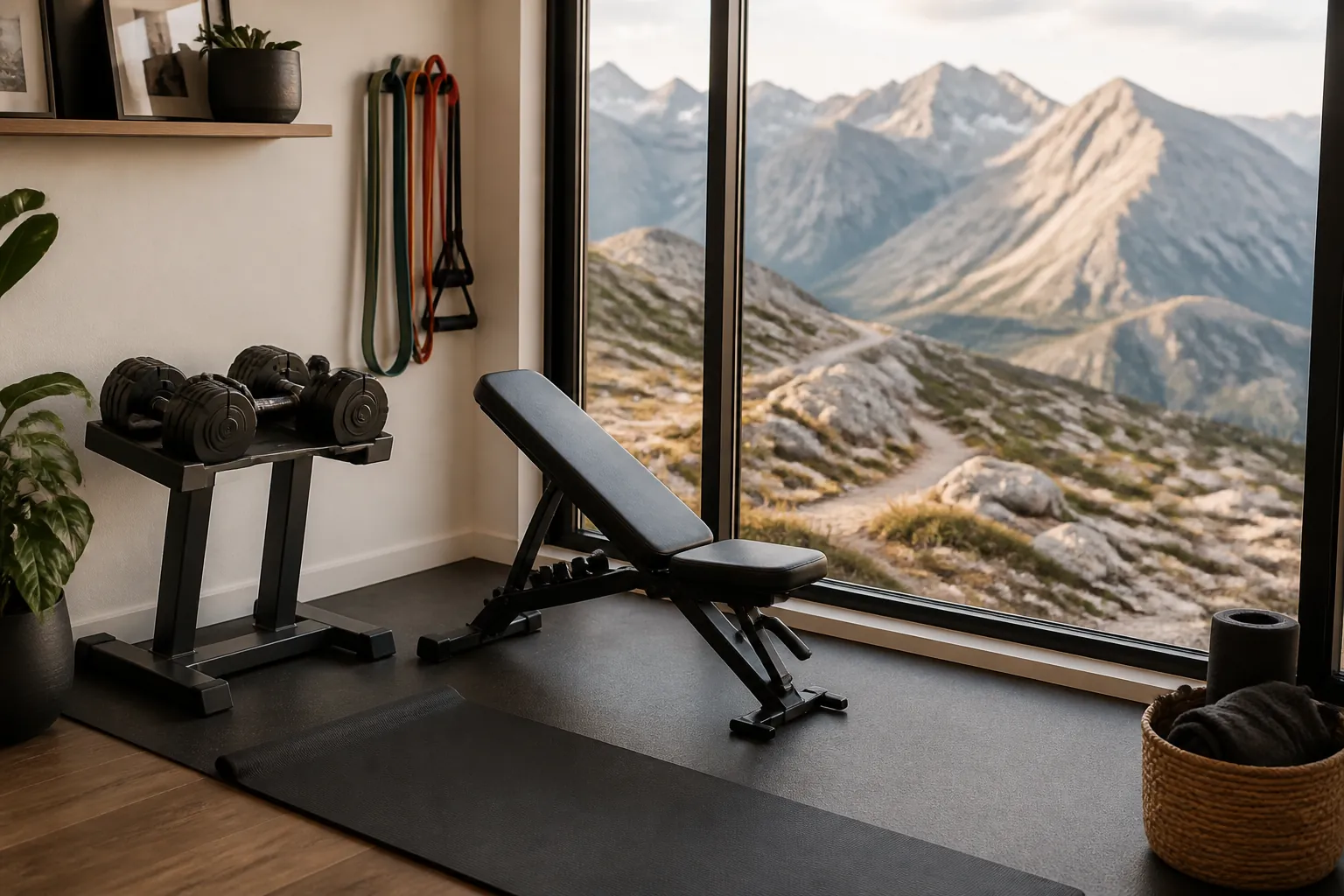
A useful CDT home-gym plan has to be boring in the right places. The work should repeat often enough to matter, progress gradually enough to absorb, and target the structures that show up in the injury data. Adjustable dumbbells, resistance bands, a bench or step, a mat, and a loaded pack are enough for the core of it.

Start with feet and calves, because plantar fasciitis leads the injury list
Plantar fasciitis making up 42.9% of reported hike-ending injuries is the clearest reason to stop treating foot care as an afterthought.[1] The foot does not need a complicated routine, but it does need regular loading and regular inspection. A hiker who only trains quads and lungs can still be stopped by a strip of irritated tissue under the arch.
- Calf raises: use straight-knee and bent-knee versions so both the gastrocnemius and soleus get loaded; progress from bodyweight to dumbbells or a pack.
- Slow eccentrics: lower the heel under control rather than bouncing through reps; downhill hiking asks the lower leg to brake repeatedly.
- Tibialis raises: lean against a wall and lift the toes toward the shins to train the front of the lower leg.
- Foot intrinsic work: use short-foot contractions, toe spreading, towel pulls, or controlled barefoot balance on a safe surface.
- Loaded standing tolerance: finish some sessions by standing or marching in place with a pack so the feet practice bearing load without the distraction of mileage.
The mistake is trying to make foot training heroic. The better version is consistent and modest: a few minutes after lower-body sessions, a few minutes during mobility work, and enough progression that the feet adapt instead of flare. If a new shoe, insert, or pack weight is being tested, the foot routine should stay stable so the hiker can tell what changed.
Train one leg at a time before the trail forces the issue
The CDT is not walked with two feet evenly planted like a barbell back squat. It is thousands of uneven single-leg problems: stepping onto rock, dropping off trail ledges, catching balance with tired hips, climbing with one side stronger than the other. That is where split squats, step-ups, lunges, and single-leg hinges earn their space.
- Step-ups: use a stable bench or box, drive through the full foot, and control the lowering phase.
- Reverse lunges: load with dumbbells when technique is steady; keep the front knee tracking over the toes without collapsing inward.
- Split squats: pause at the bottom to build control in the range where tired hikers often rush.
- Single-leg Romanian deadlifts: train hamstrings, glutes, balance, and hip control without needing heavy equipment.
- Lateral band walks: prepare the hips to resist collapse when the trail tilts or the pack shifts.
A simple home session can pair one knee-dominant movement with one hip-dominant movement: step-ups with single-leg Romanian deadlifts, or split squats with banded lateral walks. The goal is not soreness. It is repeatable control under load, especially on the lowering phase. If the descent is always an afterthought in training, it will become a bill on trail.
Build posterior-chain strength for the pack, not the mirror
A pack changes posture. It asks the glutes, hamstrings, spinal erectors, and trunk to keep doing low-grade work while the legs climb, descend, and compensate. Home-gym training should include hinges and carries because they teach the body to support load without turning every climb into a lower-back negotiation.
- Dumbbell Romanian deadlifts for hip hinge strength and hamstring tolerance.
- Glute bridges or hip thrusts for hip extension when heavier hinge work is not available.
- Farmer carries with dumbbells for grip, trunk stiffness, and loaded walking posture.
- Suitcase carries for anti-lean strength when the body is tired or the pack rides unevenly.
- Dead bugs, side planks, and bird dogs for trunk control that does not depend on a gym machine.
This is where home training should feel most unglamorous. A hiker who can hinge well, carry weight without twisting, and keep the pelvis steady on one leg has fewer leaks to manage when fatigue stacks up.
Use mobility to preserve positions, not to perform flexibility
Mobility work earns its place when it helps the hiker access positions they will need repeatedly: ankle dorsiflexion for climbing and descending, hip extension for long strides, hip rotation for uneven ground, and thoracic movement for breathing and pack posture. It does not need to become a second workout.
- Ankle rocks before step-ups or lunges to check whether the knee can travel forward without the heel lifting early.
- Calf and soleus stretching after loading, especially when the lower leg feels guarded.
- Hip flexor stretches after long sitting days or heavy step-up sessions.
- 90/90 hip switches for rotation control rather than passive stretching alone.
- Thoracic rotations to keep the upper body from turning rigid under pack weight.
The useful test is whether mobility work changes the next session. If step-ups feel cleaner, calves stop grabbing early, or the hiker can descend stairs without guarding, it is doing something. If it only makes the training log look complete, it can be shortened.
A weekly home-gym structure that leaves room to adapt
A CDT training week should not be built like a punishment calendar. It needs enough stress to create adaptation and enough recovery to keep the hiker trainable. The survey shows that many hikers used walking, day hikes, running, and weight training, but it does not prove one perfect formula.[1] The practical answer is to combine them without letting any one piece bury the others.
| Day type | Main work | Purpose |
|---|---|---|
| Strength day A | Step-ups, Romanian deadlifts, calf raises, core carry | Climbing strength, hinge capacity, lower-leg durability |
| Aerobic base day | Brisk walk, incline treadmill if available, easy run only if tolerated | Low-intensity volume without excessive impact |
| Strength day B | Split squats, single-leg Romanian deadlifts, tibialis raises, lateral band work | Single-leg control and lower-leg balance |
| Mobility and foot-care day | Ankle, calf, hip, and foot work; short easy walk | Maintain positions and check irritation early |
| Long walk or day hike | Progressive time on feet, eventually with pack weight | Practice footwear, fueling rhythm, and sustained load |
| Recovery day | Rest or very easy movement | Absorb training before fatigue becomes the training plan |
The exact days can move. The order matters less than the spacing: do not place the hardest lower-body lift, the first loaded pack hike, and a new running volume spike into the same recovery window. When two variables rise at once, the hiker loses the ability to tell which one caused the warning signal.
Progression should be plain enough to follow when life gets busy. Add a little pack weight, a little step height, a little walking duration, or a little dumbbell load—not all of them together. The CDT already supplies chaos. Training does not need to rehearse chaos by being disorganized.
Recovery is not what happens after the plan fails
The recovery numbers from finishers are worth sitting with: 125 hiking days inside 140 total days, with 16 zero days and 14 nearo days.[1] That is not a gentle schedule. It is a long sequence of stress with occasional chances to reduce it. A hiker who treats rest as a moral defeat at home is unlikely to become suddenly wise about rest when a resupply date, weather window, or partner plan is pressing.

The trail also adds an energy problem. One CDT preparation account described hikers expending roughly 4,000 to 5,000 calories per day while consuming about 2,000 to 2,500.[3] That kind of chronic gap does not automatically cause one specific injury, and one account should not be treated as a universal measurement. But the mechanism is easy to respect: under-fueled bodies have less margin for repairing the same feet and legs they are loading again tomorrow.
Practice zero and nearo logic before the CDT
A zero day is not just a day without miles. A useful zero has jobs: reduce tissue load, eat enough, sleep, dry and inspect gear, check feet without bargaining, and decide whether the next miles should be normal, shortened, or delayed. A nearo should do the same work on a smaller budget. If every low-mile day becomes errands, laundry, social catch-up, and no actual recovery, the body notices.
At home, this can be rehearsed with scheduled deloads. Every few weeks, reduce lower-body volume, keep easy movement, and spend the saved time on foot care, mobility, sleep, and meal planning. The point is not to mimic trail life perfectly. It is to make backing off feel like part of training rather than a confession of weakness.
Use soreness rules before pain becomes identity
Some discomfort belongs to training. The problem is when every signal gets filed under “normal.” A practical home-gym rule set should separate muscle soreness from tissue warning signs before the hiker is emotionally invested in making miles.
- Acceptable: general muscle soreness that warms up, stays symmetrical, and fades across a day or two.
- Caution: arch pain, heel pain, shin tenderness, pinpoint bone pain, or pain that changes gait.
- Back off: pain that increases during a session, returns earlier each workout, or lingers into normal walking.
- Stop and reassess: pain that causes limping, night pain, swelling, or a sharp localized sensation.
- Do not hide symptoms with extra intensity elsewhere; replace load with recovery work or easy movement until the pattern is clear.
This is where a notebook beats memory. Record the movement, load, footwear, pack weight, walking duration, and pain location. The goal is not to create a perfect athlete spreadsheet. It is to catch the boring sequence that often precedes a hike-ending problem: new load, tight calf, sore arch, longer walk anyway, worse morning pain, repeat.
Foot checks belong in the routine, not just the first-aid kit
Foot care is easy to respect on paper and easy to skip when tired. That is exactly why it should be practiced at home. After long walks or loaded step sessions, check hot spots, nail pressure, heel irritation, arch tenderness, and whether one side feels more beaten up than the other. If a shoe consistently creates the same problem in training, the trail will not make it kinder.
A massage ball, clean socks, trimmed nails, and five honest minutes are not dramatic equipment. They are part of the same safety system as the dumbbells. The hiker who can still do foot care when bored and mildly tired has a better chance of doing it when the day was long and the next town feels close.
Injury prevention sits inside the rest of CDT safety
Training does not outrank the other safety problems on the CDT. It just removes one preventable failure point. The same survey found that hikers who always treated water reported a 2.7% illness rate, compared with 14.3% among those who treated occasionally.[1] That is not a squat problem. It is a systems problem: the tired hiker still has to make the safe choice when water looks clear and the filter feels annoying.
Colorado is another reminder not to turn strength training into a safety fantasy. In the survey, 79% of hikers rated Colorado the most difficult section, with altitude, snow, and lightning among the major pressures.[1] Strong legs help a hiker move efficiently and make fewer fatigue-driven mistakes. They do not make lightning negotiable or altitude irrelevant.
The practical boundary
The CDT does not only test whether a hiker is fit enough to start. It tests whether that fitness survives repetition. The survey’s sharper lesson is not that thru-hikers should become gym people or that dumbbells can guarantee a finish. It is that many hikers reached the trail with a known preparation gap, while the most common hike-ending injuries pointed toward trainable tissue capacity and recoverable overuse patterns.[1]
So the home-gym task is narrow and useful: train the feet and calves because plantar fasciitis ends hikes; train single-leg strength and posterior-chain control because the trail is uneven and loaded; practice mobility because positions degrade under fatigue; schedule recovery before the body has to force it; and treat pain data as information, not a character test. That will not make the CDT predictable. It can remove one of the most preventable reasons hikers leave it.
References
- Continental Divide Trail Hiker Survey 2024, Halfway Anywhere
- Thru Hiking, Continental Divide Trail Coalition
- CDT Preparations Around Gear, Training, and Nutrition, The Trek
This is general fitness education, not medical advice. For diagnosis or treatment of pain or injury, consult a qualified clinician.
Pick your next session
Browse all routines to find an appropriately-spaced next session.
Spot something off?
This content sits adjacent to health guidance — tell us if a citation or figure needs a correction.