
What the FDA Peptide Compounding List Means for Home Fitness
The July 2026 PCAC vote recommended four recovery peptides for the FDA compounding list, but that is a non-binding advisory step — not approval. This article breaks down what the vote really means, how long formal rulemaking will take, and what risks remain for home gym athletes considering these substances.
- Citation source
- FDA
- Evidence level
- restrained inference
No: the FDA did not just green-light recovery peptides for home fitness. The July 2026 Pharmacy Compounding Advisory Committee vote recommended BPC-157, TB-500, KPV, and MOTS-c for the 503A Bulks List, but that vote was advisory. It was not FDA approval, not final rulemaking, and not a safety clearance for the vials being sold through social feeds, forums, or grey-market peptide shops.
That distinction matters because the headline version is already too neat. BPC-157, KPV, and TB-500 were recommended by an 8-6 vote, while MOTS-c was recommended by a 7-5 vote, according to July 23, 2026 reporting on the PCAC meeting.[1] A narrow advisory majority can create market momentum overnight. It does not create lawful over-the-counter access for someone rehabbing a cranky elbow between garage-gym pulling sessions.
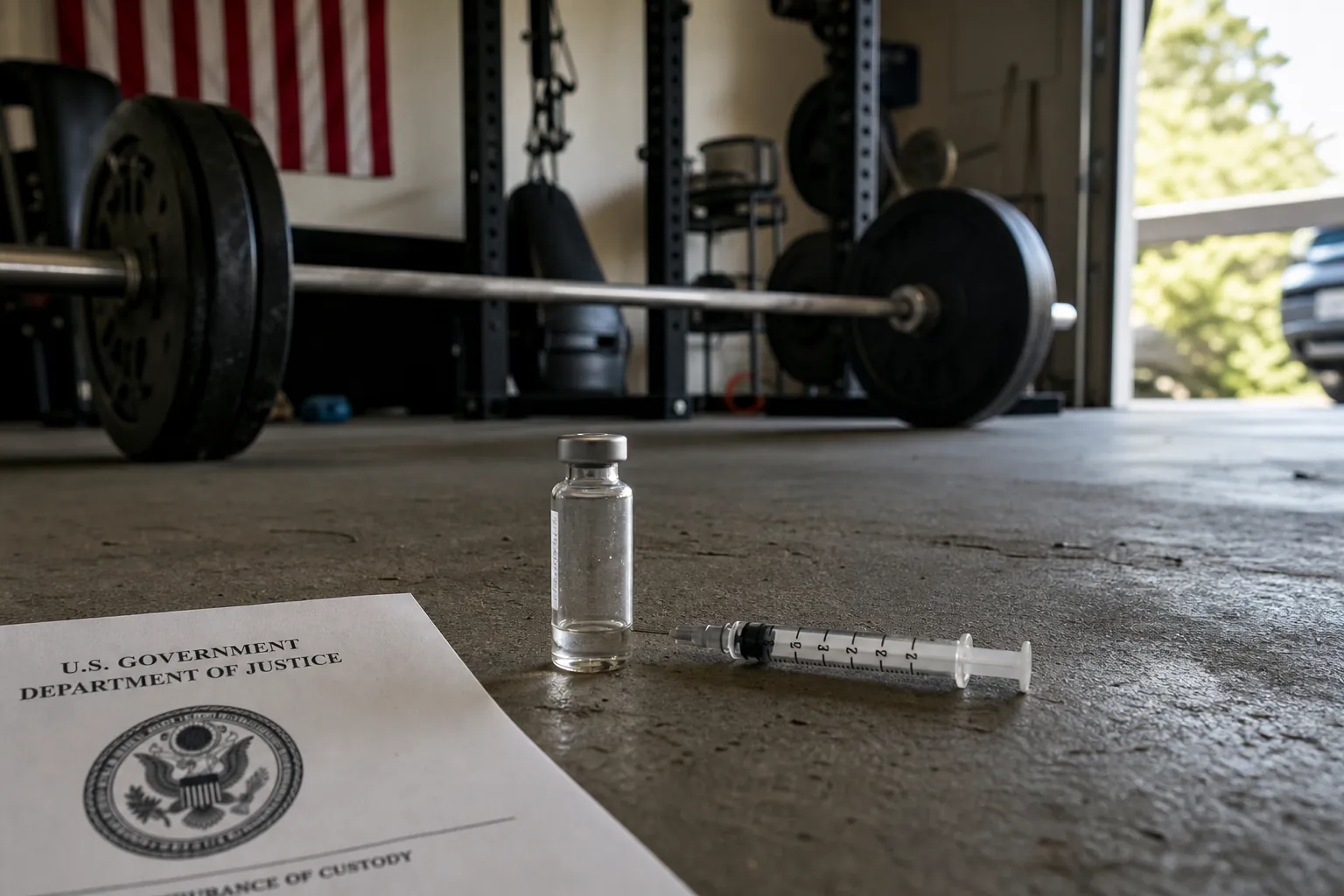
What actually happened in July 2026
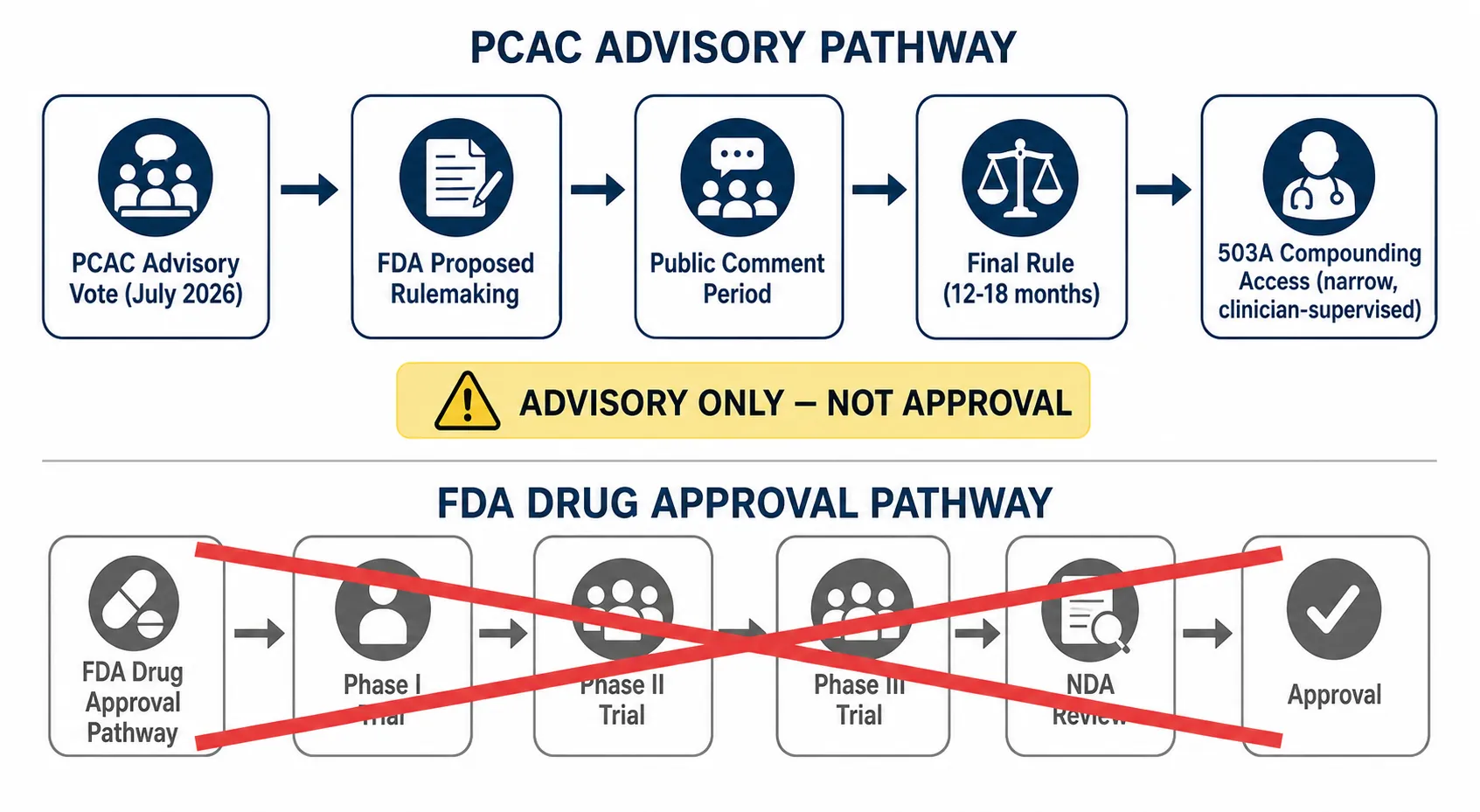
The useful way to read the July vote is procedural, not promotional. PCAC is an advisory committee. Its vote can influence what the FDA does next, but it does not itself place a substance on the final 503A Bulks List, and it definitely does not turn a peptide into an FDA-approved drug.
The tension is that the committee vote went against the FDA staff’s pre-meeting recommendation. In July 21, 2026 briefing documents, FDA staff recommended against listing all seven peptides under review, citing concerns that included lack of established quality standards and chemical identity issues for BPC-157.[2] That does not mean the committee vote is meaningless. It means the final regulatory step still has to carry the weight of those unresolved questions.
| Term being used online | What it actually means | What it does not mean |
|---|---|---|
| PCAC recommended it | An advisory committee voted in favor of recommending the substance for FDA consideration on the 503A Bulks List. | It is not FDA approval, not a final rule, and not permission for grey-market sales. |
| 503A Bulks List | A compounding-related list that can affect what bulk drug substances certain compounding pharmacies may use under the 503A framework. | It is not the same as a drug being proven safe and effective through the FDA drug approval pathway. |
| FDA drug approval | A separate pathway that normally depends on human clinical trial evidence and formal FDA review. | The July 2026 vote did not complete this pathway for BPC-157, TB-500, KPV, MOTS-c, or similar recovery peptides. |
| Legal soon | Possible future rulemaking could change access if the FDA proceeds and finalizes a rule. | It does not mean a home athlete has new lawful access today. |
The FDA had already moved peptide compounding policy earlier in 2026. On April 23, 2026, the agency removed 12 peptides from Category 2 in a Federal Register docket.[3] That matters because it shows the agency is actively revisiting peptide compounding categories, but it still does not collapse every peptide into one legal bucket. A change involving one group of substances does not automatically legalize another group for home recovery use.
The 12-month gap is where bad decisions get easier
Formal FDA rulemaking is expected to take 12 or more months.[1] That timeline is not a bureaucratic footnote. It creates the exact gap a home athlete has to live inside: the vote is public now, the marketing spin is immediate, but any formal compounding access that might come from a final rule is not here yet.
This is the part that tends to disappear in peptide chatter. Someone hears “recommended for the compounding list,” then a clinic page says “FDA reviewed,” then a forum post upgrades that to “basically approved.” By the time the phrase reaches a garage gym group chat, the procedural status has been sanded down into a recovery promise.
If a final rule eventually lists a substance, the plausible lawful path is still narrow: clinician-supervised care through an appropriate compounding channel, not bulk buying research vials because a committee vote happened. Until rulemaking is finished, a home lifter should treat “PCAC recommended” as a pending regulatory signal, not as a buying instruction.
The evidence problem is not solved by popularity
The peptide market is not small, and the online attention is not subtle. Reporting cited a $4.1 billion peptide supplement market figure for 2025 and more than 50 million BPC-157 video views across YouTube and TikTok.[4] Those are useful pressure signals. They help explain why people are asking about the FDA peptide compounding list for home fitness in the first place.
They do not answer the recovery question. A 2026 narrative review identified zero completed human Phase II/III randomized controlled trials for these substances.[5] That is a very specific limitation. It does not prove that every peptide claim is false, and it does not erase early mechanistic or animal interest. It does mean the evidence base has not reached the stage most home athletes think of when they hear “clinically proven.”
For recovery decisions, that missing human trial layer changes the burden of proof. Tendon pain, muscle strain, inflammation, sleep disruption, training load, and nutrition are messy in real life. If someone’s elbow feels better after six weeks, that improvement could reflect time, reduced volume, different exercise selection, better sleep, a placebo effect, or the substance. Without stronger human trials, the story does not cleanly separate those explanations.
Quality control is the risk you cannot feel in a workout log
A home gym makes some risks visible. You know when the rack is bolted badly, when the plates are cheap, when a cable pulley grinds under load. Peptides are different. Mislabeling, wrong concentration, contamination, or chemical-identity problems are not things you can detect by how the vial looks.
That is why the FDA staff concern about quality standards matters. The July 21 briefing documents did not merely say “more evidence would be nice.” Staff recommended against listing all seven peptides reviewed and flagged quality-related issues, including no established quality standards or chemical identity for BPC-157.[2] For a person buying from outside a tightly controlled pharmacy setting, that concern lands directly on the bottle in the mail.
The grey-market testing picture makes the same point from the consumer side. BSCG/STAT News reporting in 2026 found that approximately 30% of grey-market peptide samples showed mislabeling or contamination.[6] That number should not be stretched into “every vial is fake.” It is enough to say the buyer cannot reliably assume the label, purity, or contents are what the seller claims.
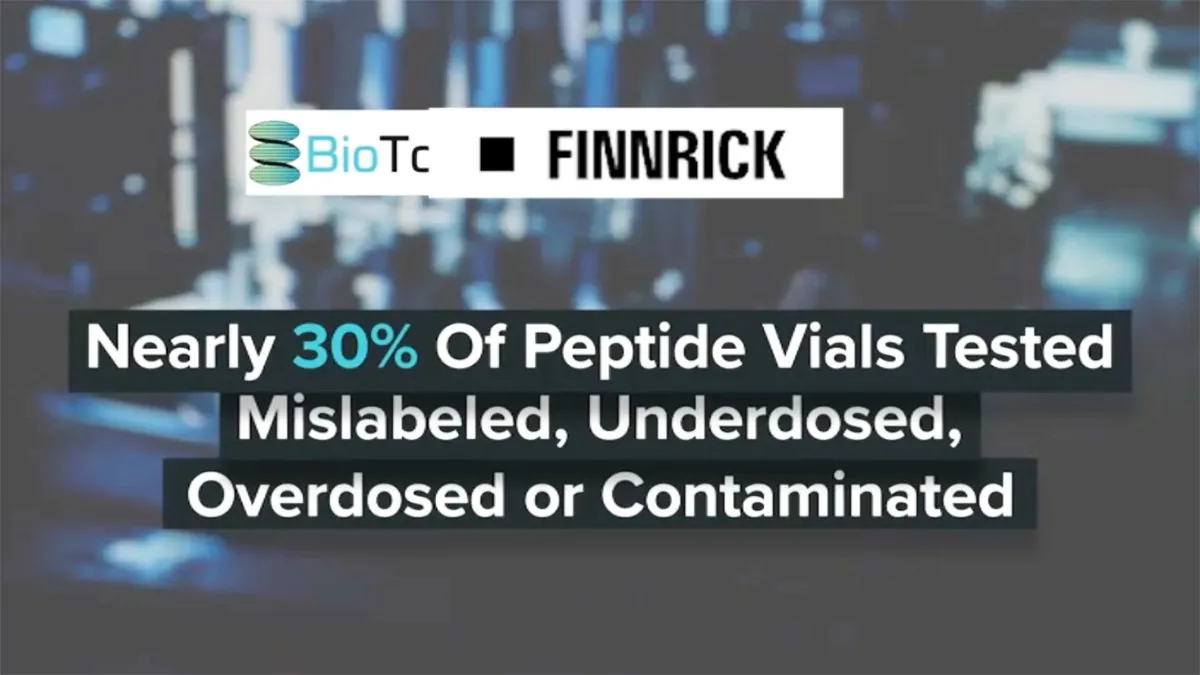
For someone training alone, this is a bad category of uncertainty. You can deload a squat, swap a barbell lift for dumbbells, or stop a movement when pain changes. You cannot train your way around an unknown contaminant or an inaccurately labeled compound.
What about compounding clinics?
The cleanest version of the future pathway would be boring and documented: a licensed clinician, a legitimate compounding pharmacy operating within the applicable 503A framework, and a substance that has actually been added through final FDA rulemaking. That is not the same thing as a wellness site using “FDA,” “PCAC,” and “compounded” in the same paragraph while leaving the legal status fuzzy.
A useful filter is to separate three claims before believing any access pitch:
- Regulatory claim: Has the FDA actually finalized a rule listing the substance, or is the seller leaning on an advisory vote?
- Clinical claim: Is the seller implying human recovery benefits that have not been shown in completed Phase II/III randomized trials?
- Product claim: Is there credible, independent quality testing for the exact product being supplied, or only generic purity language?
Those questions do not require anyone to become a regulatory lawyer. They just slow down the slide from “a committee voted” to “this vial is safe and legal for my shoulder.”
The committee controversy is real, but it is not the main takeaway
There is also a governance story around the July vote. Reporting described a PCAC composition controversy: three standing voting members, eight new members added in June 2026, and seven members with alleged industry ties.[7] That deserves scrutiny, especially because close votes can shape public expectations long before final rules are written.
But for a home athlete deciding what to do today, the legal hierarchy comes first. Even a perfectly composed advisory committee would not make an advisory vote equal to FDA approval. A controversial committee does not make the vote meaningless either. It means the next FDA steps, public comments, and final rule language matter more, not less.
What this means in a garage, basement, or apartment gym today
The practical answer is narrower than the online argument. The July 2026 PCAC vote changed the regulatory conversation. It did not change the current safety evidence, did not complete FDA rulemaking, and did not make grey-market recovery peptides a sound consumer bet.
If recovery is the actual problem, the boring options still have the advantage of being legal, trackable, and adjustable. Sleep, training-load management, protein and total energy intake, planned deloads, rehab progressions, and pain-aware exercise selection are not exciting in a thread full of peptide acronyms. They are also the things you can change without waiting for a federal rule or trusting a vial from a seller you cannot audit.
For a more grounded starting point, use a post-workout recovery routine you can run at home, learn what your fitness tracker recovery score is actually measuring, and be cautious about turning wearable data into a medical conclusion. If you are comparing devices, a recovery-tracking ring or wearable guide is a safer rabbit hole than peptide sourcing.
The key move for now is not dramatic. Do not treat “recommended for the 503A Bulks List” as “FDA-approved.” Do not assume compounding access exists before final rulemaking. Do not let influencer popularity stand in for completed human trials. And if a seller’s pitch depends on blurring those lines, that is information too.
References
- July 2026 PCAC vote reporting, NPR and ABC News, July 23, 2026.
- July 21, 2026 briefing documents, U.S. Food and Drug Administration, July 21, 2026.
- FDA-2025-N-6895, Federal Register, April 23, 2026.
- Peptide supplement market and BPC-157 social video view reporting, Forbes and Doctronic.
- Weber narrative review, PubMed Central, 2026.
- Grey-market peptide sample testing reporting, BSCG and STAT News, 2026.
- PCAC composition controversy reporting, BMJ, The Washington Post, and STAT News, 2026.
This is general fitness education, not medical advice. For diagnosis or treatment of pain or injury, consult a qualified clinician.
Pick your next session
Browse all routines to find an appropriately-spaced next session.
Spot something off?
This content sits adjacent to health guidance — tell us if a citation or figure needs a correction.