
Why Filter Coffee Lowers Blood Sugar (and How Exercise Helps)
Unsweetened filtered coffee lowers HbA1c through a specific gut-microbiome mechanism involving Veillonella bacteria — and home exercise independently enriches the same bacteria, creating a compounding benefit for blood sugar regulation.
- Citation source
- Peking University study
- Evidence level
- restrained inference
The interesting part of the new filter-coffee-and-blood-sugar evidence is how selective it is. In a Peking University Mendelian randomization analysis published in 2025 and corrected in May 2026, filtered coffee showed a statistically significant causal association with lower HbA1c, while instant coffee, coffee with sugar, coffee with milk, coffee with artificial sweeteners, and decaf did not show the same association. The reported effect was modest: OR=0.97, with a 95% confidence interval of 0.94–0.99 and P=0.04. Filtered coffee also increased the abundance of Veillonella bacteria, and mediation analysis estimated that Veillonella accounted for 43.33% of the glycemic benefit. Adding sugar showed a borderline negative association with Veillonella abundance. [1]
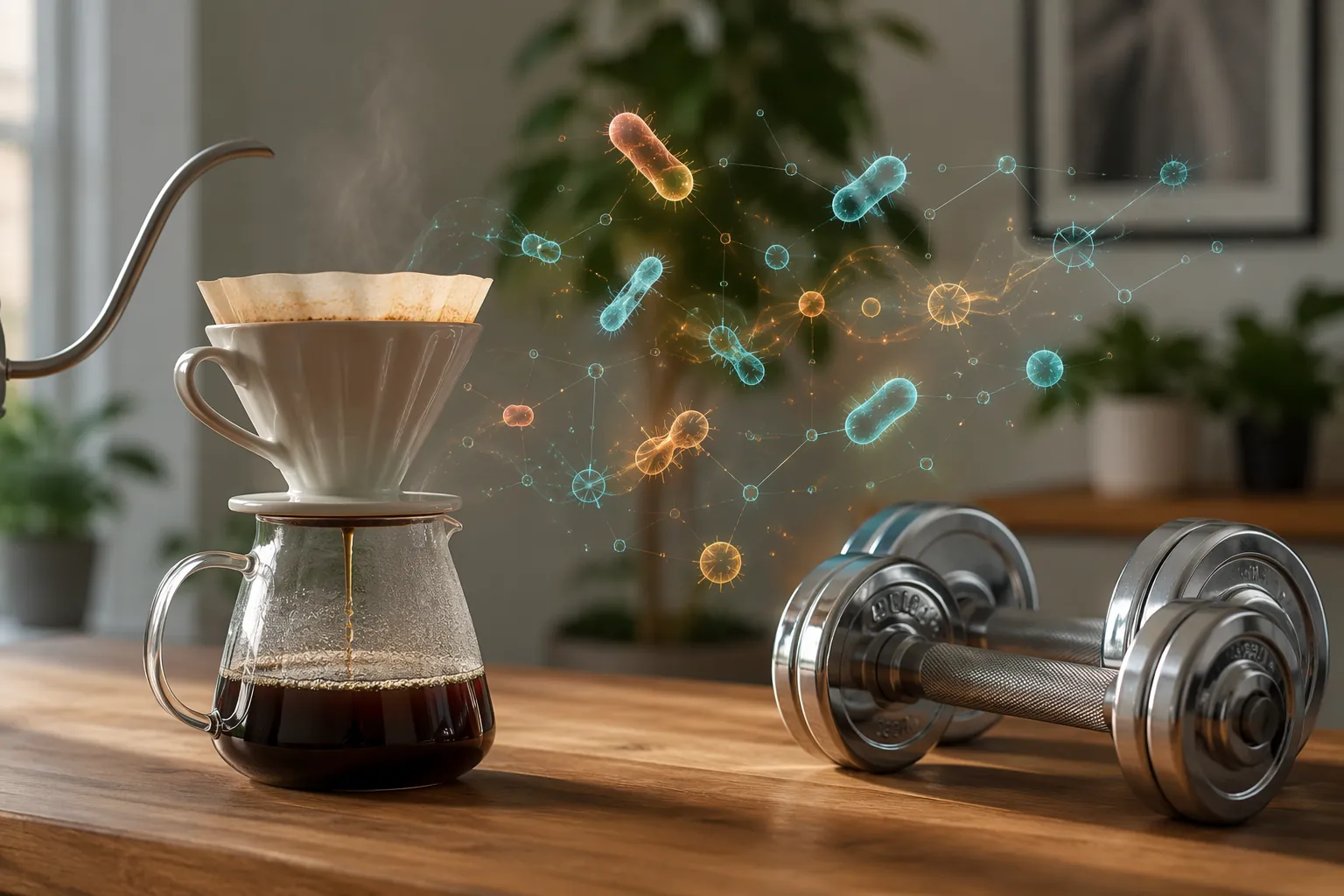
That is not a clean headline like “coffee lowers blood sugar.” It is narrower, and more useful: unsweetened filtered coffee appears to be the coffee format most aligned with a specific gut-microbiome pathway tied to HbA1c. For a home fitness reader, that matters because the same bacterial genus shows up in a separate line of exercise research. Regular training and filtered coffee may be touching the same metabolic circuit from different directions, even though their combined effect has not been tested in one intervention.
What HbA1c Actually Measures
HbA1c is a longer-window blood sugar marker. Instead of showing what happened after one meal or one workout, it reflects how much glucose has attached to hemoglobin in red blood cells over time. That makes it more stable than a single finger-stick reading, but also harder to move quickly. A small population-level shift in HbA1c can be meaningful in research without becoming a personal treatment plan.
That distinction matters here. An odds ratio of 0.97 is not a dramatic effect. It does not say a mug of pour-over coffee cancels a high-sugar diet, replaces medication, or turns breakfast into a metabolic free pass. It says that, in the genetic analysis used by the researchers, filtered coffee consumption was causally associated with slightly healthier HbA1c, and a large share of that signal appeared to run through Veillonella. [1]
Why Veillonella Makes the Coffee Finding More Interesting
Veillonella is not interesting because it sounds exotic. It is interesting because it gives the coffee finding a plausible mechanism. The Peking University analysis linked filtered coffee to greater Veillonella abundance, and then linked that Veillonella signal to the lower-HbA1c association. The estimated mediation share — 43.33% — is unusually specific for a coffee story, and it shifts the focus away from coffee as a vague antioxidant beverage toward coffee as a possible microbiome-shaping input. [1]
The proposed chain looks like this: filtered coffee is associated with more Veillonella; Veillonella produces propionic acid, a short-chain fatty acid; propionic acid is tied to improved insulin sensitivity; better insulin sensitivity supports healthier blood sugar regulation. The study does not prove every step by feeding people coffee, sampling their stool, and watching HbA1c change in real time. It uses Mendelian randomization and mediation analysis, which are stronger than simple observation for causal inference but still not the same thing as a controlled coffee trial.
| Coffee version in the Peking University analysis | Association reported for HbA1c | Why it changes the practical reading |
|---|---|---|
| Filtered coffee | Statistically significant causal association with lower HbA1c | This is the version carrying the main signal |
| Instant coffee | No association reported | The finding should not be generalized to all coffee |
| Coffee with sugar | No association reported | Sugar weakens the useful takeaway and showed a borderline negative association with Veillonella |
| Coffee with milk | No association reported | The study does not support treating every mixed coffee drink as equivalent |
| Coffee with artificial sweeteners | No association reported | The microbiome signal did not appear to transfer cleanly |
| Decaf coffee | No association reported | The result is not simply a generic coffee-flavor effect |
The sugar detail deserves more attention than it usually gets. If the pathway partly depends on Veillonella abundance, then sweetening the drink is not just “extra calories” in the abstract. In this analysis, coffee with sugar did not show the same HbA1c association as filtered coffee, and sugar addition had a borderline negative association with Veillonella. That does not prove sugar kills the pathway, but it does make sweetened coffee a poor vehicle for this particular claim. [1]
Where the Paper Filter Fits
Filtered coffee is not only a microbiome story. Brewing method also changes what ends up in the cup. Harvard Health notes that paper filters remove cholesterol-raising diterpenes, including cafestol and kahweol, and that these compounds can be about 30 times higher in unfiltered methods such as French press or boiled coffee. [2]
That does not mean a French press is a metabolic disaster or that pour-over is medicine. It means the filter is a meaningful variable. If the evidence says filtered coffee and not “coffee” in general, the paper filter should stay in the sentence. A drip machine with a paper filter and a manual pour-over are boring in exactly the right way here: they preserve the brewing condition that matches the study signal.
A Chalmers University biomarker study points in the same general direction, though through a broader diabetes-risk lens rather than the Veillonella mechanism. That work associated filtered coffee with a 60% lower risk of type 2 diabetes and reported biomarker patterns involving reduced inflammatory markers and improved metabolic profiles. [3] Useful context, yes. But it should not be mistaken for the same claim as the Peking University analysis. One widens the metabolic picture; the other gives the cleaner microbiome path.
The Exercise Side of the Same Genus
Home training enters the story through lactate. During hard enough exercise — a squat circuit, intervals on a bike, loaded carries in a garage, a brisk bodyweight session that stops feeling cute after round three — muscles produce lactate. Separate research from Harvard Medical School reported that exercise enriches Veillonella, and that Veillonella atypica can metabolize exercise-produced lactate into propionate, a short-chain fatty acid shown in that line of work to improve exercise performance. [4]
This is where the coffee finding becomes more than coffee advice for people who already train. Filtered coffee appears to increase Veillonella abundance in the blood-sugar analysis. Exercise appears to enrich Veillonella in the performance-and-lactate research. Both roads lead toward propionate, but they do not prove the same outcome. Coffee carries the causal HbA1c association in the current evidence. Exercise carries a separate microbiome-and-performance mechanism.
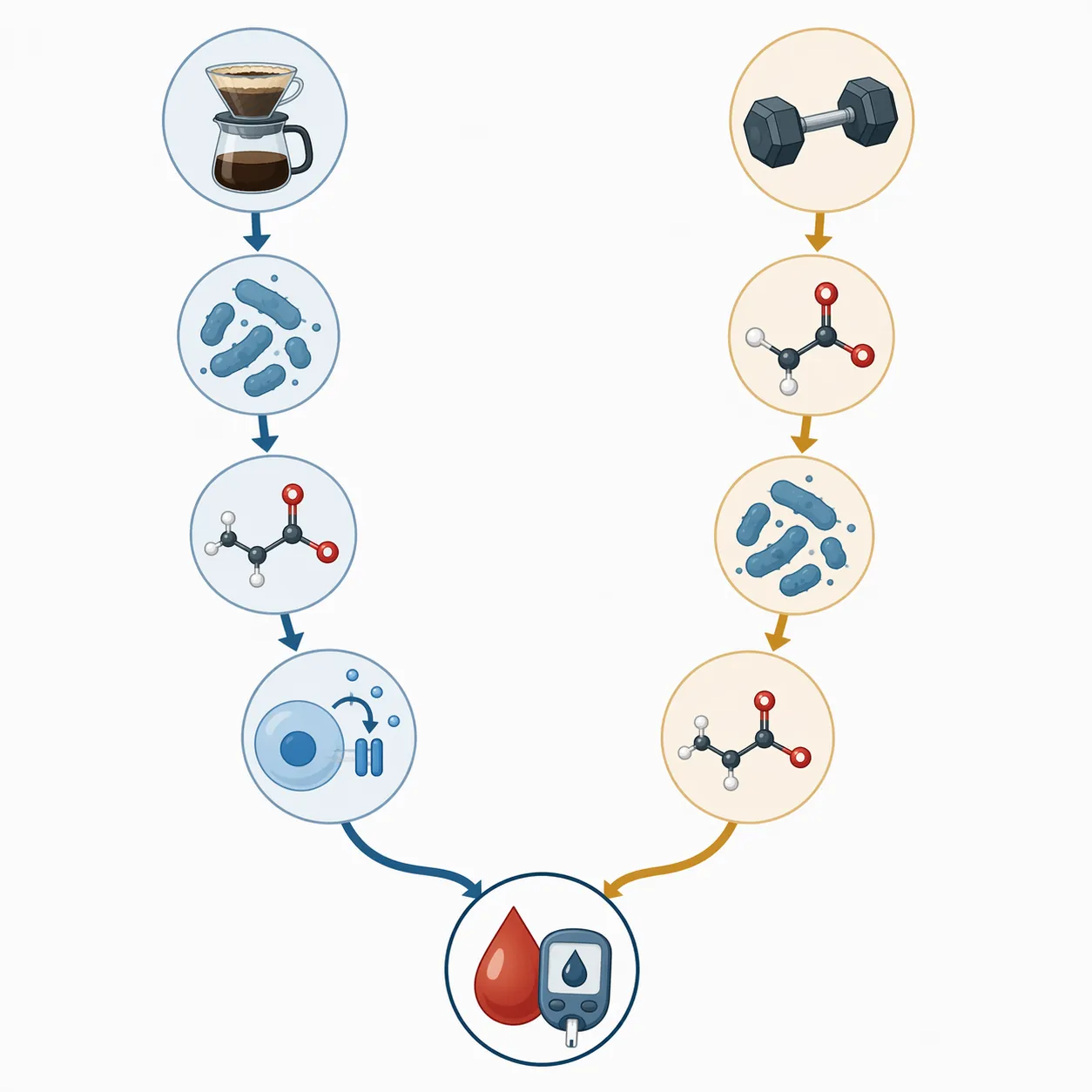
The tempting leap is to say filtered coffee plus home workouts lower blood sugar through a combined Veillonella loop. The careful version is slightly less tidy: two independent lines of evidence point to the same genus and related metabolites, which makes the pairing biologically plausible. The interactive effect has not been tested in a single trial that assigns people to filtered coffee, exercise, both, or neither and then measures microbiome changes and HbA1c.
What This Means for a Home Fitness Routine
For someone already training at home and already drinking coffee, the practical reading is simple but narrow. The version of coffee most aligned with the evidence is unsweetened filtered coffee. That means a paper-filter drip coffee or pour-over, without sugar and without turning the drink into a sweetened coffee beverage. Milk did not show the same association in the Peking University analysis, so the cleanest interpretation sticks with the condition that actually carried the signal. [1]
The training side does not require a special gut-microbiome workout. The relevant behavior is regular exercise that produces enough metabolic demand to generate lactate. A home setup can do that with basic tools: dumbbells, resistance bands, a bike, a rowing machine, a kettlebell, or bodyweight circuits. The bacteria do not care whether the lactate came from a boutique studio or a mat next to the laundry basket.
- If you drink coffee anyway, the evidence favors paper-filtered coffee over treating all brewing methods as interchangeable.
- If blood sugar regulation is the question, keep the coffee unsweetened; the sugar-added version did not show the filtered-coffee signal.
- If you train at home, consistency matters more than inventing a microbiome-specific routine.
- If you have diagnosed diabetes, medication changes, abnormal HbA1c, or symptoms, this evidence belongs in a conversation with a clinician, not a self-treatment experiment.
The Limits Are Part of the Point
The Peking University analysis used European-ancestry genetic data from UK Biobank and MiBioGen, so the generalizability to other populations is not settled. The microbiome mediation is statistically inferred, not directly confirmed by a coffee intervention with stool sampling. Those limits do not make the finding useless. They keep it from becoming a miracle claim.
The strongest conclusion is restrained: unsweetened filtered coffee is the coffee format with the clearest current link to lower HbA1c through a Veillonella-mediated pathway, and regular exercise independently appears to enrich the same bacterial genus through lactate metabolism. Together, they form a credible, low-drama habit pairing for people who already train at home and drink coffee. They are not a tested combined treatment, and they are not a substitute for medical care.
References
- Study Links Filter Coffee to Lower Blood Sugar via the Gut, Daily Coffee News, July 21, 2026.
- What's the healthiest way to brew coffee?, Harvard Health.
- Filtered coffee helps prevent type 2 diabetes, show biomarkers in blood samples, Chalmers University.
- Exercise-Veillonella connection, Harvard Medical School.
This is general fitness education, not medical advice. For diagnosis or treatment of pain or injury, consult a qualified clinician.
Pick your next session
Browse all routines to find an appropriately-spaced next session.
Spot something off?
This content sits adjacent to health guidance — tell us if a citation or figure needs a correction.