
Food Sequencing for Better Blood Sugar Control in Home Fitness
Learn how simply changing the order you eat foods—vegetables and protein before carbohydrates—can blunt post-meal blood sugar spikes and provide more stable energy for home workouts, backed by clinical studies and explained in practical terms for home exercisers.
- Citation source
- Diabetes Care
- Evidence level
- restrained inference
You finish a set of dumbbell rows, push the coffee table back into place, and look at the meal you were already going to eat: vegetables, chicken, rice. The practical question is not whether this is the perfect fitness meal. It is much smaller: if the food is already on the plate, what should you eat first?
For blood sugar control in a home fitness diet, the simplest useful meal order is: eat fiber-rich vegetables first, protein and fat second, and the main carbohydrate portion last. In a 2015 Diabetes Care study of people with type 2 diabetes, eating vegetables and protein before carbohydrates produced a 28.6% lower post-meal glucose response than eating the carbohydrates first.[1] That number is worth paying attention to because it came from changing order, not from removing the carbohydrate.
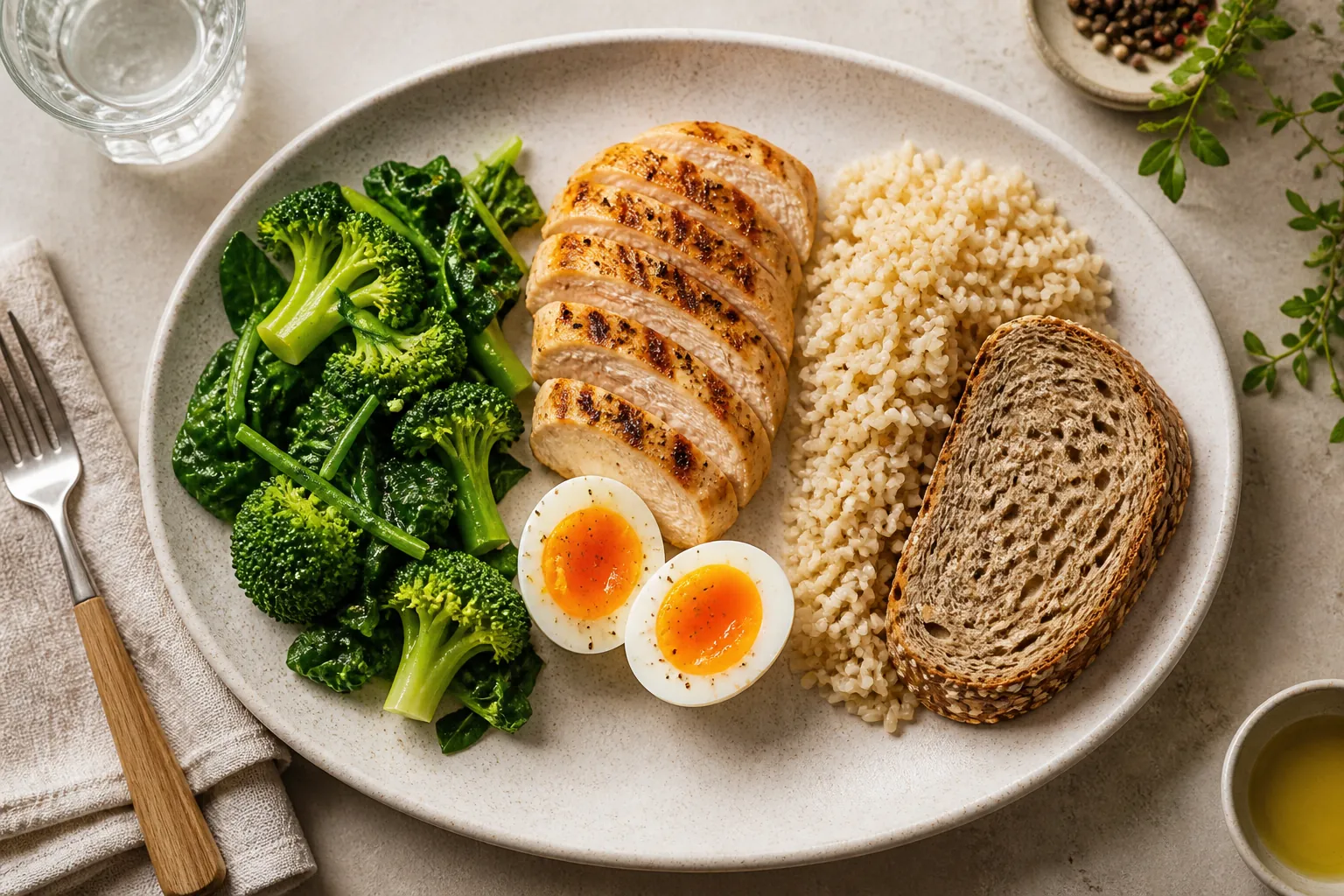
The careful part matters. That 28.6% result was not a performance trial in healthy apartment exercisers. It was diabetes-specific evidence. A generally healthy person training at home may see a smaller effect, or may notice the habit more as steadier appetite and energy than as a measurable glucose change. Still, the finding is unusually practical: same meal, different order, meaningful difference in the studied group.
The Order That Usually Makes Sense
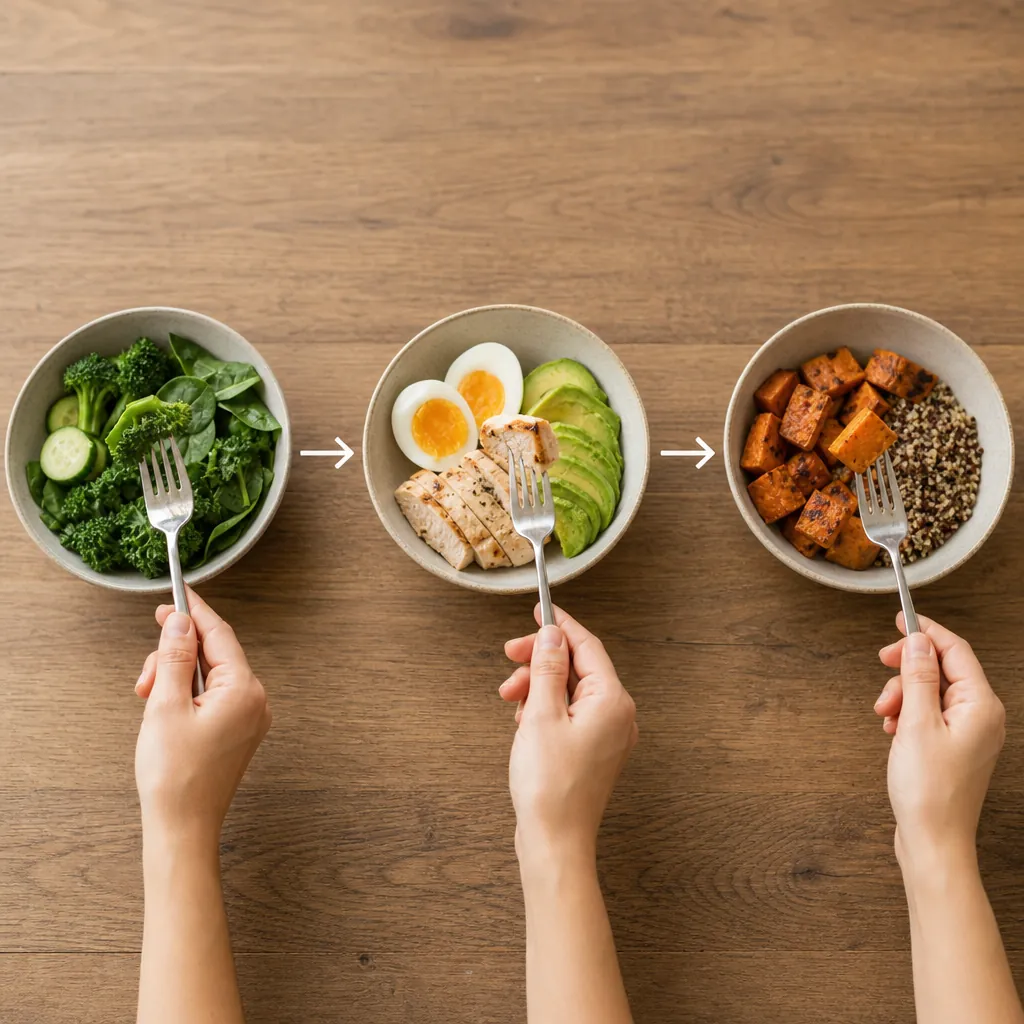
Use this sequence when the meal naturally includes all three parts:
- Start with vegetables, especially higher-fiber options such as leafy greens, broccoli, peppers, cabbage, green beans, or a salad.
- Move to protein and fat, such as eggs, chicken, fish, tofu, Greek yogurt, beans, avocado, olive oil, nuts, or cheese.
- Eat the main carbohydrate portion last: rice, potatoes, pasta, oats, bread, tortillas, fruit, or a sweeter recovery food.
This does not require a new meal plan. If dinner is a bowl, eat a few bites of vegetables first, then the protein-heavy bites, then the rice-heavy bites. If breakfast is eggs, toast, and fruit, start with the eggs, then move to the toast and fruit. If lunch is leftovers eaten between meetings, the whole intervention may be thirty seconds of attention before the fork goes in.
The sequence is easiest when the plate has clear parts. Mixed foods are not disqualified; they just need a less fussy version. With a burrito bowl, take the vegetable and protein-heavy bites first. With pasta and meat sauce, eat the salad or vegetables first if they are there, then a few bites with more meat or cheese before leaning into the pasta. With a sandwich, eat the side salad or vegetables first, then the sandwich. Good enough is the point.
Why Eating Carbs Last Can Change the Glucose Curve
The effect is not magic, and it is not really about making carbohydrates suspicious. Carbohydrates raise blood glucose more directly than protein, fat, or fibrous vegetables. When they arrive after other foods, the body is dealing with a different digestive situation than when they arrive first.
A 2020 Nutrients review explains two main routes. Protein and fat before carbohydrates can stimulate GLP-1 secretion and delay gastric emptying, meaning glucose from the carbohydrate portion enters the bloodstream more gradually. Fiber-rich foods can slow carbohydrate absorption through a separate pathway, so vegetable-first and protein/fat-first patterns may work additively rather than by the same mechanism.[2]
That mechanism is the reason the rule deserves more respect than a typical food hack. It also sets boundaries. A small side salad before a large dessert is not the same as a balanced meal. Sequencing changes the order of exposure; it does not erase the effects of total carbohydrate amount, carbohydrate quality, medication needs, sleep, training volume, or overall energy intake.
Before a Home Workout
Before training, the job of food is not only to fuel the session. It also has to sit well while you squat, hinge, press, jump, or follow a video in a small room. Meal sequencing can help here because it works inside the meal you were already going to eat instead of asking you to prep a separate pre-workout menu.
If you are eating a full meal before exercise, put the vegetable and protein bites first and let the starch come later. A plate of vegetables, eggs, avocado, and toast becomes vegetables first, eggs and avocado second, toast last. A lunch plate with chicken, rice, and vegetables becomes vegetables first, chicken second, rice last. The carbohydrate is still there; it just stops being the first thing to hit an empty stomach.
Timing still matters. Cleveland Clinic notes that blood glucose commonly peaks roughly 90 minutes after a meal.[3] That does not mean everyone should train exactly 90 minutes later, but it gives useful context: if a meal tends to make you feel sleepy, shaky, or distracted later, the order of the meal and the timing of movement may both be part of the solution.
For many home workouts, especially moderate strength training or mobility work, a short post-meal walk, an easy warm-up, or a session placed after digestion has started may complement the sequencing habit. The evidence in this article does not prove that sequencing plus home exercise creates a specific performance gain. The more honest claim is narrower: meal order can blunt post-meal glucose in studied diabetes populations, and movement around the post-meal window is a practical partner for people trying to feel steadier.
After a Home Workout
After training, people often overcomplicate recovery food. The basics still matter: enough protein, enough total food, enough fluids, and a carbohydrate source if the session was demanding or another session is coming soon. Sequencing does not replace those basics. It gives you a way to eat the recovery meal with less glucose whiplash, especially if the meal includes a larger starch or sweeter food.
A simple post-workout plate might run like this: vegetables or a fiber-rich side first, protein second, potatoes or rice last. If you are using a recovery meal template, the same order can be applied to the meals in Healthy MAHA Recipes for Post-Workout Recovery. If your recovery is more shake-based, the sequencing question changes: a drink is hard to sequence, but you can still pair it with a fiber-containing food or choose protein first when the meal includes both protein and a fast carbohydrate.
That is where protein choices matter for practical reasons, not because one product magically fixes blood sugar. Milk, whey, yogurt, eggs, tofu, fish, and meat all change the shape of a meal differently than eating starch alone. For a closer look at recovery protein tradeoffs, see Fairlife Milk vs Chocolate Milk vs Whey for Post-Workout Recovery.
What the Longer-Term Evidence Adds
Short-term glucose curves are useful, but they can make any intervention look more decisive than it is. Longer-term evidence is more interesting because habits have to survive ordinary life. In a 5-year trial published in Nutrients, people with type 2 diabetes who practiced food sequencing maintained lower A1C than controls.[4] That gives the habit more weight than a one-meal lab effect.
Again, the population matters. A1C is a clinical marker, and this was type 2 diabetes research. It does not prove that a healthy person lifting adjustable dumbbells at home will build more muscle, lose more fat, or perform better because they ate broccoli before rice. It does suggest that, in people for whom glucose control is already a real issue, the order of foods can be durable enough to matter beyond a single meal.
For home fitness, that is the right size of claim. Sequencing is not a substitute for medical guidance if you have diabetes, use glucose-lowering medication, or have been told to monitor blood sugar. It is also not a reason to avoid carbohydrates around training. Carbohydrates can be useful for exercise and recovery. The sequencing habit simply changes how they enter the meal.
How to Use It Without Turning Meals Into a Project
| Meal situation | Use this order | Keep it realistic |
|---|---|---|
| Full meal before training | Vegetables, then protein/fat, then starch | Do not force a huge high-fiber meal right before intense exercise if it upsets your stomach |
| Post-workout dinner | Fiber-rich side, then protein, then rice, potatoes, pasta, or bread | Keep enough carbohydrate if the workout was hard or you train again soon |
| Mixed bowl | Vegetable-heavy bites first, protein-heavy bites next, grain-heavy bites last | No need to separate every ingredient |
| Shake or smoothie | Sequence what you can around it, such as protein before a sweet snack | Liquids are less suited to strict meal order |
| Restaurant or takeout meal | Salad or vegetables first, protein next, fries, rice, noodles, bun, or dessert last | Use the order without pretending takeout became a clinical meal plan |
The habit is most useful when it lowers friction. If it makes you anxious, rigid, or socially strange at meals, it is doing too much. At home, it can be almost invisible: eat the salad while the rice cools, finish the eggs before the toast, take the tofu and vegetable bites before the noodles. No scale, no app, no supplement budget.
It also pairs well with recovery choices that are already low-drama. A short walk after eating, a few minutes of mobility, or an easy cooldown can support the same goal of steadier post-meal energy. For broader recovery habits that fit home training, Foam Rolling and Active Recovery for Home Gym Training sits in the same practical lane: small recovery actions that do not require rebuilding your life.
The Honest Bottom Line
Food sequencing is worth trying if you train at home and want steadier energy without turning nutrition into a second sport. Eat vegetables first when they are present, protein and fat second, and carbohydrates last. The strongest evidence comes from people with type 2 diabetes, including a 28.6% lower post-meal glucose response in the 2015 study and longer-term A1C support from the 5-year trial.[1][4]
For generally healthy home exercisers, treat it as a low-effort, low-risk recovery-and-energy habit, not as a proven performance upgrade. It is useful precisely because it is small enough to repeat.
References
- Food Order Has a Significant Impact on Postprandial Glucose and Insulin Levels, Diabetes Care, 2015.
- A Review of Recent Findings on Meal Sequence: An Attractive Dietary Approach to Prevention and Management of Type 2 Diabetes, Nutrients, 2020.
- Blood Sugar Levels After Eating: What's Normal and Abnormal, Cleveland Clinic.
- Long-Term Effects of Food Order on Postprandial Glucose and Lipid Metabolism in Patients with Type 2 Diabetes: A Five-Year Randomized Controlled Trial, Nutrients, 2022.
This is general fitness education, not medical advice. For diagnosis or treatment of pain or injury, consult a qualified clinician.
Pick your next session
Browse all routines to find an appropriately-spaced next session.
Spot something off?
This content sits adjacent to health guidance — tell us if a citation or figure needs a correction.