
Weekly Home Workout Routine for Weight Loss on GLP-1s
A week-by-week workout plan for GLP-1 medication users that combines short strength sessions, daily low-impact cardio, and mobility work to preserve muscle, manage nausea and fatigue, and support lasting weight loss — using only bodyweight or minimal equipment.
- Citation source
- Cleveland Clinic
- Evidence level
- general guideline
A weight loss home workout routine while on GLP-1 medication has one main job: help you keep useful muscle while your appetite, food intake, and body weight are changing. That means the goal is not to burn off every meal or prove you can push through nausea. The goal is to give your muscles a clear, repeatable reason to stay.
That matters because lean tissue loss is not a tiny side issue during medication-assisted weight loss. Estimates cited in clinical discussions range from 15% to 40% of total weight lost coming from lean mass, and the STEP 1 semaglutide trial body-composition data are often discussed around the high end of that range.[1] Those numbers do not mean every person will lose that much muscle, and they do not prove the same pattern across every GLP-1 drug, dose, and timeline. They do mean strength training belongs in the plan early, before weakness shows up in ordinary places like stairs, groceries, and getting up from the floor.
Before starting, check with the clinician prescribing your medication, especially if you have dizziness, dehydration, blood sugar concerns, kidney disease, heart symptoms, or a recent dose increase. The routine below is informational, not medical care. It is designed to be small enough for real GLP-1 weeks and complete enough to cover the movement patterns that protect muscle.

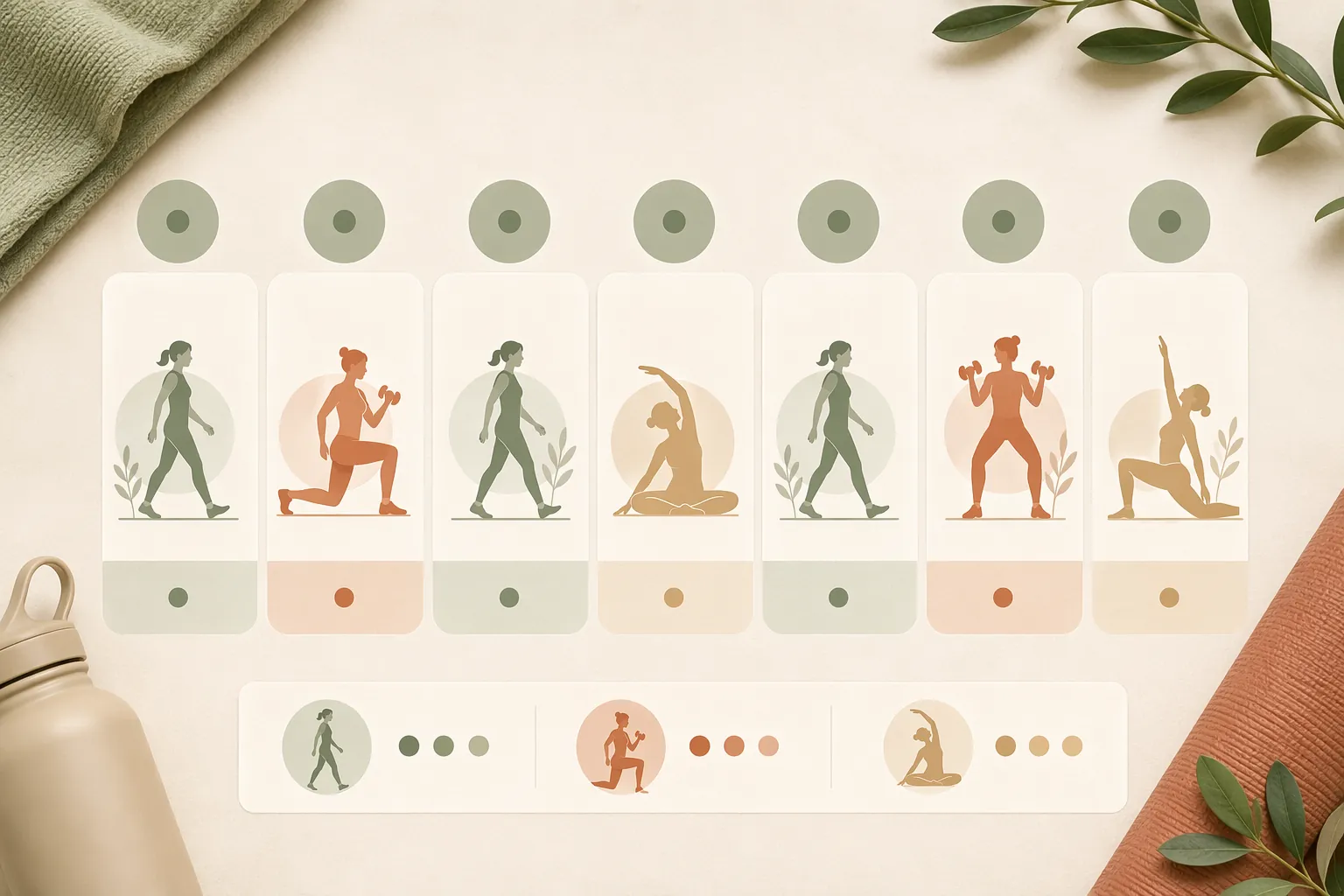
The Week At A Glance
Use this as your default week. If you are in the first low-dose weeks, each session can be shorter. Cleveland Clinic guidance suggests starting with 10 to 15 minutes a day of light activity in the early weeks, then increasing as tolerated after dose escalation around week 5 and beyond.[2]
| Day | Workout | What To Do |
|---|---|---|
| Monday | Strength A + easy walk | 20-30 minutes strength, plus 10-20 minutes easy walking |
| Tuesday | Low-impact cardio + mobility | 20-30 minutes walking, cycling, or marching in place, plus 5 minutes mobility |
| Wednesday | Strength B | 20-30 minutes strength; add a short walk only if energy is good |
| Thursday | Low-impact cardio | 20-30 minutes easy steady movement |
| Friday | Strength A or mobility-only option | Do the third strength day if recovered; otherwise do 10-15 minutes mobility and walking |
| Saturday | Longer easy cardio | 30-40 minutes low-impact movement, broken into two sessions if needed |
| Sunday | Recovery walk + reset | 10-20 minutes easy walking, gentle mobility, and plan your strength days for next week |
Across the week, aim for about 150 minutes of low-impact cardio if your side effects allow it. That can be outdoor walking, treadmill walking, an easy stationary bike ride, step-touches in the living room, or slow stair walking. It does not have to be one polished workout. Three 10-minute walks count if that is what your stomach and schedule allow.
Strength Day A
Do this session on Monday and, if you are recovered, again on Friday. Move slowly enough that you feel the working muscles, not your joints. Rest 45 to 90 seconds between exercises. If nausea is present, extend the rest and keep your head above your heart; skip fast transitions.
- Sit-to-stand from a chair: 1-2 sets of 12-15 controlled reps
- Wall push-up or countertop push-up: 1-2 sets of 12-15 controlled reps
- Glute bridge: 1-2 sets of 12-15 controlled reps
- Resistance-band row, towel row, or light dumbbell row: 1-2 sets of 12-15 reps
- Forearm plank from knees or elevated plank: 2 holds of 15-30 seconds
A single well-controlled set of 12 to 15 reps taken to muscle fatigue can be enough for muscle maintenance, according to Mayo Clinic guidance cited in iFIT’s GLP-1 strength training plan.[3] Muscle fatigue does not mean collapsing or chasing soreness. It means the last few reps are slow, your form is still clean, and you could not do many more without cheating.
That standard keeps the session honest. Twelve casual chair stands while scrolling your phone are movement, but they are probably not a strong muscle-retention signal. Twelve careful chair stands where the final reps require focus are closer to the point.
Strength Day B
Wednesday changes the angles without changing the goal. You still cover squat, hinge, push, pull, and core patterns. If you only own one piece of equipment, make it a basic resistance band; it is usually enough for rows, pull-aparts, and gentle upper-back work.
- Reverse lunge to a small range, supported split squat, or another sit-to-stand: 1-2 sets of 8-12 reps per side
- Hip hinge with hands on hips, backpack deadlift, or light dumbbell Romanian deadlift: 1-2 sets of 12-15 reps
- Incline push-up: 1-2 sets of 8-15 reps
- Band row or band pull-apart: 1-2 sets of 12-15 reps
- Dead bug, bird dog, or side plank from knees: 2 slow rounds
If lunges make you lightheaded or unsteady, do not force them. Use sit-to-stands again and make them harder by slowing the lowering phase, pausing briefly on the chair, or holding a light backpack against your chest. Repeating a safe squat pattern beats practicing a move you dread.
How Hard Each Set Should Feel
Use a simple effort scale. Most strength sets should end around a 7 or 8 out of 10: challenging, controlled, and finished with one to three good reps left in reserve. On a nausea or fatigue day, stop around a 5 or 6. On a strong day after several consistent weeks, add a second set before adding harder exercise variations.
The order matters less than the coverage. Squat helps with chairs and stairs. Hinge helps hips, glutes, and back-of-leg strength. Push and pull keep the upper body involved instead of turning weight loss into a legs-only project. Core work teaches bracing without requiring crunches, jumping, or floor drills that can aggravate nausea.
Daily Cardio Without Making Side Effects Worse
Keep cardio easy enough that you can speak in full sentences. A walk after breakfast, 10 minutes around the block after lunch, or a slow indoor walk before work all count. If your weekly total lands near 150 minutes, the plan is doing its job. If you are still adapting to the medication, start with Cleveland Clinic’s 10- to 15-minute daily activity range and build from there.[2]
Morning often works well because nausea may build later in the day. Second Nature’s Wegovy exercise guidance points to training earlier, before nausea tends to peak, and also cites Wegovy prescribing information in which nausea is reported by about 44% of users.[1] Treat that as a useful default, not a rule. If your mornings are when you feel worst, choose your steadier window.
- Best default: 10-20 minutes of easy walking in the morning.
- Best low-energy option: 5 minutes after two or three meals.
- Best indoor option: slow marching, step-touches, or a stationary bike at an easy pace.
- Best dose-increase week option: shorter walks more often, with no pressure to hit a personal best.
Mobility Goes Where It Protects The Week
Mobility is not decoration at the end of a plan. Use it when it makes the next workout more likely: after walks, before bed, or on the Friday when a third strength day is too much. Five to eight minutes is enough.
- Cat-cow: 6-8 slow reps
- Hip flexor stretch: 20-30 seconds per side
- Calf stretch against a wall: 20-30 seconds per side
- Chest opener at a doorway: 20-30 seconds
- Gentle child’s pose or supported forward fold only if it does not worsen nausea
Avoid long holds in positions that make reflux, dizziness, or nausea worse. Mobility should leave you feeling more settled, not wrung out.
How To Scale The Same Plan By GLP-1 Week
You do not need a different workout for Ozempic, Wegovy, Mounjaro, or Zepbound in the way you might need a different medication schedule. For training, the bigger question is how you are tolerating the dose this week: appetite, nausea, fatigue, hydration, and recovery.
| Medication Phase | Strength | Cardio | Rule |
|---|---|---|---|
| First low-dose weeks | 2 short sessions; 1 set per move | 10-15 minutes light activity daily | Finish feeling like you could do a little more |
| Week 5 and beyond, if tolerating well | 2-3 sessions; add second sets gradually | Build toward about 150 minutes weekly | Progress one variable at a time |
| Dose-increase or side-effect week | Keep patterns, cut volume in half | Use short easy walks | Do not chase intensity |
| Stable energy for 2-3 weeks | Add resistance band, backpack load, or harder variations | Keep cardio easy most days | Make strength harder before making it longer |
Strength training two to three times per week is a common recommendation in GLP-1 exercise guidance from clinical and sports-medicine sources, including Cleveland Clinic, Mass General, and Hospital for Special Surgery.[2][4][5] For a beginner at home, that does not require a full gym plan. It requires enough repeated tension across the major movement patterns to tell your body that muscle is still needed.
Adjustment Rules For Nausea, Fatigue, And Low Appetite
The right workout on a GLP-1 is sometimes the one you reduce early instead of quitting halfway through. Use these rules before you decide the whole plan is too hard.
- If nausea is mild: choose walking, wall push-ups, sit-to-stands, and glute bridges; avoid jumping, burpees, fast circuits, and repeated bending.
- If nausea is moderate: walk 5-10 minutes, do one easy set of two strength moves, and stop before symptoms climb.
- If you feel dizzy, faint, unusually short of breath, or unable to hydrate: stop and contact your clinician.
- If fatigue is the main problem: keep the strength day but cut each exercise to one set and skip the optional third strength session.
- If you barely ate: do easy walking or mobility, then return to strength when you can tolerate enough food and fluid.
This is where home training helps. You can do one controlled set at the kitchen chair, pause, drink water, and decide whether a second set makes sense. You are not locked into a class pace or a machine circuit across the room.
Protein Is Part Of The Muscle-Retention Signal
Strength training sends the signal. Protein supplies material. Expert guidance cited by Second Nature places a common protein target for people using weight-loss medications around 1.2 to 1.6 grams per kilogram of body weight per day.[1] Individual needs vary, and this target is not automatically appropriate for everyone, especially people with kidney disease or medical nutrition restrictions. Ask your prescribing clinician or a registered dietitian how that range applies to you.
Practically, the workout decision is simple: do not make hard strength training the only muscle-preservation tool while under-eating protein. If your appetite is lowest in the evening, it may be easier to place protein earlier in the day and train after a small tolerated meal or snack rather than on an empty, unsettled stomach.
A 20-Minute Version For Hard Weeks
When the full week looks like too much, keep the skeleton. Do this two or three times, with walking on the other days.
- Walk slowly for 3 minutes.
- Do 12-15 sit-to-stands.
- Do 12-15 wall push-ups.
- Do 12-15 glute bridges.
- Do 12-15 band rows or towel rows.
- Hold an elevated plank for 15-30 seconds.
- Walk slowly for 3-5 minutes.
That version is not a failure plan. It still covers squat, push, hinge, pull, and core. It still gives your body a reason to preserve capability while the medication is helping reduce intake. Add volume only after you can repeat it without feeling worse the next day.
When To Progress
Progress after consistency, not after enthusiasm. If you complete two strength sessions per week for two to three weeks, recover normally, and have no symptom flare from training, choose one upgrade.
- Add a second set to two exercises.
- Lower more slowly on sit-to-stands and push-ups.
- Move wall push-ups to a countertop or sturdy table.
- Use a resistance band for rows.
- Add the optional Friday strength session.
Do not progress all of them at once. More sets, harder variations, heavier resistance, and extra cardio are separate stressors. On GLP-1s, recovery is part of the routine, not a reward for finishing it.
What This Routine Should Feel Like
A good week should feel almost plain: two solid strength sessions, maybe a third; easy movement most days; a few short mobility sessions; enough protein to support the work; no heroic recovery debt. You may feel your muscles during the final reps, but you should not feel punished by the plan.
Short strength sessions are not a compromise when they are consistent, compound, close enough to fatigue, and adjusted around real side effects. For GLP-1 weight loss, that is the routine worth repeating.
References
- Wegovy exercise plan, Second Nature
- Exercise for GLP-1 Use, Cleveland Clinic
- Strength Training While on GLP-1: 6 Week Plan, iFIT
- Fitness for People Taking GLP-1 Agonists, Mass General
- 3 Strength Exercises to Prevent Muscle Loss on GLP-1s, Hospital for Special Surgery
This is general fitness education, not medical advice. For diagnosis or treatment of pain or injury, consult a qualified clinician.
Pick your next session
Browse all routines to find an appropriately-spaced next session.
Spot something off?
This content sits adjacent to health guidance — tell us if a citation or figure needs a correction.