
Heat Dome Safety Tips for Exercising at Home (65+)
Extreme heat from a heat dome poses special risks for adults 65+ who exercise at home. This guide explains when to skip a workout, how to pre-cool, which exercises avoid dangerous core temperature rise, and how to spot heat illness early.
- Citation source
- CDC, Harvard Health
- Evidence level
- general guideline
During a heat dome, the first question is not whether exercise is “good for you.” It is whether your body and your room can get rid of heat today. For adults 65 and older, a home workout is worth doing only if the room cooled down, you can cool yourself afterward, and you can keep the effort easy enough to speak in full sentences.
Skip the workout today if the room stayed hot overnight, if you woke up already sweaty or unusually tired, if the power is out and the apartment is heating up, if you had diarrhea or vomiting, if you feel dizzy before starting, or if you recently changed a medication that affects fluids, blood pressure, heart rate, sweating, or alertness. That is not surrender. That is refusing to add exercise heat to a body that has not had a chance to unload yesterday’s heat.
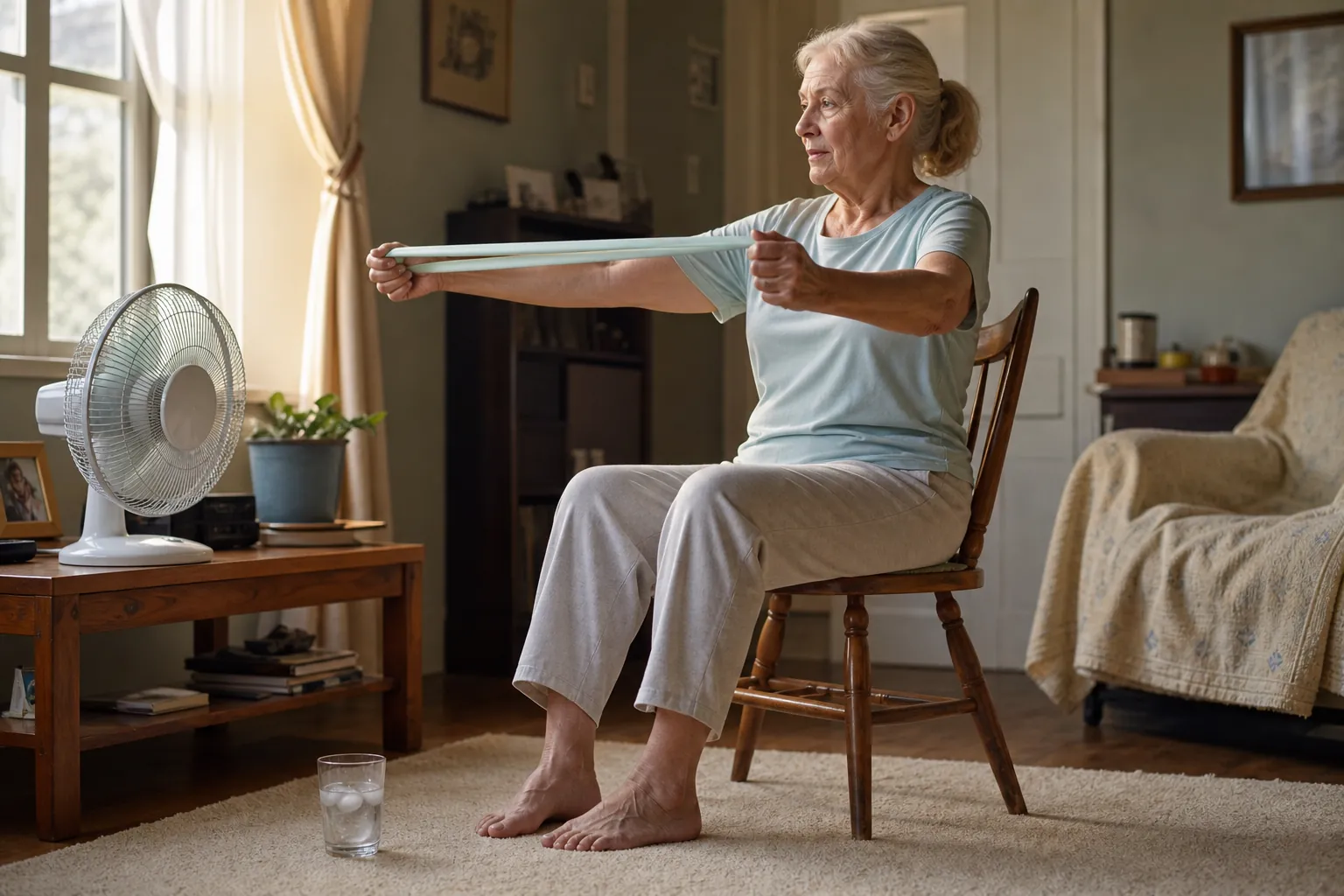
The Same Routine Is Not the Same Risk During a Heat Dome
A heat dome is not just a hot afternoon. It is a pattern of trapped heat that can last long enough for nights to stay warm, and those warm nights matter because the body normally uses cooler hours to recover from daytime heat stress. When the air stays hot overnight, yesterday’s heat load can still be with you before breakfast.[1]
That is why the usual advice to “exercise early” is incomplete. Early is safer only if the indoor air, your skin, and your general condition have actually cooled. If the living room is still heavy and warm at dawn, marching in place for twenty minutes may not be the harmless habit it was in May.
Adults over 65 also have less margin for guessing. The CDC identifies older adults as more vulnerable to heat because aging can reduce sweating, blunt thirst, affect blood vessel response, and increase the chance of using medicines that interfere with heat regulation.[2] Harvard Health has also warned that common medicines, including diuretics, beta blockers, ACE inhibitors, antidepressants, antihistamines, antipsychotics, and Parkinson’s medications, can affect hydration, sweating, heart rate, blood pressure, or alertness in the heat.[3]
Fitness helps, but it does not cancel heat. Research discussed by the Gatorade Sports Science Institute found that highly fit older adults can tolerate heat much like younger adults when matched for aerobic capacity, but that finding belongs to a narrow group of regularly active older adults, not every person trying to keep up a chair routine at home.[4]
A Plain Go/Modify/Skip Check Before You Start
Use this check before shoes go on. It works for the person exercising and for the adult child calling from across town.
| What you find today | What to do |
|---|---|
| Room stayed hot overnight, or the coolest room still feels stifling | Skip exercise or do only gentle range-of-motion while seated |
| No air conditioning, poor ventilation, power outage, or no reliable way to cool down afterward | Skip the workout and prioritize cooling, fluids, and a cooler location if available |
| Dizziness, unusual weakness, nausea, headache, confusion, chest discomfort, or shortness of breath before starting | Do not exercise; cool down and seek medical advice or emergency help depending on severity |
| New or changed medication affecting blood pressure, urination, heart rate, sweating, mood, allergy symptoms, or Parkinson’s symptoms | Keep activity very light and ask a physician or pharmacist how that medicine changes heat risk |
| Room is cooler, you feel normal, water is ready, and you can cool down afterward | Modify the routine: shorter, seated or low intensity, with scheduled water and stop rules |
The most useful rule is also the least glamorous: if the room stayed hot overnight, skip the regular workout. A few easy chair movements may still be fine, but the usual routine can wait. Muscles do not lose their usefulness in one missed morning; heat illness can take independence much faster.
Cool the Body Before You Ask It to Move
Before exercising, make the room and the body easier to cool. Close sun-facing curtains, move to the coolest room, loosen clothing, put water within reach, and sit quietly for a few minutes before starting. If the room is already uncomfortable while sitting still, it is not going to become safer once your legs and arms start making heat.
A fan is useful only within limits. CDC heat guidance says fans can help when indoor air is below 90°F, but above that, a fan may increase body temperature by blowing hot air across the skin.[1] This is annoying news if a fan is what you have, but it is better than pretending moving hot air is the same as cooling.
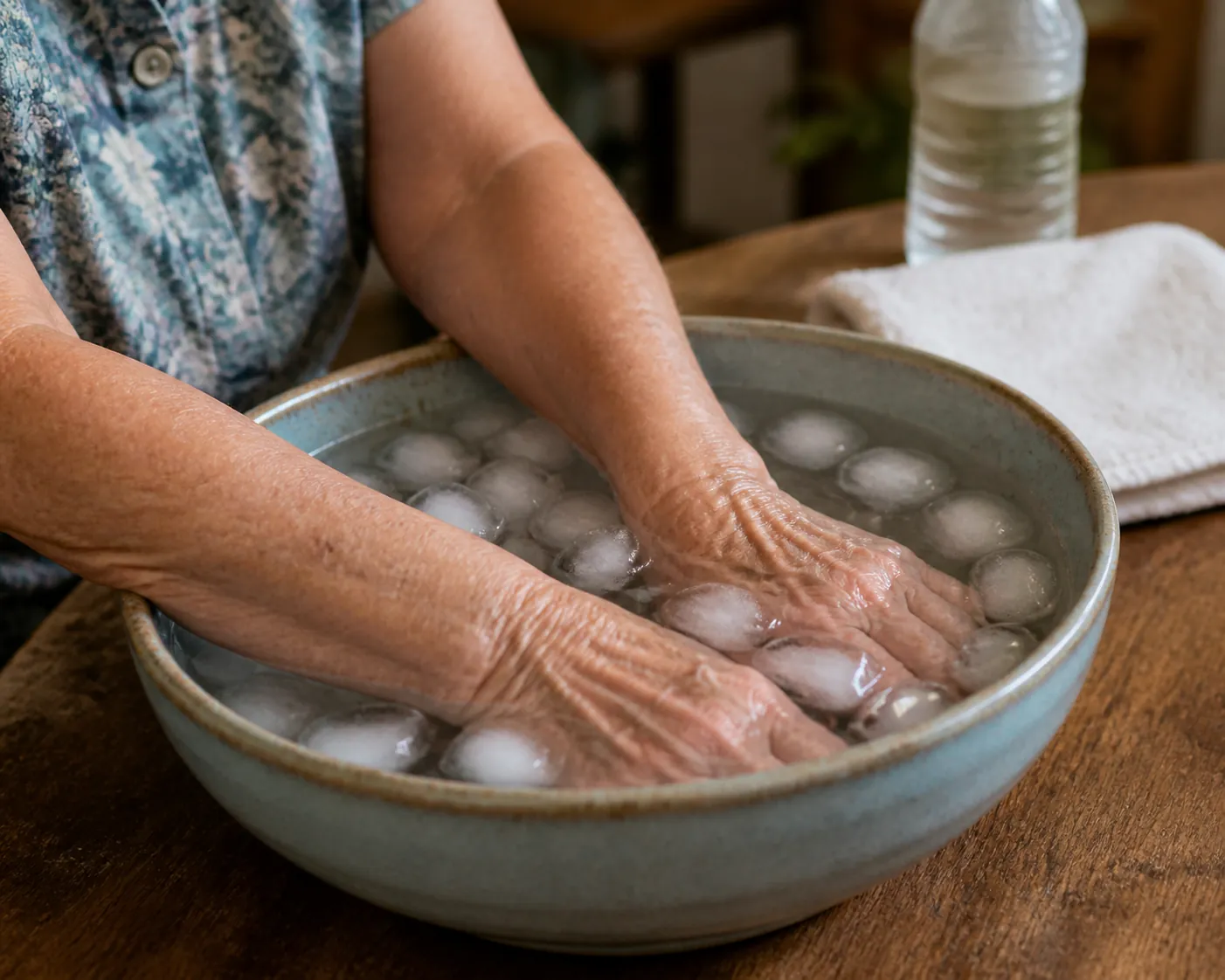
One low-tech method deserves a place beside the water glass: hand and forearm cooling. BBC Future reported in June 2026 that immersing the forearms in 50–60°F water for about 5 minutes before exercise can add a short heat buffer before core temperature climbs, and that the palms and forearms are useful cooling sites because of their heat-exchange blood vessels.[5]
This does not make a hot room safe. It buys a little margin. Fill a bowl with cool water, add ice if you have it, rest the forearms or hands in it for several minutes, dry off, and begin only if the other checks are still favorable.
Choose Exercises That Preserve Function Without Building Heat Fast
The goal during a heat dome is not to prove the old routine still fits. It is to keep the joints, balance, legs, and sleep from sliding backward while avoiding a sharp rise in core temperature. That usually means shorter, easier, more seated, and less continuous.
| Usual exercise | Heat-dome substitute |
|---|---|
| Fast walking indoors or treadmill walking | Slow indoor walking in the coolest room, broken into short rounds |
| Standing cardio intervals | Seated marching, heel taps, toe taps, or gentle arm raises |
| Heavy resistance training | Light resistance band work with longer rests |
| Burpees, planks, mountain climbers, or high-intensity circuits | Chair sit-to-stands only if the room is cool and you can talk easily |
| Long yoga flow | Gentle stretching, breathing, tai chi-style weight shifts, or seated mobility |
| Hard stationary cycling | Very easy cycling with low resistance and frequent pauses |
CenterWell Primary Care and Brown Health both describe low-impact options such as chair exercise, light resistance work, walking, yoga, tai chi, and stationary cycling as more appropriate choices for older adults than strenuous exertion in heat.[6][7] Harvard Health also points to the talk test as a practical intensity guide: if you cannot speak in full sentences, the effort is too hard.[3]
The talk test is especially useful for people taking beta blockers or other heart medicines, because heart rate may not rise in the expected way. A watch number can look calm while the person feels strained. Speech is harder to fool.
A reasonable heat-dome version of a home routine might be ten minutes total: two minutes seated marching, one minute rest, a few light band pulls, rest again, slow sit-to-stands if they feel easy, then stretching. If the room is warm, cut even that down. If standing work makes you feel woozy, stay seated or stop.
Keep the Chair Work Honest
Chair-based does not automatically mean safe. Fast seated marching with big arm swings can still raise heat quickly. Keep movements smooth enough that you can talk, and stop before you feel forced to finish a set.
- Use lighter bands than usual.
- Rest after each exercise instead of moving continuously.
- Avoid breath-holding during pushes, pulls, or sit-to-stands.
- Stop if balance feels worse than it did at the start.
- Save harder strength work for a cooler stretch of weather.
Drink by the Clock, Not by Thirst
Thirst is a poor supervisor in later life. Because older adults may not feel thirsty soon enough, scheduled drinking is safer than waiting for the body to ask. Harvard Health notes that aging can blunt thirst, and the Red Cross advises about three-quarters of a gallon of water daily as a general baseline during extreme heat, unless a clinician has given fluid limits.[3][8]
For a short, easy home session, drink 8–12 ounces of water about 30 minutes before starting, keep water beside the chair, and take small drinks during and after. Harvard Medicine also describes dark yellow urine as a practical sign that more fluid may be needed.[9]
People with heart failure, kidney disease, low-sodium history, or clinician-directed fluid restriction need individualized advice. In that situation, the right question for the doctor or pharmacist is simple: “During extreme heat, how much should I drink, and should any medication timing be adjusted?” Do not stop prescribed medication on your own because the weather changed.
Medication Heat Checks Should Be Practical, Not Frightening
Medication does not mean a person cannot move. It means the usual body signals may be less reliable. This table is a prompt for a pharmacist or clinician conversation, not a reason to change doses by yourself.
| Medication type | Heat concern to ask about |
|---|---|
| Diuretics | More fluid and salt loss through urination; dehydration risk may rise |
| Beta blockers | Heart rate may not reflect effort; use the talk test and symptoms instead |
| ACE inhibitors or ARBs | Blood pressure and hydration changes may matter more in heat |
| Antidepressants, antipsychotics, or some antihistamines | Sweating, alertness, or temperature regulation may be affected |
| Parkinson’s medications | Sweating, blood pressure, movement, or alertness may be affected |
Harvard Health’s medication list is representative, not exhaustive.[3] If a medicine makes you urinate more, sweat less, feel sleepy, feel lightheaded when standing, or miss the warning signs of strain, that matters during a heat dome. A five-minute pharmacy call can be more useful than trying to interpret a package insert alone.
Stop Early; Do Not Wait for Dramatic Symptoms
A heat-dome workout should end at the first sign that the body is struggling. Stop immediately for dizziness, headache, nausea, unusual weakness, heavy sweating that feels different from normal, cramps, chills, clumsiness, new confusion, chest discomfort, or shortness of breath.
Once stopped, sit or lie down in the coolest available place, loosen clothing, sip water if awake and able to swallow safely, cool the skin with wet cloths, and use cool water on the hands and forearms if available. Do not restart after symptoms pass. The workout is over for the day.
The Red Cross describes heat illness as a progression that can include heat cramps, heat exhaustion, and heat stroke; heat stroke is life-threatening and requires emergency help.[8] Brown Health notes that heat stroke may involve body temperature around 103–104°F or higher, but older adults may not show the classic hot, dry skin pattern; confusion or loss of consciousness may appear first.[7]
| Sign | Action |
|---|---|
| Cramps, heavy sweating, headache, nausea, weakness, or dizziness | Stop, cool down, drink if safe, and do not resume exercise |
| Symptoms do not improve with cooling and rest | Call a clinician, urgent line, or local emergency guidance |
| Confusion, fainting, seizure, loss of consciousness, or suspected heat stroke | Call 911 immediately |
| Very high body temperature, especially around 103–104°F or higher | Call 911 immediately |
What a Caregiver Can Check by Phone
A caregiver does not need a lecture to be useful. Ask concrete questions and listen for hesitation, breathlessness, or confusion.
- Did the apartment cool down overnight?
- Is the fan being used only if the room is below 90°F?
- Did you drink water before starting, or are you waiting to feel thirsty?
- Can you say a full sentence while moving?
- Any dizziness, headache, nausea, cramps, confusion, or unusual weakness?
- Can you cool down afterward, or is the room getting hotter?
If the answer to the first or last question is bad, skip the workout. If the person sounds confused, unusually sleepy, or unable to answer normally, treat that as a safety issue, not stubbornness.
The Sensible Win
Movement still matters after 65. Standing from a chair, carrying groceries, keeping balance, and sleeping better are not small prizes. During a heat dome, though, the win is not completing the normal workout. It is preserving function without adding heat stress the body cannot clear.
Some days that means a shorter chair routine. Some days it means forearms in cool water, a glass beside the chair, and ten quiet minutes of mobility. Some days it means skipping exercise because the room never cooled. That last choice belongs in the safety plan, not in the guilt column.
References
- Heat and Health Tracker, Centers for Disease Control and Prevention.
- Older Adults and Extreme Heat, Centers for Disease Control and Prevention.
- Heat is hard on the heart; simple precautions can ease the strain, Harvard Health Publishing.
- Thermoregulation and Aging, Gatorade Sports Science Institute.
- The simple trick to keep cool in a heatwave, BBC Future, June 2026.
- Safe Exercises for Seniors, CenterWell Primary Care.
- Heat Stroke vs. Heat Exhaustion: Know the Difference, Brown Health.
- Extreme Heat Safety, American Red Cross.
- Hydration and Health, Harvard Medicine Magazine.
This is general fitness education, not medical advice. For diagnosis or treatment of pain or injury, consult a qualified clinician.
Pick your next session
Browse all routines to find an appropriately-spaced next session.
Spot something off?
This content sits adjacent to health guidance — tell us if a citation or figure needs a correction.