
Heat Wave in a Small No-AC Apartment? Train, Modify, or Skip
In a heat wave, working out in a small no-AC apartment should be a decision based on measured room conditions and overnight lows — not motivation. Here's when training is safe, how to modify a hot-weather session, the symptoms that mean stop, and what to do on skip days.
- Citation source
- ACSM, CDC, NOAA, Mayo Clinic
- Evidence level
- Expert consensus and general guideline
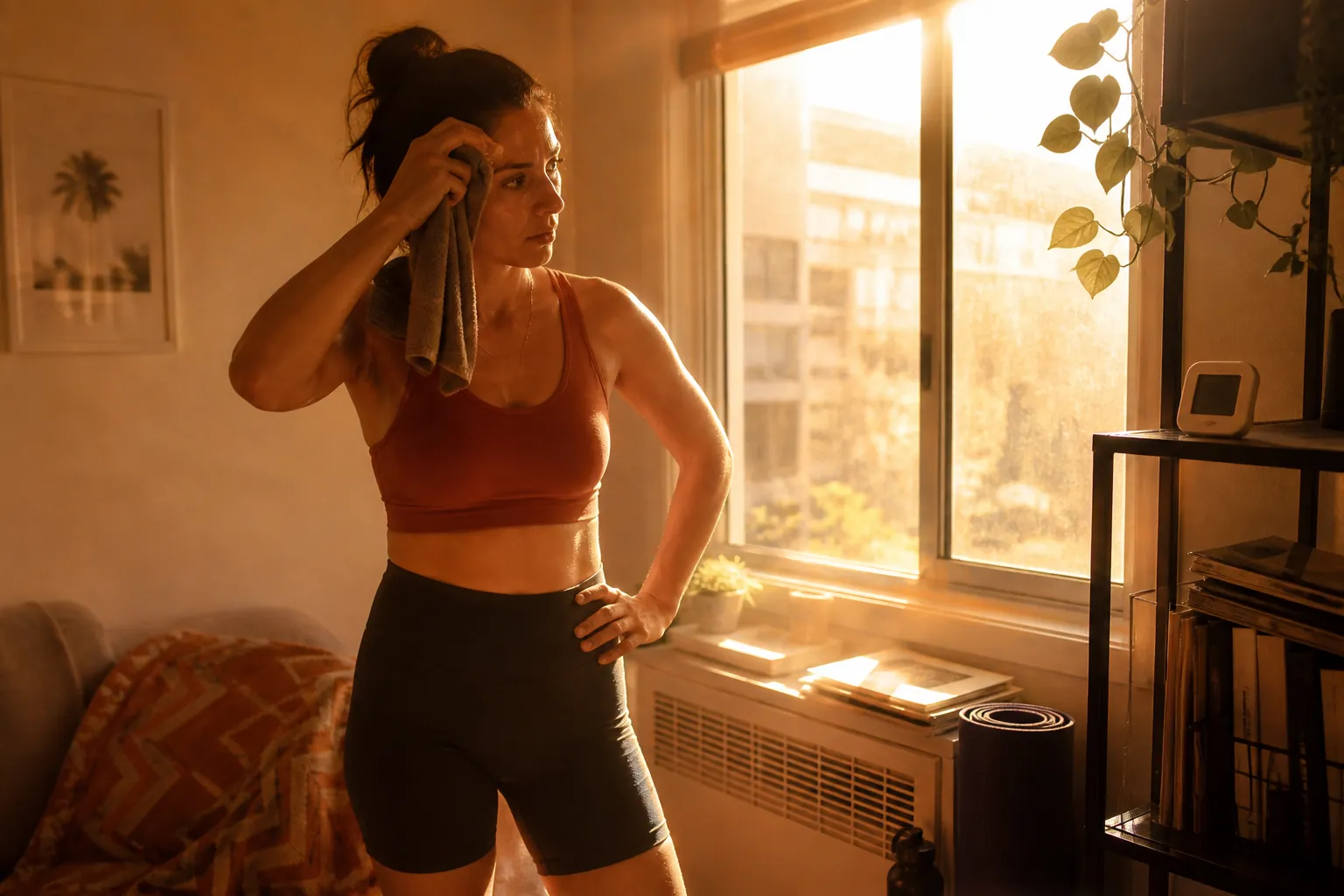
You are standing in the one clear corner of a small apartment. The mat is rolled out, the window is bright, the fan is doing its best, and the room has been collecting heat since lunch. This is the moment when advice for working out during a heat wave in a no-AC apartment needs to mean something more useful than another list of hacks.
The first question is not which circuit to do. It is whether this room is a reasonable place to train today.
That distinction matters because indoor heat can become its own hazard. During heat waves, homes can stay dangerously hot, and indoor temperatures can climb above outdoor temperatures within hours, with added risk on upper floors and near sun-facing windows.[1] Enclosed spaces with little airflow increase heat-stress risk, and heat-related deaths often happen indoors, not only on sidewalks, tracks, or job sites.[2]
The overnight pattern matters too. When nighttime temperatures stay above about 75°F, the body loses the cooler recovery window it normally gets after a hot day.[3] If you slept badly in heat, woke up already sweaty, and now want to add burpees to the same air, that is not a motivation problem. It is a heat-load problem.
Start with a room check, not a pep talk
A no-AC apartment can feel “hot” in a dozen different ways. The room can be dry and tolerable, humid and suffocating, sun-baked in one corner and calmer in another. Guessing from the weather app is not enough because the app is not measuring the mat, the window, the ceiling height, the lack of cross-breeze, or the heat stored in the walls.
Use a cheap thermometer-hygrometer in the actual workout corner before you decide. Apartment fitness guidance often recommends a basic unit around $15 for this purpose; treat that as practical equipment, not a medical device.[5] Put it where you train, wait long enough for the reading to settle, and check both temperature and humidity. A practical comfort target of about 68–75°F for a workout area can be useful, but it is not a medical cutoff.[5]
Once you have the temperature and humidity, estimate the heat index for the room. Heat index is not a perfect home-workout instrument, but it gives you a more honest picture than temperature alone because sweat cooling depends heavily on humidity. Mayo Clinic notes that a heat index around 91°F or higher is a point where activity calls for precautions.[4] NOAA’s heat-index guidance, discussed in PBS NewsHour coverage, places prolonged strenuous activity in a danger zone around 96°F at 45% humidity.[3]
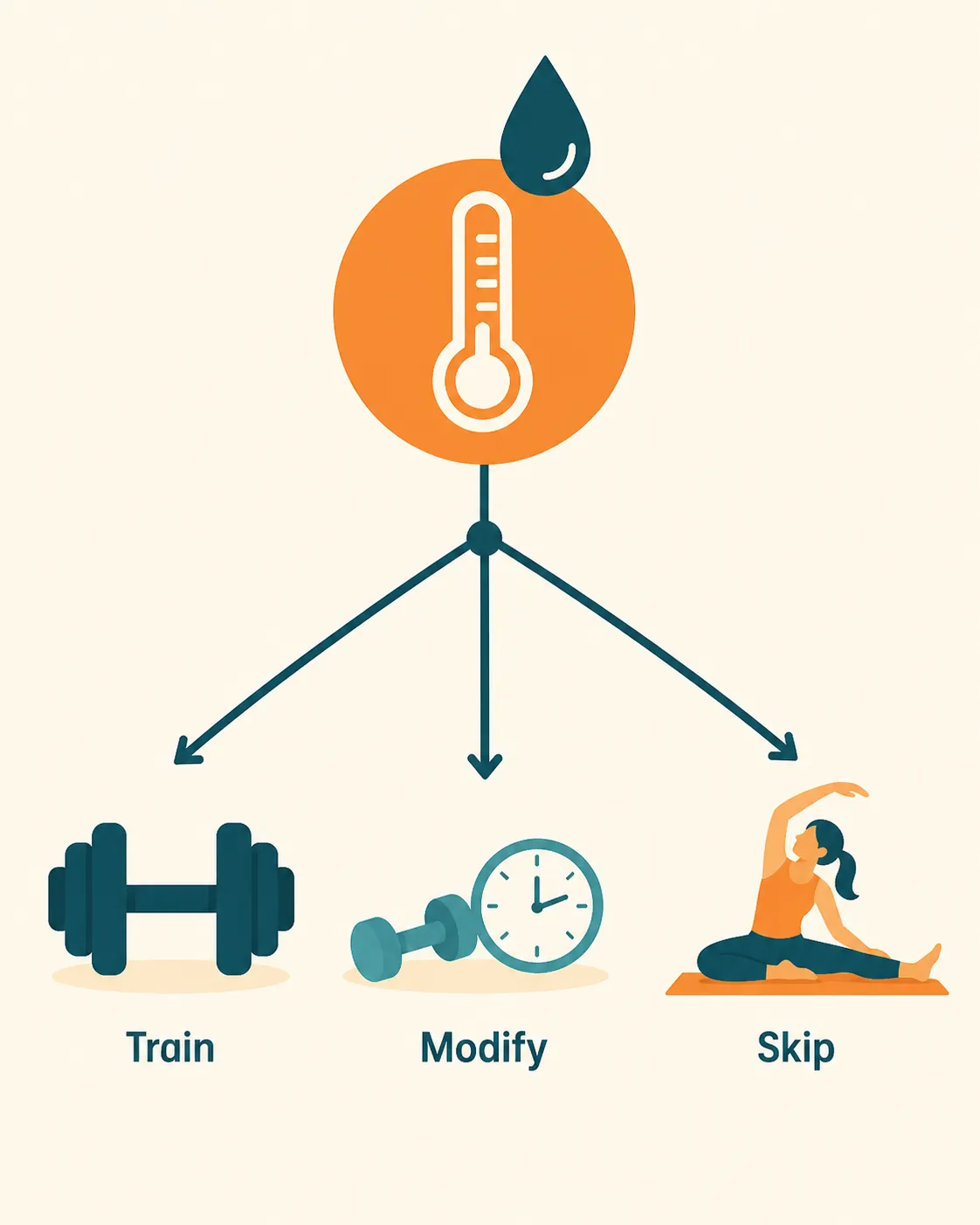
| What you find in the workout corner | What the day becomes |
|---|---|
| Room feels warm but measured heat burden is below the caution range, you slept reasonably, and you have no heat symptoms | Train, but keep the first round easy and reassess before increasing effort |
| Heat index is around 91°F or higher, the room is humid, the sun-facing corner is still radiating heat, or the night stayed hot | Modify: shorten the session, lower intensity, extend breaks, and avoid any finishers |
| Heat index is near the danger range for prolonged strenuous activity, the room is hotter than outdoors, you feel off before starting, or symptoms appear | Skip the workout and make it recovery, mobility, stretching, breath work, or a cooler-time walk if conditions allow |
This is deliberately conservative. A small apartment does not give you the same margin as a shaded outdoor route with airflow, a gym with cooling, or a room you can leave and cool down in quickly. If the only available training space is the hottest corner of the home, the room gets a vote.
What “modify” actually means in a hot apartment
A modified workout is not the same workout with more water nearby. The whole point is to reduce heat production and give your body more chances to dump heat. Exercise intensity is a major driver of core-temperature rise, so the most useful lever is usually effort, not cleverness.[2]
That means the workout may keep the habit but lose the performance goal. If the plan was intervals, make it steady and easy. If the plan was a full-body strength circuit with minimal rest, turn it into a few controlled sets with generous pauses. If the plan included jumping, crawling, mountain climbers, squat thrusts, or a “quick” finisher, those are the first pieces to go.
- Lower the effort first. You should be able to speak in full sentences. If you keep drifting into hard breathing, the session is no longer modified enough.
- Shorten the work. Do one easy block instead of trying to rescue the full plan.
- Lengthen the rests until they feel almost too long. In heat, rest is part of the safety structure, not wasted time.
- Choose lower-impact movements: slow bodyweight strength, light bands, mobility flows, balance work, gentle core work, or stretching.
- Remove competitive cues. No beat-the-clock formats, no max reps, no final burnout round.
A useful modified session in a hot room often looks almost boring on paper. That is fine. Boring is much safer than turning a no-AC corner into a closed-box conditioning test.
Hydration helps, but it is not permission
Start hydrated before you exercise, not halfway through when you already feel behind. NPR’s heat-exercise guidance gives a rough target of 0.5–1 liter of fluid per hour of exercise in heat, using urine color as a practical gauge, and notes that electrolytes become more relevant for sessions lasting more than an hour.[6]
That does not make water a safety override. Drinking can support cooling and circulation, but it does not turn a dangerously hot, humid room into a safe training environment. If the room fails the check, the answer is not “more water and push through.” The answer is change the session or stop.
The stop signs need names
“Listen to your body” is too vague when you are hot, sweaty, and alone in an apartment. The signs need to be specific enough that you can act before bargaining with yourself.
CDC, NOAA, Mayo Clinic, and Johns Hopkins materials describe heat illness along a practical ladder: cramps can be an early warning; heat exhaustion is more serious; heat stroke is an emergency.[7][8][9][4][10] This is safety education, not a diagnosis. If symptoms are severe, worsening, confusing, or not resolving, get medical help.
| If this happens | What to do first |
|---|---|
| Painful muscle cramps or spasms during or after training | Stop exercising, move to the coolest available place, sip fluids, and do not restart the workout just because the cramp eases |
| Heavy sweating with weakness, dizziness, headache, nausea, vomiting, faintness, cool or clammy skin, or unusual fatigue | Stop immediately, cool the body, loosen clothing, sip water if fully alert, and seek medical care if symptoms worsen, vomiting occurs, or symptoms do not improve |
| Confusion, slurred speech, loss of consciousness, seizure, very hot skin, or signs that the person cannot safely drink or respond | Call 911. Begin cooling while waiting for help. Do not try to make an unconscious or confused person drink |
The lonely part of home training is that there may be no coach, classmate, front desk, or passerby to notice that you look wrong. Set the rule before the workout starts: any heat-illness sign ends the session. Not the round. Not the set. The session.
Return-to-activity decisions after exertional heat illness deserve caution. ACSM’s expert consensus frames recognition, management, and return to activity as connected safety issues, not as a simple matter of feeling better a few minutes later.[11] If you had significant symptoms, the safer next step is recovery and medical guidance, not proving the streak survived.
Fans, shade, and cooling accessories are support tools
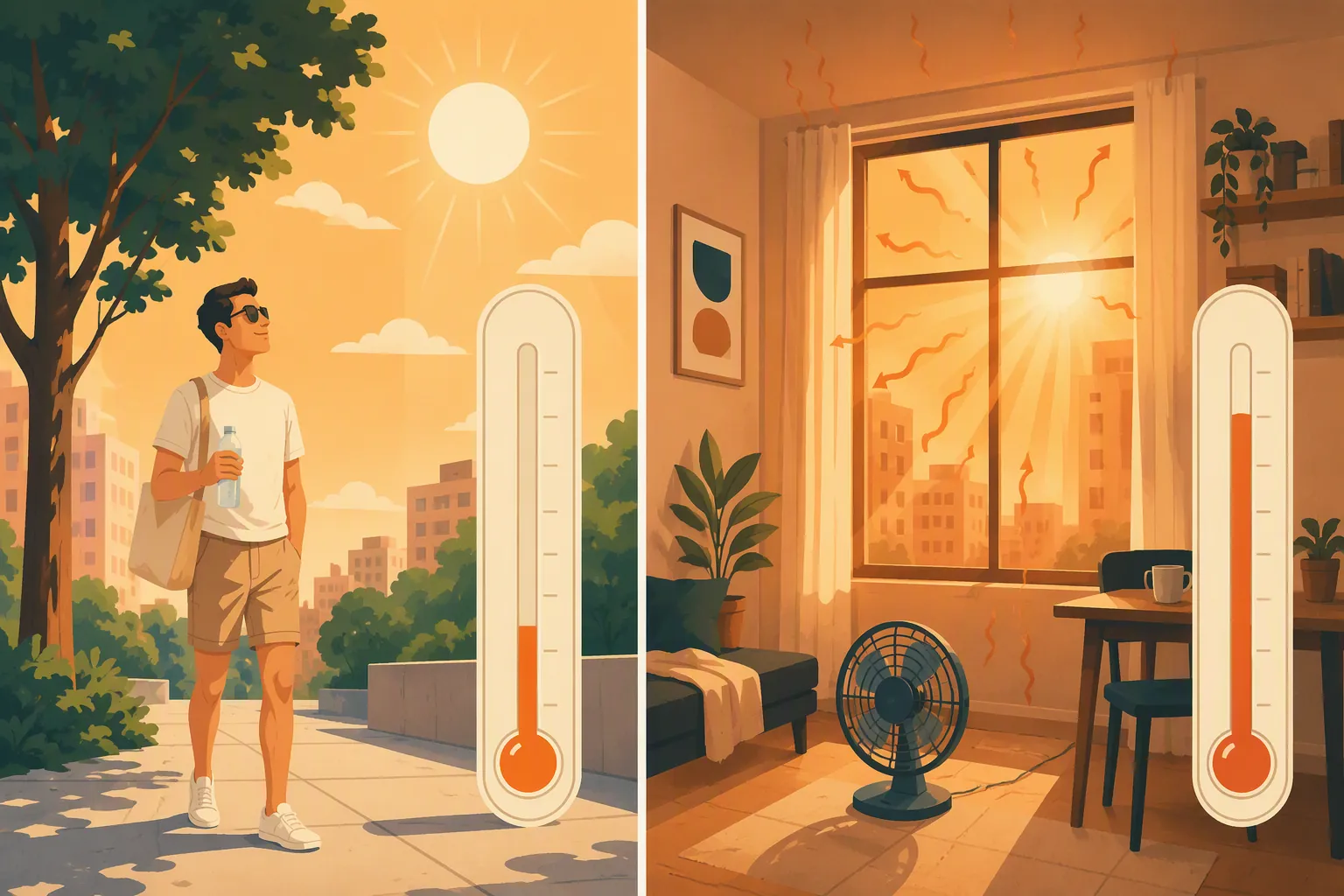
Apartment adjustments can help. Close blinds before the sun hits the room. Move the mat away from the sun-facing window if another patch of floor is cooler. Create cross-ventilation if the outdoor air is cooler than the indoor air. Place a fan so it moves air across your body rather than just stirring the hottest corner. Keep a towel nearby. Use cooling accessories if they make the session feel easier.
Just keep those tools in their place. A fan does not erase a dangerous heat index. Ice nearby does not make high-intensity intervals wise. A cooling towel does not cancel out a bad night of heat exposure. These are supporting details after the room check, not replacements for it.
Acclimatization is also real, but it is not a guarantee. Sources describe heat adaptation across a variable span, from several days to a couple of weeks or longer depending on the person and conditions.[2][4] A renter in a top-floor apartment with no AC is not training in a controlled heat-acclimation protocol. If the room is unsafe today, being “used to summer” is not enough reason to force the workout.
When the answer is skip
A skip day in a heat wave does not have to become a collapse of the routine. It can be active recovery: mobility, stretching, gentle breath work, or a walk later when conditions are cooler, if that is actually available and safe.[12] BBC Future’s heat-exercise guidance also points toward lower-intensity activity and cooler timing as ways to stay active without forcing the same heat stress.[2]
The important part is naming the decision honestly. If the room is too hot, too humid, or still loaded from a night that never cooled down, skipping is not a character flaw. It is the recovery-rest choice that protects the next session.
References
- Heat waves can leave homes dangerously hot, even for young, healthy adults — The Conversation
- How to keep exercising when it's really hot — BBC Future — June 18, 2026
- How to stay cool and safe in a heat wave, even without air conditioning — PBS NewsHour
- Heat exhaustion — Mayo Clinic
- Indoor Workouts During Outdoor Heatwaves — Weidner — June 10, 2026
- How To Heat-Proof Your Summer Workout — NPR — July 19, 2021
- Heat Stress: Heat-related Illnesses — CDC NIOSH
- Heat and Athletes — CDC
- Heat exhaustion or heat stroke? Know the signs of heat illness — NOAA
- Exercise-Related Heat Exhaustion — Johns Hopkins Medicine
- American College of Sports Medicine Expert Consensus Statement on Exertional Heat Illness: Recognition, Management, and Return to Activity — PubMed — 2023
- Ready to Get Your Summer Sweat On? 5 Tips for Exercising in the Heat — MU Health Care
This is general fitness education, not medical advice. For diagnosis or treatment of pain or injury, consult a qualified clinician.
Pick your next session
Browse all routines to find an appropriately-spaced next session.
Spot something off?
This content sits adjacent to health guidance — tell us if a citation or figure needs a correction.