
Why High-Protein Tuna Salad Is Perfect for Post-Workout Recovery
This high-protein tuna salad recipe uses Greek yogurt instead of mayo and pairs with carbs for a complete post-workout recovery meal in under 10 minutes, backed by ACSM and ISSN recommendations on protein timing and muscle repair.
- Citation source
- ACSM, ISSN
- Evidence level
- formal position stand
You need a post-workout meal in under 10 minutes, not a project. This high protein tuna salad recipe works because it does the recovery job directly: canned tuna for complete protein, Greek yogurt instead of mayo for a bigger protein hit, and chickpeas or whole-grain bread so the bowl is not just a protein snack pretending to be a meal.
A can of tuna is not a fallback here. The American College of Sports Medicine lists a can of tuna as a practical way to reach a 20–30 gram per-meal protein target, and its broader sports nutrition guidance includes fish among recovery protein foods.[1]
The 10-Minute High-Protein Tuna Salad
This is the version I would make after training, when the mat is still on the floor and the kitchen counter is already crowded. It uses one can, one bowl, and no cooking.
| Ingredient | Amount | Recovery role |
|---|---|---|
| Canned tuna, drained | 1 can, about 3 oz drained | Complete protein; EPA and DHA omega-3s |
| Plain Greek yogurt | 3/4 cup | Adds protein and replaces mayo |
| Chickpeas, drained and rinsed | 1/2 cup | Adds carbohydrates for glycogen support |
| Diced cucumber or celery | 1/2 cup | Crunch, volume, hydration-friendly texture |
| Red onion or scallion | 1–2 tablespoons | Sharpness so the yogurt does not taste flat |
| Lemon juice | 1 tablespoon | Acidity and brightness |
| Dijon mustard | 1 teaspoon | Flavor without needing extra fat |
| Fresh dill, parsley, or chives | 1–2 tablespoons | Flavor and plant compounds, without pretending herbs do the whole recovery job |
| Black pepper | To taste | Seasoning |
| Whole-grain toast, pita, crackers, or extra chickpeas | As needed | Turns the salad into a fuller post-workout meal |
- Drain the tuna well so the yogurt does not turn watery.
- Stir Greek yogurt, lemon juice, mustard, pepper, and herbs in a bowl.
- Fold in the tuna, chickpeas, cucumber or celery, and onion.
- Taste once, then adjust with more lemon, pepper, mustard, or herbs.
- Serve it with whole-grain toast, stuffed into a pita, over rice, with crackers, or over greens plus a separate carb.
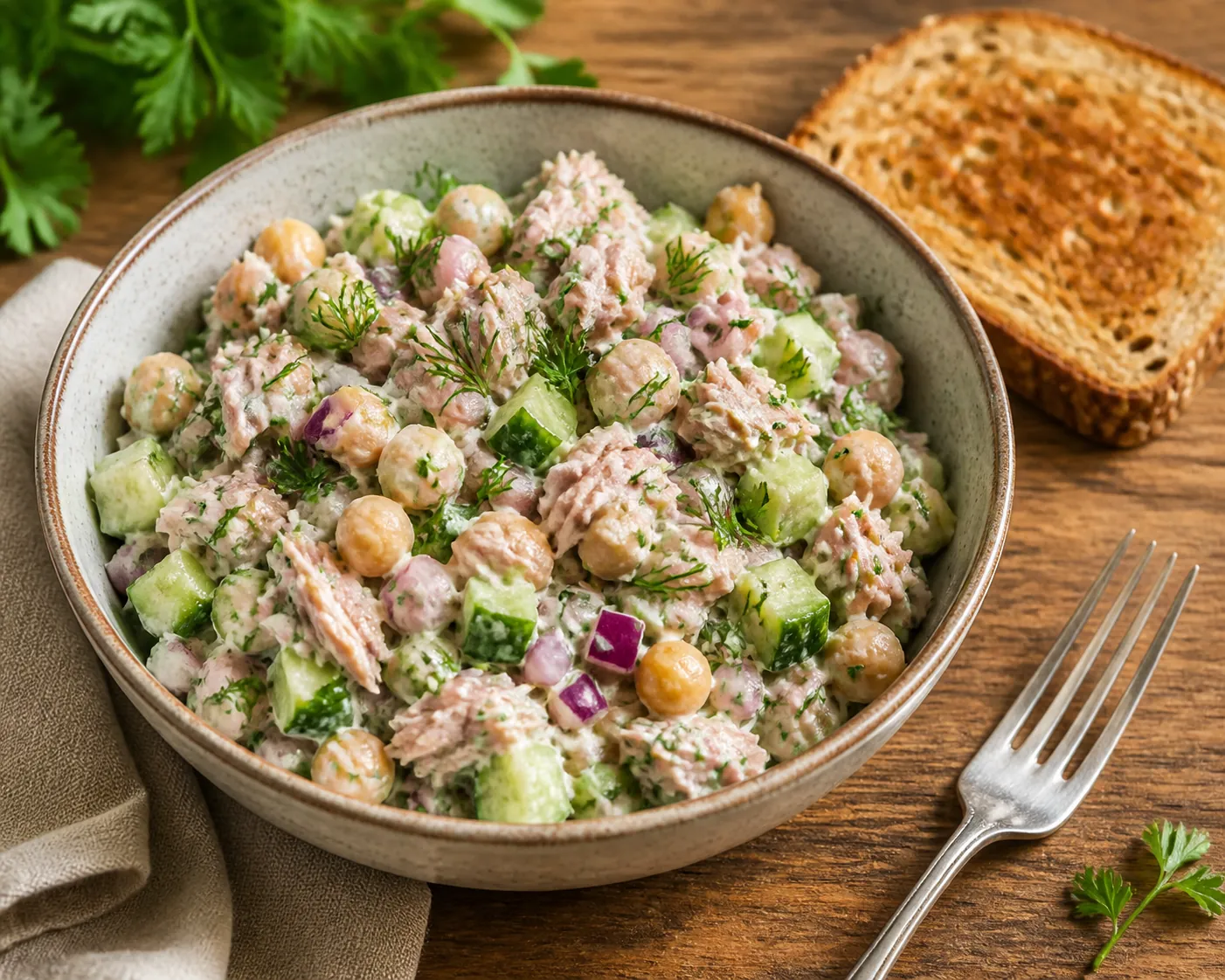
If you want the quickest recovery version, do not stop at tuna plus yogurt. Add the chickpeas, put it on bread, or eat it with another real carbohydrate. That is the difference between a high-protein tuna salad and a post-workout recovery meal.
Why This Bowl Actually Qualifies as Recovery Food
The first job after lifting is giving muscle enough amino acids to repair and adapt. The International Society of Sports Nutrition position stand identifies roughly 20–40 grams of high-quality protein per meal as a useful range for stimulating muscle protein synthesis, depending on the person and training context.[2]
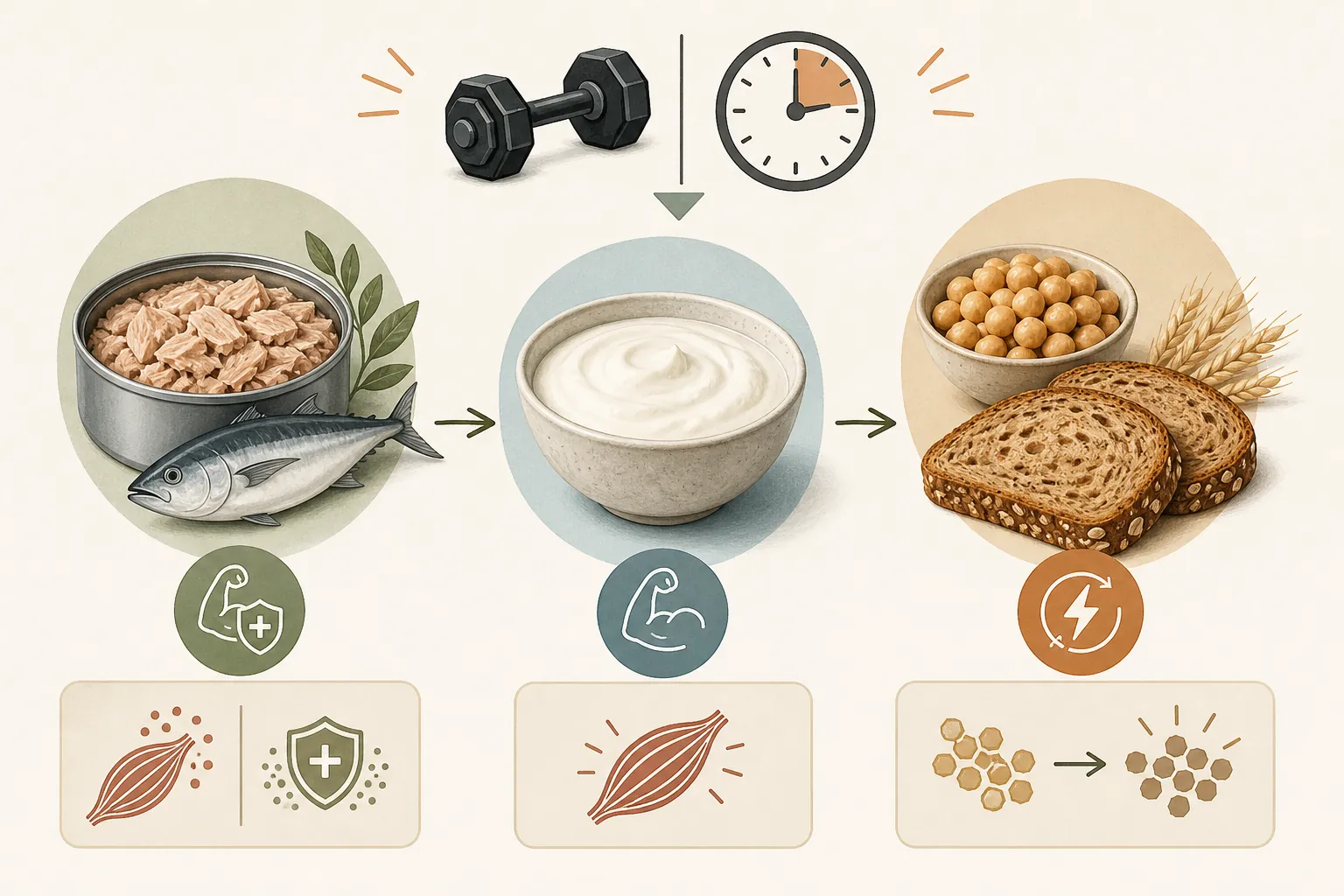
A 3 oz serving of canned tuna can deliver about 20 grams of complete protein, meaning it contains all nine essential amino acids.[3] That is why tuna is unusually tidy for a home-gym meal: one can can already put you at the lower end of the per-meal protein target before anything else enters the bowl.
The Greek yogurt is not there to make the salad look more virtuous than mayo. It changes the math. A 3/4 cup serving of plain Greek yogurt adds roughly 16 grams of protein in recipe calculator estimates, with USDA dairy data supporting Greek yogurt as a concentrated protein source.[3][4] Put that with the tuna and the salad lands around 35–40 grams of protein before counting small contributions from chickpeas or bread.
Those numbers are useful, not sacred. Cans vary, yogurt brands vary, and recipe calculators are estimates rather than lab tests. But for a sweaty person standing in a small kitchen, the range is good enough to make a decision: this meal can cover the protein side without a scoop of powder.
The Carb Part Is Not Optional If This Is Post-Workout
Protein gets most of the attention because it is easy to count and easy to market. Training also uses muscle glycogen, especially if the session includes higher-volume lifting, circuits, intervals, or conditioning work. A tuna salad with no carb source may be high-protein, but it is not as complete as a recovery meal.
That is where chickpeas and bread earn their place. A 1/2 cup serving of chickpeas supplies about 22 grams of carbohydrates, and whole-grain bread, pita, rice, or crackers can push the meal further toward glycogen replenishment.[3] The older 3:1 carbohydrate-to-protein recovery ratio is still a practical reference point in some sports nutrition discussions, but it should be treated as a guide, not a rule that every lifter has to calculate after every workout.[5]
Tuna Has One Recovery Advantage Chicken Does Not
Chicken breast can absolutely be a recovery food. The reason tuna is interesting is that it brings complete protein and marine omega-3 fats in the same no-cook package. Tuna contains EPA and DHA, the omega-3 fatty acids usually discussed in relation to fish and inflammation.
That does not mean a tuna salad erases soreness. The fairer claim is narrower: omega-3 intake has evidence behind it for reducing some exercise-induced muscle damage biomarkers. A 2024 systematic review and meta-analysis found that omega-3 polyunsaturated fatty acid supplementation reduced markers associated with exercise-induced muscle damage.[6]
A serving of tuna salad is food, not a controlled supplement protocol. Still, choosing a recovery meal that naturally contains EPA and DHA is a reasonable upgrade over building every post-workout plate from lean protein alone.
Timing Matters, Just Not in the Panicked Way
The appeal of this recipe is partly timing. Harvard Health has advised getting about 20 grams of protein within 45 minutes after a workout for women, with a longer window of up to 3 hours for men.[7] ISSN’s broader position is less frantic, placing nutrient timing in a context where post-exercise protein within about 2 hours can be sufficient depending on the pre-workout meal and total daily intake.[2]
That is exactly the kind of window a no-cook meal can hit. You can drain tuna, stir yogurt, add chickpeas, and sit down before a cooked protein would be halfway done. If you trained after work, or between meetings, or while a kid’s laundry is still in the machine, that speed is not a minor convenience.
How to Adjust It Without Turning It Into a Different Meal
The structure is simple: tuna, Greek yogurt, carb, crunch, acid, herbs. Change the flavor if you want, but keep the recovery pieces in place.
- For more carbs: add extra chickpeas, serve it on two slices of whole-grain toast, or spoon it into a pita.
- For a lighter meal: keep the chickpeas but serve over greens, then add fruit or toast if the workout was harder.
- For more flavor: use dill pickles, capers, smoked paprika, hot sauce, or extra lemon.
- For less tang: use half Greek yogurt and half avocado, but expect the protein total to drop.
- For meal prep: mix the tuna-yogurt base ahead, then add cucumber, herbs, and toast right before eating so it does not go soggy.
The one adjustment I would not make after training is removing the carb and calling it finished. If the goal is recovery, the bread, pita, crackers, rice, or chickpeas are doing real work.
The Budget Argument Is Real
Tuna also wins a very unglamorous category: it is cheap, shelf-stable protein. At roughly $1.50–$3.00 per can for about 20 grams of protein, canned tuna lands around $0.08–$0.15 per gram of protein in one cost comparison, making it competitive with chicken breast and cheaper than many protein powders.[8]
That matters if your home gym is a corner of a room and your recovery plan has to survive normal grocery shopping. Protein powder can be useful. It is not automatically more serious than a can opener and a bowl.
The Mercury Constraint
The practical limit on tuna is mercury, not whether the meal is “clean” enough. FDA benchmark data put canned light tuna around 0.126 parts per million mercury and albacore around 0.350 parts per million, though mercury varies by brand, fish size, and source.[9][10]
For frequent tuna eaters, canned light tuna is usually the better default. FDA guidance allows 2–3 servings per week from lower-mercury “Best Choices” fish such as canned light tuna, while albacore falls into the “Good Choices” category typically limited to 1 serving per week.[9] People who are pregnant, may become pregnant, breastfeeding, or feeding young children should follow the FDA’s fish advice more carefully and treat this as general food guidance, not individualized medical advice.
The Version Worth Keeping
This is not a magic recovery food, and it does not replace the rest of your diet. It is just unusually efficient when built deliberately: choose canned light tuna if you eat it often, use Greek yogurt for the protein upgrade, and add chickpeas or whole-grain bread when the meal is truly post-workout.
That combination gives you the part that matters after training: enough protein to be useful, enough carbohydrate to stop pretending recovery is protein-only, and a meal you can make before the urge to give up and drink something from a shaker wins.
References
- Ten Things You Need to Know About Sports Nutrition, American College of Sports Medicine.
- International Society of Sports Nutrition Position Stand: protein and exercise, Journal of the International Society of Sports Nutrition, 2017.
- FoodData Central, U.S. Department of Agriculture.
- High Protein Tuna Salad, Walder Wellness.
- Nutrient timing revisited: is there a post-exercise anabolic window?, Journal of the International Society of Sports Nutrition, 2008.
- Effects of omega-3 polyunsaturated fatty acid supplementation on exercise-induced muscle damage: a systematic review and meta-analysis, 2024.
- Timing of protein intake is important for muscle growth, Harvard Health Publishing.
- Is Canned Tuna A Good Source of Protein?, American Tuna.
- Mercury in Tuna: Is This Fish Safe to Eat?, Healthline.
- Mercury Levels in Commercial Fish and Shellfish (1990-2012), U.S. Food and Drug Administration.
This is general fitness education, not medical advice. For diagnosis or treatment of pain or injury, consult a qualified clinician.
Pick your next session
Browse all routines to find an appropriately-spaced next session.
Spot something off?
This content sits adjacent to health guidance — tell us if a citation or figure needs a correction.