
Can Home Exercises Beat PT for Wrist Fracture Recovery?
Research shows that a properly structured home exercise program can outperform supervised physical therapy for wrist fracture recovery in certain cases. This article examines the evidence, the tested protocol, and the important caveats you need to know before choosing a recovery path.
- Citation source
- PubMed
- Evidence level
- Restrained inference
The most interesting evidence on doing wrist fracture recovery exercises at home is not a vague reassurance that home rehab is “good enough.” In one randomized trial of 56 patients after volar plate fixation for distal radius fractures, the home exercise group recovered 54% of grip strength at six weeks, compared with 32% in the supervised physiotherapy group. Extension/flexion range of motion recovered to 79% versus 52%, and PRWE pain/function scores were much lower: 18.5 versus 36.1, with P<.001. Those are not tiny differences at the stage when many patients are worried about stiffness, weakness, and whether they are falling behind. [1]
The fence around that result matters. This was not a trial of every wrist fracture, every age group, or every “do a few movements when you remember” routine. It was after volar plate fixation, over the first six weeks, with a structured home program. For a patient trying to decide between paying for supervised PT and doing the daily work at home, the lesson is not “skip therapy.” It is narrower and more useful: in a specific post-surgical distal radius fracture situation, a properly taught and tracked home program performed better than supervised physiotherapy in that trial. [1]

What “tested at home” actually meant
A home program can sound casual until the details are named. In the Krischak trial, “home” meant written step-by-step instructions, a training diary, and a six-week progression. It did not depend on expensive equipment. The patient still had to understand what to do, repeat it, and record it. That combination is easy to underestimate because it is not dramatic. It is also the part that separates a tested home program from a loose list of wrist circles found online. [1]
The training diary deserves more respect than it usually gets. After a wrist fracture, the work is repetitive and unglamorous. A diary turns that work into visible evidence: which sessions were done, whether a phase was skipped, and whether symptoms changed after progression. It also gives a clinician something concrete to review if pain, swelling, stiffness, or fear starts changing the plan. A patient who brings back a filled diary is not merely saying, “I tried to be consistent.” They are showing what actually happened.
The written instructions also matter because wrist rehab is full of small ways to drift. One patient moves through a safe range slowly; another forces the end range because it feels like “stretching.” One patient supports the forearm; another lets the whole arm compensate. One patient increases effort only after clearance; another adds resistance because the hand feels better for a day. Once an exercise sheet leaves the clinic, nuance starts leaking out. A tested home program tries to plug that leak with sequence, repetition, and records.
| Part of the home program | Why it matters in practice |
|---|---|
| Initial professional instruction | The patient learns timing, safe movement limits, and what should trigger a check-in before doing the program alone. |
| Written step-by-step directions | The program is repeatable instead of dependent on memory, confidence, or guesswork. |
| Training diary | Completion and symptom patterns are visible rather than reconstructed days later. |
| Six-week progression | The workload changes over time instead of staying either too timid or too aggressive. |
| No expensive equipment requirement | The tested idea is not built around a device; it is built around structure and follow-through. |
That last point is worth keeping clean. The trial was not evidence for one magic movement. It was evidence for a program: instruction, written steps, diary, and progression after volar plate fixation. Pulling one exercise out of that package and calling it the reason for better grip strength or range of motion would be a much larger claim than the evidence supports. [1]
Why the Krischak result is strong, and why it should not be stretched
Grip strength, extension/flexion range of motion, and PRWE pain/function scores are not abstract outcome measures to someone trying to use a hand again. Grip strength affects opening containers, carrying a bag, using tools, and trusting the wrist under load. Extension and flexion affect pushing up from a chair, typing position, grooming, cooking, and many small daily tasks that become irritating after a fracture. PRWE scores bring pain and function into the same conversation. When all three favor the home group at six weeks in the same trial, the finding is hard to dismiss. [1]
Still, the comparison was made in a defined surgical context. Volar plate fixation usually gives the treating team a different stability situation than a fracture managed only with casting. That does not make one treatment better for every person; it means the rehab decision sits on top of fracture pattern, fixation, surgeon instructions, healing, swelling, pain behavior, and complications. A home program that is sensible after fixation may be premature or poorly matched for a wrist that is still being protected in a cast or has not been cleared for motion.
This is where many home-rehab articles become too loose. “Distal radius fracture” is not enough information to copy a protocol. A plated fracture in the early post-operative period is not the same decision as a non-operated fracture, a delayed union, nerve symptoms, severe swelling, tendon irritation, complex regional pain concerns, or a patient who cannot understand or safely perform the instructions. Medical clearance is not a formality here. It controls when motion begins, what kind of loading is allowed, and when the plan needs to change.
The supporting evidence is encouraging, but not universal
A later randomized trial in elderly patients after volar locking plate fixation found that home exercises were as effective as supervised physiotherapy. That does not repeat the exact Krischak result of home exercise outperforming supervised PT, but it supports the more restrained point: after surgical fixation with a volar locking plate, home exercise can be a legitimate evidence-backed route when the program and patient fit are right. [2]
The counterpoint is just as important. In conservatively treated patients over 60, Gutiérrez-Espinoza and colleagues found supervised physical therapy performed better. That result blocks the lazy conclusion that home exercise is generally superior for wrist fractures. It is not. The evidence changes when the population and treatment method change. [3]
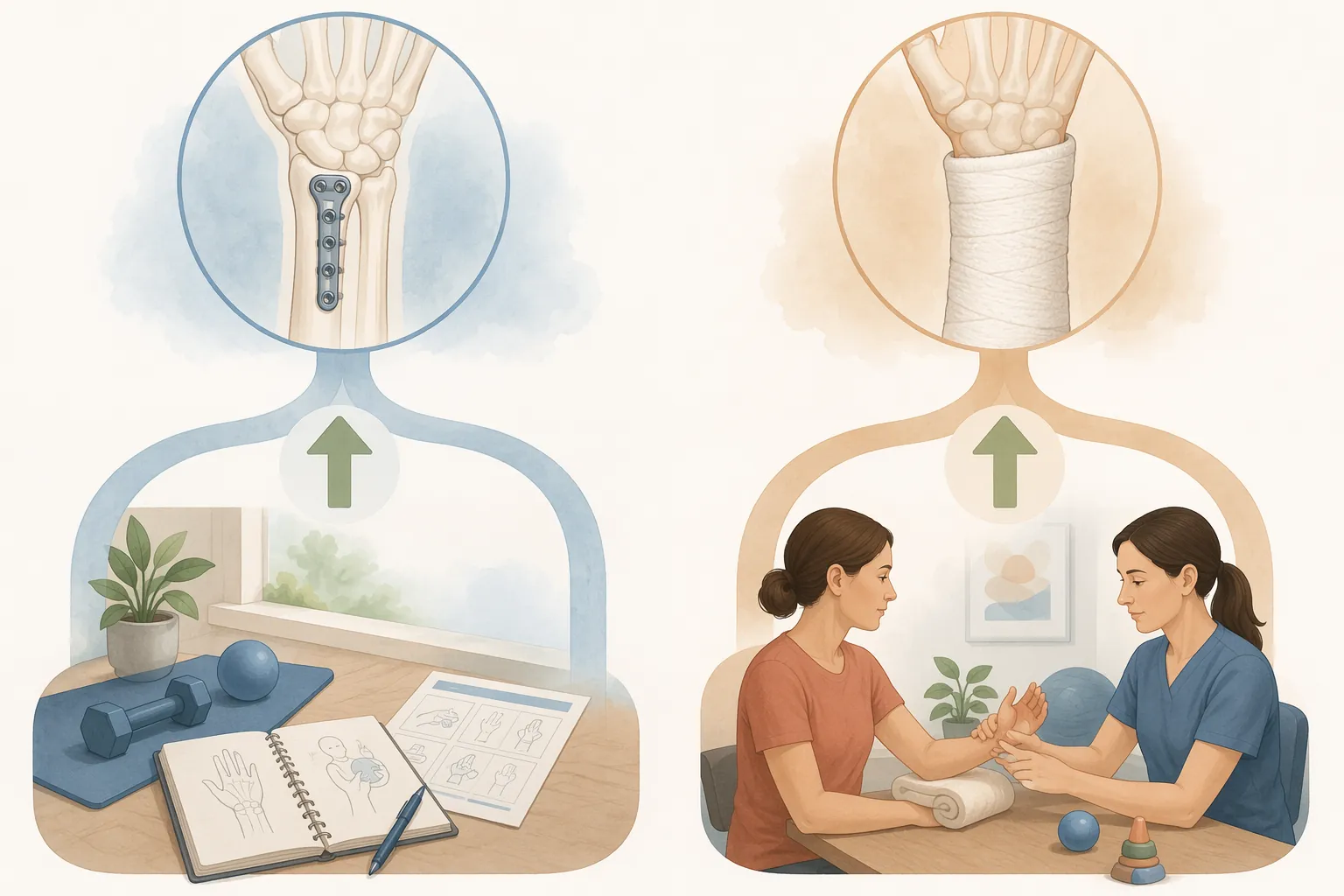
The broader rehab literature is also not settled enough to hand every patient one universal protocol. A 2023 systematic review of 23 studies reported no consensus on a standardized exercise protocol after distal radius fracture. It also found that 70.9% of therapists used no standardized protocol, with a median treatment duration of 12 weeks. A 2015 Cochrane review similarly found insufficient evidence to recommend one standard practice over another. That does not make therapy careless; it shows how much clinical judgment is still being used because fracture care, patient tolerance, and local practice vary. [4][5]
For the patient at home, that uncertainty cuts both ways. It means there is room to take a tested home protocol seriously, especially after volar plate fixation. It also means a generic printout is not automatically equivalent to the programs studied in trials. The useful question is not whether the plan happens at home or in a clinic. The useful question is whether the plan has the ingredients that made home rehab testable in the first place.
Who might reasonably discuss a structured home program
A structured home program is most worth discussing when the situation resembles the surgical trials: a distal radius fracture treated with volar plate or volar locking plate fixation, no major complications identified by the treating clinician, clear permission to begin the relevant movements, and a patient who can follow written instructions closely. The discussion should happen with the surgeon, physician, hand therapist, or physical therapist who knows the fracture and fixation status.
The patient also has to be honest about temperament and logistics. Some people do better when no one is watching because they can repeat short sessions faithfully at the kitchen table. Others need an appointment to notice compensations, control fear, or keep from doing too much too soon. Neither pattern is a moral virtue. It is just part of matching the rehab format to the person who has to live with it.
| Situation | Reasonable next conversation |
|---|---|
| Volar plate or volar locking plate fixation, uncomplicated recovery, cleared for movement | Ask whether a written, phased home program with diary tracking is appropriate, and how often progress should be checked. |
| Cast-treated fracture, especially in an older adult | Do not assume the surgical home-exercise findings apply; ask whether supervised therapy is preferred. |
| Age over 60 with conservative treatment | Be especially cautious, because supervised PT performed better in this group in one randomized trial. |
| Increasing pain, swelling, numbness, color changes, tendon irritation, or fear of movement | Pause progression and contact the treating clinician rather than trying to solve it with more exercise. |
| Unclear instructions or no clearance timeline | Get professional clarification before starting or advancing exercises. |
The diary is not decoration
The home program’s strength is also its weak point: the patient has to do it. Older adherence literature has estimated overall adherence at only 19–35%, which is a blunt warning for any recovery plan that depends on unsupervised repetition. [6][7]
That number should not be used to scold patients. Fracture recovery is tiring. The wrist may ache, the hand may feel clumsy, and progress can be hard to judge day by day. A diary helps because it reduces the amount of remembering and interpreting the patient has to do. It can be as simple as recording the date, the exercises completed, any symptom change, and whether the session matched the current phase of the plan.
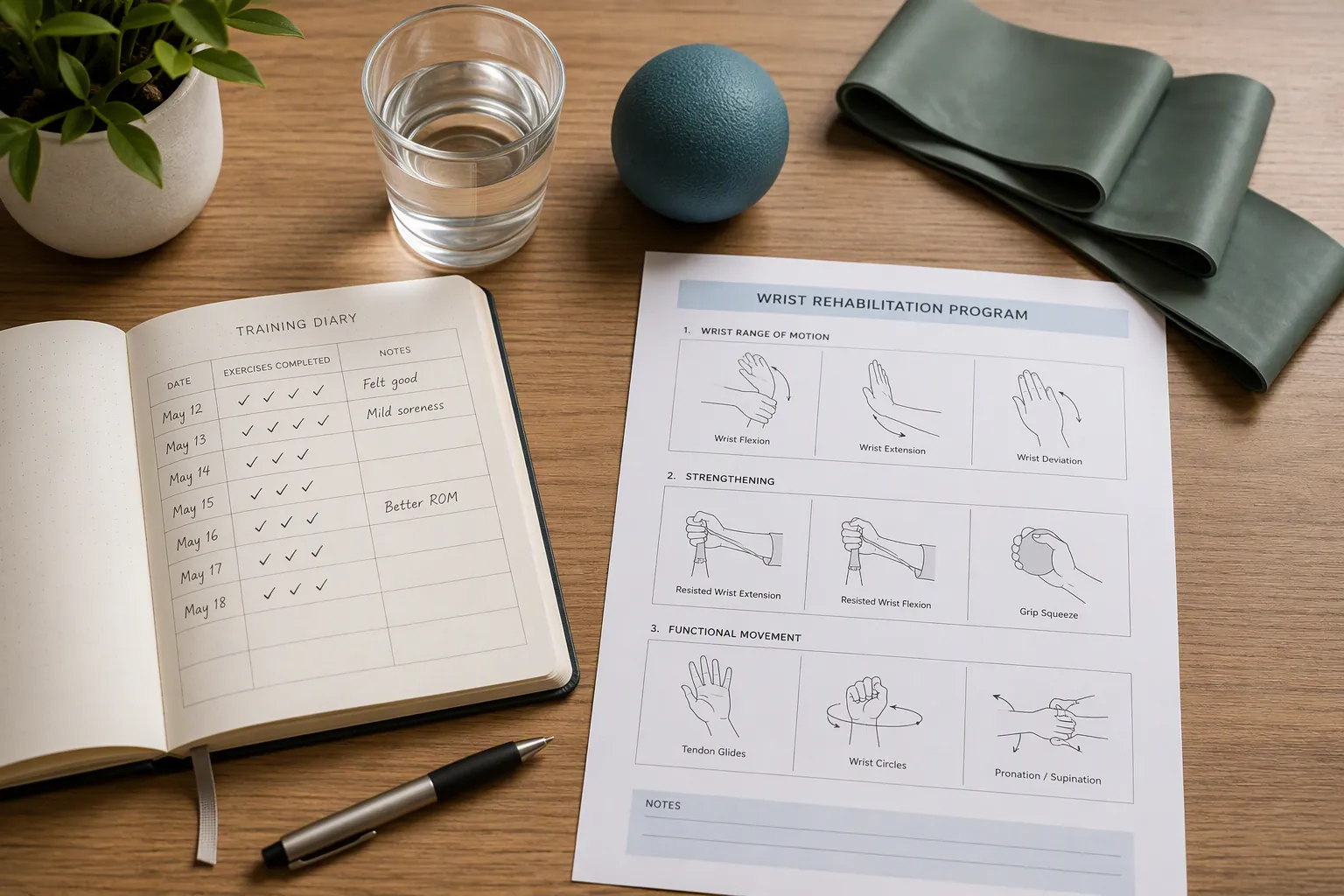
A good diary also protects against two opposite mistakes. It can show under-dosing: skipped sessions, long gaps, or staying in the easiest phase because the wrist still feels vulnerable. It can also show over-dosing: extra sessions, early resistance, or symptom spikes after progression. Both matter. A home program is not safer because it happens at home; it is safer when the patient follows the cleared plan and has a way to notice when the plan is no longer fitting.
What not to take from the evidence
Do not take the Krischak trial as proof that supervised therapy is unnecessary after all wrist fractures. Do not take it as proof that cast-treated fractures should be managed the same way as plated fractures. Do not take it as proof that older conservatively treated patients should avoid supervised PT; the available counterpoint points the other direction. [1][3]
Also do not take “home exercise” to mean self-designed rehab. The tested version had structure. If a clinician gives only vague advice, it is reasonable to ask for specifics: what movements are allowed, how often to do them, what symptoms should stop a session, when resistance can begin, when to follow up, and what should be written down. Those questions are not fussy. They are the difference between a program and a hope.
Structured home exercises can beat or match supervised PT in specific post-surgical distal radius fracture cases when instruction and follow-through are strong. The evidence does not justify skipping professional guidance for cast-treated fractures, older conservatively treated patients, complications, or anyone without medical clearance.
References
- Physiotherapy after volar plating of wrist fractures is effective using a home exercise program. PubMed. 2009.
- Home exercises after volar locking plate fixation in elderly patients were as effective as supervised physiotherapy. PubMed. 2022.
- Effectiveness of supervised physical therapy in the treatment of patients with distal radius fracture. PubMed. 2017.
- Rehabilitation after distal radius fractures: a systematic review. PMC. 2023.
- Rehabilitation for distal radial fractures in adults. Cochrane Database of Systematic Reviews. 2015.
- The challenge of patient adherence. Therapeutics and Clinical Risk Management. 2005.
- Correlates of exercise compliance in physical therapy. PubMed. 1993.
This is general fitness education, not medical advice. For diagnosis or treatment of pain or injury, consult a qualified clinician.
Pick your next session
Browse all routines to find an appropriately-spaced next session.
Spot something off?
This content sits adjacent to health guidance — tell us if a citation or figure needs a correction.