
How to Stay Safe Exercising at Home in High Heat Index
Learn how to exercise safely at home during high heat index conditions with evidence-based guidelines on when to train, how much to hydrate, and how to cool your space without air conditioning.
- Citation source
- CDC
- Evidence level
- General guideline
The awkward part of exercising safely at home in a high heat index is that the weather app is not measuring your workout corner. It is measuring an outside condition. A small garage, spare bedroom, upstairs apartment, or laundry-room gym can feel different once the door is closed, the sun hits the wall, and you start producing heat for 20 minutes.
That matters because home training removes some of the usual safety rails. There may be no coach watching your pace slow down, no teammate noticing confusion, no lifeguard, and no easy exit into a cooled lobby. A box fan and a water bottle help on some days. They do not turn a hot room into a safe room by default.
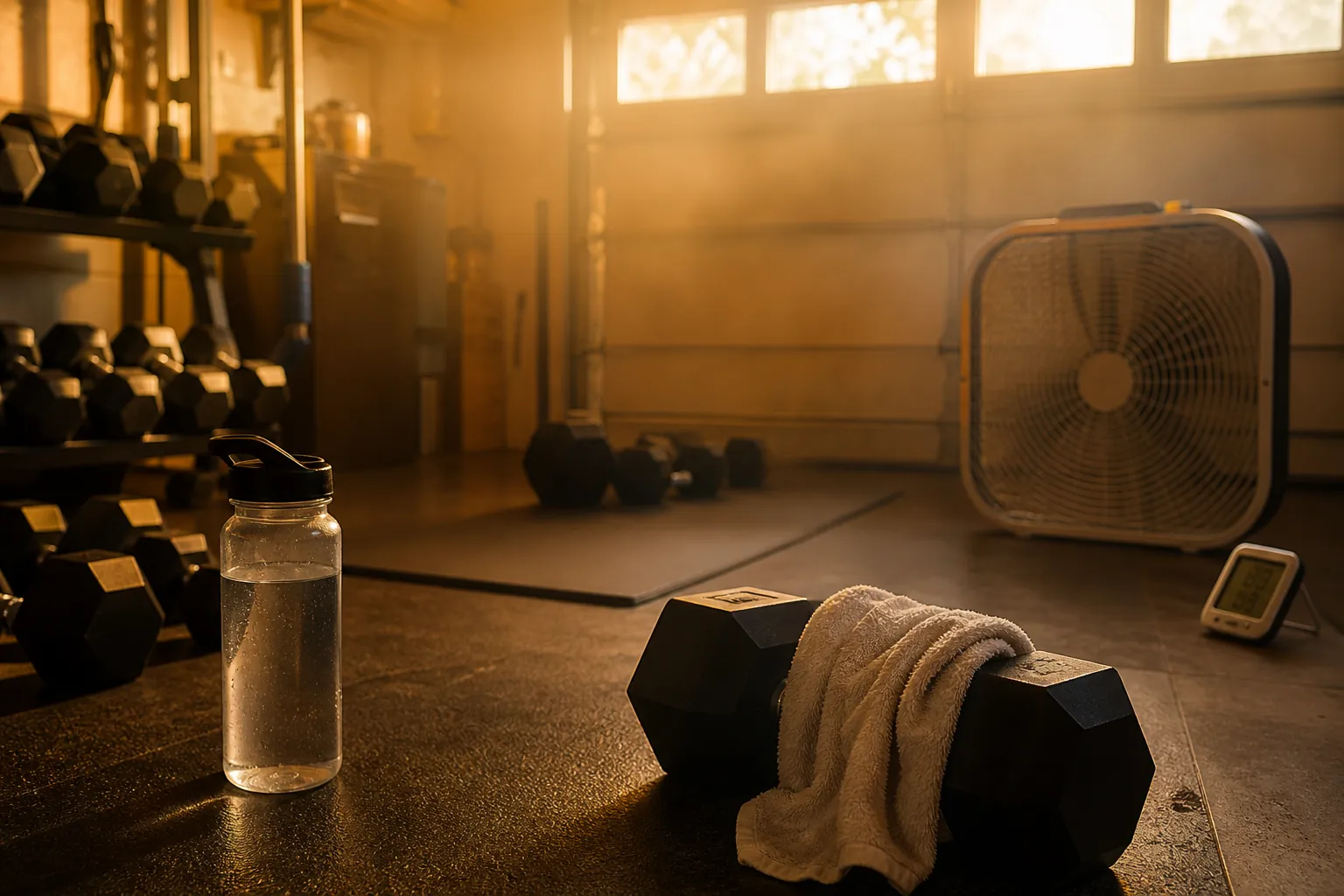
The better rule is to make the decision before you are already lightheaded: check the heat index, check the room, choose the workout version that fits those conditions, and keep a clear stop line.
Start With the Heat Index, Then Adjust for the Room
Heat index combines air temperature and humidity into an estimate of how hot conditions feel to the body. For exercise decisions, the useful part is not the formula. It is the threshold band. A National Weather Service/NOAA heat-index chart, discussed by Verywell Fit for exercise planning, places 80°F to 90°F in a caution range, 90°F to 103°F in an extreme-caution range, and 103°F or higher in a danger range for heat illness risk.[1]
Those bands are outdoor weather guidance, not a perfect laboratory measure of your garage. Still, they are a practical starting point because they give the home exerciser a decision rule instead of a mood check.
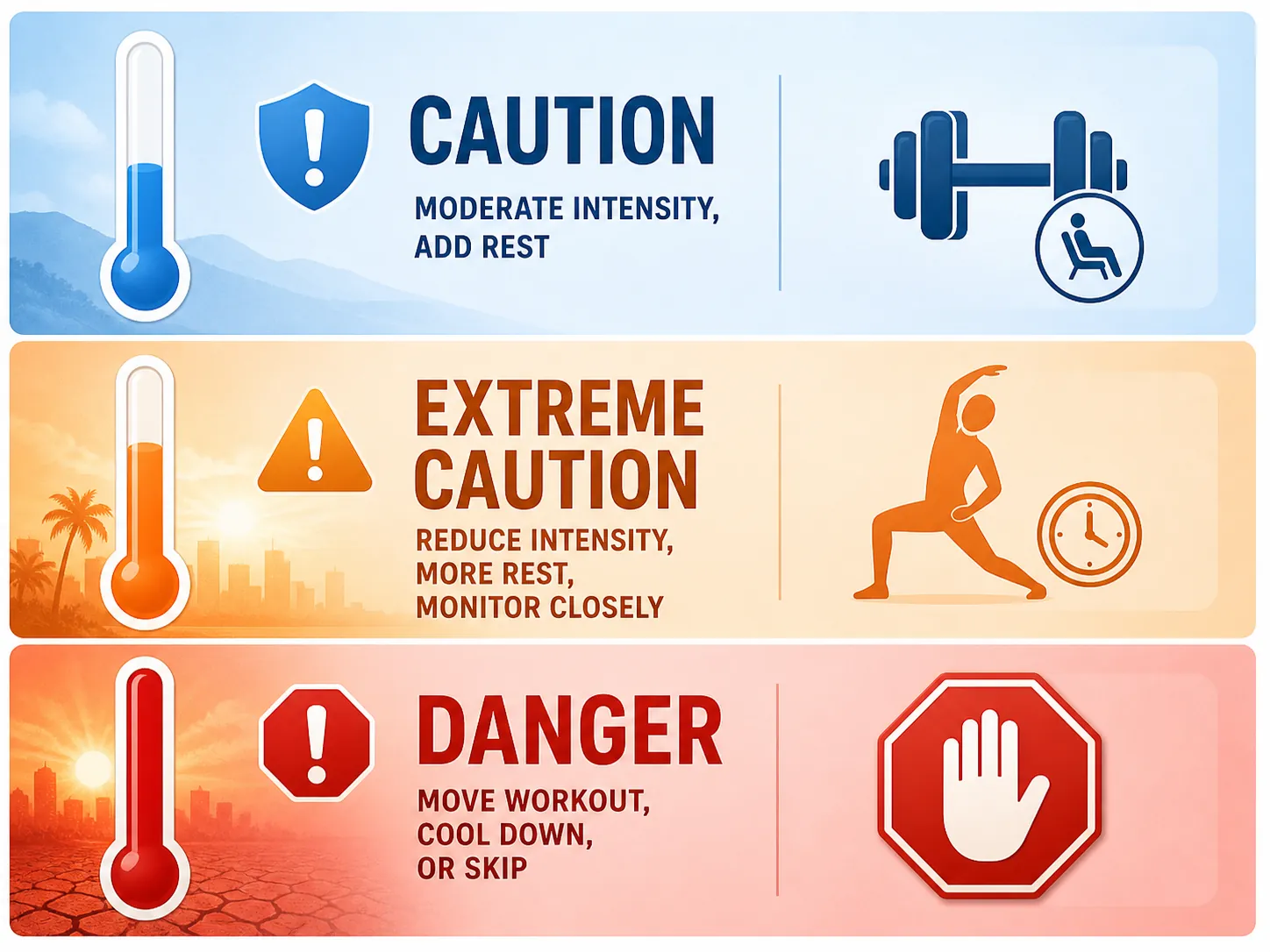
| Heat index | Home-training decision | What changes |
|---|---|---|
| Below 80°F | Train normally if the room is comfortable | Keep normal hydration nearby and monitor how the room changes during the session. |
| 80°F-90°F | Use caution | Reduce intensity if the room is stuffy, add rest, avoid long all-out intervals, and watch sweating, cramps, and unusual fatigue. |
| 90°F-103°F | Use extreme caution | Shorten the workout, move to technique, mobility, easy strength work, or lower-volume circuits; make rest periods longer; stop early if symptoms appear. |
| 103°F or higher | Treat as a danger zone | Do not do hard training in an uncooled home space. Move to a cooler room, postpone, or skip. |
The room can push the decision toward the safer column. A still upstairs bedroom with poor airflow should not be treated the same as a shaded basement. A garage that starts tolerable can become harder to cool once you close the door and start moving. One small-room treadmill study found that a treadmill session increased room temperature by 0.6°C and relative humidity by 4%, which supports the concern that indoor exercise can raise the local heat load rather than merely reflect the weather outside.
That finding does not prove every garage gym behaves the same way. Room size, ventilation, sun exposure, equipment, and starting humidity all matter. But it is enough to reject the lazy assumption that indoor exercise is automatically safer than outdoor exercise during a heat wave.
What Each Heat-Index Band Means for a Home Workout
80°F to 90°F: Keep the Session, Remove the Heroics
This is the range where many people can still train, but the plan should become less precious. If the workout calls for heavy sets near failure, dense supersets, or a conditioning finisher, the safer version is to cut the top end first. Leave more reps in reserve. Rest longer between sets. Remove the part of the workout that turns the room into a sauna.
For strength training, that may mean doing the main lift or main dumbbell movement and dropping the accessory circuit. For cardio, it may mean steady easy work instead of intervals. For a bodyweight routine, it may mean turning a timed AMRAP into unhurried sets with full recovery.
90°F to 103°F: Shorten, Slow, or Change the Goal
The extreme-caution band is where a home workout should stop pretending to be normal. If you train, make it deliberately easier and easier to end. A useful version is 15 to 30 minutes of mobility, technique practice, light strength work, or low-intensity movement with breaks that are longer than the work bouts.
This is not the day for repeated near-max lifts, high-rep leg circuits, burpee ladders, hard treadmill intervals, or anything that punishes you for stopping. If the only way to complete the planned session is to ignore rising heat stress, the plan is the wrong one for the room.
Sports heat-modification protocols often use work-to-rest changes to keep athletes from accumulating heat too quickly. Home exercisers can borrow the principle without pretending the evidence is home-gym-specific: reduce work density, increase rest, and make the session easier to abandon.
103°F and Higher: Do Not Try to Out-Plan the Danger Zone
At a heat index of 103°F or higher, hard exercise in an uncooled home workout space is a bad bargain. The safer decision is to move the session to a cooler place, replace it with light mobility in a cooler room, or skip it. Training continuity is useful only if it does not turn one hot day into a medical emergency.
People with cardiovascular disease, diabetes, kidney disease, respiratory disease, a history of heat illness, pregnancy, older age, or medications that affect fluid balance or sweating should use more conservative cutoffs and ask a clinician how heat should change exercise. The American Heart Association warns that heat places added strain on the cardiovascular system during activity, especially when the body has to send more blood to the skin for cooling while also supplying working muscles.[2]
A Five-Minute Pre-Workout Heat Check
A home heat check does not need to be elaborate. It needs to happen before the warmup, while you can still make a calm decision.
- Check the local heat index, not only the air temperature.
- Measure the workout room if you can, using a basic thermometer and humidity reading.
- Notice the room: sun on the wall, closed garage door, poor airflow, upstairs heat, or trapped humidity should push you toward modification.
- Pick the workout version before starting: normal, reduced, technique-only, mobility-only, or no session.
- Set an exit option: a cooler room, shower, shaded doorway, cold towel, or a place to sit where you are not still inside the hottest air.
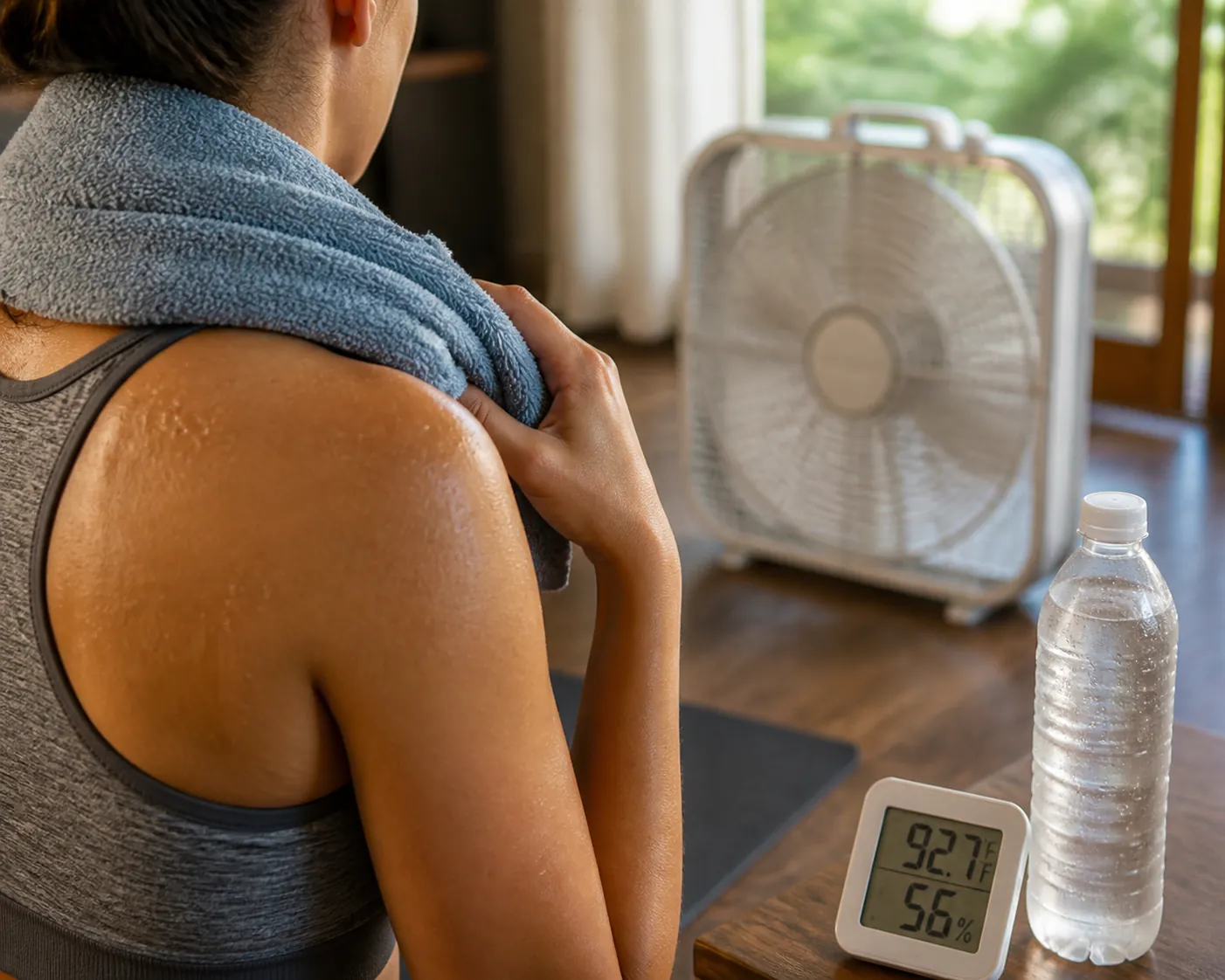
The exit option is not cosmetic. The CDC advises that electric fans may provide comfort but do not prevent heat-related illness when temperatures are above 90°F, and it warns that using a fan as the main cooling strategy above 90°F can increase body temperature in some conditions.[3][4]
A fan is most useful when it helps move cooler air across sweat-damp skin or pulls cooler air from another room. It is much less useful when it is just blowing hot air around a closed garage. If the fan is your only cooling plan and the room is already above the CDC’s warning range, downgrade or skip the workout.
Hydration Helps, but It Is Not a Permit
Hydration is one control, not the control. A well-hydrated person can still overheat in a hot, humid room, especially during hard intervals or long sets with little rest.
For general exercise, Mass General Brigham recommends drinking 17 to 20 ounces of water 2 to 3 hours before exercise, 4 to 8 ounces every 15 to 20 minutes during exercise, and 16 to 24 ounces afterward for every pound of body weight lost during activity.[5]
In a home heat-index situation, those numbers are a starting structure. They do not mean you should keep exercising through dizziness because you drank on schedule. They also do not mean more water is always better. Long, sweaty sessions may require electrolytes, and people with medical conditions that affect fluid intake should follow medical advice rather than generic workout rules.
- Before training: start hydrated rather than trying to catch up after the first set.
- During training: keep the bottle within reach so drinking does not require leaving the workout area.
- After training: replace fluid losses, cool down, and do not use a second workout as proof that the first one went fine.
Use Acclimatization, Not Toughness, for the First Hot Days
Heat acclimatization is the gradual process of letting the body adapt to exercising in warmer conditions. The commonly cited sports-medicine approach is to build exposure over 7 to 14 days, starting with lower intensity and shorter sessions before returning toward normal training loads.[5]
That first hot week is exactly when the home gym should feel boring. Cut volume. Keep intensity moderate. Leave conditioning finishers out. If a garage workout usually takes 50 minutes, the first hot version may be 20 to 30 minutes with longer rests and no test sets.
Acclimatization reduces risk; it does not erase the heat index. A person who has adapted to summer conditions still needs to respect a room that is hotter than expected, a humidity spike, poor sleep, illness, alcohol use, or medication changes. The point is to widen the margin, not to earn permission to train hard in dangerous conditions.
Cooling Without Air Conditioning
If the workout space has no air conditioning, timing does more than most gear. Early morning is often better than late afternoon in a garage or upper-floor apartment, though the right window depends on the building. A room that stores afternoon heat may still be hostile after sunset.
- Open doors or windows only if the outside air is cooler or helps move humidity out.
- Use fans to move cooler air through the space, not as a substitute for cooling when the room is already dangerously hot.
- Keep a cold towel ready for the neck, armpits, or groin if symptoms begin; these areas are standard first-aid cooling targets.
- Move rest periods to the coolest nearby room instead of standing in the hottest corner between sets.
- Shorten the session before the room peaks, rather than waiting until the workout falls apart.
Clothing can help at the margins: lighter, breathable clothing is better than heavy layers. But clothing is not the main decision point. If the heat index and room conditions say the workout is unsafe, changing shirts is not a safety strategy.
Know the Stop Signs Before You Start
Heat illness is usually discussed as a continuum, including heat cramps, heat exhaustion, and heat stroke. The CDC/NIOSH describes heat cramps as painful muscle cramps or spasms, heat exhaustion as a more serious condition with symptoms such as heavy sweating, weakness, dizziness, nausea, headache, and fainting, and heat stroke as a medical emergency involving high body temperature and possible confusion, loss of consciousness, or seizures.[6]
Johns Hopkins Medicine also notes that exercise-related heat exhaustion can include cool, moist skin, goose bumps in heat, fast pulse, low blood pressure upon standing, muscle cramps, tiredness, dizziness, headache, and nausea.[7]
At home, the safe response is simple because there is no one else managing the session. Stop exercise at the first signs of dizziness, confusion, nausea, chills or goose bumps in heat, unusual weakness, faintness, or cramps that do not resolve. Move to a cooler place, loosen clothing, sip fluids if you are alert and not nauseated, and use active cooling such as cold towels.
Call emergency services if there is confusion, loss of consciousness, seizure, very high body temperature, or symptoms that worsen or do not improve with cooling. Heat stroke is not a wait-and-see condition.[6]
A Practical Home Rule
Before a hot-weather home workout, make the decision in this order: heat index, room condition, workout intensity, personal risk factors, cooling exit. If any one of those is unfavorable, modify. If several are unfavorable, skip or move the session.
Home training in high heat is possible on some days. It is not something to force through every day with a fan and optimism. Shorten, move, cool down, or rest when the room and the heat index stop supporting the workout.
References
- Is It Too Hot to Exercise? Use the Heat Index, Verywell Fit, https://www.verywellfit.com/is-it-too-hot-to-exercise-use-the-heat-index-3435800
- How to Be Active Safely in Warm Weather, American Heart Association, https://www.heart.org/en/healthy-living/exercise-and-physical-activity/getting-active/how-to-stay-active-in-warm-weather
- Heat and Your Health, CDC, https://www.cdc.gov/heat-health/about/index.html
- Heat and People without Air Conditioning, CDC, https://www.cdc.gov/heat-health/risk-factors/heat-and-low-income.html
- Prevent overheating during workouts, Mass General Brigham, https://www.massgeneralbrigham.org/en/about/newsroom/articles/prevent-overheating-during-workouts
- Heat-related illnesses, CDC/NIOSH, https://www.cdc.gov/niosh/heat-stress/about/illnesses.html
- Exercise-Related Heat Exhaustion, Johns Hopkins Medicine, https://www.hopkinsmedicine.org/health/conditions-and-diseases/exerciserelated-heat-exhaustion
This is general fitness education, not medical advice. For diagnosis or treatment of pain or injury, consult a qualified clinician.
Pick your next session
Browse all routines to find an appropriately-spaced next session.
Spot something off?
This content sits adjacent to health guidance — tell us if a citation or figure needs a correction.