
How Much Water to Drink During Home Workouts for Blood Pressure
This article provides a precise, evidence-based hydration protocol for home exercisers managing blood pressure, including how much water to drink before, during, and after a workout to avoid dehydration that can raise BP.
- Citation source
- ACSM, AHA
- Evidence level
- general guideline
- Recommended frequency
- 4–8 oz every 15 minutes
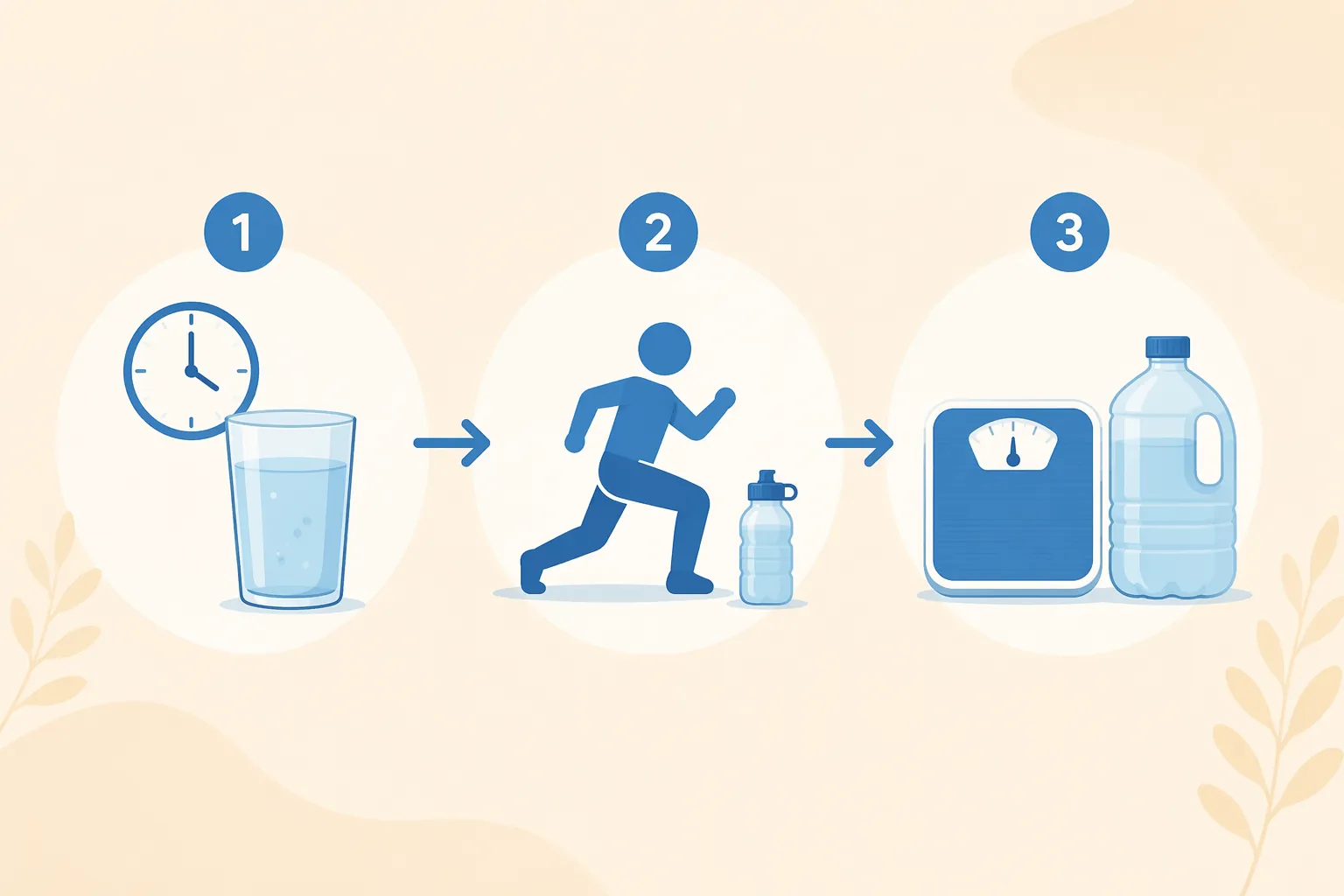
For a typical home workout under 60 minutes, the working answer is simple enough to write on tape and stick to your bottle: drink 17–20 oz of water 2–3 hours before exercise, another 8 oz about 20–30 minutes before you start, then 4–8 oz every 15 minutes while you exercise. Afterward, replace sweat losses with 16–24 oz for each pound lost, if you weigh yourself before and after the session.[1][2][3]
That is the default plan for 20–45 minutes of low-impact cardio, resistance bands, dumbbells, or bodyweight circuits in a climate-controlled room. For most of those workouts, plain water is enough. The answer changes if you sweat heavily, exercise in heat, take blood pressure medication or diuretics, have kidney or heart disease, feel dizzy, or have been told to restrict fluids.
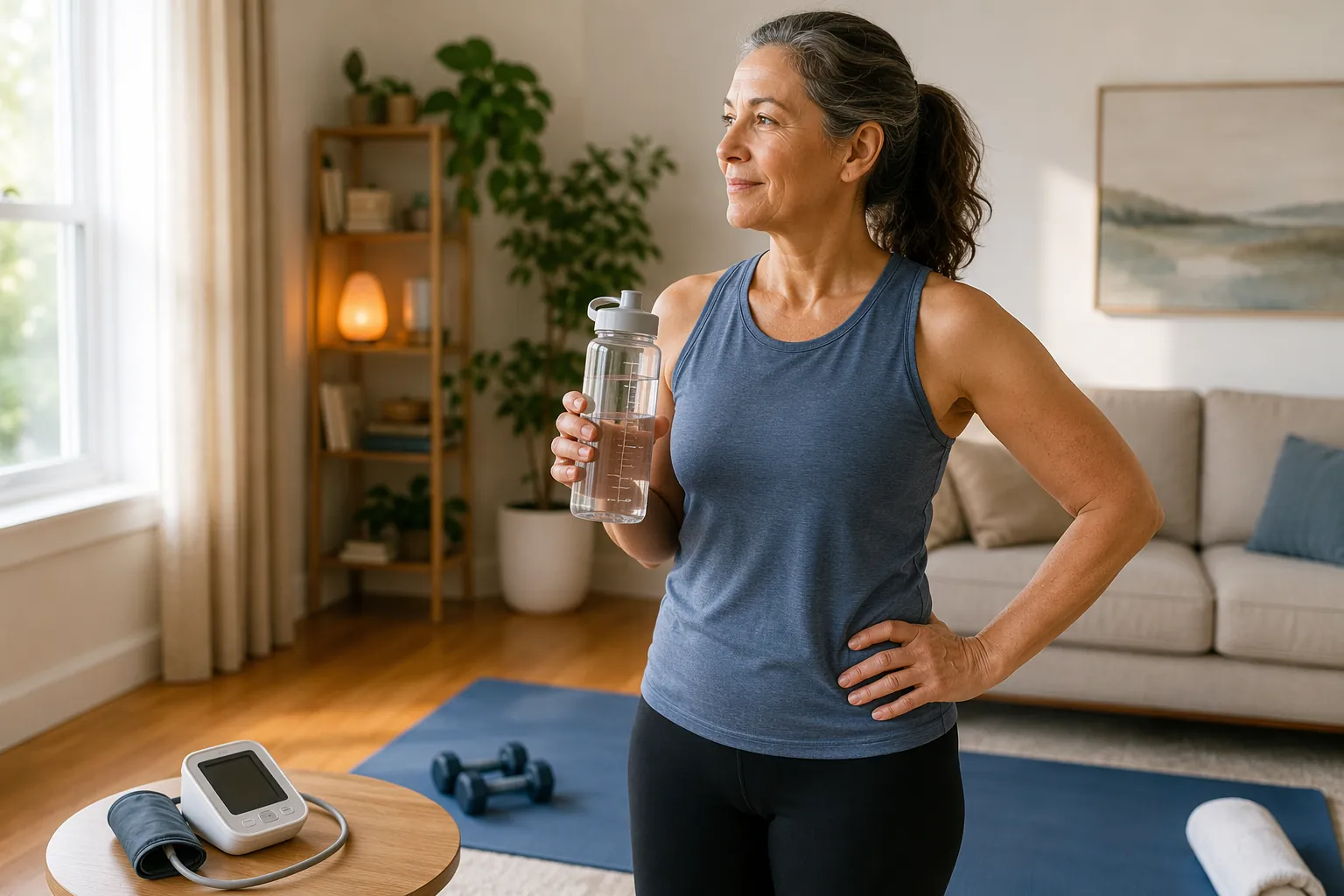
One guardrail belongs near the top, not buried after the advice: do not turn these ounce targets into a chugging contest. Drinking more than 1 liter of plain water per hour without electrolytes can dilute blood sodium and become dangerous.[4] If anxiety about blood pressure makes you want to keep drinking “just to be safe,” use the clock and the bottle markings instead.
The Three-Phase Water Plan
| Workout phase | How much water | When to drink it | How to make it practical at home |
|---|---|---|---|
| Before | 17–20 oz, then 8 oz more | 17–20 oz 2–3 hours before; 8 oz 20–30 minutes before | Fill a marked bottle earlier in the day instead of trying to catch up right before warmup. |
| During | 4–8 oz every 15 minutes | For home sessions under 60 minutes | Take a few measured swallows at each 15-minute mark; do not wait until you feel very thirsty. |
| After | 16–24 oz per pound of sweat lost | After exercise, if you weigh before and after | If your weight is down by 1 lb, replace it gradually with 16–24 oz rather than gulping it all at once. |
The pre-workout amount matters because starting dry is hard to fix once the circuit begins. A person who discovers thirst halfway through a step routine may drink quickly, feel sloshy, skip the next set, and still remain behind on fluid. The cleaner fix is boring: put the bottle beside the mat before the workout starts, already marked in ounces.
During the workout, the range matters. Four ounces every 15 minutes may be enough for a gentle mobility-and-band session in a cool room. Eight ounces every 15 minutes may fit a sweatier cardio interval session. If the workout stays under an hour and the room is comfortable, this is usually not a sports-drink situation.
After the workout, the scale method is more useful than guessing. Weigh before exercise, weigh after, and treat the difference as sweat loss. A 1 lb drop calls for 16–24 oz of replacement fluid.[3] If weighing feels fussy, use urine color, thirst, and how sweaty your clothes are as rough signals, but do not pretend those signals are as precise as the scale.
If you are looking for a broader timing guide without the blood-pressure layer, the companion article on when to drink water during your home workout routine covers general home-exercise hydration. Here, the extra concern is what dehydration can do to blood pressure regulation.
Why Hydration Matters More When Blood Pressure Is the Concern
The mistake is thinking of dehydration as only a comfort issue: dry mouth, headache, or a workout that feels harder than expected. For someone managing blood pressure, the problem can start earlier, inside the circulation.
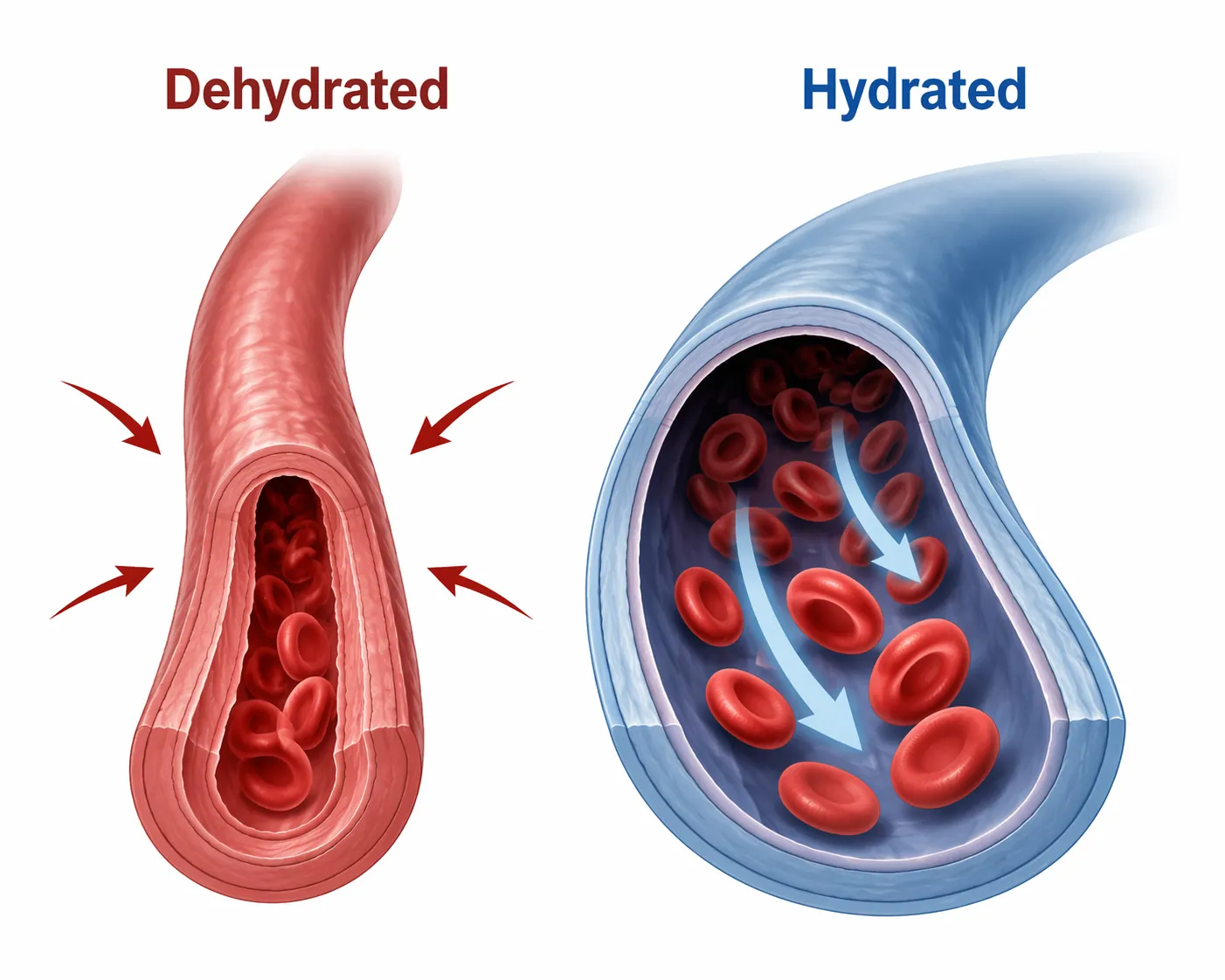
When fluid levels drop, blood volume can fall. The body then tries to preserve circulation through hormones and vessel changes, including vasopressin and angiotensin II activity, which can constrict blood vessels and make blood pressure regulation harder.[5] That does not mean one missed bottle of water “causes hypertension.” It means dehydration can push the cardiovascular system in the wrong direction at the exact time exercise is already asking it to work.
That distinction matters. Exercise is still one of the better tools in the home routine. ACSM states that regular aerobic exercise can lower resting systolic blood pressure by 5–7 mmHg among adults with hypertension.[6] But the point of the session is not to make the heart fight through preventable fluid stress. A well-timed bottle supports the workout; it is not a substitute for medication, monitoring, or clinical care.
The research pattern is worth paying attention to, but it should not be oversold. In a 2022 cross-sectional study of 235 participants, hypertensive subjects had a lower total body water percentage than normotensive subjects, 48.4% compared with 54.6%, with p=0.001.[7] Cross-sectional means the study observed an association at one point in time; it does not prove that drinking a certain amount of water would lower a person’s blood pressure.
A 2024 longitudinal analysis also found that people reporting at least 6 cups of plain water per day had a 41% lower hypertension risk over 9 years, with an odds ratio of 0.59.[8] That is an association, not a treatment plan, and the population may not map perfectly onto every U.S. home exerciser. Still, it fits the physiology closely enough to justify being deliberate about fluid timing around workouts.
How to Adjust the Plan Without Guessing Wildly
The default plan assumes a short, moderate session in a reasonable room temperature. Move away from that situation and the water plan needs attention. It does not need panic; it needs a reason for each change.
- If the room is hot or humid, start closer to the higher end of the during-workout range and consider shortening the session.
- If you sweat through clothing or leave visible sweat on the mat, use the before-and-after weigh-in method for a few sessions.
- If the session runs longer than 60 minutes, plain water may no longer be the whole answer, especially with heavy sweating.
- If you feel dizzy, unusually weak, confused, nauseated, or faint, stop exercising rather than trying to solve it by drinking more.
- If a clinician has given you a fluid restriction, that instruction outranks a general exercise-hydration protocol.
Electrolytes are where many short home workouts get overcomplicated. For a 30-minute walk-at-home video or resistance-band circuit in a cool living room, water is usually the right tool. Electrolyte needs may change with long duration, high sweat rates, heat, or individual medical advice. The more medication or diagnosis is involved, the less useful a generic sports-drink rule becomes.
Medication deserves its own caution because home exercisers often treat it as background information. Diuretics can change fluid balance. Some blood pressure drugs can affect how a person responds to heat, exertion, or position changes. Over-the-counter choices matter too; if soreness pushes you toward medication, the article on which pain reliever is best for home workout soreness is a better place to continue that medication-aware question.
A Home-Workout Example
Take a hypothetical 35-minute low-impact cardio and dumbbell session at home. The workout starts at 6:00 p.m. The practical setup would look like this: drink 17–20 oz between 3:00 and 4:00 p.m., drink another 8 oz around 5:30 p.m., keep a marked bottle by the mat, and drink 4–8 oz around the 15-minute and 30-minute marks.
If body weight is unchanged after the workout, there is no need to force a large recovery drink. If weight is down by 1 lb, replace that loss gradually with 16–24 oz. If the person becomes lightheaded during the session, the next step is not “finish the bottle and push through.” The next step is to stop, sit or lie down safely, and treat dizziness as information that needs attention.
For readers building a broader heart-health routine at home, hydration is only one support. A structured plan such as this 8-week home exercise plan for cholesterol or the discussion of whether home workouts and diet can lower cholesterol may be the more useful next layer. Water helps the session run safely; it does not carry the whole cardiovascular plan.
Where the Water Rule Stops
A water protocol is not blood pressure treatment. It is a way to avoid two preventable workout problems: starting underhydrated and forcing excess water because a number sounded reassuring. Both can disturb the body’s normal regulation.
Use the three-phase plan for ordinary home workouts: 17–20 oz 2–3 hours before, 8 oz 20–30 minutes before, 4–8 oz every 15 minutes during sessions under 60 minutes, and 16–24 oz per pound of sweat lost afterward. Avoid both dehydration and forced overdrinking. If blood pressure medication, diuretics, kidney or heart conditions, dizziness, heat illness risk, or a fluid restriction are part of the picture, ask a healthcare professional for individualized fluid guidance.
References
- How Much Water Should You Drink During Exercise — Flushing Hospital
- 9 Facts About Hydration & Electrolytes — ACSM
- Staying Hydrated, Staying Healthy — American Heart Association
- Can You Drink Too Much Water During Exercise? — Houston Methodist, 2024
- Hydration and Blood Pressure — Baptist Health
- Exercise for the Prevention and Treatment of Hypertension — ACSM
- Assessment of Hydration Status and Blood Pressure — PMC, Cureus, 2022
- Association between plain water intake and risk of hypertension — PMC, Front Public Health, 2024
This is general fitness education, not medical advice. For diagnosis or treatment of pain or injury, consult a qualified clinician.
Pick your next session
Browse all routines to find an appropriately-spaced next session.
Spot something off?
This content sits adjacent to health guidance — tell us if a citation or figure needs a correction.