
How Hot Weather Sleep Quality Impacts Your Fitness Gains
Hot weather disrupts the deep sleep your muscles need to repair, creating a cumulative recovery debt that stalls your summer training progress. This article explains the science behind the trap and offers practical, low-cost countermeasures to protect your gains without installing air conditioning.
- Citation source
- Multiple peer-reviewed studies
- Evidence level
- restrained inference
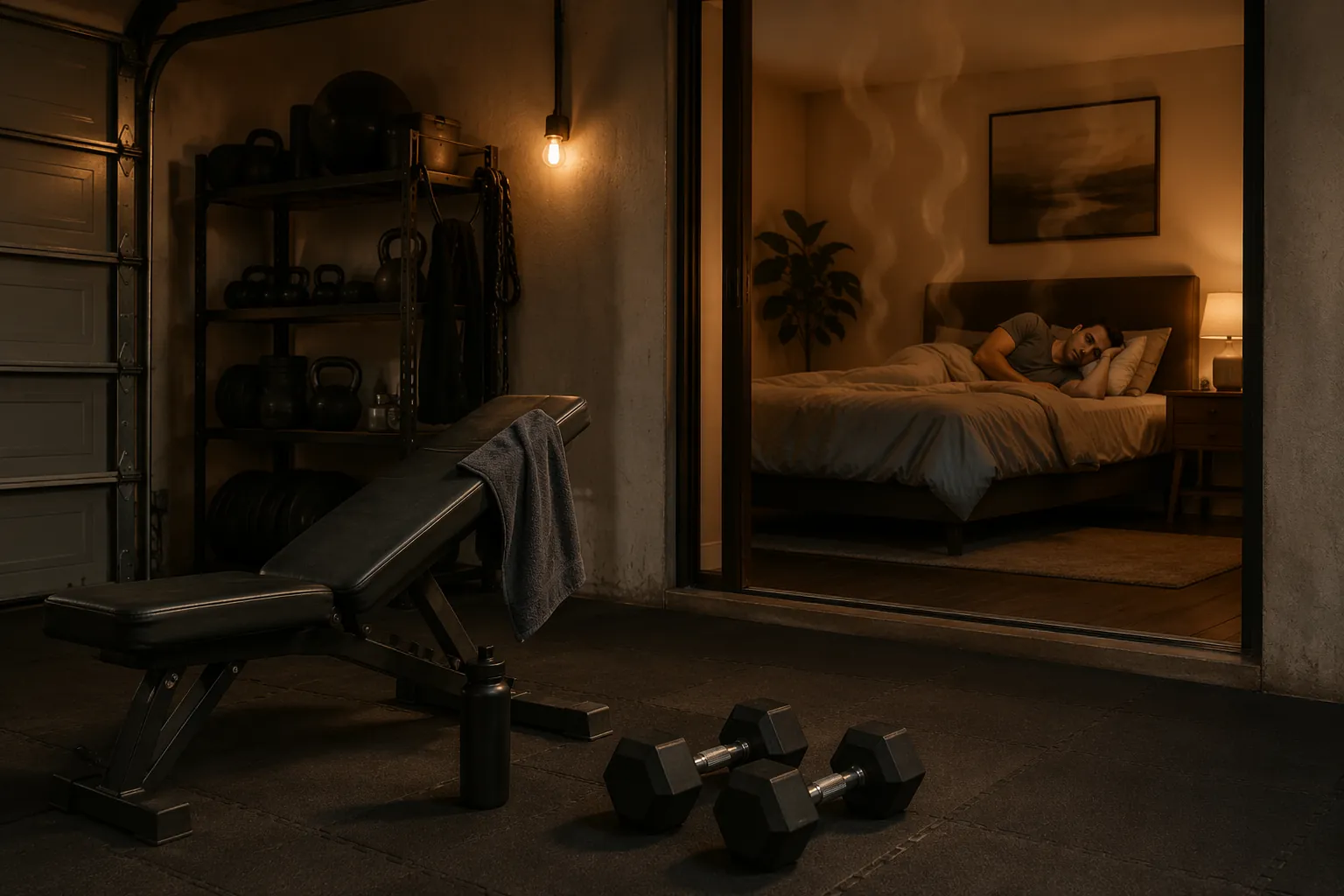
The frustrating summer stall usually does not announce itself as a sleep problem. It looks like the same garage workouts, the same dumbbells, the same program, the same protein shake, and a worse return for the effort. Reps feel heavier. The next session arrives before the last one has really cleared. A deload starts to look like weakness even though the calendar says you have been consistent.
That is where hot weather’s impact on sleep quality becomes more than a comfort complaint. Heat can turn sleep into the missed work shift after training: the time when tissue repair, nervous-system recovery, and adaptation are supposed to happen. If the room stays hot enough to keep you restless, the workout may be finished, but the recovery process is still fighting for a place to start.
The Problem Is Not One Bad Night
A single sticky night can make anyone feel flat. The more useful warning is what happens when heat keeps repeating itself. In a study of consecutive-day heat training, five straight days of training in hot conditions reduced total sleep time, sleep efficiency, and perceived sleep quality; the same study also found that 30-minute heat-training sessions preserved sleep latency better than 90-minute sessions at equal intensity.[1]
That pattern fits the home-training version of summer better than a one-night sleep-hygiene lecture. A garage lifter or apartment exerciser is rarely dealing with one isolated exposure. The room is hot during training, the bedroom stays warm after sunset, and the next workout asks for fresh output before the previous day has been fully paid back.
The evidence is not perfect or unlimited. The Skein study used 30 participants, and heat-training research often leans toward specific athletic populations rather than every age, sex, and home setup.[1] Still, the direction matters: consecutive heat exposure can degrade sleep in measurable ways, which gives a disciplined exerciser a better explanation than “you must not want it enough.”
Why Heat Steals the Sleep That Training Needs
Sleep onset is partly a temperature event. The body normally needs core temperature to drop by about 1–2°F for sleep to begin smoothly, and a hot environment can interfere with that drop.[3] This is why a warm bedroom is different from a noisy room or an uncomfortable pillow. It is not just annoying you; it is pushing against a physiological transition the body uses to enter sleep.
Deep sleep, also called slow-wave sleep, is especially relevant for training because it is one of the major recovery windows after hard work. When the body struggles to offload heat, sleep can become lighter and more fragmented. You may technically be in bed for enough hours, but the night delivers less of the kind of sleep that makes yesterday’s squats or intervals productive.
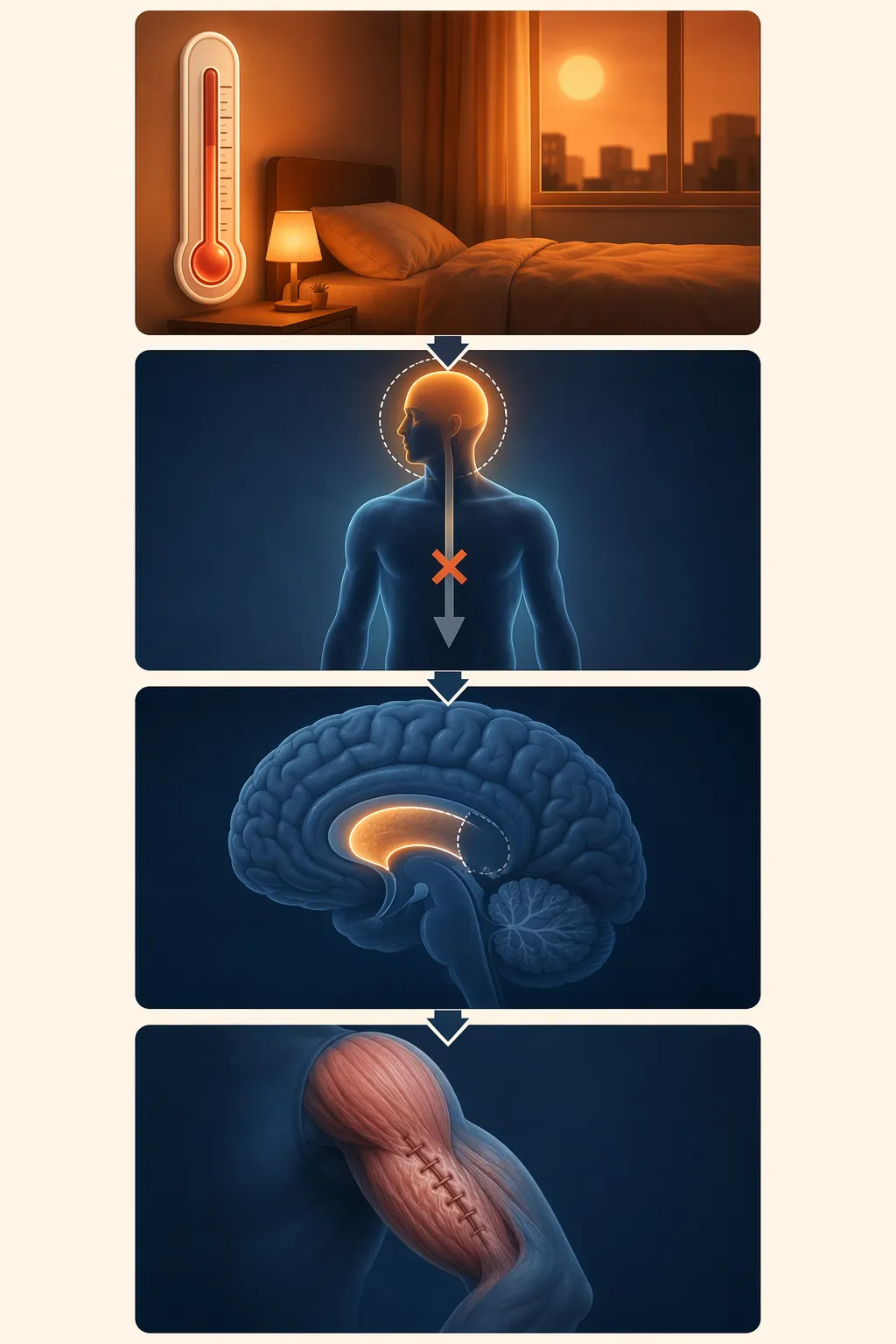
This is the recovery-debt version of summer fatigue. The debt does not have to feel dramatic. It can show up as a few extra wake-ups, a shallower night, a slower start the next morning, or a workout that feels oddly expensive for the work performed. Enough of those nights stacked together can make a reasonable program look broken.
The Small Sleep Losses Still Count
A 10-day heat-training protocol in a small study of eight participants found that sleep efficiency dropped by about 2.1%, wake-after-sleep-onset increased by about 7.6 minutes, and participants became 35 minutes more sedentary during off-training hours.[2] None of those numbers sounds like a disaster on its own. Together, they look like the body quietly reducing output after accumulating recovery stress.
That sedentary-behavior signal is useful because it gets closer to what exercisers actually notice. You may not know your sleep efficiency without a tracker, but you know when the stairs feel less optional, when a warm-up takes longer to feel normal, or when the day after training becomes a long negotiation with the couch. The study is too small to treat as a universal rule, but it supports a practical suspicion: heat-disrupted sleep can leak into next-day behavior before it looks like an obvious performance collapse.[2]
This also explains why hydration advice only solves part of the summer problem. Replacing fluids matters, but it does not guarantee that your bedroom will let core temperature fall or that slow-wave sleep will be protected. A person can drink enough water, hit the planned sets, and still lose the recovery night that turns training stress into adaptation.
Shorten the Heat Exposure Before You Blame the Program
When the room is hot and the week is not cooling down, session length becomes a recovery variable. The same Skein study found that 30-minute heat-training sessions preserved sleep latency better than 90-minute sessions at the same intensity.[1] That does not mean every summer workout must become short. It means long hot sessions have a cost that may show up later in bed, not only during the final set.
| Summer training choice | Recovery reason |
|---|---|
| Move hard sessions earlier or later when possible | Reduces the chance that training heat carries straight into bedtime |
| Trim accessory volume during heat waves | Keeps the main stimulus while lowering total heat exposure |
| Use active recovery instead of forcing a hard day | Protects movement quality when sleep has already been compromised |
| Track performance and sleep together | Helps separate a programming issue from heat-driven recovery debt |
A practical home-gym adjustment is to keep the priority lift or main conditioning piece and cut the parts that mostly extend time in the hot room. On a normal week, extra sets may be useful. During a heat wave, they may be the difference between a training stimulus and a night of delayed, restless cooling.
If heat forces a lighter day, that does not have to mean doing nothing. Low-intensity movement, mobility, and easy circulation work can keep the habit intact while lowering the recovery bill; a structured approach to foam rolling and active recovery for home gym training fits better here than pretending every hot day deserves the same workload.
Cool the Body You Actually Sleep With
Without air conditioning, the goal is not to create a perfect sleep lab. The goal is to help the body dump enough heat to enter and stay in better sleep. Local cooling is one of the more realistic levers for renters, garage lifters, and anyone trying not to solve a recovery problem with a major purchase.
In a warm-environment sleep study, cooling the back and neck reduced skin temperature by 1.5–2.0°C and improved sleep quality and thermal comfort.[4] That supports a simple principle: aim cooling at areas that help the body feel and shed heat, rather than only moving air randomly around the room.
- Aim a fan across the upper back, neck, or side of the body rather than only at the feet.
- Use breathable bedding and remove layers that trap heat around the torso.
- If using a cooling towel or cool pack, avoid anything cold enough to wake you or irritate the skin.
- Create cross-ventilation when outdoor air is cooler than indoor air, then close the room back down when it reverses.
Fan placement sounds too ordinary to count as a recovery intervention, but it is often the cheapest controllable variable in a non-ideal room. The point is not luxury. It is giving the body a better chance to complete the temperature drop that sleep requires.
Use the Warm Bath Trick Carefully
A warm bath before bed can sound backwards in July, and mistimed heat can absolutely make a bedroom feel worse. The useful version is earlier: a warm bath taken 1–8 hours before bed has been associated with increased slow-wave sleep through vasodilation followed by passive cooling.[3]
The timing is the whole point. Right before bed, extra heat may leave you sweating into the pillow. Earlier in the evening, warmth can draw blood toward the skin, and the later cooling phase may help the body move toward sleep. If your apartment is already trapping heat and humidity, this may not be the right lever every night. It is a tool to test, not a rule to obey.
Do Not Let Compromised Sleep Turn Into Compromised Tissue
The injury connection deserves a careful mention, not a scare campaign. In adolescent athletes, sleeping fewer than 8 hours was associated with a 1.7-times higher likelihood of sports injury.[5] That figure should not be lifted straight onto adult home-gym training as a prediction. The population is different, and the study does not prove that every hot night causes injury.
The narrower lesson is still useful: when sleep is chronically shortened or degraded, recovery quality changes. Tendons, joints, coordination, and decision-making all have to show up again the next day. If the week has included hard training plus hot, fragmented sleep, a lower-load session may be the more disciplined choice.
Nutrition does not erase bad sleep, but it is one recovery lever worth keeping steady when the sleep window is under pressure. If post-workout eating gets sloppy during summer evenings, a simple protein routine such as using milk for post-workout recovery can reduce one avoidable gap while you work on the bigger heat problem.
Measure the Heat Debt, Not Just the Workout
The simplest heat-wave audit is four lines long: sleep quality, session length, next-day energy, and training performance. You do not need a perfect device to notice the pattern. If longer hot sessions are followed by worse sleep and flatter workouts two days later, that is usable information.
Wearables can help if you already use them, especially for spotting changes in sleep efficiency, wake time, and recovery trends. Readers deciding whether that kind of data is worth paying for can compare the tradeoffs in WHOOP recovery tracking or broader fitness tracker recovery options. If you already track recovery scores, summer is the season to watch whether hot nights, not weak motivation, are pushing the score down; the same logic applies when trying to improve a WHOOP recovery score.
For the next heat wave, test the variables together instead of changing everything at once. Shorten the hottest session first. Aim cooling at the neck and upper back. Move the hardest training away from bedtime when your schedule allows it. If using a warm bath, place it early enough that the cooling phase happens before sleep rather than after you are already under the sheets.
If summer progress stalls, the first audit is not always the program, the supplement shelf, or the effort level. Check whether heat has been stealing the deep sleep that makes the training productive.
References
- Sleep quantity and quality during consecutive day heat training with the inclusion of cold-water immersion recovery, ScienceDirect, 2018.
- Evidence that heat acclimation training may alter sleep and incidental activity, European Journal of Sport Science, Taylor & Francis, 2023.
- The effects of thermal environment on sleep and circadian rhythm, PMC, 2024.
- Local body cooling to improve sleep quality and thermal comfort in a hot environment, PubMed, 2018.
- Chronic lack of sleep is associated with increased sports injuries in adolescent athletes, Journal of Pediatric Orthopaedics, 2014.
This is general fitness education, not medical advice. For diagnosis or treatment of pain or injury, consult a qualified clinician.
Pick your next session
Browse all routines to find an appropriately-spaced next session.
Spot something off?
This content sits adjacent to health guidance — tell us if a citation or figure needs a correction.