
How Heat Disrupts Sleep and Workout Recovery
Heat from evening exercise keeps core temperature elevated, directly conflicting with the natural cooling your body needs to fall asleep and enter deep sleep. This article explains the physiology behind why warm post-workout conditions degrade sleep quality and slow muscle repair.
- Citation source
- Okamoto-Mizuno & Mizuno (2012)
- Evidence level
- Restrained inference
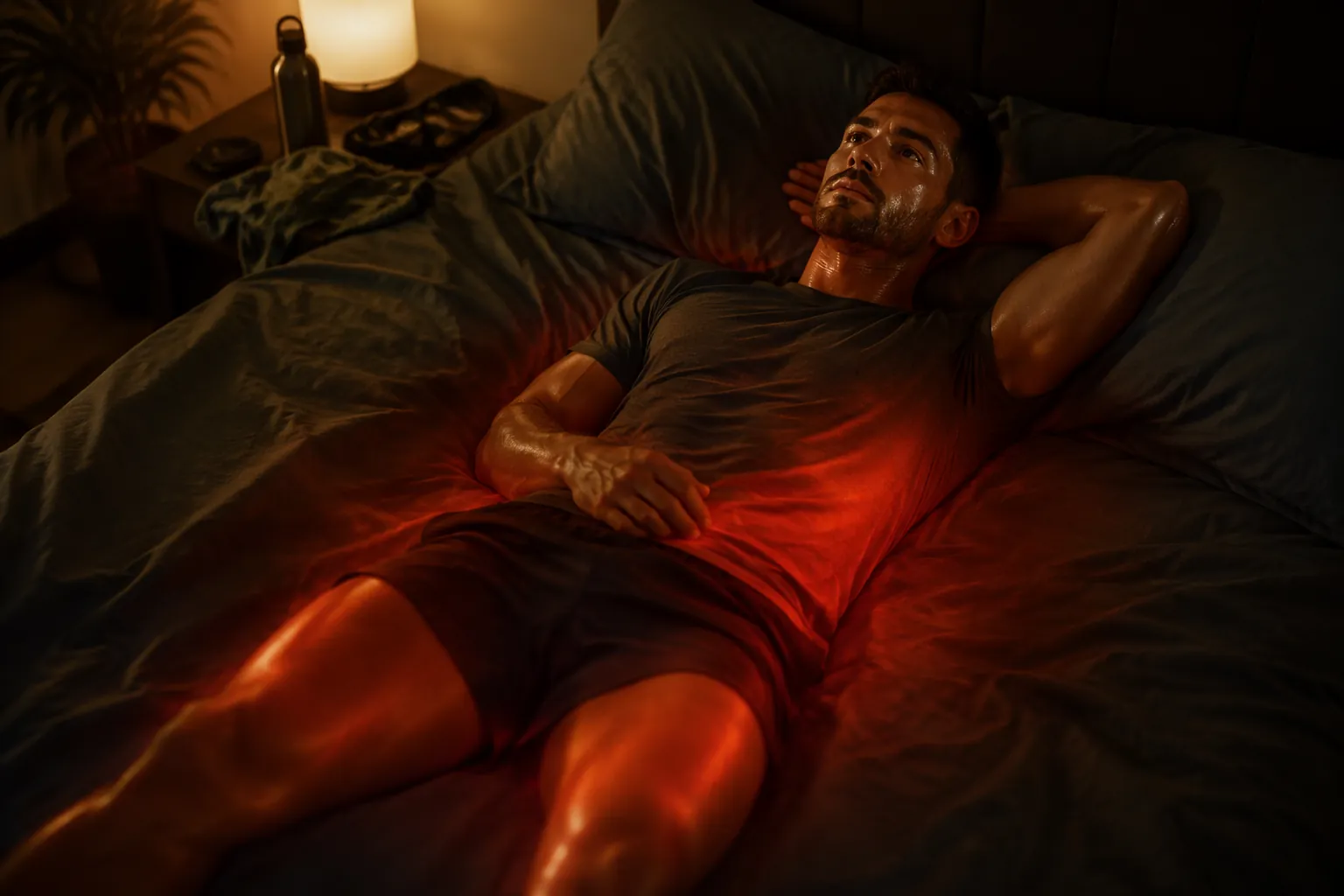
You finish the hard session late because that is when the apartment is finally quiet. You hit the protein, shower, dim the room, get into bed on schedule, and still feel as if the workout followed you under the sheets. Your skin is warm. Your legs are heavy but not sleepy. The ceiling gets more interesting than it should.
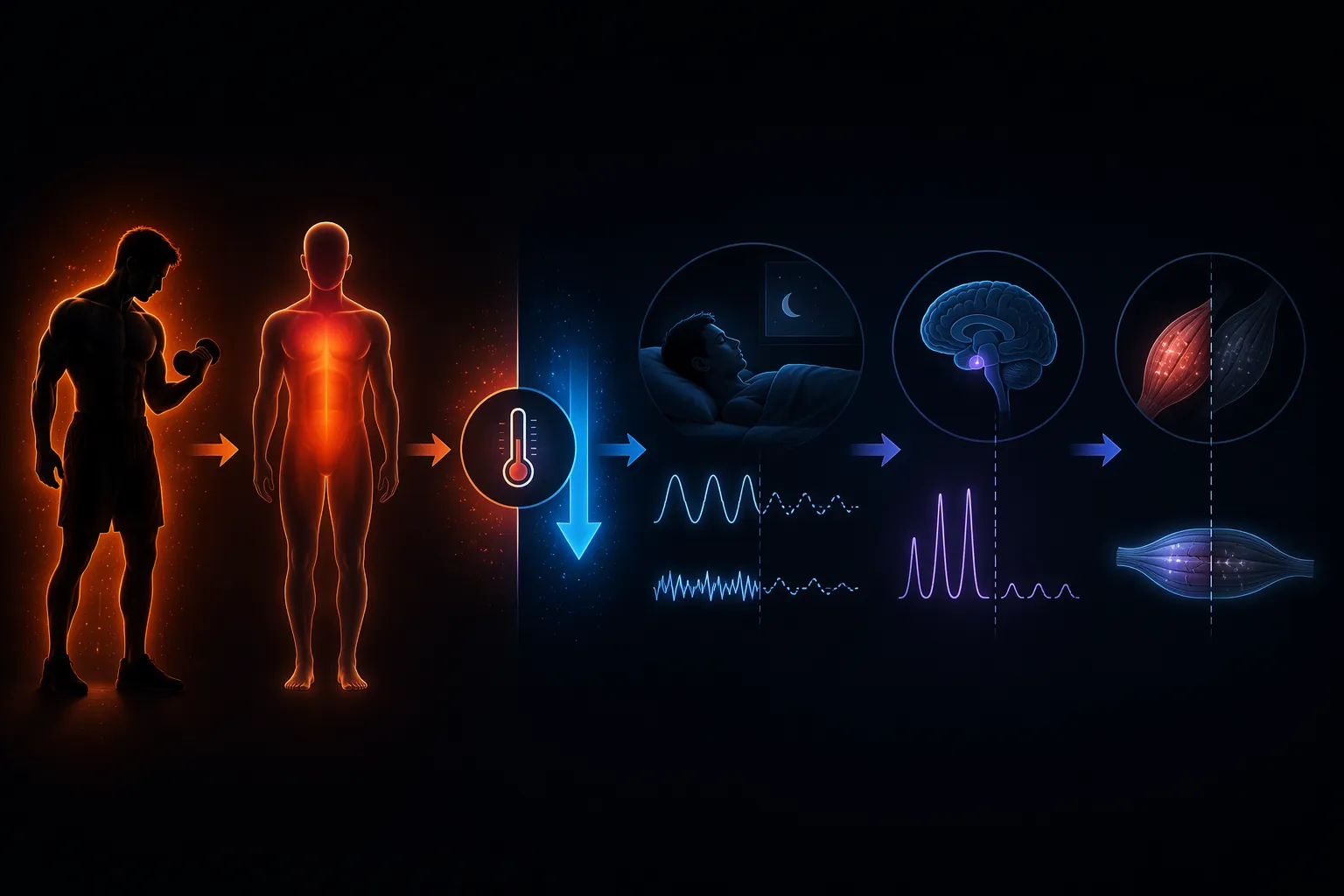
That is the practical answer to why heat disrupts sleep and workout recovery: after hard evening training, your body may still be trying to dump exercise heat at the same time sleep is asking your core temperature to fall. Sleep onset is not just a decision to lie still. It depends partly on a pre-sleep drop in core body temperature of about 0.5–1°C, and a warm room, warm bedding, or humid air can make that drop harder to complete.
The problem starts before sleep architecture does
A hard workout turns muscle into a heat engine. Contracting muscle produces heat, core temperature rises, and after the session your body keeps moving blood toward the skin so that heat can leave through radiation, convection, and sweating. That cooling system is useful, but it is not instant. In a small room after work, especially one that has been collecting heat all day, the body may still be in heat-rejection mode long after the last set.
This is why the usual checklist can feel insulting when it stops at discipline. You can be fed, hydrated, showered, and in bed at the same time as usual, yet still be physiologically late for sleep. The clock says bedtime. Your temperature regulation says the session is not fully over.
The sleep environment matters because it decides how easily heat can leave. A review of thermal environment and sleep describes a bed climate around 32–34°C with 40–60% relative humidity as supportive of normal sleep onset, while also showing that heat exposure during sleep increases wakefulness and reduces slow-wave and REM sleep, with stronger effects in the first half of the night.[1] That “bed climate” is not the same as the thermostat reading across the room. It is the small heat-and-humidity pocket around your body, mattress, sheets, and blanket.
That distinction is where home training gets messy. A bedroom can feel merely warm when you walk in, then become a sealed microclimate once you add a recently trained body, a foam mattress, a comforter, and humid air. Sweat does less when evaporation is limited. Skin blood flow can move heat outward, but if the air and bedding around the skin are already warm, the gradient for heat loss narrows. The body is still trying to cool; the room is refusing to take the heat.
Warm sleep is not just lighter sleep
The first half of the night matters because it is where a large share of deep sleep pressure is normally paid down. In the thermal sleep studies summarized by Okamoto-Mizuno and Mizuno, heat exposure did not only make people feel uncomfortable; it changed sleep structure. Wakefulness increased, and both slow-wave sleep and REM sleep decreased, with effects concentrated early in the night.[1]
Slow-wave sleep is the stage lifters should care about without turning it into a magic recovery switch. It is strongly tied to the hormonal and metabolic environment of repair. Charest and Grandner’s review of sleep and athletic performance notes that growth hormone release occurs primarily during slow-wave sleep, and that sleep loss can affect recovery-relevant processes including muscle repair, glycogen restoration, pain perception, and next-day performance.[2]
So the consequence of a hot post-workout night is not only “I slept badly.” It can mean the part of the night most favorable to growth-hormone-heavy repair is fragmented or shortened. It can mean the next day starts with more soreness than expected, flatter legs, worse mood, and less tolerance for the same training stress. Nutrition still matters, but food cannot make you spend enough time in a sleep stage you kept getting pulled out of.
REM sleep also deserves more than a footnote. It is not the main stage people associate with muscle repair, but it supports nervous system function, learning, and emotional regulation. If heat cuts into both slow-wave and REM sleep, the athlete does not just lose one narrow recovery pathway. The whole night becomes a poorer handoff between physical repair and next-day readiness.
Why the same workout feels worse in July than in March
The workout may be identical on paper: same sets, same load, same protein shake, same bedtime. The thermal load is not identical. A warm room raises the starting point. Humidity slows evaporation. Bedding traps heat around the skin. A late session shortens the time between peak exercise heat and sleep onset. Put those together and the body has less margin to reach the cooling state sleep prefers.
General bedroom guidance is still useful as a rough target. Sleep Foundation lists 65–68°F as an optimal bedroom temperature range for sleep and notes that temperatures outside a comfortable range can increase wakefulness and reduce deep and REM sleep.[3] For someone training at home in the evening, that number is best treated as the room-side part of a larger heat equation, not as a guarantee. If the room is 68°F but the bed is heavy, the air is stale, and your core temperature is still elevated, the body can still struggle.
Climate makes this less of a niche problem. A 2025 USC report connected rising temperatures with reduced sleep among U.S. adults, but that source is press-release context rather than a substitute for carefully reading the final paper’s exact effect sizes.[4] The cautious takeaway is enough here: warmer nights make sleep harder at the population level, and evening exercisers add their own internal heat load on top of the room’s heat load.
The recovery cost shows up the next day
Recovery is often discussed as if it ends when the shake is finished. The harder truth is that training creates a repair demand, and sleep is one of the main places the body gets enough uninterrupted time to meet it. Charest and Grandner summarize evidence that sleep restriction after heavy exercise can impair next-day performance; in one cited study, a single restricted night after heavy exercise worsened a 3-km cycling time-trial.[2]
That finding should not be stretched into a prediction that every warm night ruins every lift. It does show the direction of the problem. Poor sleep after training is not just an unpleasant side effect. It can reduce the performance capacity you were trying to build.
The injury data points in the same direction, though it needs careful handling. Charest and Grandner report that athletes sleeping less than 7 hours were 1.7 times more likely to sustain an injury than athletes sleeping more than 8 hours, drawing on Milewski’s work.[2] That does not mean a recreational lifter who sleeps hot one night has a quantified personal injury risk. It means chronic short sleep is associated with a higher injury burden in athlete populations, and poor thermoregulation can be one reason an otherwise disciplined person keeps landing in that short-sleep range.
Glycogen resynthesis, soreness, and neuromuscular readiness also sit inside this recovery window. Carbohydrate and protein provide substrate. Sleep gives the body time and hormonal conditions to use that substrate well. When heat fragments the early night, the recovery plan becomes uneven: the inputs are there, but the overnight processing environment is degraded.
What the evidence can prove, and what it cannot
The mechanism is strong enough to take seriously: exercise raises temperature, sleep onset depends on cooling, heat exposure changes sleep architecture, and slow-wave sleep is tied to repair-relevant growth hormone release. The limits are also real. The controlled thermal sleep studies discussed in the Okamoto-Mizuno review often used small polysomnography samples, commonly in the range of 6–12 participants.[1] That is not unusual for lab sleep research, but it argues against pretending the exact response will be the same for every home-gym athlete.
The sports-performance literature has another translation problem. Many athlete sleep studies come from elite or professional settings, where training load, travel, competition stress, and monitoring differ from a person lifting in a spare room after work.[2] A professional cohort can show why sleep matters for performance; it cannot perfectly describe the life of someone choosing between a late squat session, a hot apartment, and a normal job in the morning.
Even with those limits, the practical judgment does not need to be soft. If hard evening training happens in a warm environment, nutrition and bedtime consistency cannot fully compensate for a body that has not cooled enough to sleep deeply. The bottleneck is not motivation. It is thermoregulation.
Where this leaves the evening home workout
The useful question is not whether evening training is “bad.” For many people, it is the only training slot that survives the day. The useful question is whether the workout, room, and bed allow enough heat loss before the first part of the night, when deep sleep pressure is highest.
Once that is clear, the standard recovery routine becomes easier to judge. Cooling the room, reducing trapped bedding heat, leaving more time between the hardest work and sleep, and keeping the post-workout routine simple are not lifestyle decorations. They are ways to remove friction from the cooling drop that sleep requires.
For the full practical sequence after training, use Your Complete Post-Workout Recovery Routine at Home. The point here is narrower: when the room is warm and the workout is hard, the body may not be failing to recover because you ignored recovery. It may be failing because it is still too hot to enter the sleep that recovery depends on.
References
- Effects of thermal environment on sleep and circadian rhythm, PMC, 2012.
- Sleep and Athletic Performance: Impacts on Physical Performance, Mental Performance, Injury Risk and Recovery, and Mental Health, PMC, 2020.
- Athletic Performance and Sleep, Sleep Foundation.
- Study links rising temperatures to reduced sleep in U.S. adults, USC, 2025.
This is general fitness education, not medical advice. For diagnosis or treatment of pain or injury, consult a qualified clinician.
Pick your next session
8 Common Home Leg Workout Mistakes That Kill Your Progress — and How to Fix Each One
Are you doing leg workouts at home but not seeing the results you expect? This article breaks down 8 common mistakes home trainers make—from over-relying on bodyweight squats to poor warm-ups—and provides targeted fixes to help you build stronger, more defined legs.
8-Week Home Strength Training Plan for Beginners
A complete two-phase home strength program for true beginners: three full-body sessions per week in weeks 1–4 to build movement patterns, then a four-day upper-lower split in weeks 5–8 to increase weekly volume — all executable with bodyweight or a single pair of dumbbells, no gym required.
The Complete Home Leg Workout Progression: How to Build Leg Strength From Bodyweight Basics to Heavy Dumbbells Without a Gym
A structured multi-level system for home leg training that maps a clear path from bodyweight fundamentals through dumbbell loading to advanced tempo techniques — with a sample 6-week plan and concrete progression milestones.
Spot something off?
This content sits adjacent to health guidance — tell us if a citation or figure needs a correction.