
What's the Ideal Indoor Humidity for Home Workouts?
Sweat stops cooling you effectively when a workout room is too humid, while very dry air can irritate airways during heavy breathing. The evidence-backed target for home workouts is a 40–60% relative humidity band, and holding that range takes little more than a cheap hygrometer, a fan, and seasonal adjustments.
- Citation source
- US EPA, ASHRAE, and Jones et al.
- Evidence level
- General guideline
For comfortable home workouts, the best target is a band: roughly 40–60% relative humidity at normal indoor temperatures. If the room is regularly above about 60%, that is the line to take seriously for both sweat evaporation and household moisture risk. If it is below about 30%, heavy breathing can start to feel dry and scratchy for some people. The reason 40–60% is a defensible answer is not that one perfect home-gym study found it; it is that indoor-air guidance, thermal-comfort standards, and human indoor-building symptom data all point to the same practical neighborhood. EPA materials recommend keeping indoor humidity in a controlled range and below 60% for moisture and mold prevention, ASHRAE’s occupied-space comfort framing is commonly discussed around a 30–60% RH band, and Jones et al. found 40–60% RH to be the most favorable range in a large office-building symptom dataset. [1][2][3][4]
That matters because a workout room is not just a room you sit in. Once you are breathing hard and sweating, the problem shifts from “What number looks ideal?” to “Can this room let heat and moisture leave my body and the space?” A hygrometer reading helps, but it should end the argument, not become a new decimal-point hobby.
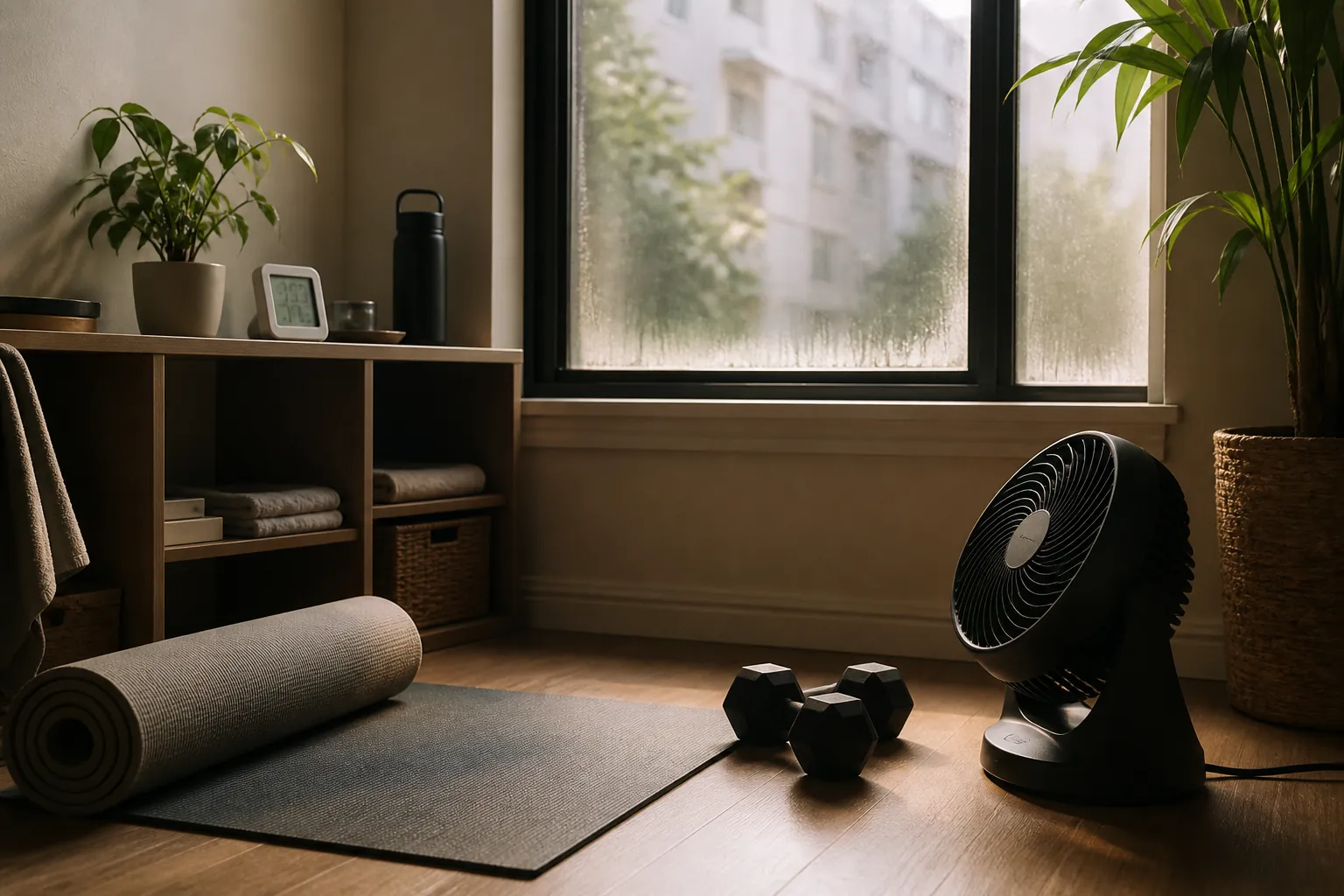
Why the answer is a range, not exactly 45% or 50%
The honest answer to “ideal indoor humidity for comfortable home workouts” is not a single magic number. EPA’s indoor-air guidance gives a home-friendly boundary: keep humidity controlled, measure it with a basic humidity gauge, and avoid letting indoor moisture run high. Its mold guidance is especially useful in apartments and small rooms because it treats moisture as a building problem, not a wellness preference. [1][2]
ASHRAE’s Standard 55 is not a squat-rack standard, and the standard itself is paywalled, so it should not be oversold as direct home-workout evidence. Its value here is narrower: it is a thermal-comfort reference for occupied spaces, and the 30–60% RH comfort framing associated with it supports the same usable boundary rather than a fake-precise target. [3]
Jones et al. adds the strongest human indoor-building evidence behind the middle of the range. In the Harvard Global CogFx cohort, the researchers analyzed 43 buildings in 6 countries and 227 workers, and reported 40–60% RH as the optimal range for reported symptoms. Across the observed 14–70% RH range, each 10-point RH increase was associated with about 54% lower adjusted odds of dry or itchy skin among females and about 42% lower adjusted odds of unusual fatigue among males. [4]
That is still office-building evidence, not a direct test of burpees beside a bed at room temperature. But for a home workout space, convergence is enough to be useful: 40–60% is the comfortable middle, above about 60% deserves action, and below about 30% is where dry-air complaints become more plausible during hard breathing.
The workout-specific part: sweat only cools you when it evaporates
A room can be “within range” and still feel bad if it is warm, still, and humid. During exercise, sweating is only half the cooling system. The useful part is evaporation: liquid sweat has to turn into vapor and leave the skin. Périard et al., in a review of exercise under heat stress, explain that evaporative heat loss is governed by the water-vapor pressure gradient between skin and air, meaning absolute humidity matters—not relative humidity alone. [5]

This is the part generic humidity advice often flattens. Relative humidity is a percentage of how saturated the air is at its current temperature. Warm air at the same RH contains more water vapor than cooler air at the same RH. So 60% RH in a warm workout room can feel much more oppressive than 60% RH in a cool room, because the air is already carrying more moisture and sweat has a harder time evaporating.
That is also why a fan is usually the first fix. It may not change the hygrometer reading at all, but it moves saturated air away from your skin and improves convective and evaporative cooling. Périard et al. specifically note that fanning enhances both convective and evaporative cooling, which is exactly why a small fan can make a rented spare room feel dramatically more tolerable without touching the thermostat. [5]
This does not mean hot-lab exercise studies should be turned into a rule for every living-room workout. Heat-stress research often uses trained cyclists, elevated temperatures, and controlled airflow. Those conditions are useful for understanding evaporation and heat strain, but they do not prove that a typical 65–75°F apartment workout has one universal ideal RH number. The practical lesson is simpler: if the room feels muggy, stale, and slow to dry, improve airflow before chasing a more exact humidity target.
Measure where you actually train
A cheap digital hygrometer is enough for this job. EPA’s indoor-air guidance explicitly points homeowners toward measuring humidity with a humidity gauge, and a basic hardware-store monitor is usually more useful than guessing from how the room feels. [1]
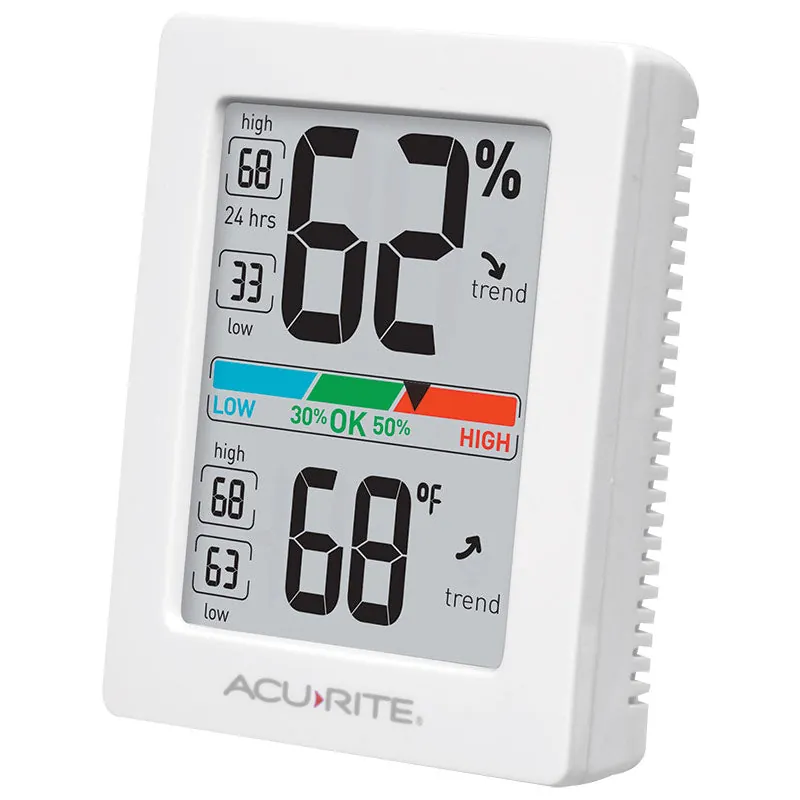
Put the sensor where the workout happens: near the mat, bench, bike, or dumbbells, at about the height where you are breathing during most of the session. Do not park it on a windowsill, directly beside a vent, on top of a humidifier, or in the path of a dehumidifier exhaust. Those spots tell you about the machine or the cold glass, not the air you are training in.
Watch patterns instead of one-off readings. A small bedroom gym can spike during a hard session and then settle back down once the door is open and the fan runs. That is different from a room that sits at 65% all evening, leaves windows wet, and makes towels stay damp. The second room needs moisture control; the first may only need airflow and a little time.
What to do with the number
| Workout-room reading | How to treat it |
|---|---|
| Below about 30% RH | Dry-air territory. In winter especially, consider cautious humidification, but stop before window condensation becomes a habit. If hard breathing repeatedly brings coughing, wheezing, or chest tightness, treat that as a medical question rather than a humidity-tuning project. |
| About 30–40% RH | Often workable, especially in winter. It may feel a little dry during high-breathing sessions, but it is usually easier on the building than pushing humidity higher when windows are cold. |
| About 40–60% RH | The year-round comfort target for most home workout rooms, supported by the convergence of EPA moisture guidance, ASHRAE comfort framing, and Jones et al.’s indoor-building symptom findings. [1][2][3][4] |
| Consistently above about 60% RH | Do not ignore it. Add airflow during workouts, open the door afterward if outdoor conditions allow, run exhaust ventilation where available, and consider dehumidification if the room stays high. This is the range where sweat evaporation feels worse and moisture risk becomes the bigger household problem. [2][5] |
The order matters. First measure the space. Then add air movement. Then decide whether the room actually needs humidity equipment. In many small apartments, a fan angled across the workout zone plus an open door after training does more for comfort than trying to hold a perfect reading all day.
Winter may call for a lower target
Winter makes people chase humidity because the air can get genuinely dry. The Center for Energy and Environment notes that forced-air heating can push indoor humidity into roughly the 15–30% RH range, and Jones et al. reported that 94% of UK indoor RH measurements from December through February were below 40%. [6][4]
That does not mean “more humidity” is automatically better. In a cold climate, the window is often the referee. If a humidifier makes the workout room feel nicer but the glass fogs every morning or condensation collects along the sill, the room is telling you that moisture is meeting a cold surface and staying there. For winter, a lower target—often closer to 30–40%—can be the more practical compromise, especially in apartments with older windows or limited ventilation. CEE’s seasonal guidance makes the same basic point: indoor humidity has to be managed against comfort, outdoor conditions, and condensation risk. [6]
The renter-safe move is to raise humidity slowly if the room is truly dry, then watch the windows and corners. A humidifier that helps breathing comfort during a January workout but leaves the room damp afterward has not solved the problem; it has moved it.
A simple control hierarchy for a small workout room
- Measure RH where you train, not beside a vent, window, humidifier, or dehumidifier.
- Use 40–60% RH as the normal comfort target, with 60% as the line that should trigger attention rather than shrugging.
- When the room feels muggy during exercise, add airflow first. A fan can improve evaporative cooling even if RH does not immediately change.
- If RH is consistently high after workouts, remove moisture: open the door when practical, use existing exhaust ventilation, dry towels elsewhere, or dehumidify.
- If winter RH is consistently below about 30%, add humidity cautiously and let condensation—not a wellness chart—set the upper limit.
That is enough control for most home gyms. The goal is not to engineer a laboratory. It is to keep the room in a range where sweat can evaporate, breathing does not feel unnecessarily harsh, and the person who lives with the windows, walls, and laundry afterward does not inherit a moisture problem.
References
- Care for Your Air: A Guide to Indoor Air Quality, US EPA
- A Brief Guide to Mold, Moisture and Your Home, US EPA
- ANSI/ASHRAE Standard 55, Thermal Environmental Conditions for Human Occupancy, ASHRAE
- Indoor Humidity Levels and Associations with Reported Symptoms in Office Buildings, Indoor Air / PubMed Central, 2021
- Exercise Under Heat Stress: Thermoregulation, Hydration, Performance Implications, and Mitigation Strategies, Physiological Reviews, 2021
- Managing Indoor Humidity Levels All Year Round, Center for Energy and Environment
This is general fitness education, not medical advice. For diagnosis or treatment of pain or injury, consult a qualified clinician.
Pick your next session
Browse all routines to find an appropriately-spaced next session.
Spot something off?
This content sits adjacent to health guidance — tell us if a citation or figure needs a correction.