
Home Training Routine for Your Injury Recovery Timeline
Muscle, tendon, bone, ligament, and cartilage each heal on different timelines driven by blood supply. This article shows how to match your home training routine to each tissue type's recovery phase so you avoid re-injury or excessive caution.
- Citation source
- British Journal of Sports Medicine
- Evidence level
- general guideline
The hard part of building a home training routine around an injury recovery timeline is not memorizing the week number. It is knowing whether the tissue you injured is ready for the kind of signal you are about to give it. A sore calf muscle, an irritated tendon, a healing bone, a sprained ligament, and damaged cartilage do not respond to the same calendar. Their timelines are shaped partly by blood supply: muscle has rich circulation and tends to heal faster; cartilage has very limited blood supply and tends to heal slowly.
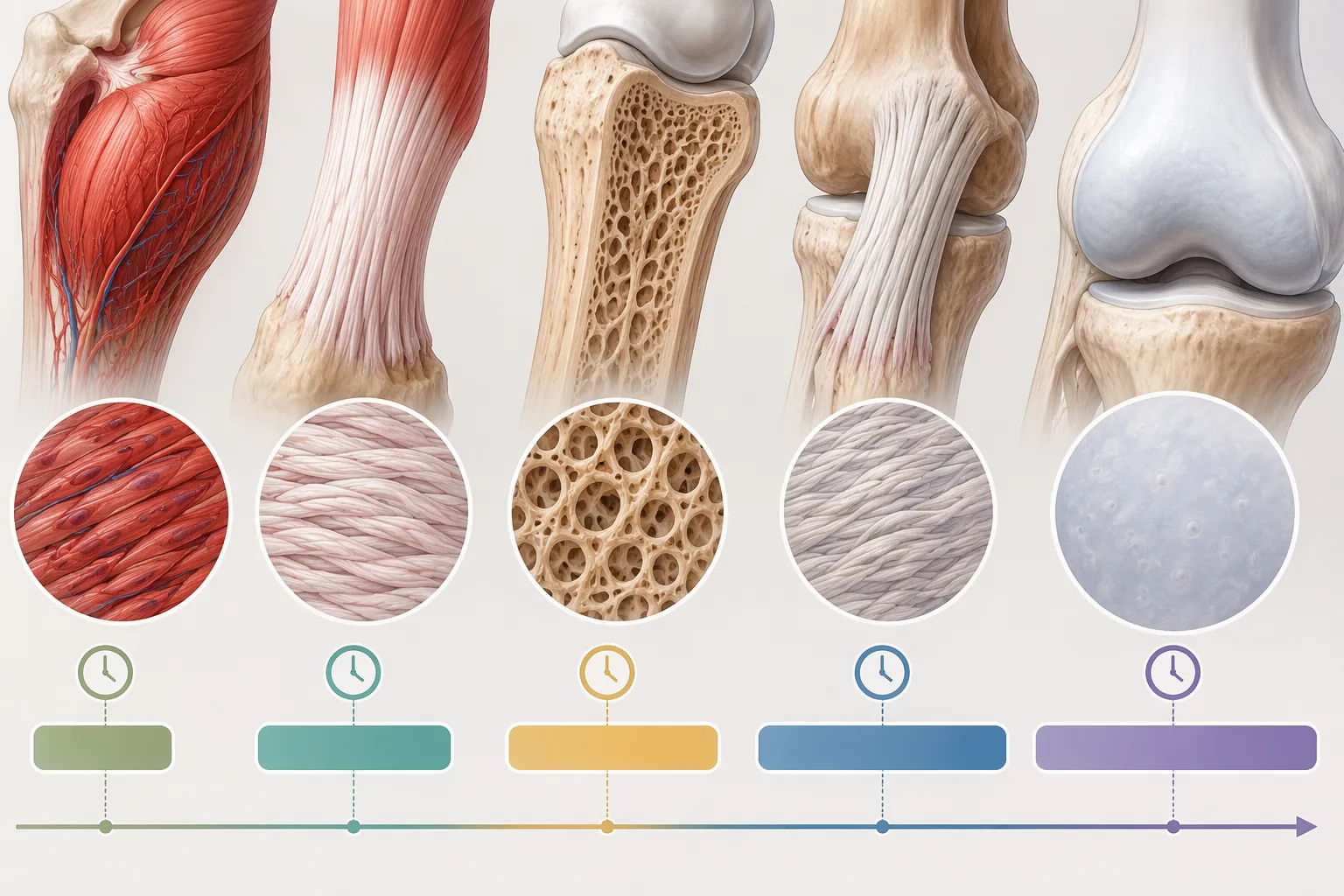
| Tissue type | Approximate healing window | Why the timeline differs | What this means for home training |
|---|---|---|---|
| Muscle | About 2–4 weeks | Relatively rich blood supply | Often progresses sooner from pain-free motion to light strengthening, if symptoms settle |
| Tendon | About 4–6 weeks | Less vascular than muscle and sensitive to load spikes | Needs gradual loading; jumping from rest to high-rep band work is a common mistake |
| Bone | About 6–8 weeks | Healing depends on stability, blood supply, and medical clearance | Home training should not guess around suspected fracture or weight-bearing restrictions |
| Ligament | About 10–12 weeks | Blood supply varies and joint stability matters | Range of motion and strength are not enough; balance and control have to return |
| Cartilage | Around 12 weeks | Very limited blood supply | Usually needs the most caution with impact, deep joint loading, and rapid progression |
These ranges come from a clinical physical therapy summary of tissue-healing expectations: muscle about 2–4 weeks, tendon about 4–6 weeks, bone about 6–8 weeks, ligament about 10–12 weeks, and cartilage around 12 weeks, with blood supply described as a major reason the windows differ.[1] That does not mean a hamstring strain is automatically “done” at week four or that a ligament sprain is safe at week twelve. It means your home routine should begin with the likely tissue involved, then keep checking what the body does after the session.
If the injury type is unclear, if pain is worsening, if you suspect a fracture, if the joint feels unstable, or if there is numbness, tingling, weakness, major swelling, deformity, or inability to bear weight, the home plan is not the decision-maker. Diagnosis comes first.
The Calendar Starts the Conversation; the Tissue Finishes It
A generic “six-week recovery” can be too aggressive for a ligament and too conservative for a mild muscle strain. That is where people get into trouble at home. Monday feels manageable, so the routine gets rebuilt around hope: squats come back, the resistance band gets doubled, the step becomes a calf-raise station. By Wednesday, pain has lingered long enough to make the whole plan feel suspect.
The better question is not “What week am I in?” It is “What phase is this tissue probably in, and what kind of load belongs there?” Rehabilitation frameworks commonly move from an acute inflammatory phase into repair and then remodeling, with exercise shifting from protection and pain-free movement toward loading, strengthening, and sport- or task-specific control.[2][3][4]
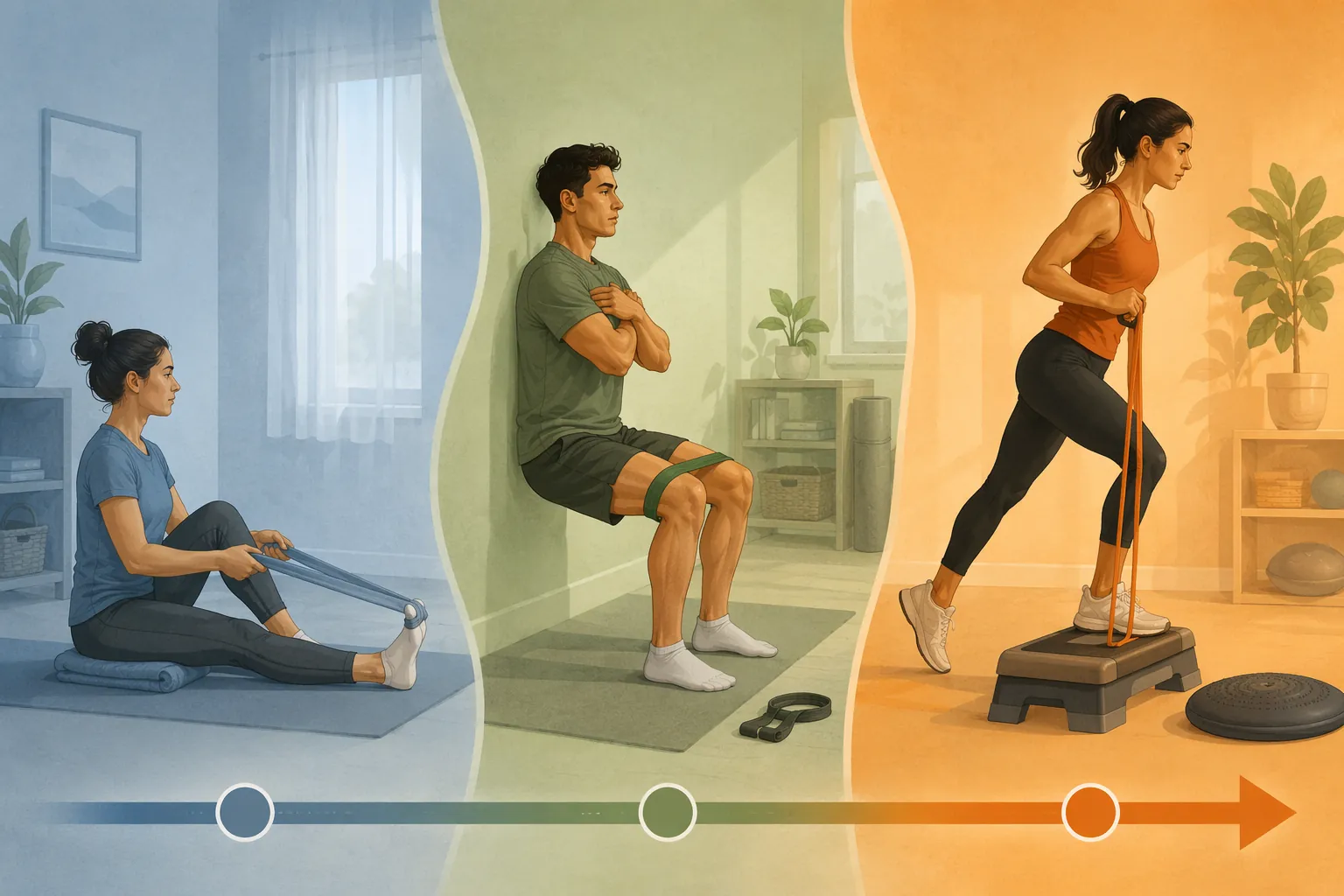
Acute Phase: Protect the Area Without Going Completely Silent
In the first several days after many soft-tissue injuries, the goal is not fitness. It is damage control. The PEACE & LOVE framework describes early care as Protect, Elevate, Avoid anti-inflammatories, Compress, and Educate, followed by Load, Optimism, Vascularisation, and Exercise as recovery moves forward.[2] The useful part for home training is the continuum: briefly reduce stress, then reintroduce the right stress.
Protection usually means unloading or reducing painful movement for about 1–3 days in the PEACE & LOVE model, not disappearing onto the couch for two weeks because movement feels emotionally risky.[2] For a mild muscle strain, that may mean easy walking and gentle pain-free range of motion. For a suspected fracture, significant ligament injury, or injury with instability, it may mean not loading the area until a clinician has assessed it.
- Keep movement pain-free or very low irritability; do not stretch hard into symptoms.
- Use short bouts of range of motion instead of long corrective sessions.
- Train uninvolved areas if doing so does not disturb the injury.
- Avoid turning “testing it” into repeated mini re-injuries throughout the day.
The “Avoid anti-inflammatories” and “avoid ice” discussion deserves care. PEACE & LOVE argues that anti-inflammatory approaches may impair long-term tissue healing and that evidence for routine icing is limited.[2] That is not the same as saying every person must refuse every medication or never use cold for symptom relief. Medication decisions belong with a clinician or pharmacist, especially if there are other health conditions involved.
Repair Phase: Isometrics and Light Loading Replace Guesswork
The repair phase is where home exercisers often make the biggest jump. Pain is lower, swelling may be down, and ordinary movement feels possible. That improvement matters, but it is not a license to return to the old routine. In staged rehabilitation models, this is the period where controlled mobility, activation, and early strengthening begin to matter more, while return to full activity still waits for function to catch up.[3][4]
Isometrics are often useful here because they let you create force without much joint motion. A tendon-sensitive knee might tolerate a wall sit better than repeated deep squats. A shoulder may tolerate a gentle band external-rotation hold before it tolerates sets through a larger range. A calf may tolerate an isometric hold on two feet before single-leg raises make sense.
Tendons need special patience. Tendon recovery guidance emphasizes progressive loading rather than complete rest, with exercise selected and advanced according to pain response and tissue tolerance.[5] The mistake is not using a band or a step; the mistake is treating the first pain-free day as proof that the tendon is ready for the highest-volume version of the exercise.
| Home-training choice | Usually fits this phase when | Regress if |
|---|---|---|
| Pain-free range of motion | The area feels guarded, stiff, or newly irritated | Motion increases pain during or after the session |
| Gentle isometric holds | You can contract the muscle without sharp pain or compensation | Pain climbs during the hold or lingers the next day |
| Light band or bodyweight work | Isometrics are tolerated and daily activity is improving | You need momentum, bracing, or altered mechanics to finish reps |
| Low-impact aerobic work | It stays pain-free and does not change your gait or posture | You limp, protect the area, or feel worse later |
Minimal equipment helps here because it makes progression small. A light resistance band, a mat, a step, or a stable chair is usually enough to create early loading choices. If you are setting up that kind of small-space recovery kit, FitAtHome Builds can support the equipment side without turning the routine into a full gym project.
Remodeling Phase: Strength, Eccentrics, and Control Come Back Gradually
Remodeling is not the dramatic finish line. It is the long stretch where the tissue is asked to become more organized, stronger, and better at handling the forces of normal training. Rehabilitation phase models place more advanced strengthening, proprioception, and return-to-activity work later in the process, after earlier pain, swelling, and motion limits have improved.[3][4]
This is where eccentric work may enter. For a tendon, that might mean slowly lowering from a calf raise instead of only pushing up. For a hamstring, it might mean a controlled bridge variation before fast hinge work. For a ligament injury, it may mean balance and joint-position control before cutting, jumping, or loaded twisting. The exact exercise depends on the injury, but the direction is consistent: more load, more range, more control, and more resemblance to the activity you eventually want back.
- Add resistance before speed.
- Add range before impact.
- Add single-leg or single-arm work only when double-limb work is controlled.
- Add balance and proprioception when the joint must control position under load.
- Add sport-like or workout-like movements last, not first.
For bone, cartilage, and significant ligament injuries, remodeling-phase ambition should not outrun medical restrictions. A person with a fracture history, joint locking, repeated giving-way, or cartilage-related joint symptoms needs more than a home progression chart. The issue is not effort; it is whether the tissue can safely accept the forces being applied.
Use the 24-Hour Pain Response as Your Load Check
A home routine needs one rule that is simple enough to remember before the next session: if pain persists beyond 24 hours after exercise, the load was probably too high and the next session should regress. That may mean fewer reps, less range, lighter resistance, a shorter hold, more rest, or returning from dynamic movement to an isometric version.
This rule protects against the most common home-training trap: judging the session only by how it felt while you were warmed up. Tendons, joints, and irritated soft tissues can complain later. The next morning tells you something the workout did not.
| After-session response | What it suggests | Next session |
|---|---|---|
| No increase in symptoms during or after | The current dose is probably tolerated | Repeat once before progressing |
| Mild discomfort during exercise that settles quickly | The dose may be acceptable, depending on injury type | Keep the same level and monitor the next 24 hours |
| Pain, swelling, or stiffness lasts beyond 24 hours | The load was probably too high | Regress resistance, range, volume, or exercise complexity |
| Sharp pain, instability, neurological symptoms, or worsening function | Home progression may be inappropriate | Stop and seek clinical guidance |
Keep the Routine Small Enough to Actually Do
A perfect-looking rehab menu is not useful if it is too long to repeat. A review on home-based exercise programs reported nonadherence estimates of 30–50%, with forgetting reported by 50% of participants and lack of time by 37%; pain-related fear also appeared as a barrier.[6] That makes simplicity a safety feature, not a lack of sophistication.
For most home sessions, choose one mobility item, one strength or isometric item, and one low-irritation conditioning or control item if the phase allows it. The routine should be easy to repeat, easy to scale down, and easy to track. If you need a spreadsheet to remember the plan, the plan is probably too fragile for a week when sleep, work, and pain all vary.
| Phase | Main home goal | Reasonable routine shape |
|---|---|---|
| Acute inflammatory | Protect the injury and keep safe motion available | Short pain-free range-of-motion bouts; gentle activity for uninvolved areas; no forced stretching |
| Subacute repair | Reintroduce controlled force | Isometrics, light band or bodyweight work, low-impact aerobic movement if tolerated |
| Remodeling | Build capacity and control | Progressive strengthening, eccentric emphasis when appropriate, balance or proprioception, gradual return to normal patterns |
The tissue timeline sets expectations. The phase tells you what kind of exercise belongs in the session. The 24-hour response tells you whether the dose was too much. If the diagnosis is uncertain, symptoms worsen, a fracture is possible, the joint feels unstable, neurological symptoms appear, or daily function is declining, stop treating the calendar as a coach and involve a healthcare provider.
References
- Healing Expectations for Different Tissue Types, Symmetry Physical Therapy.
- Soft-tissue injuries simply need PEACE and LOVE, British Journal of Sports Medicine, 2020.
- The 5 Phases of Rehabilitation, Isokinetic.
- Don't Forget the Rehab, Nationwide Children's Hospital Sports Medicine.
- Tendon Healing and Exercise Guidelines for Recovery, Evolve PT.
- Patient Involvement With Home-Based Exercise Programs, JMIR, 2018.
This is general fitness education, not medical advice. For diagnosis or treatment of pain or injury, consult a qualified clinician.
Pick your next session
Browse all routines to find an appropriately-spaced next session.
Spot something off?
This content sits adjacent to health guidance — tell us if a citation or figure needs a correction.