
A Phase-by-Phase Knee Recovery Protocol Tested at Home
This article presents a phase-by-phase knee recovery protocol based on ACSM, AAOS, and NHS guidelines, designed for small-space home use without equipment. It includes self-monitoring instructions using the NHS pain scale to know when to progress safely.
- Citation source
- ACSM, AAOS, NHS
- Evidence level
- general guideline
If you searched for “knee injury recovery exercises at home tested,” the useful answer is not a longer list of moves. It is a way to decide what your knee is ready for when nobody is in the room checking your form. This protocol is for mild-to-moderate knee recovery in a small space: the sort of cautious home work that may follow a sprain, strain, period of reduced activity, or familiar non-emergency knee irritation. It is not a diagnosis, a post-surgical plan, or a substitute for care if symptoms are acute, worsening, medically complex, or unexplained.
Here, “tested” means the exercises and progression rules are anchored to published guidance and research, not that a single brand or website personally trialed a magic routine. The spine of the plan comes from NHS and AAOS knee-rehab guidance: Leeds Teaching Hospitals describes a staged approach for soft-tissue knee injuries, including a first 48–72 hours of protection, rest, ice, and elevation, followed by mobility, strengthening, and return-to-function work; it also notes that soft-tissue knee injuries can take 6–8 weeks to settle, with individual variation [1]. NHS inform adds the simplest home decision tool in the whole article: a 0–10 pain response scale where 0–3 is minimal, 4–5 is acceptable, and 6 or higher means the exercise is excessive and should stop [2].
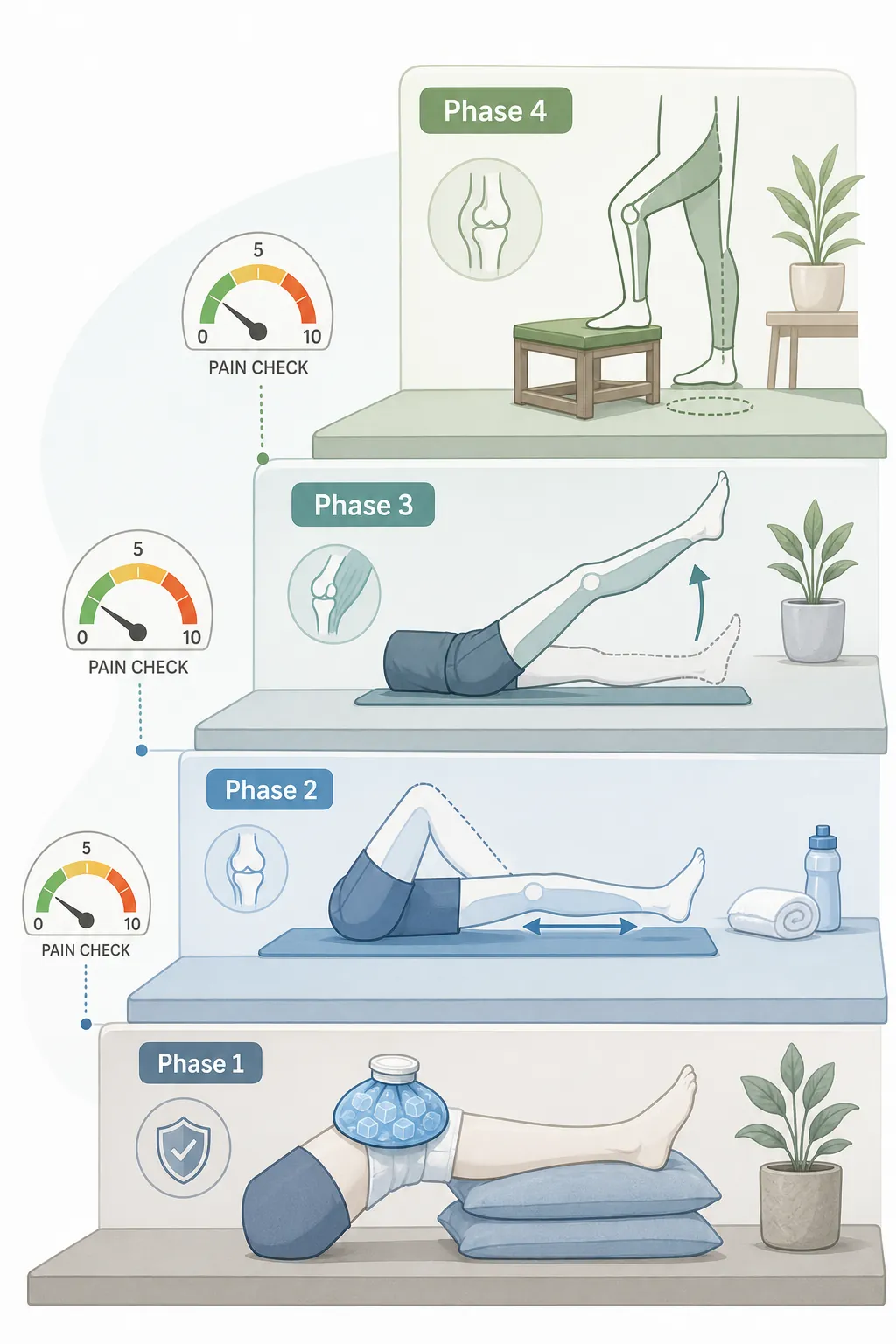
| Phase | What you are testing | Home work | Move on when |
|---|---|---|---|
| Phase 1: calm and protect | Can the knee settle without being repeatedly provoked? | Protection, rest, ice, elevation during the first 48–72 hours after a soft-tissue knee injury [1]. | Pain is not escalating, swelling or warmth is not getting worse, and gentle daily movement feels controlled. |
| Phase 2: restore easy motion | Can the knee bend, straighten, and accept light muscle activation without a flare? | Heel slides, quad sets, and static holds; Leeds describes beginning with 2–3 repetitions and building toward 2 sets of 15 for early exercises [1]. | Pain stays mostly 0–3, or at most 4–5 without a worsening trend, using the NHS pain scale [2]. |
| Phase 3: rebuild strength | Can the thigh, hip, calf, and hamstring work without the knee taking over with pain? | Straight leg raises, mini squats, calf raises, hamstring curls, and side-lying hip abduction, using AAOS sets and frequencies where appropriate [3]. | You can repeat the movements with the same form at the end as at the beginning, and the knee is no worse later or the next morning. |
| Phase 4: return to function | Can the knee handle balance, controlled stepping, and single-leg support? | Single-leg stance, balance work, and step-ups as return-to-function checks [1]. | You can perform everyday tasks more confidently without using pain, swelling, or instability as the price of progress. |
Why this protocol moves slowly
The annoying truth about home knee rehab is that “simple” exercises are not automatically self-explanatory. In a 2022 BMC Musculoskeletal Disorders study, 19 participants with an average age of 63 were taught knee strengthening exercises by a physical therapist and given a pamphlet; one week later, none could correctly perform every exercise, and straight leg raise form deteriorated by 4.3 degrees of knee flexion, a statistically significant change [4]. That does not mean home rehab is doomed. It means the program has to treat form as part of the exercise, not as a decorative instruction at the end.
The broader evidence still supports exercise therapy. A 2023 systematic review and network meta-analysis in the Orthopaedic Journal of Sports Medicine included 39 randomized controlled trials and 2,646 participants with knee osteoarthritis, finding that exercise therapy benefited pain relief, stiffness, and function [5]. That evidence is not the same thing as saying every painful knee should do the same routine. It supports the more modest and more useful claim: when exercise is matched to the stage of recovery, monitored, and progressed carefully, it belongs in the recovery conversation.
The pain scale is the steering wheel
Use the NHS pain scale before, during, and after a session. A 0–3 response means the exercise is in the minimal range. A 4–5 response is described as acceptable, but it is not a dare to push harder. A 6 or higher response means the exercise is too much and should stop [2]. The scale is a self-report guide, not a diagnosis, so the safest reading is conservative: progress when the knee is boring, not when it is merely tolerating you.
- If pain stays 0–3 and the knee is not worse later or the next morning, repeat the same level or add only one small change: a little more range, a few more reps, or one new exercise.
- If pain reaches 4–5, hold the level steady. Do not add range, reps, speed, or a harder variation in the same session.
- If pain reaches 6 or higher, stop that exercise, return to the previous phase or easier version, and seek clinical guidance if the pattern persists or symptoms are worsening.
- If you cannot tell whether a sensation is normal effort or joint pain, treat it as a reason to slow down, not as a test of toughness.
Phase 1: calm the knee before training it
The first phase is not a workout. It is the part where you stop turning a mild injury into a longer one by repeatedly checking whether it is still angry. Leeds places protection, rest, ice, and elevation in the first 48–72 hours for soft-tissue knee injuries [1]. In a small apartment, that may look like choosing the shortest necessary walking route, avoiding repeated deep bending, keeping the leg supported when resting, and using ice and elevation as the early calming tools rather than trying to “loosen it up” with strengthening work.
Do not use Phase 1 to prove that you are ready for Phase 3. If the knee is warm, swollen, sharply painful, or giving you a sense that something is not right, the useful action is not to find a gentler squat. It is to stop loading the joint and get appropriate medical advice, especially if symptoms are acute, worsening, or tied to a known diagnosis.
Phase 2: get motion back without negotiating with pain
Phase 2 starts when the knee is settling enough that gentle movement does not feel like poking a bruise. The goal is not strength yet. It is to restore easy bending and straightening, wake up the quadriceps, and learn what your pain response does when the movement is slow enough to observe.
Heel slides
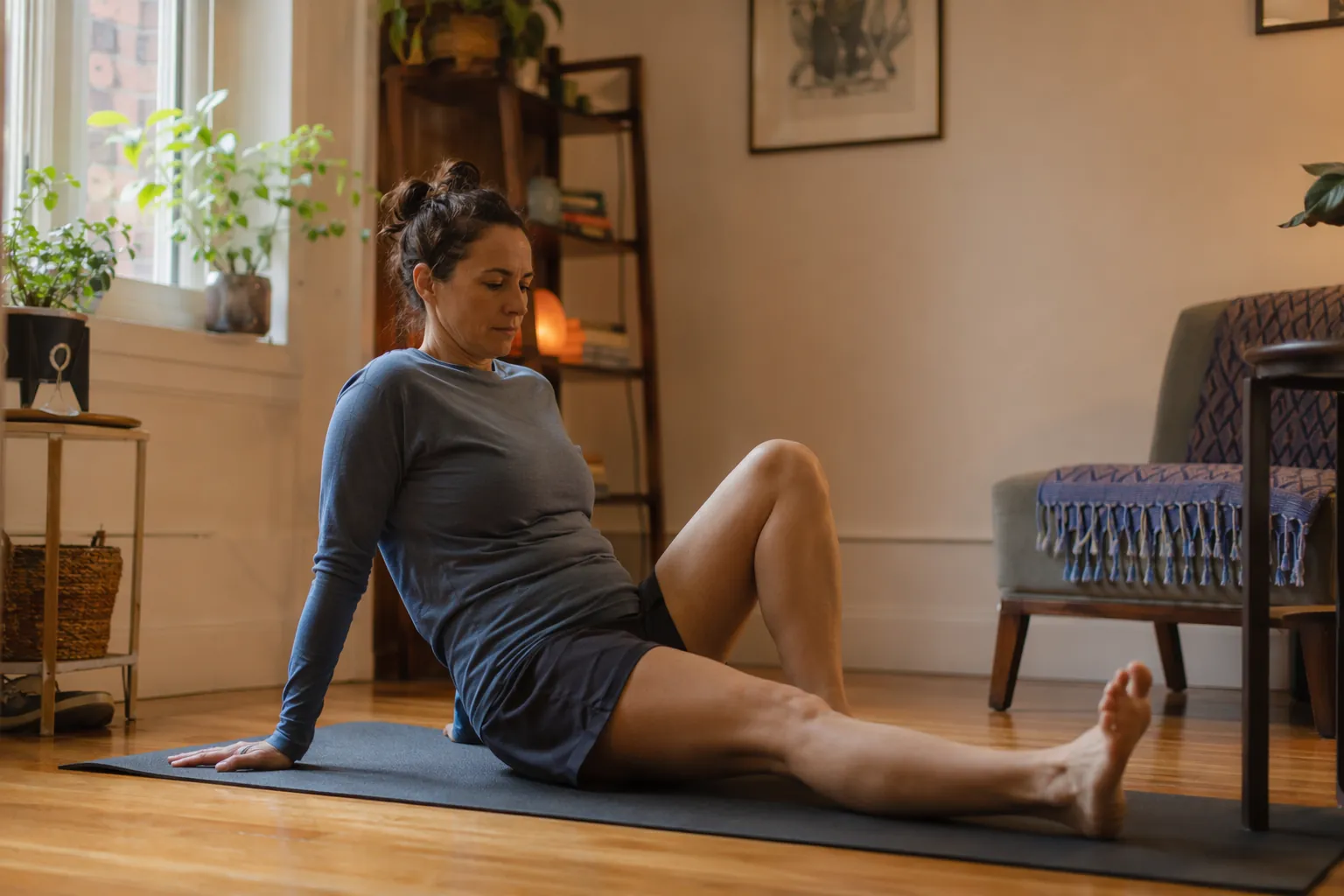
Sit or lie on the floor, a mat, or a firm bed with the leg supported. Slide the heel toward you only as far as the knee allows without a pinch, then slide it back out. Keep the foot in contact with the surface so the hamstrings are helping the motion rather than the knee being dragged through space. Leeds includes heel slides in early mobility work and describes starting with just 2–3 repetitions, building toward 2 sets of 15 as tolerated [1].
The small-space advantage is real here: a heel slide needs only the length of your leg. The main mistake is making the range look impressive. If the first few inches feel clean and the last few inches create a sharp or grabbing sensation, the useful exercise is the first few inches.
Quad sets
Lie or sit with the leg straight and the kneecap facing the ceiling. Tighten the front of the thigh as if you are gently pressing the back of the knee toward the floor or mat. The ankle and hip should stay quiet. AAOS lists quad sets at 3 sets of 10, 4–5 days per week, in its Knee Conditioning Program [3]. Early in Phase 2, that full volume may be too much; the phase matters more than copying the largest number on the page.
A good quad set often looks underwhelming. That is fine. What matters is whether the thigh contracts without the knee pain jumping. If the kneecap area feels irritated, try a gentler contraction; if the pain still rises into the excessive range, stop and return to Phase 1 behavior.
Static holds
Static holds belong here because they give the knee a way to experience muscle work without the extra irritation that sometimes comes from repeated bending. Keep the hold easy enough that breathing stays normal and the rest of the leg does not brace. If you notice the hip hiking, the foot gripping, or the knee drifting into discomfort, reduce the effort.
Phase 2 is successful when the knee becomes more predictable. You should know which movements stay in the 0–3 range, which ones touch 4–5, and which ones are not ready. That information is not a side effect of rehab; it is the point of this phase.
Phase 3: strengthen without letting form decay
Phase 3 is where many home programs get too casual. The knee feels better, so the exercises start moving faster, the last repetitions get sloppy, and the person doing them assumes that finishing the set is the win. The Mitchell study is a good warning here: even after professional instruction and a pamphlet, people’s home form deteriorated within a week [4]. For this phase, the last repetition has to resemble the first one.
Straight leg raises
Start by setting the quadriceps, then lift the straight leg in a controlled way and lower it with the same control. The knee should not gradually bend more as the set continues; that is exactly the kind of form drift that makes this exercise less simple than it looks. AAOS lists straight leg raises at 3 sets of 10, 4–5 days per week, with later progression to ankle weight [3]. For a no-equipment recovery protocol, body weight is enough until the movement is clean, pain-monitored, and repeatable.
Mini squats
Stand near a counter, wall, or sturdy chair so balance is not the limiting factor. Bend only into a shallow range, send the hips slightly back, and keep the knees tracking in the same direction as the toes. AAOS lists mini squats at 3 sets of 10, 4–5 days per week [3]. The word “mini” is not filler; it is the safety feature.
In an apartment, mini squats should be quiet. If the heels pop up, the knees collapse inward, or you drop quickly into the bottom, the movement is too large or too rushed. A shallower, slower squat that stays in the minimal pain range is more useful than a deeper one that leaves the knee warm afterward.
Calf raises
Hold a counter or wall, rise onto the balls of the feet, then lower slowly. Keep the weight even across both feet unless a clinician has told you to bias one side. AAOS lists calf raises at 2 sets of 10, 6–7 days per week [3]. Because this exercise can feel easy at first, the temptation is to rush it; slow lowering is usually where you find out whether the knee and ankle are actually controlling the motion.
Hamstring curls
Stand with support and bend the knee so the heel moves toward the back of the thigh, then lower it without swinging. AAOS lists hamstring curls at 3 sets of 10 [3]. Keep the thighs roughly in line with each other; if the working knee drifts forward or the hip twists, reduce the range.
Side-lying hip abduction
Lie on your side with the working leg on top. Lift the top leg without rolling the pelvis backward, then lower it slowly. This is a hip exercise, but it matters because knee control often depends on what the hip is doing above it. AAOS lists side-lying hip abduction at 3 sets of 20, 4–5 days per week [3]. If that volume causes form to fall apart, split the work into smaller sets rather than turning the last repetitions into a hip-roll exercise.
You do not need to perform every Phase 3 exercise at full AAOS volume on the first day you enter the phase. A cautious session might include quad sets, straight leg raises, and calf raises first, then add mini squats or hamstring curls once the pain response is predictable. The progression is still evidence-aligned; it is just not pretending that every knee reads the same schedule.
Phase 4: use balance and step-ups as checks, not a finale
Phase 4 is not a dramatic return-to-training montage. It is where you ask whether the knee can manage everyday demands that are slightly less predictable than floor exercises. Leeds places balance work, step-ups, and single-leg stance in the return-to-function phase [1]. These are checks for control, confidence, and symptom response.
- Single-leg stance: Stand near a wall or counter and shift onto one leg. The test is whether the knee can stay calm while the hip, foot, and trunk make small balance corrections.
- Balance work: Keep it quiet and low-risk. A small reduction in hand support is a progression; you do not need wobble boards or unstable props.
- Step-ups: Use a bottom stair or a stable step if one is available. Step up slowly, control the knee direction, and step down without dropping. If you do not have a safe step, do not improvise with furniture.
The pass-fail signal is not whether you can do one repetition. It is whether the knee tolerates repeated control. If single-leg stance produces wobbling but no pain, you may simply need practice. If step-ups bring back sharp pain or a swelling response, the knee has answered the phase question for you.
How often to repeat the work
AAOS gives exercise-specific frequencies in its Knee Conditioning Program, often 4–5 days per week for strengthening moves such as quad sets, straight leg raises, mini squats, and side-lying hip abduction, with calf raises listed at 6–7 days per week [3]. ACSM’s broader strength guidance for osteoarthritis discusses at least 2 strengthening sessions per week, 50–60% of maximum effort, and 2–3 sets of 8–12 repetitions for major muscle groups; it also reports that lifelong strength exercise participation is associated with an 18–23% lower lifetime risk of knee osteoarthritis, while noting that at least 12 sessions are needed for sustained pain reduction [6]. That lifetime risk figure should not be borrowed as a promise for short-term injury recovery.
For the home exerciser, frequency should be filtered through phase and pain response. Phase 1 is not strength training. Phase 2 may be frequent but very low intensity. Phase 3 can use AAOS-style strengthening volumes when form and symptoms allow. Phase 4 can be practiced as a function check, not as an excuse to stack harder balance tasks onto a knee that is already tired.
Once the injury episode has settled and the goal is general knee pain management rather than acute recovery, HSS guidance from a physical therapist recommends stretches 3–5 times per week and strengthening 2–3 times per week [7]. That belongs in the maintenance conversation, not in the first 48–72 hours after a new flare.
When to hold, regress, or get help
A phased protocol only helps if you are willing to let the phase change backward. If heel slides were fine yesterday but today they hit a 6 on the pain scale, the answer is not to complete the planned set. Stop, return to calming work, and see whether the knee settles. If a Phase 3 exercise repeatedly pushes into 4–5, keep the same exercise but reduce the range, repetitions, or effort. If it repeatedly reaches 6 or higher, it does not belong in the current phase [2].
| What happens | What to do next |
|---|---|
| Pain stays 0–3 during the exercise and the knee is not worse later | Repeat the same level, or progress one small variable next time. |
| Pain reaches 4–5 but settles and does not trend worse | Hold the current level. Do not add a harder variation yet. |
| Pain reaches 6 or higher | Stop that exercise and return to an easier version or earlier phase. |
| Pain, swelling, warmth, instability, or uncertainty is worsening | Stop treating the article as enough information and contact a qualified healthcare professional. |
Home knee recovery can be safe and useful without equipment when it is phased, pain-monitored, and conservative. The important test is not whether you finished every exercise on the list. It is whether you noticed what the knee reported and changed the plan before a small setback became the next flare-up.
References
- Early advice and exercises for soft tissue injuries of the knee — Leeds Teaching Hospitals NHS Trust
- Exercises for knee muscle and joint problems — NHS inform
- Knee Conditioning Program — AAOS OrthoInfo
- Quality of knee strengthening exercises performed at home deteriorates after one week — BMC Musculoskeletal Disorders, 2022
- Exercise Therapy for Knee Osteoarthritis: A Systematic Review and Network Meta-analysis — Orthopaedic Journal of Sports Medicine, 2023
- Hot Topic: Strength & Power Exercise for Osteoarthritis — ACSM
- Stretches and Exercises to Strengthen Your Knees — HSS, Apr 2026
This is general fitness education, not medical advice. For diagnosis or treatment of pain or injury, consult a qualified clinician.
Pick your next session
Browse all routines to find an appropriately-spaced next session.
Spot something off?
This content sits adjacent to health guidance — tell us if a citation or figure needs a correction.