
Do You Need Equipment for Knee Rehab at Home?
Wondering if you need to buy equipment for knee rehab at home or if body-weight exercises alone are enough? This evidence-based guide separates what's worth buying from what's a waste, drawing on research and expert protocols.
- Citation source
- AAOS, HSS
- Evidence level
- Formal position stand and systematic review
The hard part about shopping for knee injury rehab exercises at home is that everything starts to look responsible. A resistance band seems sensible. Ankle weights seem sensible. A pedal exerciser, a stationary bike, a balance board, and a knee-specific machine with straps and settings all seem like proof that you are taking recovery seriously.
The first useful reality check is much plainer: the AAOS Knee Conditioning Program is built around a stable chair, a wall, a towel, and optional ankle weights, with the program performed under a doctor's supervision.[1] That does not mean every knee problem can be handled with a towel and optimism. It does mean the baseline for home rehab is not a room full of medical-looking plastic.
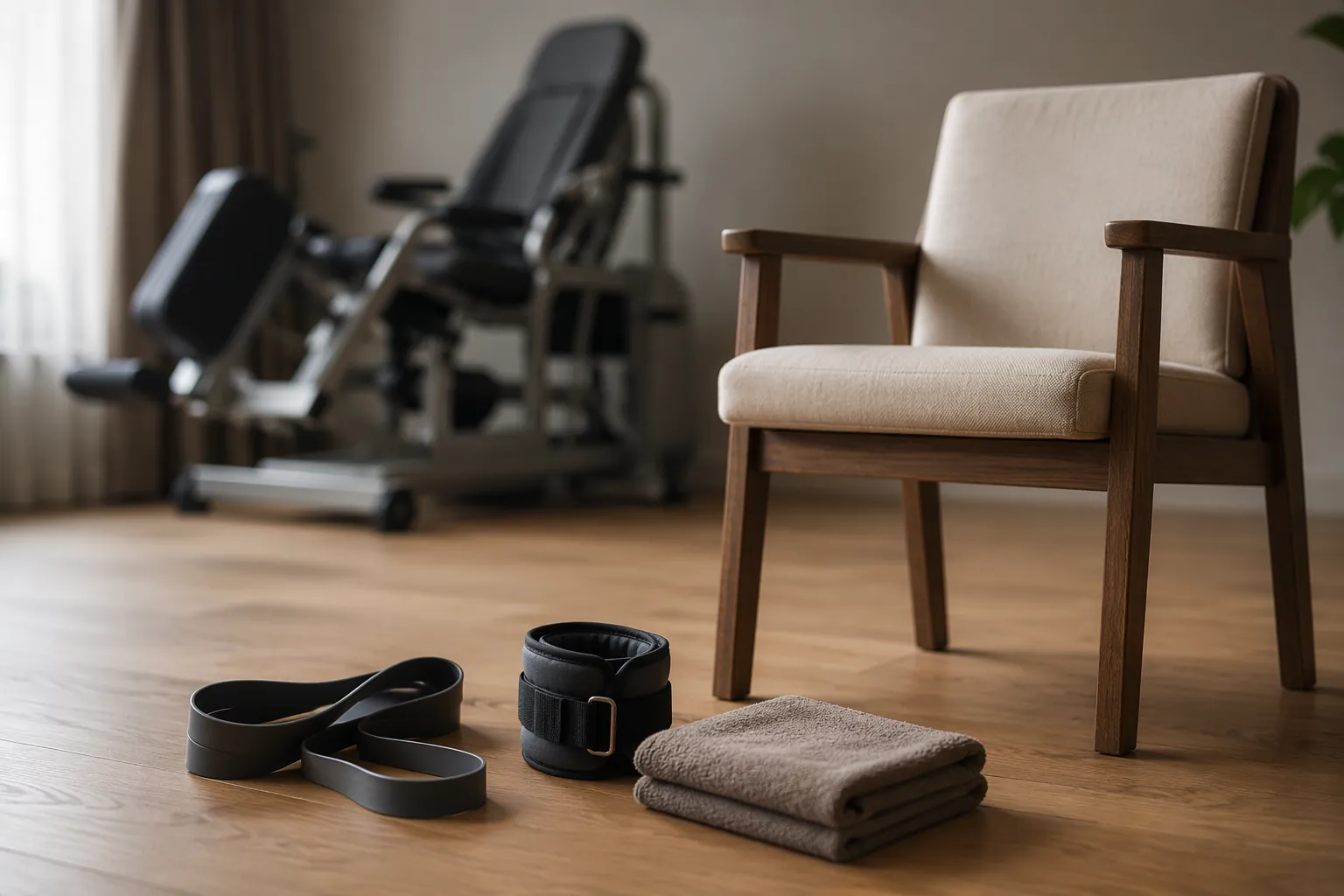
This article is buying guidance, not a treatment plan. Knee pain after surgery, a suspected ligament injury, meniscus symptoms, arthritis flares, swelling, locking, worsening pain, or uncertainty about what you are allowed to do belongs with a clinician. The useful home-gym question is narrower: once you have clinician-approved exercises, what equipment actually expands your options, and what just makes rehab look more official?
Start With the Exercises That Need Almost Nothing
Body-weight knee rehab is not the cheap version of "real" rehab. It is the base layer. The common early and middle-ground movements keep showing up because they train the muscles that usually have to carry more of the work around the knee: quadriceps, hamstrings, glutes, hips, and calves.
Forefront Physical Therapy's no-equipment home list includes familiar movements such as quad sets, heel slides, straight-leg raises, clamshells, mini squats, and calf raises.[2] HSS physical therapist Mohammad Saad's strengthening recommendations also stay simple, using squats, deadlift patterns, monster walks, and heel/toe raises, with a resistance band appearing as the main add-on rather than a whole equipment stack.[3] The AAOS program overlaps with the same basic idea: controlled strengthening and stretching with household-level setup, not a dedicated machine bay.[1]
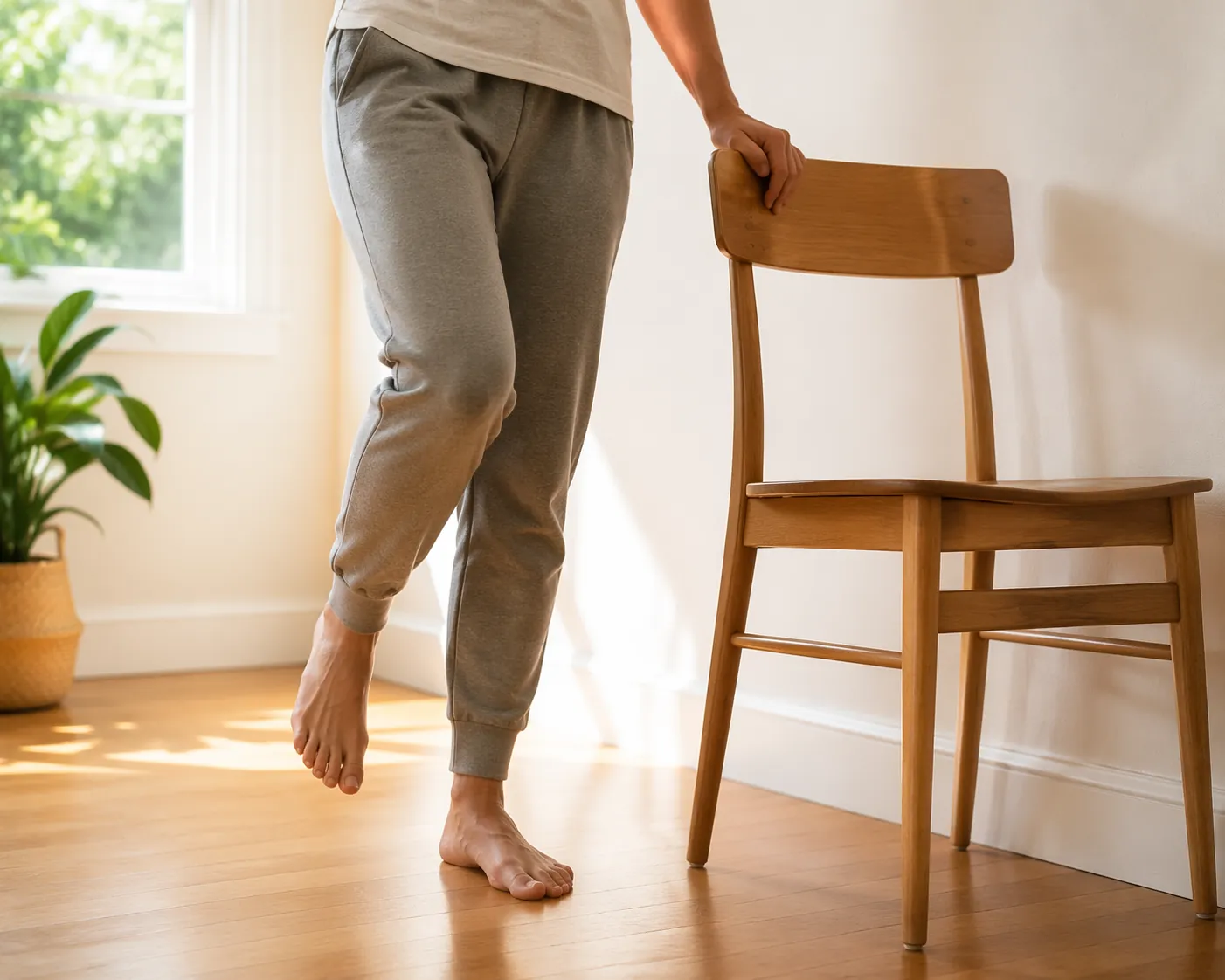
That overlap matters more than any single exercise list. A quad set asks you to re-learn controlled quadriceps tension. A heel slide works knee bending and straightening without needing to stand. A straight-leg raise makes the front of the thigh work while the knee stays controlled. A mini squat starts teaching both legs to share load again. Calf raises and glute work bring in the lower leg and hip, which are easy to ignore when all the anxiety is focused on the knee joint itself.
None of those movements become better because a product label says "rehab." They become useful when the range is appropriate, the motion is controlled, the progression is gradual, and the exercise fits the plan your clinician gave you. A chair can be a balance aid. A wall can set up a calf stretch or supported squat. A towel can help with stretching or sliding. That is not a hack; it is exactly the kind of plain setup that credible knee-conditioning materials already use.[1]
The Small Gear That Actually Earns Space
Once the base movements are cleared for you, a few items can make home rehab easier to progress. The point is not to buy everything. The point is to add tools only when they solve a specific problem: more resistance directions, clearer loading, or low-impact range-of-motion work.
| Item | What it adds | When it makes sense |
|---|---|---|
| Resistance band | Light-to-moderate resistance from different angles | When body weight is too easy or you need hip, quad, hamstring, or glute variations |
| Ankle weights | Simple, measurable load for leg raises and similar movements | When your plan calls for adding weight to controlled open-chain exercises |
| Stationary bike | Low-impact cycling and knee range-of-motion practice | When cycling motion is appropriate and seat height can be adjusted |
Resistance Bands: The Best First Buy for Most Small Spaces
If I had to pick the least-regrettable knee rehab purchase, it would be a resistance band. A loop band can turn side steps, clamshells, bridges, and hip work into something you can progress. A tube band can support hamstring curls, terminal knee extensions, rows, and general training after the knee-specific phase calms down. It stores in a drawer and stays useful after rehab, which is more than can be said for a lot of single-purpose recovery gear.
The evidence is also more interesting than the usual "bands are convenient" argument. A 2019 systematic review and meta-analysis by Lopes and colleagues compared elastic resistance with conventional resistance training for muscular strength. Across 8 randomized controlled trials with 224 participants, the authors found no significant difference in lower-limb strength gains between elastic resistance and conventional weight machines, with an effect estimate of SMD = 0.09, 95% CI -0.18 to 0.35, p = 0.52.[4]
That does not prove a band is equal to every machine for every knee condition. The review was small, and its average PEDro score was moderate at 6.5.[4] Still, it is enough to push back against the shopping fear that a home setup is automatically inferior unless it includes a bulky machine. For many strength exercises, elastic resistance is a legitimate loading tool, not a consolation prize.
The practical advantage is control. You can choose a very light band, shorten or lengthen the band path, change the angle, and stop the set before the movement gets sloppy. For a small apartment, that flexibility matters. A band can be rehab gear in the morning and a general strength tool later in the week.
Ankle Weights: Useful, But Only When You Are Ready to Load
Ankle weights are not exciting, which is probably why they are useful. They do one job: add a known amount of load to movements such as straight-leg raises or other clinician-approved leg-lifting patterns. Unlike a band, they do not change the resistance angle much. Unlike a machine, they do not take over the room.
The AAOS Knee Conditioning Program specifically lists optional ankle weights and describes progression from 5 lb to 10 lb.[1] That is a helpful guardrail for shopping. You do not need an elaborate adjustable tower. A comfortable pair that can sit securely around the ankle and cover a light progression range is usually the point.
The mistake is buying ankle weights too early because they feel like proof of progress. A straight-leg raise that is shaky without load does not become more therapeutic because weight is strapped to it. Load makes sense when the movement is already controlled and your plan calls for progression.
A Stationary Bike Has a Specific Rehab Use, Not Just a Cardio Use
A bike is the one larger item that can be worth it, but only if it fits your space and your situation. Its rehab value is not that it looks athletic. It is that the cycling motion can give repeatable, low-impact knee bending and straightening when that pattern is appropriate for you.
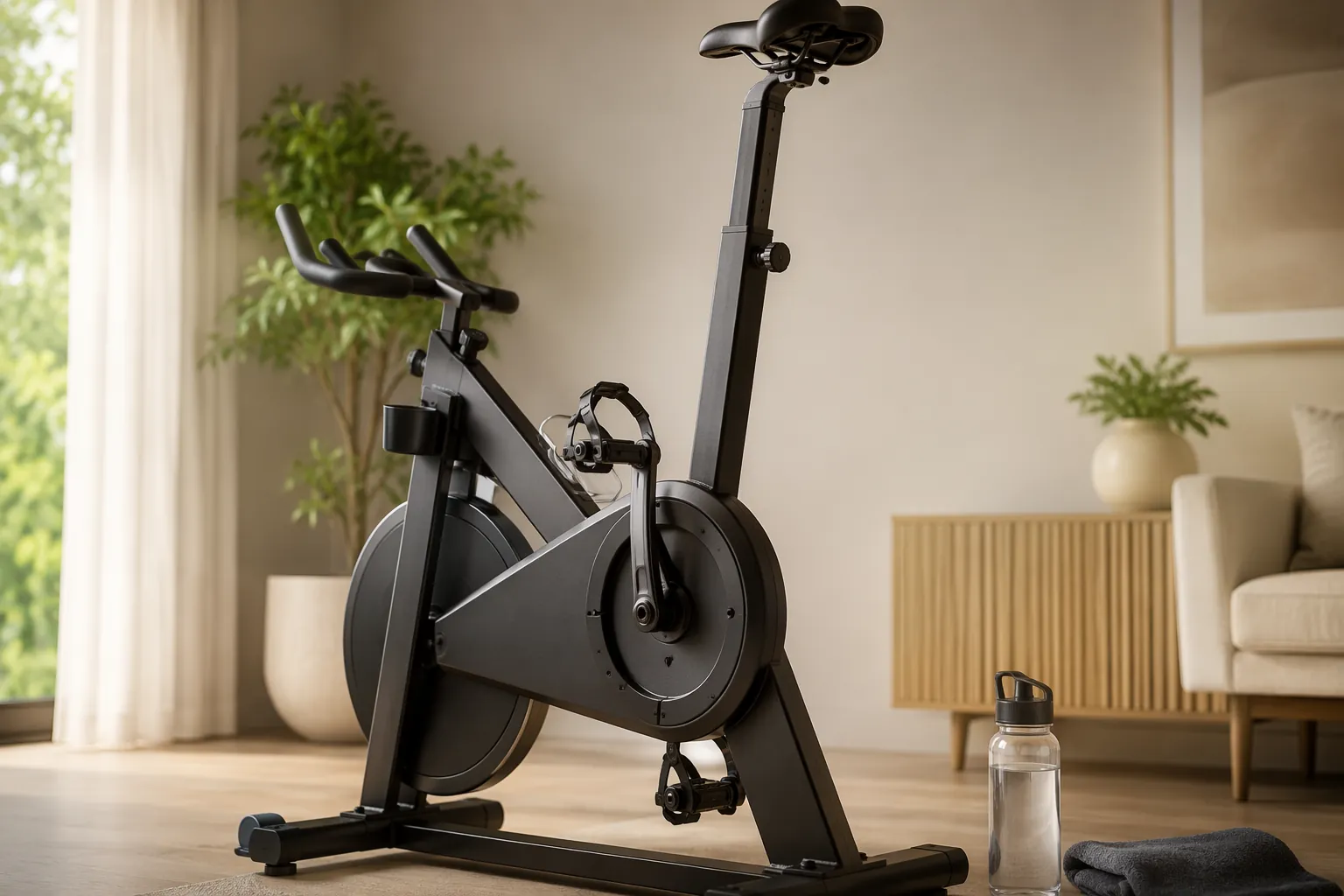
E3 Rehab describes a specific early range-of-motion setup: raise the seat high, start with partial revolutions if full circles are not available, progress toward full rotations, and use a range of 5 to 25 minutes daily when appropriate.[5] That is the kind of equipment use I trust more than vague promises about "knee recovery," because the bike is solving a defined problem.
For a small home, the decision is less about how medical the bike looks and more about practical fit. Can the seat adjust high enough? Can you get on and off safely? Will it also serve as low-impact conditioning after rehab? If the answer is yes and your clinician is on board, a stationary bike can justify its footprint. If not, a pedal exerciser or no bike at all may be more realistic, depending on what your plan actually requires.
What I Would Skip
Most dedicated knee rehab machines are hard to justify for a normal home user. The strongest materials here do not point toward a knee-only machine as the missing piece. AAOS uses a chair, wall, towel, and optional ankle weights.[1] HSS recommendations stay around body weight and a band.[3] Forefront's no-equipment list covers the same foundational exercise families without turning the living room into a clinic.[2]
That does not mean a machine is never useful in a clinic, or never appropriate when a professional specifically recommends one. It means the burden of proof is higher at home. A large knee-only device has to beat cheaper tools on progression, safety, storage, and long-term usefulness. Most anxious buyers are not comparing one perfect machine against nothing. They are comparing it against a clinician-approved exercise plan, a chair, a towel, a band, ankle weights, and patience.
Be especially skeptical of equipment that sells seriousness rather than function. If the device mainly lets you do a movement you could already do with a chair, a band, or an ankle weight, it is probably not solving the problem you think it is solving.
A Practical Buying Rule
Start with the body-weight exercises your clinician approves. If those cover your current plan, you do not need to buy anything just to make rehab feel official.
- Add a resistance band when you need more exercise angles, hip and glute variations, or light progressive resistance.
- Add ankle weights when controlled leg-raise-style movements are ready for measurable load.
- Use a stationary bike when range-of-motion cycling and low-impact conditioning fit your plan and your space.
- Skip expensive knee-only machines unless a clinician gives you a specific reason to use one.
References
- Knee Conditioning Program, AAOS OrthoInfo.
- Knee Rehab Exercises You Can Do At Home Without Equipment, Forefront Physical Therapy.
- Stretches and Exercises to Strengthen Knees, HSS, April 2026.
- Effects of training with elastic resistance versus conventional resistance on muscular strength, SAGE Open Medicine, 2019.
- Exercises for Knee Pain, E3 Rehab.
This is general fitness education, not medical advice. For diagnosis or treatment of pain or injury, consult a qualified clinician.
Pick your next session
Browse all routines to find an appropriately-spaced next session.
Spot something off?
This content sits adjacent to health guidance — tell us if a citation or figure needs a correction.