
Stop Believing These Lightning Safety Myths on the Trail
Many hikers rely on outdated lightning safety advice that can put them in danger. This article debunks common myths—like the lightning position and cave sheltering—and explains the prevention-first strategies that actually save lives, backed by NOAA, CDC, and NWS data.
- Citation source
- CDC
- Evidence level
- general guideline
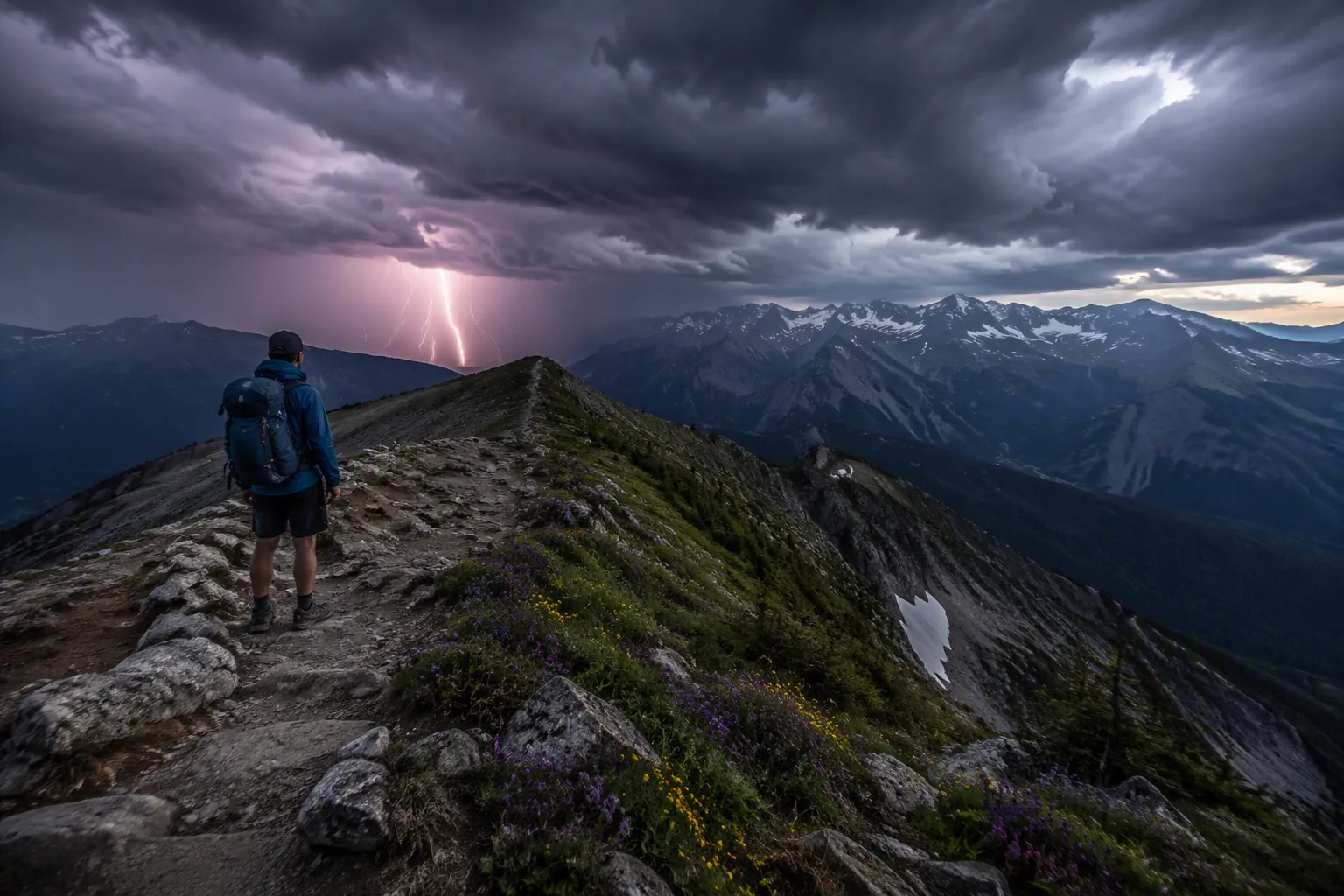
The dangerous moment on a hiking trail is often quieter than people expect. Thunder rolls somewhere behind the ridge, the sky is still half-open, and somebody remembers the rule they were taught years ago: crouch down, get on the balls of your feet, make yourself small.
That memory feels useful because it gives your body something to do. The problem is that several familiar lightning safety tips for hiking are last-resort rituals, not reliable protection. Dr. Ron Holle, a lightning safety expert cited by Backpacker, has reviewed a database of more than 5,000 lightning injury and death cases and calls the traditional lightning position “useless”; Backpacker also notes that NOLS and the National Park Service still teach variations of it as a last-resort measure, which is exactly the tension hikers need to understand rather than wave away.[1]
The better lesson is not that every older instructor was careless. It is that once thunder catches you on exposed terrain, you are already negotiating losses. The safest move happened earlier: checking the forecast, starting early, choosing a route with escape options, and turning around before the storm owns the ridge.
The lightning position is not a safety plan
The old crouch has a narrow logic: reduce your height, keep your feet close, and minimize contact with the ground. If lightning is imminent and there is nowhere else to go, some organizations still present it as the least-bad posture. But that is a very different claim from “this will keep you safe.”
The mechanical problem is ground current. A direct strike is not the main way people are injured. Backpacker reports that direct strikes account for only 3% to 5% of lightning injuries, while ground current causes up to 50%.[1] When lightning hits the ground or a nearby object, electricity can spread outward through the surface. A hiker does not need to be the tallest point to be hurt.
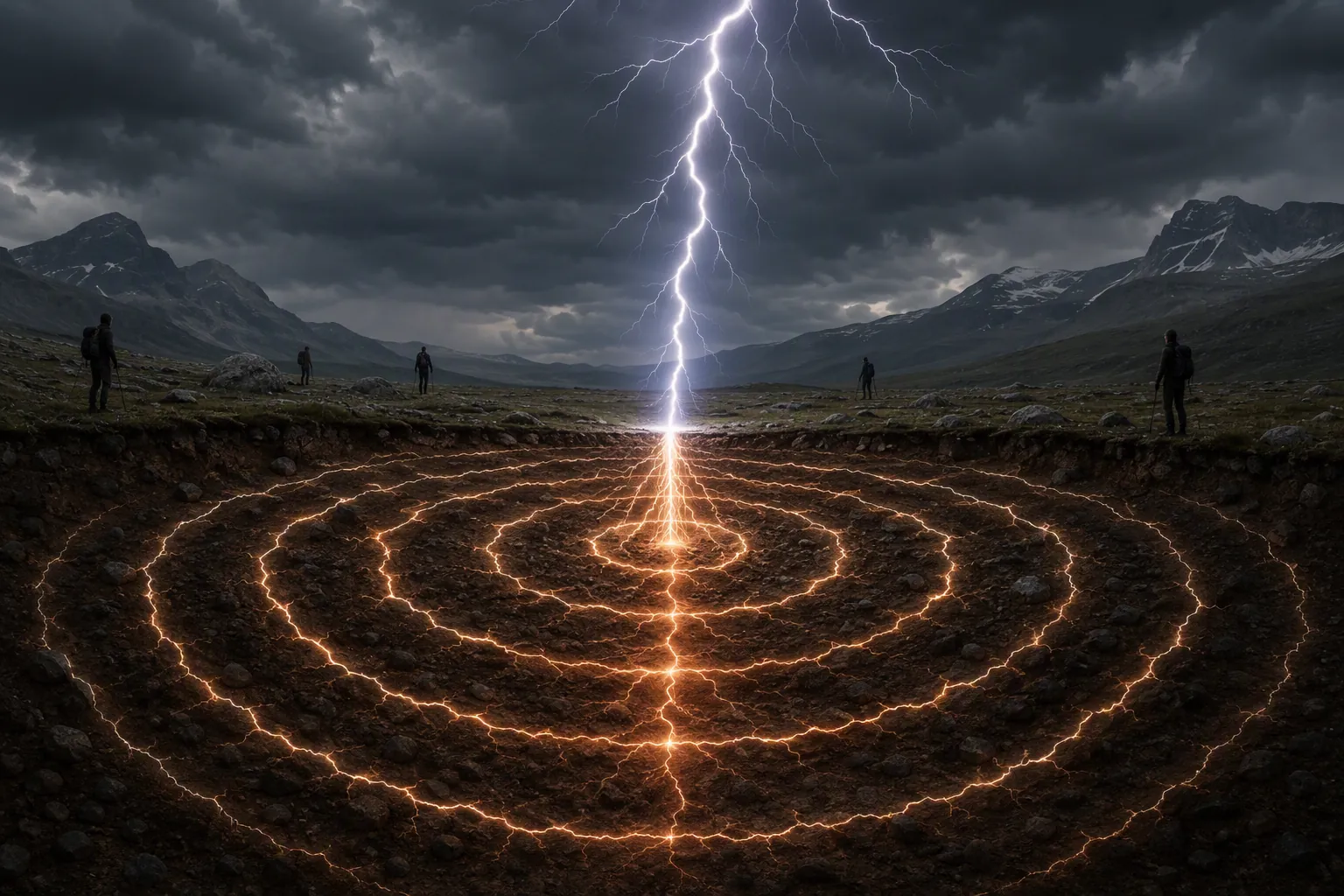
That is why the crouch can be psychologically oversized. It gives a scared group a shared instruction at the exact moment when the real protective choices have mostly expired. If you are already above treeline, on a ridge, or crossing an open slope with thunder close enough to hear, the question is no longer “What perfect body position saves me?” It is “How do I reduce exposure while moving toward less-bad terrain without creating a new hazard?”
A fair reading of the disagreement matters. If lightning is about to strike and there is no time to move, dropping from a tall standing profile may be preferable to standing upright with trekking poles in hand. But treating that posture as a primary rule encourages the wrong planning sequence. The trail decision that matters most is not how elegantly you crouch; it is whether you arranged your day so you did not need to crouch at all.
A tent is not shelter from lightning
A tent feels like shelter because it solves ordinary trail discomfort. It blocks rain, wind, bugs, and the feeling of being exposed. For lightning, that feeling is misleading. A typical hiking tent is not a substantial building, and it does not provide the electrical protection of a hard-topped vehicle or a grounded structure.
The camping numbers should make that point stick. From 2006 through 2023, Backpacker reports that more people died while camping than while hiking: 23 camping deaths compared with 12 hiking deaths.[1] That does not prove camping is more dangerous per hour or per participant, and it should not be read that way. It does show that being inside a tent during a storm is not the same thing as being protected.
For FitAtHome readers who use a trail day as a break from apartment workouts, this is the same kind of distinction that matters indoors: equipment can feel sturdy without being fit for a specific load. A tent is excellent at being a portable bedroom. It is not a lightning shelter.
Caves, overhangs, and lone trees can make the trap worse
Rock overhangs and shallow caves attract hikers for the same reason tents do: they look like shelter in a rain problem. Lightning is not just a rain problem. Dr. Kristin Calhoun of NOAA’s National Severe Storms Laboratory told Backpacker that caves and overhangs can be dangerous because current may travel through rock surfaces, across the cave mouth, or through a person bridging different contact points.[1]
A small cave can put your head near the ceiling, your back near the wall, and your feet on wet ground. An overhang can concentrate people at the exact edge where water, rock, and ground contact meet. That is not a controlled shelter; it is an electrical environment you cannot evaluate by sight.
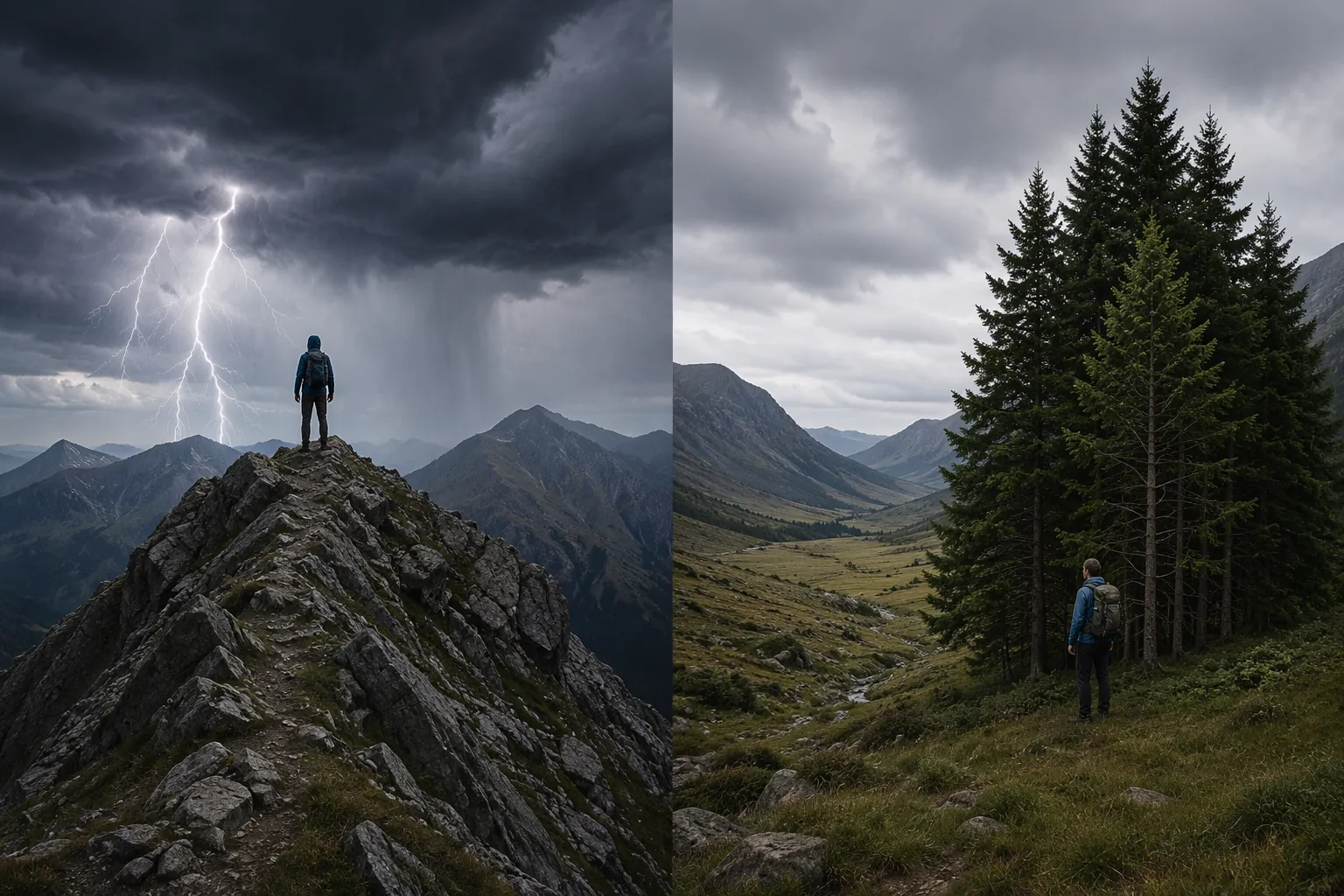
The lone tree has a different version of the same problem. It may be the tallest object around, and even if lightning hits the tree instead of you, ground current and side flash can still injure people nearby. Standing under the only tall tree in an open meadow is not clever compromise. It is moving closer to a likely strike point.
If you are caught out, lower-risk terrain usually means moving away from isolated tall objects, ridgelines, summits, open fields, and water. A cluster of smaller trees in lower terrain is generally preferable to a single tall tree or an exposed ridge, but that word “preferable” is doing real work. Outside a substantial shelter, the goal is risk reduction, not safety.
Metal is a distraction, not the main reason lightning hits
Trekking poles, pack frames, zippers, phones, and watches can conduct electricity. That part is real. The myth is the leap from “metal conducts” to “metal attracts lightning in a way that should dominate your decisions.” Backpacker’s myth-busting summary puts the emphasis back where it belongs: terrain, exposure, storm distance, and timing matter more than obsessing over small metal items.[1]
If lightning is close, put poles down because they can create awkward contact and because you may need your hands free to move carefully. But do not spend the storm reorganizing your pack hardware while staying on a ridge. That is a tidy action aimed at the wrong threat.
“I’ll see the storm coming” fails more often than hikers admit
The sky does not owe hikers a clean warning sequence. NOAA says lightning can strike more than 10 miles from rainfall, and if you can hear thunder, you are close enough to be struck.[2] A storm can still look like something happening over there while the electrical risk has already arrived where you are standing.
Counting seconds between flash and thunder can help estimate distance, but it is not a permission slip to keep climbing. On trail, the useful threshold is simpler: thunder means change the plan. If your route still requires an exposed ridge, a summit push, a long open traverse, or a slow descent through high terrain, you waited too long.
Afternoon timing is lightning safety, not generic hiking advice
“Start early” can sound like the sort of bland advice that gets stapled to every hiking article. For lightning, it is more specific than that. CDC data for 2006 through 2025 reports 517 lightning deaths in the United States, with 62% occurring during leisure activities and about two-thirds occurring between noon and 6 p.m.; July is the deadliest month.[3]
That pattern does not mean mornings are magically safe or afternoons are automatically deadly. It does mean that the casual Saturday plan—sleep in, drive late, reach the exposed part after lunch—is aligned with the part of the day where fatal incidents cluster. For a hiker using the trail as active recovery from a home training week, the fix is not heroic. It is boring in the best way: earlier trailhead time, shorter objective, and a hard turnaround before the exposed section becomes a weather bet.
Recent fatality numbers add context without needing to become the whole story. The National Weather Service lists 21 lightning deaths in 2025 and a 10-year average of about 20 deaths per year; its preliminary 2026 page showed 4 deaths through June.[4] Those totals are small compared with many everyday hazards, but lightning risk is unusually sensitive to a few choices hikers can make before they leave the house.
Use terrain ratings before the storm, not during it
The National Park Service’s Rocky Mountain lightning guidance uses a National Weather Service 0-to-10 terrain exposure scale, and it is one of the more useful tools because it forces the route question before thunder starts. In that scale, 0 is the highest-risk terrain, such as summits, ridges, open fields, or being near isolated tall objects; 10 is a substantial building or fully enclosed metal vehicle.[5]
| Terrain choice | What it means for a hiker |
|---|---|
| 0 to 2 | Exposed terrain such as summits, ridgelines, open areas, or isolated tall objects; avoid being here when storms are possible. |
| Middle ground | Lower terrain may reduce risk, especially away from isolated trees and open slopes, but it is not true shelter. |
| 10 | A substantial building or fully enclosed metal vehicle; this is the real target when lightning is in the area. |
The scale is useful because it cuts through the fantasy that all outdoor locations are roughly equivalent once a storm arrives. They are not. A broad ridge, a lakeshore, a boulder field above treeline, and a low area near a cluster of smaller trees do not carry the same exposure. None of them is a true substitute for a building or enclosed vehicle, but some give lightning more obvious targets and cleaner paths through a person’s body than others.
This is where route choice becomes safety gear. Before the hike, look at when the route reaches its most exposed terrain, how long that section lasts, and whether there is a realistic way down before noon. A trail that spends hours above treeline may be a poor choice on a forecast with afternoon storms, even if the distance fits your fitness.
The 30-minute rule is the cleanest decision threshold
If thunder sends you to shelter, do not pop back out because the rain eased or the sky brightened. NOLS-oriented backcountry guidance summarized by The Trek uses the 30-minute rule: wait at least 30 minutes after the last thunder before leaving shelter or resuming exposed travel.[6]
That rule is useful because it removes negotiation. Groups are bad at weather patience when a summit is close, daylight is fading, or someone is worried about losing the workout they planned. Thirty minutes after last thunder is not a vibe check. It is a threshold.
It also reframes what “shelter” means. If the only available place is lower-risk terrain, waiting there may still be wiser than moving back onto an exposed ridge. But if a substantial building or enclosed vehicle is reachable, that is the shelter standard to aim for. A trailhead bathroom with real wiring and plumbing, a visitor center, or a car is a different category from a tent, overhang, or tree.
If caught outside, reduce exposure instead of acting protected
There is no satisfying outdoor answer here. If thunder catches your group away from real shelter, the job is to stop making the situation worse. Move off summits and ridges if you can do so safely. Avoid open fields, isolated tall trees, water, metal fences, and shallow caves or overhangs. Spread group members out so one ground-current event is less likely to injure everyone at once, while staying close enough to communicate and help.
- Leave exposed high points early; do not wait for rain to prove the storm is close.
- Choose lower terrain over ridges, summits, lakeshores, and open meadows.
- Avoid isolated tall trees; a cluster of smaller trees in lower terrain is generally less bad.
- Stay out of shallow caves and rock overhangs that can conduct current across contact points.
- Separate group members rather than huddling together under one object.
This is also where fitness judgment matters. A strong hiker can still make a poor safety choice by treating speed as a rescue plan. Descending fast on wet rock, sprinting through talus, or scrambling down an unfamiliar slope can trade lightning risk for a fall. The best lightning plan is still the one that keeps you from needing a panicked descent.
After a strike, CPR is one action that can matter
Lightning victims do not carry an electrical charge, so it is safe to touch and help them once the scene is as safe as you can make it. Backpacker reports that CPR is highly effective after lightning strikes, with about 90% of victims surviving when resuscitation is performed.[1] That is not an argument for accepting more risk. It is a reason a hiking group should know what to do if prevention fails.
Call emergency services as soon as possible, start CPR if the person is not breathing or has no pulse, and treat multiple victims by helping those who appear lifeless first. In many emergencies that instinct feels backwards; with lightning, immediate breathing and circulation support can be decisive.
What to trust on trail
Trust substantial shelter first: a real building or fully enclosed metal vehicle. Trust the forecast before the trailhead, and timing before exposed terrain. Trust thunder as a decision point, not as background noise. Trust the 30-minute rule after the last thunder. If you are caught out, trust lower-risk terrain and group spacing more than a memorized crouch. If someone is struck, trust CPR and fast emergency response.
Hiking can still be a clean way to make a training week feel less boxed-in. It does not need to become a survival drama. But trail folklore is not a safety system, and lightning is a poor place to discover which old rule was mostly there to make people feel less helpless.
References
- Lightning Safety Facts for Hikers, Backpacker, July 8, 2025.
- Lightning Safety, NOAA.
- Lightning Strike Victim Data, CDC.
- Lightning Fatalities 2026, National Weather Service.
- Lightning Safety, National Park Service.
- The Ultimate Guide to Lightning Safety for Thru-Hiking: Tips & Resources, The Trek.
This is general fitness education, not medical advice. For diagnosis or treatment of pain or injury, consult a qualified clinician.
Pick your next session
Browse all routines to find an appropriately-spaced next session.
Spot something off?
This content sits adjacent to health guidance — tell us if a citation or figure needs a correction.