
The Science of Neural Pathways for Building At-Home Exercise Habits
The popular 21-day habit claim isn't backed by evidence. This article explains how long it actually takes to make an at-home workout automatic, why the 66-day median matters, and how context-dependent repetition in a shared living space affects the neural handoff from effortful decision-making to automatic execution.
- Citation source
- Singh et al. (2024)
- Evidence level
- general guideline
The hard part of an at-home workout is often not the workout. It is the five minutes before it, when the mat is rolled against the wall, the dumbbells are under the side table, the couch is doing what couches do, and the same room is offering three other easier identities: office, storage area, recovery zone, screen room.
That is why neural pathways for building exercise habits at home are not just a brain story. They are a room story. The question is not whether you “want it enough” every Tuesday. The question is how long the workout keeps requiring a fresh decision before the cue, the movement, and the reward start to run with less argument.

The popular 21-day answer does not survive contact with the evidence. It is commonly traced to plastic surgeon Maxwell Maltz, who wrote about patients taking roughly 21 days to adjust to physical changes. That was not a controlled habit-formation finding, and it was not about the brain learning to start a workout in a shared living room.
The better number is 59 to 66 days, and even that is not a deadline
The strongest current anchor is a 2024 systematic review and meta-analysis by Singh and colleagues. Across 20 studies with 2,601 participants, health habits took a median of 59 to 66 days to reach automaticity, with individual estimates ranging from 4 to 335 days.[1]
That range matters as much as the median. A median is the middle of a distribution, not a promise written on your calendar. If a home workout still feels annoyingly deliberate on day 40, that does not mean your brain is defective. It may mean you are still somewhere inside the normal spread of habit formation. If it feels easier after three weeks, that is useful, but it should not be used as proof that everyone else is making excuses.
The famous 66-day figure comes largely from Lally and colleagues’ real-world habit-formation study, which modeled how repeated behaviors became more automatic over time. In that study, the time to reach a plateau varied widely, commonly cited as 18 to 254 days, and only 23% of participants reached the predetermined automaticity threshold.[2]
That 23% result is not a reason to give up. It is a reason to stop treating automaticity as a participation trophy. Some behaviors become smoother without ever feeling fully automatic. Some people get a reliable rhythm but still need a visible cue. Some home workouts remain partly chosen, especially when the room keeps changing.
| Claim | What the evidence supports | How to use it at home |
|---|---|---|
| “It takes 21 days.” | Not supported as a habit-formation rule. | Do not use day 22 as a pass/fail test. |
| “It takes 66 days.” | A useful median estimate, not a guarantee. | Plan for roughly two months, while allowing wide variation. |
| “Once it is automatic, it is effortless.” | Automaticity can reduce decision load, but it is not guaranteed and may be partial. | Keep cues visible even after the routine feels easier. |
| “Missing once resets the habit.” | Single missed days do not appear to meaningfully derail the trajectory. | Protect the next repetition instead of starting over. |
What the brain is actually handing off
Early in a new home workout habit, the prefrontal cortex is doing a lot of the work: choosing, inhibiting competing options, sequencing the session, and negotiating with the part of you that would rather stay seated. As repetition accumulates, habit learning involves a shift toward brain systems associated with automatic action patterns, especially the basal ganglia.[3][4]
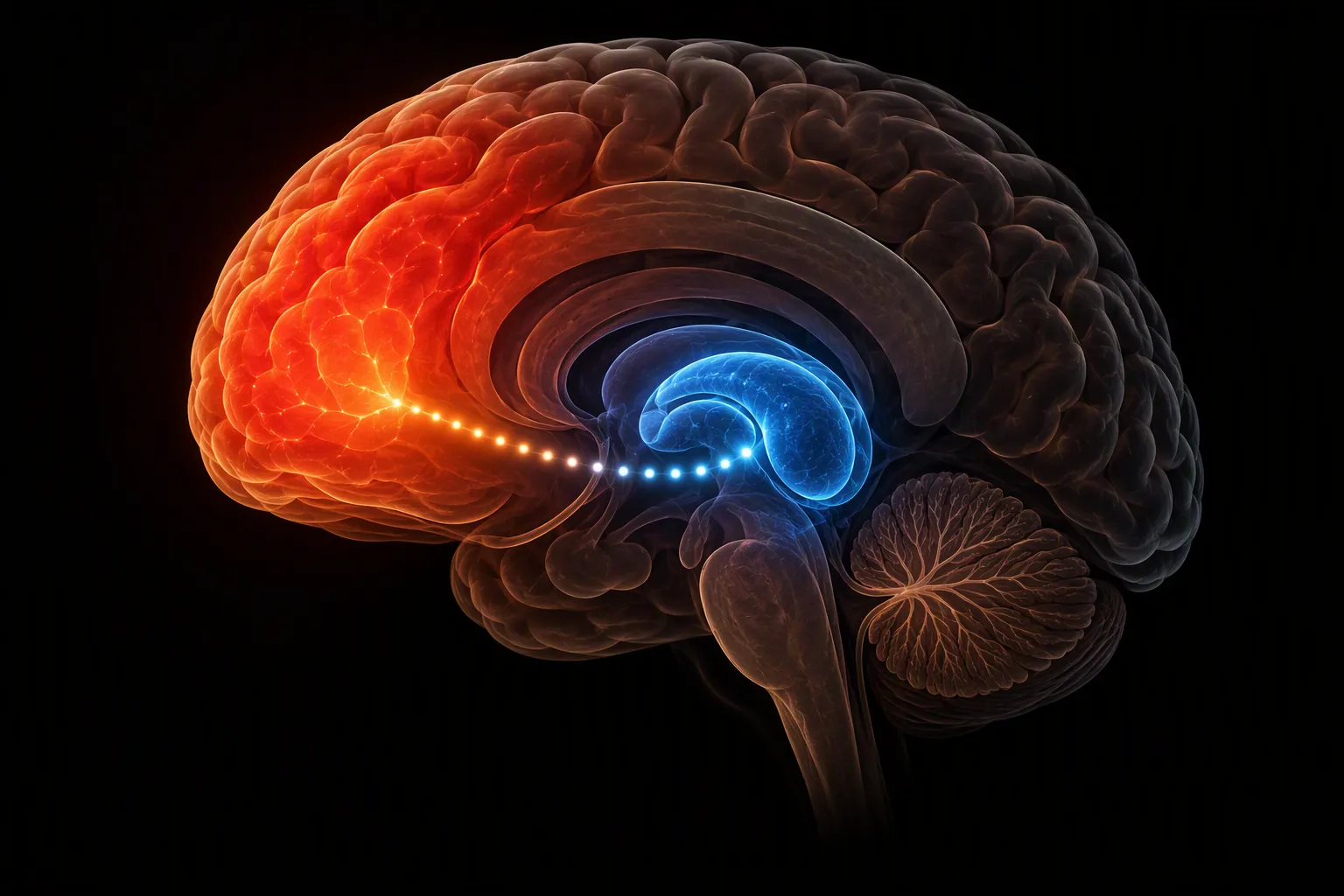
That does not mean the basal ganglia flips on at day 66 and saves you from being human. The cleaner translation is this: repeated behavior in a stable context can reduce the amount of deliberate control needed to begin and carry out the behavior. You still may notice the effort. You still may dislike the first set. But the starting friction can shrink.
For a home workout, the lived timeline often feels like this: the first week has novelty and equipment guilt; the second week still has enough freshness to feel like a project; then weeks 3 to 5 can get strangely vulnerable. The purchase glow is gone, the room has returned to normal life, and the neural handoff has not had much time to consolidate. That middle stretch is where many people mistakenly conclude that the routine “isn’t sticking.”
A more accurate reading is less dramatic. The behavior may simply still be prefrontal-heavy. It still needs setup, attention, and protection from competing cues. That is not a character flaw; it is the expensive part of the learning curve.
Home workouts have a cue problem
A gym is imperfect, but it has one useful advantage: the environment is blunt. The racks, benches, mirrors, lockers, and other people all point toward the same behavior. At home, the same eight square feet may mean mobility work at 7 a.m., email at 9 a.m., folded laundry at noon, and television at night.
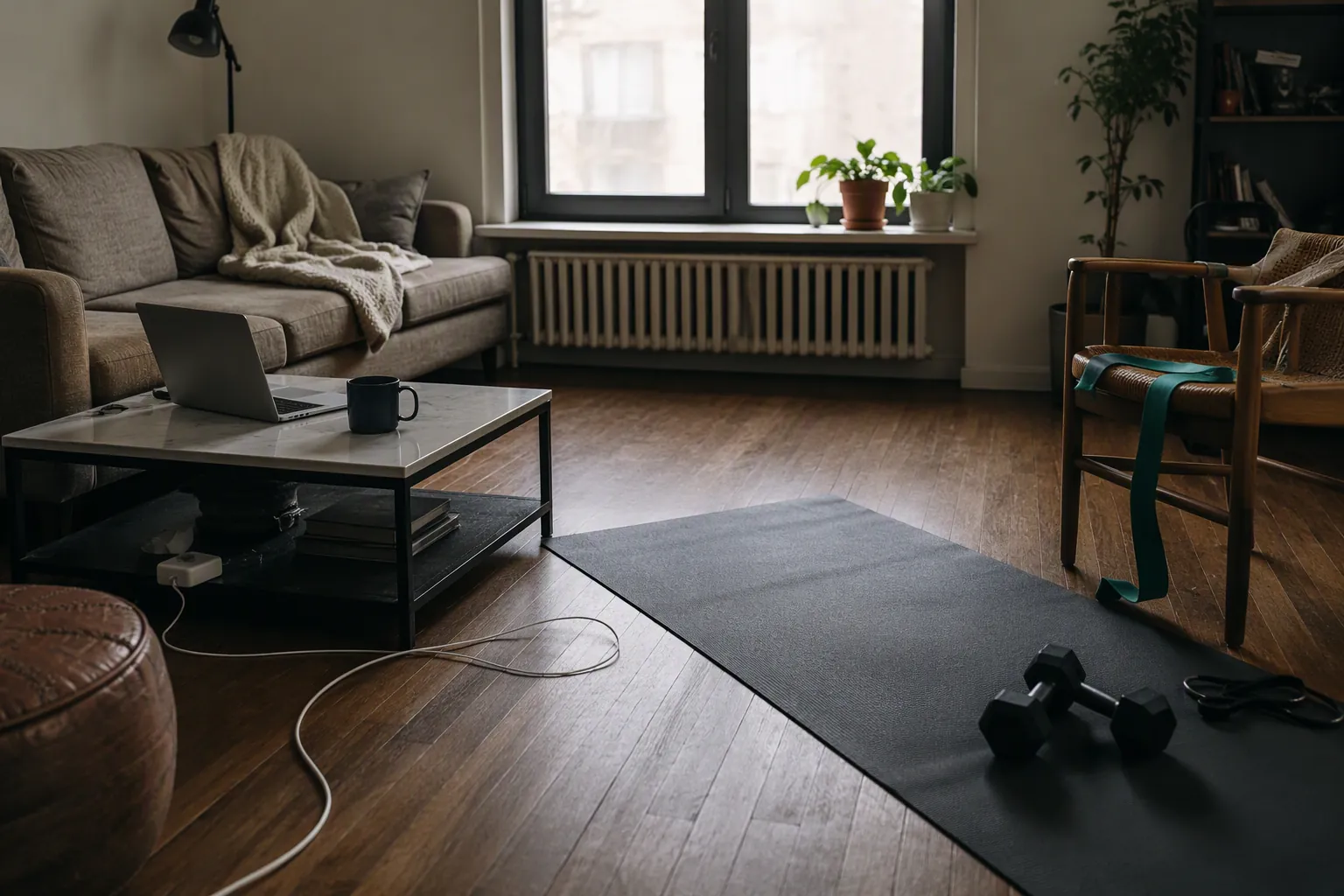
That is why context-dependent repetition is more than a tidy behavior-science phrase. Physical activity and habit-planning research points toward the importance of consistent cues and routines in strengthening automaticity, including work on physical activity interventions and cue-planning approaches.[5][6]
At home, “consistent cue” does not have to mean a perfect home gym. It may be as small as leaving the resistance band looped over the same chair, always doing the first set after starting the coffee maker, or keeping the adjustable dumbbells in the one place where they do not have to be excavated from under winter coats. The cue has to be obvious enough that the room makes the next action easier, not merely aspirational.
This is also why buying better equipment can help or do nothing. A compact bench that folds neatly under the bed solves a space problem, but if using it requires moving a hamper, clearing toys, finding collars, and relocating a laptop charger, the cue chain is weak. The brain is not just learning “work out.” It is learning the whole pre-workout negotiation.
Make the starting cue boringly specific
A useful home cue names the moment and the first action, not the whole ambition. “After I close my laptop, I put on training shoes.” “After the kids’ lunch boxes are packed, I unroll the mat.” “After I brush my teeth, I do the first warm-up drill.” The first action should be small enough that it does not require a motivational speech.
- Weak cue: “I’ll work out sometime tonight.”
- Better cue: “After I start the dishwasher, I put the dumbbells beside the mat.”
- Weak cue: “I need to use my equipment more.”
- Better cue: “When the coffee finishes brewing, I do one mobility round before checking my phone.”
The point is not to make the workout tiny forever. It is to give the neural pathway a clean entrance ramp. Once the first movement begins, the rest of the session has a better chance of following.
Morning may help, but it is not magic
There is some evidence that timing can matter. Fournier and colleagues studied the development of a health habit and found faster habit formation in the morning condition, with a mean of 106 days, compared with 154 days in the evening condition.[7]
That finding is useful, especially for people whose evenings are repeatedly ambushed by work, family, fatigue, or the couch. But it should not turn into another rigid rule. A morning workout that you can do four days a week is a strong candidate. A morning workout that depends on heroic sleep sacrifice is not. The better question is which time of day gives you the most stable cue with the least competition.
The missed day is usually not the problem
One of the most merciful findings in habit research is that missing a single day does not appear to meaningfully impair the habit-formation trajectory. Lally and Gardner’s discussion of habit formation, and related work on making health behaviors habitual, separates occasional lapses from abandonment.[8][9]
This matters because at-home exercise is full of legitimate misses. Someone gets sick. A work call runs late. The living room becomes a guest room. A child needs the floor space. The mistake is not the skipped Tuesday; it is turning skipped Tuesday into “I guess I’m not the kind of person who sticks with this,” then hiding the dumbbells in a closet where the cue disappears.
After a missed day, the next job is not punishment. It is cue repair. Put the mat back where it belongs. Return the band to the same hook. Choose the next obvious start time. If the full session feels too loaded, repeat the opening action anyway. The pathway is protected by returning to the context, not by making the next workout twice as hard.
What to expect from the first two months
The first two months of an at-home exercise habit should be judged less by perfect attendance and more by whether the cue is getting cleaner. Can you start with fewer steps? Is the equipment easier to reach? Do you know what the first five minutes are without reopening a workout app and shopping for a better personality? Those are practical signs that the system is improving.
| Period | What often happens | What to protect |
|---|---|---|
| Days 1–14 | Novelty carries more of the load. Setup flaws are easy to ignore. | Make the first action repeatable and keep equipment visible. |
| Weeks 3–5 | Motivation feels thinner, and the workout may still require deliberate choice. | Do not redesign everything. Stabilize the cue and lower setup friction. |
| Around days 59–66 | Many health habits are near the median automaticity window, but individual variation is wide. | Look for reduced decision fatigue, not a perfect autopilot. |
| After a lapse | The all-or-nothing story can become louder than the actual missed session. | Return to the next cue without adding punishment. |
This is where the 66-day number is most useful: not as a finish line, but as a reason to stop quitting in the ugly middle. If the median sits near two months and the measured range extends much farther, then a difficult fourth week is not evidence that the habit failed. It is exactly the part where a shared home environment needs better design.
Let the habit reduce decision fatigue, not demand more grit
A good at-home exercise habit is not a command to grind harder every day. It is a recovery strategy for the mind. The less often you have to decide where to train, what to move, when to start, and whether one missed day means you failed, the more energy remains for the actual work and for the rest of your life.
No study can promise that your workout will become automatic on schedule. The better standard is calmer and more useful: protect the cue, repeat it long enough for the prefrontal-to-basal-ganglia handoff to have a chance, and treat one missed day as noise rather than evidence.
References
- Time to Form a Habit: A Systematic Review and Meta-Analysis — PMC, 2024
- How are habits formed: Modelling habit formation in the real world — European Journal of Social Psychology, 2010
- Forming new habits involves creation of new neural pathways — UCLA Health
- The Neuroscience of Training Consistency — UMO Health
- Mediating Mechanisms in a Physical Activity Intervention — PubMed, 2018
- Habit formation following routine-based vs. time-based cue planning — PubMed, 2021
- Effects of circadian cortisol on the development of a health habit — PubMed, 2017
- Promoting habit formation — Taylor & Francis, 2013
- Making health habitual: the psychology of 'habit-formation' and general practice — PMC, 2012
This is general fitness education, not medical advice. For diagnosis or treatment of pain or injury, consult a qualified clinician.
Pick your next session
Browse all routines to find an appropriately-spaced next session.
Spot something off?
This content sits adjacent to health guidance — tell us if a citation or figure needs a correction.