
Boost Memory with Nutrition and Home Workout Routines
Learn how pairing a moderate home workout routine with MIND diet principles can produce additive memory benefits through BDNF, blood flow, and inflammation pathways. This article provides a practical, evidence-based protocol for maximizing cognitive gains from your home fitness and food choices together.
- Citation source
- Other
- Evidence level
- general guideline
- Recommended frequency
- 150 min/week moderate aerobic, 2 strength sessions/week
If you already roll out a mat in the living room, march through intervals beside the couch, or lift dumbbells before work, the better question is not whether exercise is “good for the brain.” It is how to pair food with your home workout routine so the work you are already doing has a better chance of supporting recall, focus, and long-term brain health.
The practical answer is less exotic than most brain-health advice makes it sound: build the week around regular moderate aerobic work, add two strength sessions, and eat in a MIND-leaning pattern that prioritizes leafy greens, berries, fatty fish, whole grains, olive oil, and nuts. A 2021 review of human memory research reported that acute exercise improved long-term recall with an effect size of 0.52, while also noting that the field still needs cleaner work on timing, intensity, and individual differences; newer meta-analyses may refine that number, but the direction of the evidence is hard to dismiss.[1]

Start With the Dose You Can Repeat
For memory support, the center of a home routine should be moderate aerobic work: brisk indoor walking, step-ups, low-impact cardio circuits, dance cardio, cycling on a stationary bike, or treadmill walking if you have the equipment. The useful weekly target is about 150 minutes, split however your life will actually allow.
Moderate intensity is not a punishment pace. It is the level where breathing deepens, conversation becomes shorter, and you finish feeling worked rather than wrecked. For many home exercisers, that looks like 25 to 30 minutes on most days, or three longer sessions plus one shorter session when the week gets crowded.
The long-game evidence matters here. In a randomized trial published in 2011, aerobic exercise training increased hippocampal volume and improved memory in older adults; the hippocampus is central to memory consolidation, which is why this study keeps showing up in serious discussions of exercise and brain health.[2] That does not mean a 40-year-old doing home workouts should expect a measured hippocampal change from every month of cardio. It does mean the most defensible routine starts with consistent aerobic work, not with novelty drills marketed as brain hacks.
| Weekly piece | Home version | Why it belongs |
|---|---|---|
| Moderate aerobic work | About 150 minutes from brisk walking, step-ups, bike, dance cardio, or low-impact intervals | Most directly tied to blood flow, BDNF signaling, and memory research |
| Strength training | Two sessions using bodyweight, bands, dumbbells, or loaded household movements | Supports metabolic health, function, and the ability to keep training consistently |
| MIND-style meals | Greens, berries, whole grains, olive oil, nuts, beans, fish, poultry, and limited fried foods, sweets, butter, cheese, and red meat | Adds anti-inflammatory and vascular support around the training habit |
The Food Pattern Is Narrower Than a Brain-Food List
A grocery list can get long fast. The MIND diet keeps the memory conversation more useful because it is a pattern, not a scavenger hunt. Its original scoring system includes 15 components: 10 brain-healthy food groups and 5 less-healthy groups to limit.[3] That structure is why it fits home training so well. You are not trying to eat one heroic food after a workout; you are making the default meals around the workout less inflammatory and more vascular-friendly.
The best-known MIND diet paper found that the highest adherence group, with a mean score of 9.6 out of 15, had a 53% lower rate of Alzheimer’s disease, while moderate adherence, with a mean score of 7.5, was associated with a 35% lower rate.[3] Those numbers come from older adult observational research, so they should not be sold to a 35-year-old as a guaranteed risk reduction. The useful point for a busy home exerciser is the graded target: moderate consistency still mattered.
That is a relief, because the highest-value changes are ordinary. Put leafy greens into one meal most days. Keep berries in the rotation at least twice a week. Use olive oil as the main cooking fat when it fits the meal. Choose whole grains often enough that lunch is not built entirely from refined snack foods. Add nuts as a practical snack, not as a magic memory pill. Eat fish when it is realistic, especially fatty fish, and use beans or poultry on other days.
Leafy greens deserve special priority because about one serving per day has been associated with cognitive aging that looked roughly 11 years younger in observational research summarized by Cleveland Clinic.[4] Berries are similarly specific: intake of at least two servings per week has been associated with delayed memory decline by up to 2.5 years in research discussed in the same clinical summary.[4] Those findings do not turn spinach or blueberries into medicine. They do make them better first buys than a cabinet full of vague “brain” snacks.
Why the Combination Is Plausible
Exercise and food are usually explained in separate rooms: one article tells you to move, another tells you to eat berries. Memory does not live in separate rooms. The main pathways overlap, which is why the pairing makes practical sense even though the strongest combined-intervention trials still skew older than the 30-to-60 home-workout audience.
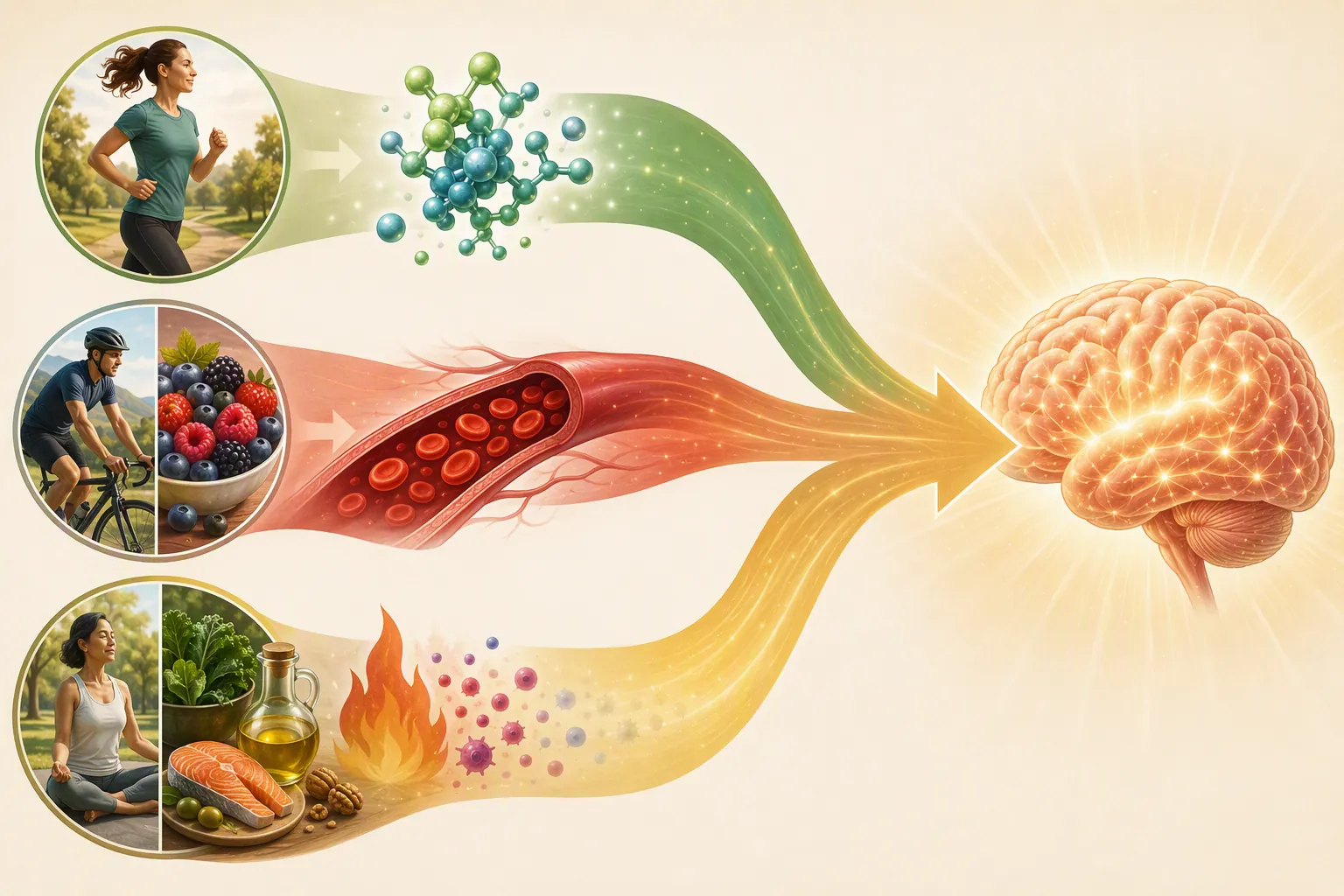
BDNF: the reason moderate cardio stays central
BDNF, or brain-derived neurotrophic factor, is often described as support for neuronal growth and plasticity. For a home exerciser, the action step is simple: do the aerobic work often enough that it becomes a repeated signal, not an occasional event. A single session can help memory encoding, but the more interesting habit is the weekly rhythm that keeps the signal returning.[1]
This is also where intensity needs some restraint. If a workout is so hard that you avoid the next one, it is not a better memory strategy. Moderate indoor cardio done repeatedly has more value than a heroic session that turns the living room into a place you dread.
Blood flow: why the meal around training should not be an afterthought
Aerobic exercise increases circulation demands throughout the body, including the brain. Food can support the same general direction through vascular health: berries bring flavonoid-rich choices into the week, leafy greens add micronutrients and plant compounds, and whole grains help make meals steadier. This is not about eating one perfect pre-workout food; it is about making the meals around training less chaotic.
A useful Tuesday-night version might be a brisk 30-minute indoor walk before dinner, then salmon or beans with greens, olive oil, and a whole grain. Another day might be a low-impact cardio circuit after work and oatmeal with berries the next morning. The exact pairing can change. The pattern is what matters.
Inflammation: why consistency beats the occasional cleanse
Systemic inflammation is one of the reasons the MIND pattern and regular exercise belong in the same conversation. Moderate training, olive oil, greens, nuts, berries, fish, beans, and whole grains all push the routine toward a less inflammatory lifestyle pattern. Fried foods, sweets, excess butter, and heavily processed default meals pull in the other direction.
The 2023 Nutrients review of diet and exercise interventions in older adults concluded that combined interventions can produce larger cognitive gains than either diet or exercise alone, including additive executive-function benefits in weight-loss trials when exercise was added to caloric restriction.[5] That is not a blank check to promise synergy for every person at every age. It is enough to justify building the home routine around both habits instead of treating workouts and meals as unrelated chores.
A Home Week That Actually Fits Around Work and Meals
The week does not need to become a new identity project. Start by placing the aerobic minutes, then attach the food pattern to meals you already repeat. The first win is not culinary variety; it is removing the blank spaces where dinner becomes whatever is closest.
| Day | Workout focus | Food anchor |
|---|---|---|
| Monday | 30 minutes moderate indoor cardio | Leafy greens at lunch or dinner |
| Tuesday | Strength session with bodyweight, bands, or dumbbells | Whole grain plus olive-oil-based meal |
| Wednesday | 25 to 30 minutes brisk walking, step-ups, cycling, or dance cardio | Berries with breakfast, yogurt, oatmeal, or a snack |
| Thursday | Rest, mobility, or easy walk | Beans, poultry, or fish as the main protein |
| Friday | 30 minutes moderate cardio | Leafy greens again; keep fried foods from becoming the default |
| Saturday | Strength session plus optional easy cardio | Nuts as a practical snack; olive oil where it fits |
| Sunday | Longer easy-to-moderate walk or indoor cardio to complete the weekly dose | Fish, berries, or meal prep for greens and whole grains |
If the week falls apart, protect two things first: the aerobic total and the leafy-green habit. Those are not the only pieces, but they are high-yield and easy to measure. After that, add berries twice a week, then make olive oil, nuts, whole grains, beans, and fish more normal. The goal is not a perfect MIND score; the original MIND work is useful partly because moderate adherence still showed an association with lower risk.[3]
Before the workout
For a short or moderate home session, most people do not need a special pre-workout formula. If you are hungry, choose something that will not sit heavily: whole-grain toast, oatmeal, fruit with yogurt, or a small handful of nuts with fruit. Complex carbohydrates are a practical fit because the brain relies heavily on glucose, and steadier carbohydrate sources are easier to live with than sugar spikes.
After the workout
After training, make the next meal do two jobs: recovery and brain-supportive patterning. That can be eggs with greens and whole-grain toast, salmon with a grain bowl, lentils with olive oil and vegetables, or Greek yogurt with berries and nuts. None of those meals is a memory treatment. They are repeatable ways to stop the workout from being followed by the same low-quality food default every time.
On strength days
Strength training supports the plan even when cardio carries more of the memory-specific evidence. Two weekly sessions help maintain muscle, glucose handling, balance, and confidence with movement. At home, that can mean squats to a chair, push-ups against a counter, rows with bands, deadlifts with dumbbells, lunges, carries, and core work. Keep it simple enough that it does not steal the aerobic minutes you are trying to accumulate.
What Not to Overbuy
Supplements are the tempting shortcut in this conversation because they are easier to buy than a week of groceries and easier to imagine than 150 minutes of movement. But for a food-first memory routine, they are not the main event. Northwestern Medicine notes that brain-health supplements may not help much compared with eating a healthy diet rich in foods such as berries, greens, nuts, and fish.[6]
The same caution applies to extreme diet rules. A home exerciser does not need to turn memory support into a very-low-carb experiment, a cleanse, or a perfect anti-inflammatory menu. The better-supported move is to improve the ordinary plate that shows up again and again.
The Useful Standard for a 30-to-60 Home Exerciser
For adults in the 30-to-60 range, the most honest reading is encouraging but not magical. Exercise-memory evidence is strong enough to act on. MIND-diet evidence is strong enough to shape the grocery list. Combined diet-and-exercise research suggests additive cognitive benefits, but much of the strongest intervention work comes from older adults, so the claim should stay measured.[5]
That still leaves a clear home protocol: reach roughly 150 minutes a week of moderate aerobic movement, lift twice, eat leafy greens most days, include berries at least twice a week, and make olive oil, nuts, whole grains, beans, and fish familiar parts of the week. If you are already clearing floor space to train, this is the food pattern most worth clearing fridge space for.
References
- Acute and Chronic Exercise Effects on Human Memory: What We Know and Where to Go from Here — PMC
- Exercise training increases size of hippocampus and improves memory — PNAS — 2011
- MIND diet associated with reduced incidence of Alzheimer's disease — PMC — 2015
- The Best Brain Foods for Better Memory and Function — Cleveland Clinic
- Impact of Diet and Exercise Interventions on Cognition and Brain Health in Older Adults: A Narrative Review — Nutrients — 2023
- Best Brain-Boosting Foods: What to Eat for Better Memory and Focus — Northwestern Medicine
This is general fitness education, not medical advice. For diagnosis or treatment of pain or injury, consult a qualified clinician.
Pick your next session
8 Common Home Leg Workout Mistakes That Kill Your Progress — and How to Fix Each One
Are you doing leg workouts at home but not seeing the results you expect? This article breaks down 8 common mistakes home trainers make—from over-relying on bodyweight squats to poor warm-ups—and provides targeted fixes to help you build stronger, more defined legs.
8-Week Home Strength Training Plan for Beginners
A complete two-phase home strength program for true beginners: three full-body sessions per week in weeks 1–4 to build movement patterns, then a four-day upper-lower split in weeks 5–8 to increase weekly volume — all executable with bodyweight or a single pair of dumbbells, no gym required.
The Complete Home Leg Workout Progression: How to Build Leg Strength From Bodyweight Basics to Heavy Dumbbells Without a Gym
A structured multi-level system for home leg training that maps a clear path from bodyweight fundamentals through dumbbell loading to advanced tempo techniques — with a sample 6-week plan and concrete progression milestones.
Spot something off?
This content sits adjacent to health guidance — tell us if a citation or figure needs a correction.