
Can a Daily Oat Latte Fit Your Weight-Loss Diet?
An oat latte does not have to be banned on a weight-loss diet. This guide breaks down where latte calories actually come from and shows how to keep the ritual inside a daily calorie and added-sugar budget at home.
- Citation source
- CDC and American Heart Association
- Evidence level
- general guideline
A daily oat latte can fit a weight-loss diet at home. It just cannot live in the imaginary category of “basically coffee.” Plain brewed coffee contributes less than 5 calories, but Mayo Clinic’s practical warning is the one that matters here: all calories count, including liquid calories. [1]
That is not a reason to ban the drink. It is a reason to build it like any other repeatable part of a calorie deficit: choose the milk deliberately, measure the pour often enough to know your default, and decide whether syrup or toppings are worth the trade. For a home exerciser trying to keep one normal daily ritual before a workout, commute, or work-from-home morning, that is a much more useful standard than pretending coffee has to be black to “count.”
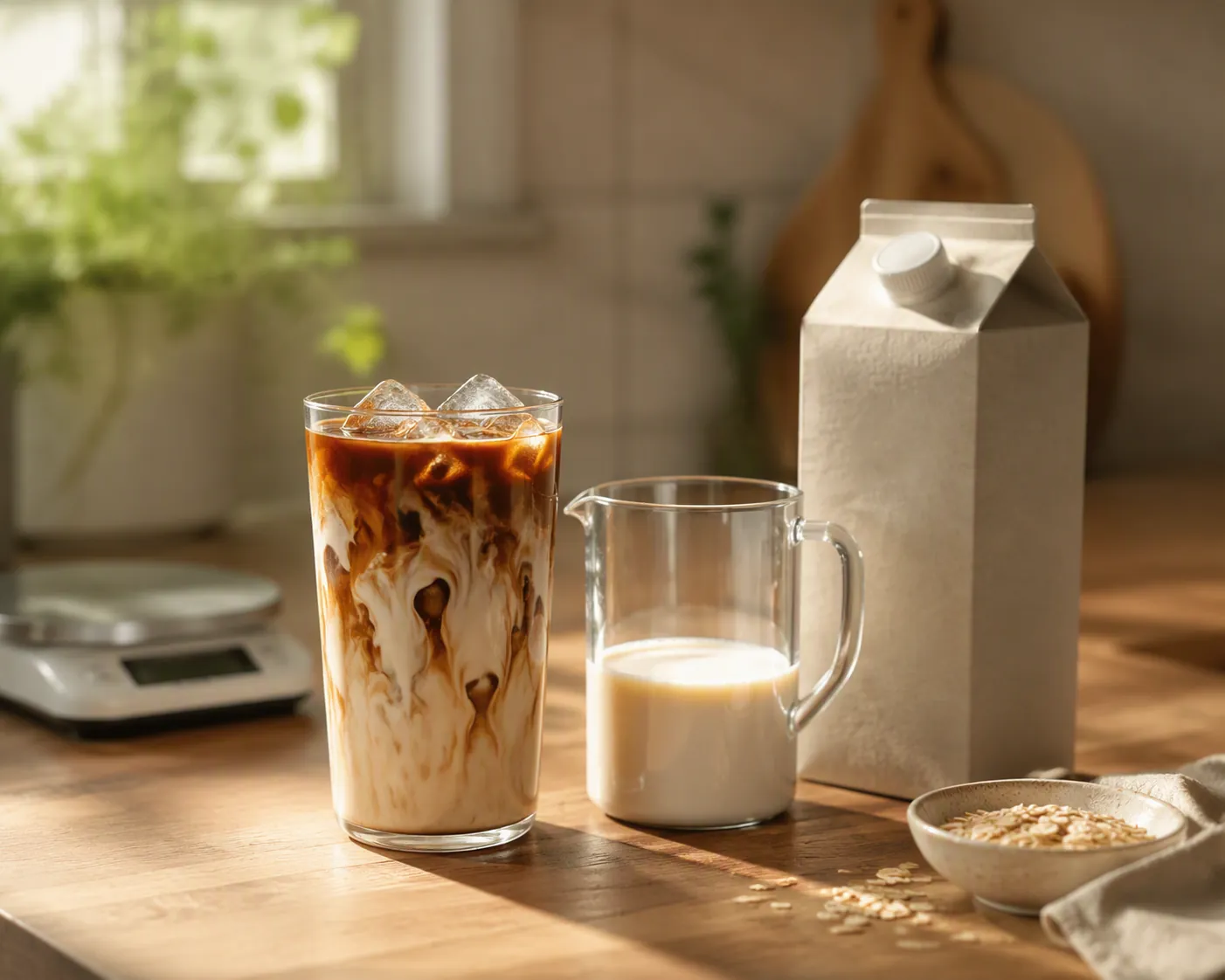
The milk is the latte
The word “oat” can make a latte sound lighter than it is, but the baseline comparison is more ordinary. A USDA-derived UF/IFAS comparison puts unsweetened oat milk at about 91 calories per cup. That is close to skim milk, below whole milk, higher in carbohydrates than dairy milk, and much lower in protein. [2]
| Milk, per cup | Calories | Carbohydrates | Protein |
|---|---|---|---|
| Unsweetened oat milk | About 91 kcal | About 19 g | About 2 g |
| Skim milk | About 83 kcal | About 12 g | About 8 g |
| 1% milk | About 102 kcal | About 12 g | About 8 g |
| Whole milk | About 150 kcal | About 12 g | About 8 g |
That table knocks down two common shortcuts. Oat milk is not automatically the lowest-calorie choice, and it is not a meaningful protein source in the way dairy milk is. If the latte is just a pleasant drink, that may be fine. If it is being treated as a post-workout recovery move, the numbers do not really support that role. A cup of oat milk with about 2 grams of protein is not doing the same job as an actual recovery meal. [2]
That distinction matters when the rest of the day is already tight. If your training plan depends on both food and exercise, the latte belongs on the food side of the ledger, while your sessions belong in the broader routine. For the training half of that equation, see these weight-loss home workouts. For protein planning, it makes more sense to compare the latte with real food options such as healthy recovery meals under $5 than to expect oat milk to carry recovery nutrition.
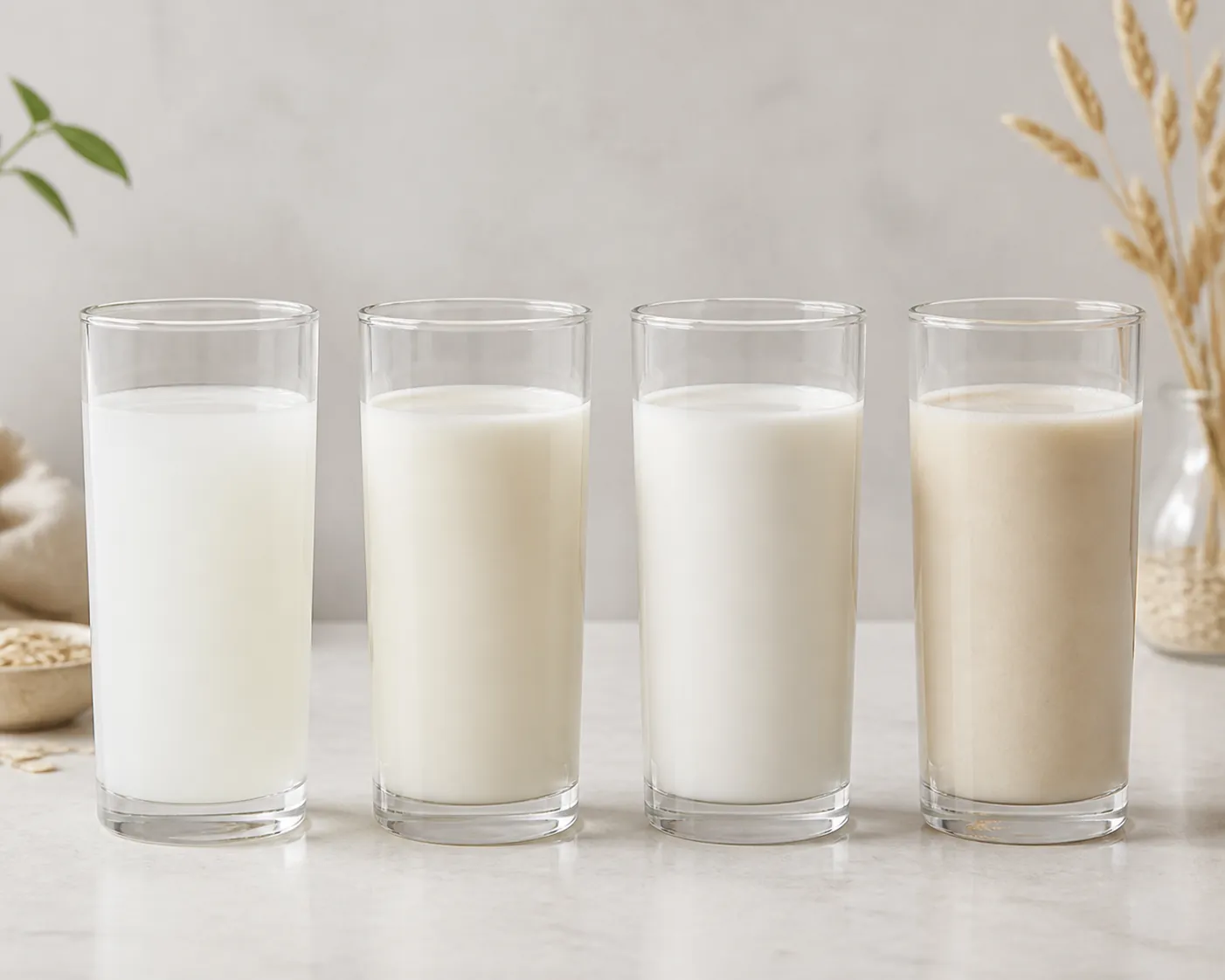
“Oat milk” is not one number
The UF/IFAS number is a useful sober baseline, not a universal label. Commercial oat milks vary widely. Noom’s oat-milk comparison notes that products can run roughly 90 to 140 calories per cup, depending on the brand and whether the formula includes added oil, sugar, or a barista-style texture designed to foam well. [3]
This is where a home oat latte becomes easier to control than a café drink. You can turn the carton around. You can see whether the serving size is one cup. You can check whether the product is unsweetened or simply oat-based and sweetened. You can notice whether the calories are closer to 90 per cup or closer to 140.
That difference changes the drink quickly. A latte made with 1.5 cups of an unsweetened oat milk at about 91 calories per cup lands around 137 calories before coffee and extras. The same 1.5-cup pour from a product at 140 calories per cup reaches about 210 calories before syrup, whipped topping, or a second splash of creamer enters the picture. [2][3]
The lesson is not that oat milk is bad. It is that the phrase “oat latte” does not tell you enough. The carton, the pour, and the add-ons tell you enough.
The add-ons are where the quiet drift happens
Most people do not need a lecture about one pump of syrup. They need a receipt for the version they actually drink. A pump here, a little whipped cream there, a spoon of honey because the oat milk is unsweetened — none of these is dramatic by itself. Repeated daily and left uncounted, they are exactly how a small ritual stops being small.
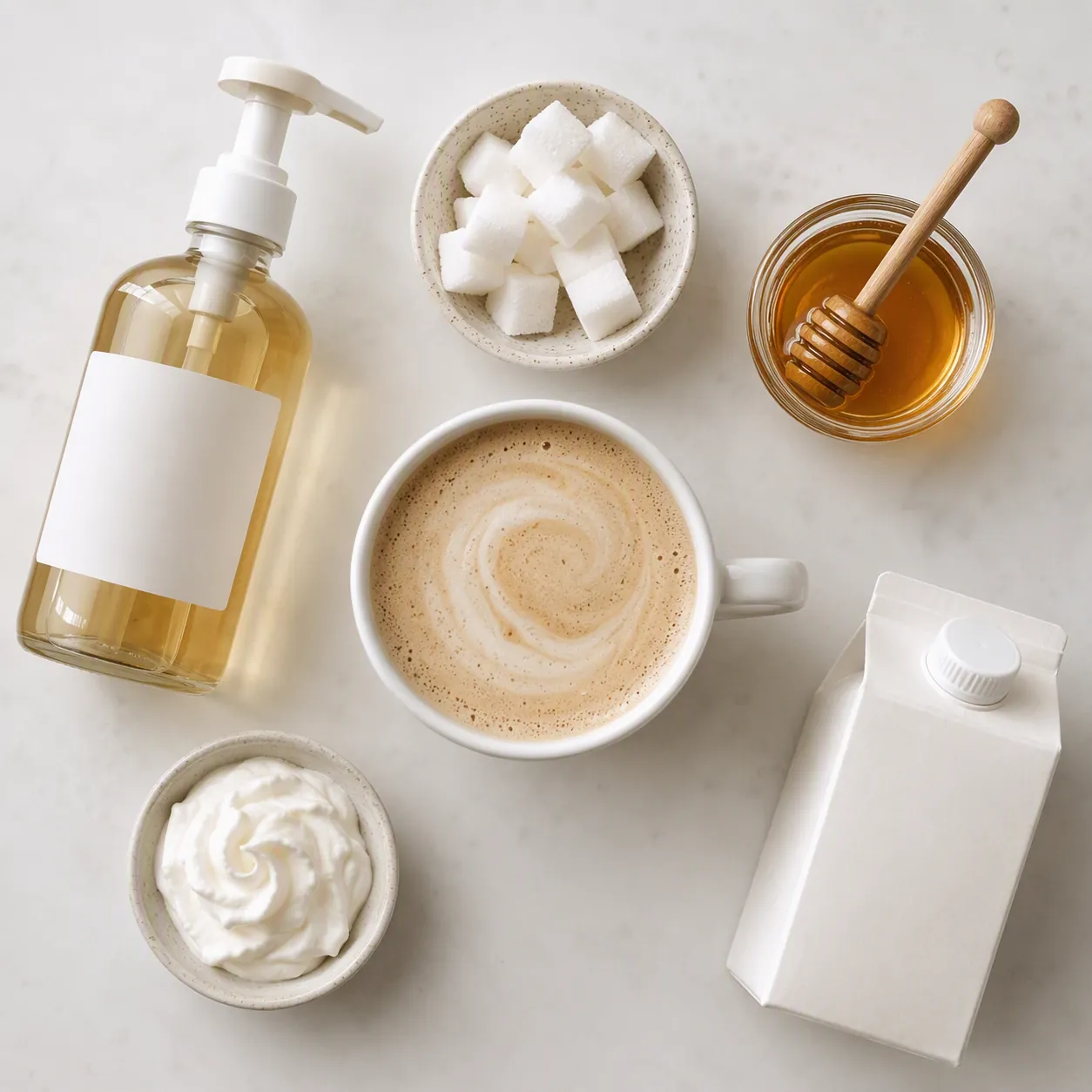
Use a simple add-on ledger. Syrup is roughly 10 to 20 calories per pump. Whipped cream is about 73 calories per 2 tablespoons. Half-and-half is about 40 calories per 2 tablespoons. Honey is about 21 calories per teaspoon. [1]
| Add-on | Budget impact | How to treat it at home |
|---|---|---|
| Syrup | About 10–20 kcal per pump | Choose the number of pumps before pouring, not after tasting. |
| Whipped cream | About 73 kcal per 2 tbsp | Use as an occasional topping, not a default finish. |
| Half-and-half | About 40 kcal per 2 tbsp | Count it separately if it goes in addition to oat milk. |
| Honey | About 21 kcal per tsp | Measure the teaspoon if it is part of the daily version. |
Added sugar has two useful guardrails, and they are not the same thing. The CDC, reflecting Dietary Guidelines for Americans language, says adolescents and adults should get no more than 10 grams of added sugars per meal. [4] The American Heart Association gives daily caps: about 100 calories per day from added sugar for women and about 150 calories per day for men. [5]
Those numbers do not mean a sweetened oat latte is automatically off-limits. They do mean the sweetener has to be visible. If your breakfast already includes added sugar, the latte cannot borrow from a budget that has already been spent. If the latte is the sweet thing you genuinely want most mornings, then give it that role and keep the rest of the meal plainer.
Mayo Clinic also cites a finding that adding just 1 teaspoon of sugar to a daily coffee was linked to weight gain. [1] That should be read as a cautionary nudge, not a panic headline. The point is not that one teaspoon is ruinous. The point is that a daily liquid habit can be easy to underestimate because it does not feel like eating.
A workable 150–200 calorie oat latte at home
A practical home build starts with the version you can repeat without negotiating with yourself every morning. For many people, that means strong coffee or espresso-style coffee, unsweetened oat milk, and either no sweetener or a measured small sweetener.
| Component | Example amount | Approximate calories |
|---|---|---|
| Brewed coffee or espresso-style coffee | As desired | Less than 5 kcal |
| Unsweetened oat milk | 1.5 cups | About 137 kcal, using the 91 kcal-per-cup baseline |
| Optional syrup | 1 pump | About 10–20 kcal |
| Estimated total | Coffee + oat milk + 1 pump syrup | About 152–162 kcal |
That same drink without syrup lands lower. A larger pour, a higher-calorie barista oat milk, or whipped topping can push it higher. This is why the range matters more than a single perfect number. A roughly 150–200 calorie at-home oat latte is realistic when the milk is unsweetened, the pour is measured, and extras stay minimal.
There are also very lightly built versions. One two-ingredient oat-milk-latte method lists a serving around 49 calories and can be made hot or iced without an espresso machine. [6] That low end is useful if you prefer a coffee-forward drink with a smaller milk portion. It is less useful if your normal glass is mostly oat milk with a shot of coffee, because then the milk math returns immediately.
No-machine hot or iced method
- Brew strong coffee, or use espresso-style coffee if you have it.
- Measure the oat milk before heating, frothing, or pouring it over ice.
- For a hot latte, warm the oat milk and froth it if you like the texture.
- For an iced latte, pour measured oat milk over ice, then add coffee.
- Add sweetener only after deciding how many calories and how much added sugar you want the drink to use.
The measuring step is the unglamorous one, which is why it works. You do not have to weigh a latte forever. Measure your usual glass a few times, learn whether your casual pour is closer to 1 cup or 2 cups, and then decide whether that default still fits the rest of the day.
Where it fits in a weight-loss day
A calorie deficit is built across the whole day, not proved by one austere breakfast. If your oat latte is the thing that makes a morning home workout or a long work block feel repeatable, it may be a good use of 150 or so calories. The question is whether those calories are planned or whether they are drifting in on top of a day that was already budgeted.
That is also why exercise content and coffee content should not be kept in separate fantasy worlds. A realistic weight-loss home routine still needs food choices that match the goal. Exercise helps the process, but it does not make untracked drinks disappear.
The cleanest way to keep the latte is to set a house version:
- Use unsweetened oat milk when possible.
- Pick a standard pour, such as 1 cup for a lighter drink or 1.5 cups for a creamier one.
- Choose either syrup, honey, whipped cream, or half-and-half — not all of them as background flavor.
- Check added sugar against the meal and daily guardrails, especially if the latte is sweetened.
- Do not count the latte as a protein-rich recovery choice just because it contains a plant milk.
A daily oat latte can fit a weight-loss diet at home when the milk type, portion size, and add-ons are controlled. If those choices are not controlled, the problem is not that oat milk is uniquely fattening. It is that liquid calories and added sugar are being treated as atmosphere instead of food.
References
- Coffee calories: Sabotaging your weight loss?, Mayo Clinic, June 2024
- Plant-Based Beverages: Comparison of Nutritional Values, UF/IFAS
- Oat Milk for Weight Loss, Noom
- Get the Facts: Added Sugars, CDC, April 2026
- Added Sugars, American Heart Association
- Oat Milk Latte, The Big Man’s World
This is general fitness education, not medical advice. For diagnosis or treatment of pain or injury, consult a qualified clinician.
Pick your next session
Browse all routines to find an appropriately-spaced next session.
Spot something off?
This content sits adjacent to health guidance — tell us if a citation or figure needs a correction.