
Use Parker Valby’s Cross-Training to Recover From a Running Injury at Home
Elite runner Parker Valby maintained running fitness through high-intensity cross-training during a 19-month navicular fracture layoff. This article adapts her methods for home recovery with budget equipment alternatives and a clinical return-to-run protocol so injured runners can rebuild fitness and return safely.
- Citation source
- Running Physio
- Evidence level
- restrained inference
- Recommended frequency
- every other day
The useful part of Parker Valby’s injury recovery is not that she came back from a navicular fracture with a better attitude. It is that her running fitness did not depend on much running. The documented pattern is blunt: 2–3 running days per week, about 25–40 miles, 4–5 cross-training days, and 6–8 total sessions across the week, a setup Coach Saltmarsh presents as the architecture behind her ability to maintain elite fitness while keeping run volume unusually low for her level.[1]
That matters to an injured runner at home because “cross-train” is usually where plans get vague. Valby’s version was not vague. Runner’s World reported Arc Trainer work around incline 7/10 and resistance 30–40%, with her heart rate on the Arc Trainer exceeding what she often saw while running; she also used the very unscientific but hard-to-fake marker of leaving “puddles of sweat.”[2] Exact settings vary by machine, but the principle is clear enough: the substitute work had to be hard enough to act like training.
Her comeback timeline is not a neat motivational arc. Athletics Illustrated reported her May 2026 return at the LA Track Fest, where she ran 14:49.41, after a 19-month layoff connected to a navicular fracture.[3] LetsRun had reported in July 2025 that she missed USAs because of a foot injury, which gives the middle of the story some needed weight: this was not a short interruption with a heroic montage pasted over it.[4]
The training pattern worth copying is the structure, not the mileage
Valby’s 25–40 miles per week are not a beginner injury plan. For most sidelined runners, especially anyone with a foot or lower-leg bone injury, copying that number would be reckless. The transferable part is the distribution of stress: fewer impact days, more aerobic sessions, and enough weekly repetition that fitness has something to hold onto.
| Valby pattern | What it means for an injured home runner |
|---|---|
| 2–3 running days per week | Running is not the center of the week until the injury can tolerate impact. |
| 25–40 miles per week | Do not copy the mileage unless your clinician has cleared it and your history supports it. |
| 4–5 cross-training days | The aerobic workload moves to lower-impact modes instead of disappearing. |
| 6–8 sessions per week | Frequency stays high enough to preserve routine, but the mechanical load changes. |
The trap is treating cross-training as a placeholder until “real” running returns. If the session is easy because the machine is boring, it probably is not replacing much. If the session has a warm-up, a defined main set, a target effort, and a reason to stop, it starts to behave like training.

Make the substitute session hard enough to count
The Arc Trainer details are the most practical part of the whole Valby story. Incline 7/10 and resistance 30–40% are not magic numbers; they are a clue that she was not spinning lightly while watching the clock. Runner’s World reported that her Arc Trainer heart rate could exceed her running heart rate, which is the opposite of the lazy recovery-machine stereotype.[2]
At home, that means the machine choice matters less than the effort you can repeat without irritating the injury. A standard elliptical, bike, deep-water running setup, or soft treadmill walk can all be useful if the injured area tolerates them. None of them automatically preserves fitness. The work has to be organized.
- Use heart rate if you have it. The target is not a single heroic number; it is whether the workout reaches the aerobic demand your normal running used to create.
- Use perceived effort if you do not. Easy means conversational. Moderate means controlled. Hard means you are working enough that the final minutes require attention.
- Use sweat and breathing as secondary checks. Valby’s “puddles of sweat” proxy is crude, but it points in the right direction: the session should not feel like waiting.
- Stop judging the session by whether it looked like running. Judge it by whether it loaded the cardiovascular system while sparing the injured tissue.
For a runner in a boot, on a modified weight-bearing plan, or coming out of a stress fracture, the first question is still medical clearance. But once a clinician allows cross-training, the home plan should be written with the same seriousness as a run plan: duration, effort, recovery, and progression.
Translate the equipment honestly
Valby’s home setup is not normal home equipment. The Life Fitness and Hammer Strength collaboration lists a Club Series+ Arc Trainer, a Symbio Runner, a Hammer Strength half rack, and adjustable dumbbells; the Arc Trainer is a $10k-plus commercial machine, and the Symbio Runner is listed around $21k.[5] That is a serious small-space training setup, not a realistic shopping list for most injured runners.
The wrong lesson is “buy the machine Parker uses.” The better lesson is to identify what each piece of equipment solved.
| Elite setup | Training problem it solves | Home translation |
|---|---|---|
| Club Series+ Arc Trainer | Hard aerobic work with reduced impact | Standard elliptical, gym elliptical, stationary bike, or pool running if the foot tolerates the option |
| Symbio Runner on a soft setting | Controlled return to running with a more forgiving surface | Soft treadmill walking, cautious treadmill jogging after clearance, or outdoor flat routes only after readiness checks |
| Half rack and adjustable dumbbells | Strength work without needing a full gym | A pair of adjustable dumbbells, resistance bands, calf-raise setup, step, or bodyweight strength circuit |
| Pool sessions | Running-like aerobic work without ground impact | Deep-water running at a community pool, apartment pool, or gym pool when available |
Women’s Health has described cross-training as part of Valby’s mental relief and injury-prevention structure, including pool work rather than only machine sessions.[6] That is useful for a home runner because equipment access changes week to week. If the apartment elliptical is occupied, the pool may save the day. If the pool is unavailable, a bike session may be the least irritating option. The hierarchy is not prestige; it is tolerance, intensity, and repeatability.
A no-running week that keeps the engine on
The following is a sample structure, not Valby’s log and not a medical prescription. It is for the runner who has been told not to run but has been cleared for non-impact or low-impact training. The goal is to make the week feel like training again without sneaking impact back through the side door.
| Day | Session | Purpose |
|---|---|---|
| Monday | Elliptical or Arc-style trainer: warm up, then steady moderate-hard aerobic work, then cool down | Replace an aerobic run without pounding the foot |
| Tuesday | Strength: hips, hamstrings, glutes, core, and approved calf/foot work only if pain-free | Keep the chassis from going quiet during the layoff |
| Wednesday | Pool running or bike intervals: short controlled hard efforts with easy recovery | Create a workout stimulus without impact |
| Thursday | Easy cross-training or complete rest | Absorb the harder work |
| Friday | Elliptical progression: sustained effort that reaches running-like breathing | Practice Valby’s intensity principle on accessible equipment |
| Saturday | Pool running, bike, or incline walk if cleared and symptom-free | Add frequency without forcing the same movement pattern every day |
| Sunday | Rest, mobility, and readiness checks if appropriate | Keep recovery part of the plan, not a sign of failure |
The hard days should feel like workouts. The easy days should feel easy enough that the next hard day is possible. That sounds obvious until injury panic takes over and every session becomes either too timid to matter or too aggressive to survive.
If symptoms increase during or after a session, the session was not a clever workaround. It was load. Treat it that way. Reduce the next exposure, switch modes, or stop until the injured area settles.

The return to running should be boring on purpose
The most dangerous moment in a good cross-training block is when fitness comes back before the tissue is ready. You feel fit. Your heart and lungs are ready. Your foot, shin, calf, tendon, or bone may not be. That mismatch is where a return-to-run plan has to be stricter than your mood.
Running Physio’s return-after-injury guidance gives a clean safety spine: establish a pain-free baseline, subtract 10–20% from it, run every other day, and increase by only 5–10% per week if symptoms stay controlled.[7] It also gives simple readiness checks before running resumes: a 30-minute pain-free walk, 30 seconds of single-leg balance, 15–20 single knee dips, and 20–30 single-leg calf raises.[7]
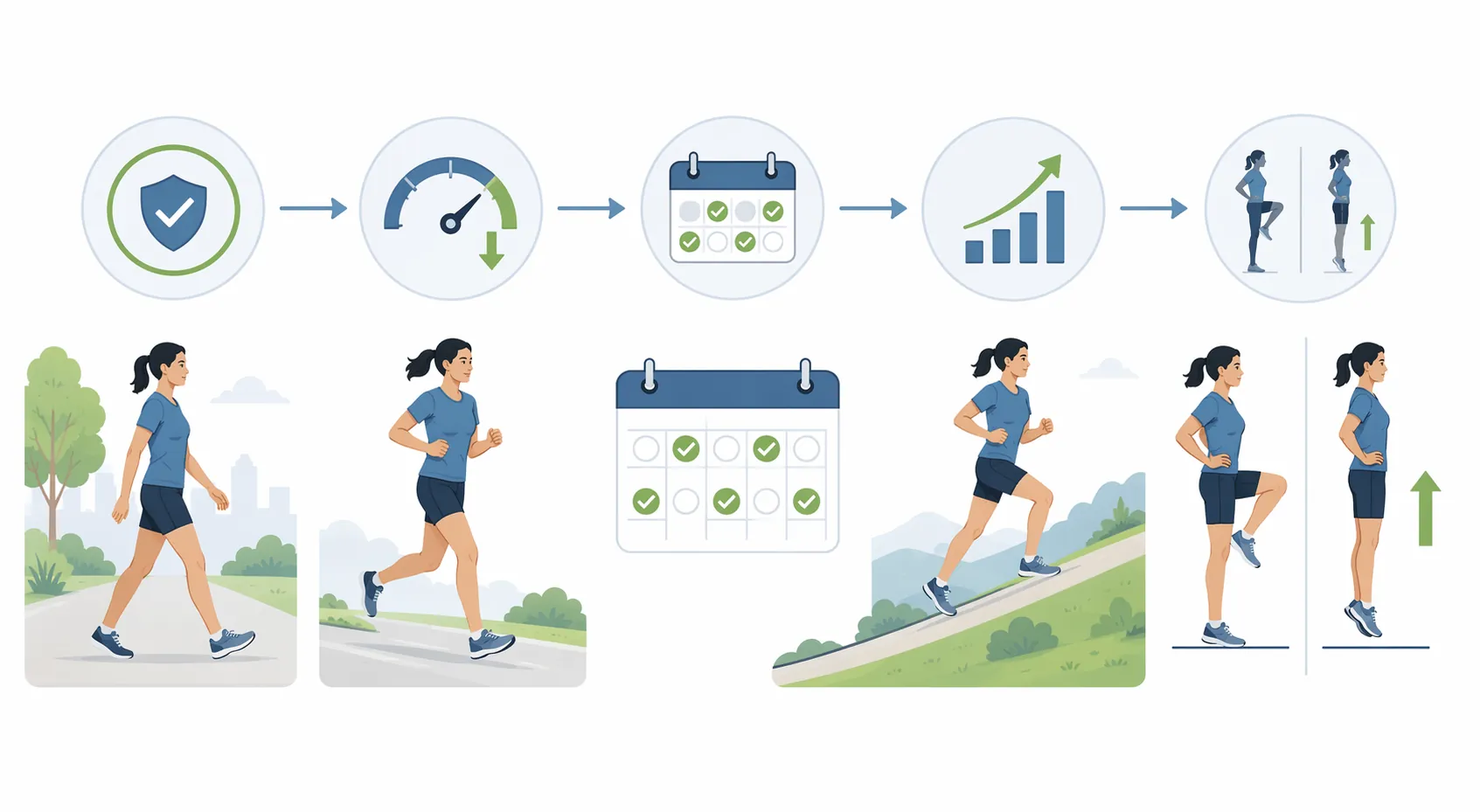
| Gate | What has to be true before moving on |
|---|---|
| Walking | You can walk 30 minutes pain-free. |
| Single-leg control | You can balance for 30 seconds on the injured side. |
| Knee dips | You can complete 15–20 single knee dips without pain or collapse. |
| Calf raises | You can complete 20–30 single-leg calf raises without symptoms. |
| First run baseline | You start below what you think you can do by subtracting 10–20%. |
| Early frequency | You run every other day, not daily. |
| Progression | You increase by 5–10% per week only if symptoms stay quiet. |
This is where Valby’s example needs restraint. Her outcome shows what can be preserved with serious cross-training, but it does not make a 19-month elite recovery timeline transferable. Fick PT’s navicular stress fracture case study describes a non-elite runner taking 10 months to return fully, and the same material notes that navicular stress fractures often involve 6–8 weeks of non-weight-bearing immobilization, with full return to racing commonly taking 9–12 months.[8] One case does not define everyone’s recovery, but it does push back against the fantasy that a hard engine means a healed foot.
Use the mental side, but do not let it write the training plan
There is a mental reason Valby’s method catches injured runners. It gives the day a job. Olympics.com quoted her reframing the pressure of her injury period with the line, “I’m the underdog now.”[9] That is a useful frame when running has been taken away, but it is not a substitute for load management.
The better psychological move is more ordinary: remove the blank space. Write the cross-training week before the week starts. Decide which sessions are hard. Decide which are easy. Decide what symptom response cancels or modifies the next session. Injury recovery gets less dramatic when the next choice is already made.
What Parker Valby’s recovery actually gives the home runner
Valby’s recovery is not proof that every runner can cross-train into a personal best after a serious foot injury. It is proof of something narrower and more useful: aerobic fitness can survive a long lower-leg layoff when the replacement work is frequent, hard enough, and organized like real training.
The home version has three rules. First, do not confuse low impact with low effort. Second, do not pretend commercial-grade machines are required or that cheaper options are identical. Third, do not let preserved fitness rush the return to running. Cross-train hard when it is safe to cross-train. Re-enter running slowly when the tissue has earned it.
References
- Coach Saltmarsh, Parker Valby Cross Training
- Runner’s World, Parker Valby Cross-Training Routine
- Athletics Illustrated, Parker Valby Wins First Race Back
- LetsRun, Parker Valby Out of USAs, July 2025
- Life Fitness, Training With Parker Valby
- Women’s Health, Parker Valby Training
- Running Physio, Return After Injury
- Fick PT and Performance, Navicular Stress Fracture Recovery
- Olympics.com, Parker Valby Exclusive
This is general fitness education, not medical advice. For diagnosis or treatment of pain or injury, consult a qualified clinician.
Pick your next session
Browse all routines to find an appropriately-spaced next session.
Spot something off?
This content sits adjacent to health guidance — tell us if a citation or figure needs a correction.