
Which Peptides Actually Work for Home Fitness Recovery?
Not all peptides are created equal. This evidence-tiered guide separates the few with human trials (collagen peptides) from the gray-market injectables that lack Phase III evidence for musculoskeletal recovery, so you can make an informed decision about using peptides in your home fitness routine.
- Citation source
- Harvard Health
- Evidence level
- Restrained inference
The confusing part about peptides for home fitness recovery is that the word “peptide” gets used for products that do not belong in the same decision bucket. A scoop of collagen peptides in a kitchen shaker, a prescription GLP-1 medication, and an unlabeled vial sold as “research use only” may all involve peptides. That does not make their evidence, risk, or purpose interchangeable.
For home training, the useful first move is not memorizing peptide chemistry. It is sorting the category before anyone sells you a recovery shortcut.
| Peptide category | What it actually is | Home fitness recovery judgment |
|---|---|---|
| Oral collagen peptides | Supplemental collagen protein fragments, usually mixed into drinks or food | Modest human RCT support for soreness and connective-tissue-related recovery, with limits |
| FDA-approved peptide medications | Prescription drugs such as insulin and GLP-1 medicines used for medical conditions | Real medicines, but not recovery hacks for sore elbows or home workouts |
| Injectable “research peptides” | Gray-market vials such as BPC-157, TB-500, CJC-1295, and Ipamorelin | Not justified for home fitness recovery given the human evidence gap, sourcing risk, and regulatory problems |
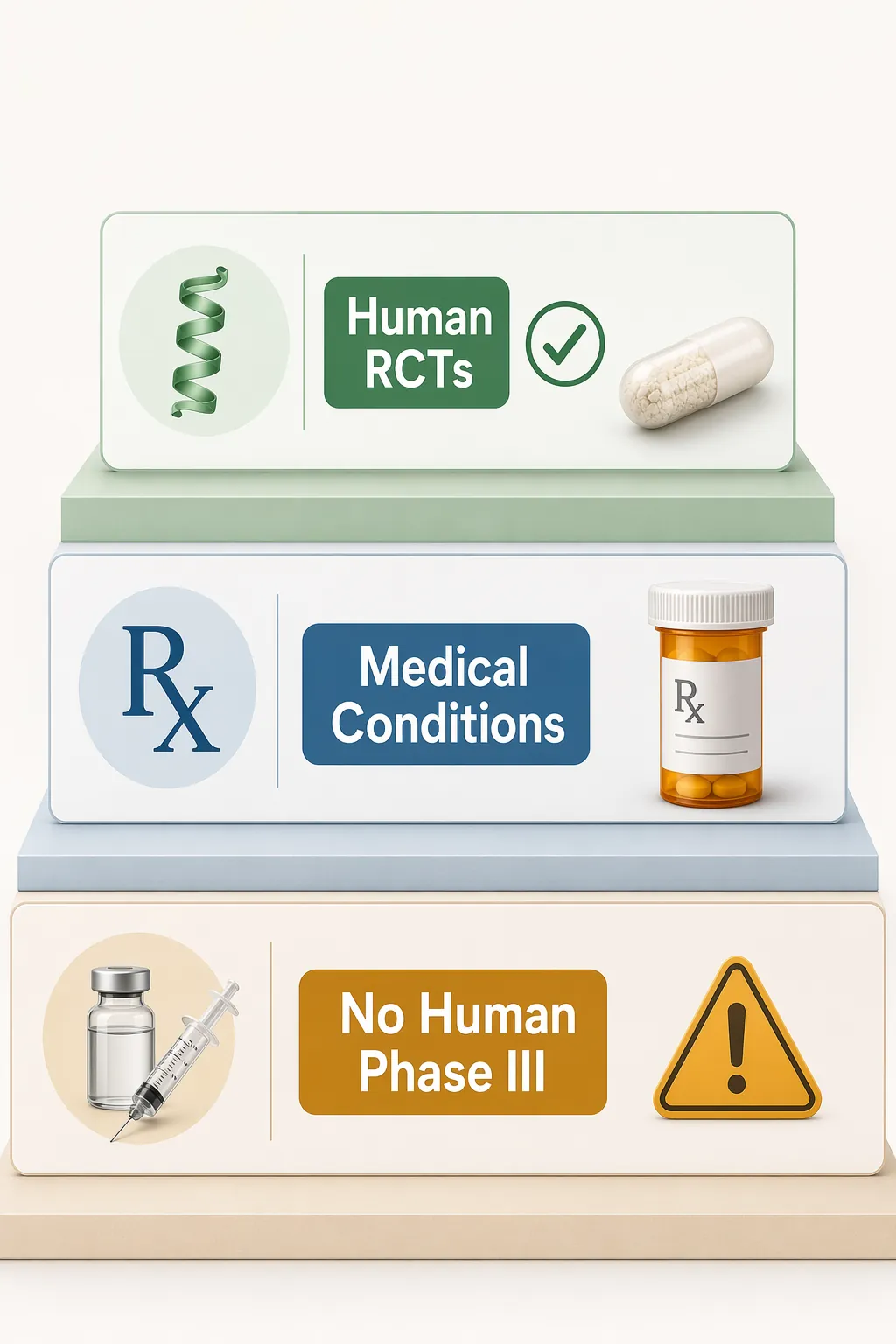
This is a recovery-rest reference, not a protocol for self-treatment. If an injury is not resolving, or if an injection is on the table, that decision belongs with a licensed clinician, not a peptide vendor or a comments section.
The evidence does not rise and fall together
Peptide marketing often borrows credibility sideways. Approved peptide drugs are real, so the word sounds medical. Collagen has human trials, so the category sounds proven. Animal data on injectable research peptides looks exciting, so wellness clinics package the whole thing as a recovery frontier. That is how a sore home lifter ends up being asked to pay medical-level prices for non-medical-grade certainty.
The evidence tiers are sharply different. Harvard Health’s July 2026 overview quotes Dr. Pieter Cohen plainly: “I do not recommend injecting yourself with peptides.” The same broad concern appears in NewYork-Presbyterian’s peptide explainer, where sports medicine physician Dr. Elan Goldwaser distinguishes medically used peptides from the recovery claims circulating around unapproved products.[1][2]
As of mid-2026, the available evidence supports a narrow but important line: injectable recovery peptides popular in gym culture have no completed human Phase III randomized trial showing musculoskeletal recovery benefits.[1][2] That does not prove every molecule is useless. It does mean the burden of proof has not been met for ordinary home fitness recovery, where the user is often sourcing, dosing, injecting, and absorbing the downside alone.
Collagen peptides are the category worth taking seriously
Collagen peptides are not magic tendon dust. They are also not in the same bucket as gray-market injectables. The best case for them comes from human trials that ask practical recovery questions: soreness, force recovery, connective tissue synthesis, joint discomfort, and training adaptation.
In a 2019 randomized controlled trial in Amino Acids, Clifford and colleagues tested collagen peptides at 15 to 20 grams per day after eccentric exercise. The study was small, with about 20 participants, but the findings were relevant to the kind of recovery most home lifters actually notice: reduced muscle soreness and faster recovery of explosive force compared with placebo.[3]
That matters because soreness is not just a mood problem. If Tuesday’s lower-body session leaves stairs miserable through Friday, the next workout often gets shortened, delayed, or turned into half-effort mobility. A modest reduction in soreness can be useful even if it is not a transformation.
The connective-tissue angle is also more interesting than the usual supplement-label language. In a small crossover study of 8 participants, Shaw and colleagues found that vitamin C-enriched gelatin taken about 60 minutes before intermittent activity increased markers of collagen synthesis.[4] That does not mean a scoop guarantees tendon repair. It does support the more restrained idea that collagen or gelatin plus vitamin C, timed near loading, may help provide raw materials and stimulus for collagen turnover.
A 2021 Nutrients review by König and colleagues also looked at collagen peptides alongside resistance training. Across the reviewed work, collagen supplementation combined with 8 to 12 weeks of resistance training was associated with improved fat-free mass compared with placebo.[5] The clean interpretation is not that collagen beats complete proteins for muscle building. It is that collagen may have a supporting role when training is already happening.
The limits deserve equal space. The collagen trials in this area are small, often in the range of 8 to about 60 participants. Small studies can catch a useful signal, but they can also overestimate how reliable that signal will be across different ages, training histories, injury backgrounds, diets, and programs. If a product label talks like collagen has settled every recovery problem, it is outrunning the evidence.
Collagen also has a basic protein-quality issue: it is low in leucine, the amino acid that strongly helps trigger muscle protein synthesis. The König review notes this limitation, which is why collagen should not be treated as a whey replacement or as the main protein anchor in a strength-training diet.[5] If someone is under-eating total protein, collagen is not the first fix.
Where collagen fits in a normal home routine
The practical case for collagen is boring in the best way. It can be mixed into coffee, yogurt, or a shake. It does not require sterile technique. It does not ask a home trainee to become their own injection clinic. The possible upside is also appropriately modest: less soreness after hard sessions, better support for connective-tissue remodeling, and perhaps a more tolerable return to the next workout.
- More reasonable: using collagen as an add-on while keeping total daily protein adequate.
- Less reasonable: counting collagen as the main protein serving after lifting.
- More reasonable: pairing collagen or gelatin with some vitamin C near tendon-loading work.
- Less reasonable: expecting collagen to heal a persistent injury that needs assessment.
- More reasonable: judging it by whether training consistency improves, not by whether soreness disappears.
That is the kind of supplement claim I can live with: small, testable, and easy to stop if it does nothing. It does not need to be sold as a breakthrough to be useful.
Prescription peptide medicines are real medicine, not recovery shortcuts
Insulin and GLP-1 medications are peptide-based medicines with substantial evidence in the conditions they are prescribed to treat. That is exactly why they should not be casually dragged into home fitness recovery marketing. Their legitimacy comes from medical indications, clinical monitoring, dosing standards, contraindication screening, and adverse-event tracking.[2]
A medication can be evidence-based and still be irrelevant to a sore shoulder after push-ups. For a home trainee, the important distinction is purpose. If a peptide drug is prescribed for diabetes, obesity, hormone deficiency, or another medical condition, that is a clinician-led treatment decision. It is not proof that peptide injections as a category are appropriate for recovery.
The injectable research-peptide pitch skips the part that should matter most
The gray-market recovery tier usually includes names such as BPC-157, TB-500, CJC-1295, and Ipamorelin. They are often presented with mechanism-heavy language: angiogenesis, tissue repair, growth hormone signaling, inflammation modulation, tendon healing. Mechanisms can be worth studying. They are not the same as completed human outcome trials.
BPC-157 is the clearest example of the gap. The available record includes more than 100 rodent studies but zero human randomized controlled trials for musculoskeletal endpoints, a conclusion that aligns with the broader Harvard Health and NewYork-Presbyterian cautions around unapproved recovery peptides.[1][2] If you want the peptide-by-peptide version, we have a deeper look at BPC-157 for home workout recovery.
TB-500 has a similar problem for fitness recovery decisions. The claims are usually much larger than the human evidence. It is also tied to sport-governance concerns: WADA bans TB-500. That matters even for non-elite lifters, because products that live in anti-doping territory are not harmless just because they are marketed through wellness channels. For more detail, see our separate guide to TB-500 muscle recovery evidence.
CJC-1295 and Ipamorelin are usually pitched through hormone and recovery language rather than direct tissue-healing claims. That does not solve the home-fitness problem. If the goal is better recovery from training, the question is still whether human trials show meaningful recovery outcomes in the intended population. The answer supported here remains no completed Phase III musculoskeletal recovery evidence as of mid-2026.[1][2]
The sourcing problem is not a footnote. Gray-market “research peptide” products are not the same as pharmacy-grade medications. Reported purity can vary from 70% to 99%, with endotoxin contamination risk. That is a huge spread when the product is being injected, and the person absorbing the consequence is often an ordinary buyer who cannot verify the certificate of analysis or sterile handling.[1]
This is where the usual purity excuse becomes unconvincing. “You just need a good source” is not a safety plan for a home gym. It is a transfer of responsibility from the seller to the buyer. If the vial is mislabeled, contaminated, underdosed, overdosed, or made with a problematic impurity profile, the buyer is the one injecting it.
Advisory votes are not approvals
The regulatory picture also gets spun hard. In July 2026, the FDA Pharmacy Compounding Advisory Committee voted 8-6 to recommend BPC-157, TB-500, and KPV for the 503A Bulks List. That vote was non-binding. It was not FDA approval, and it did not turn those peptides into proven home recovery treatments.
That distinction is not legal trivia. FDA approval means a product has gone through a specific evidentiary and regulatory path for a defined use. A committee recommendation about compounding access is a different question. Readers who want the narrow compounding issue can read our separate breakdown of the FDA peptide compounding list and home fitness implications.
A practical decision boundary for home recovery
If the goal is recovering well enough to keep training at home, the decision does not need to be dramatic. Collagen peptides are the only peptide category here with enough human recovery evidence to justify attention as a modest supplement. The best-supported use is not “build more muscle than protein” or “heal injuries faster than rehab.” It is a smaller claim: collagen may reduce soreness, support connective-tissue remodeling, and fit into a normal routine when total protein and training load are already handled.[3][4][5]
FDA-approved peptide medications belong in medical care. Their existence should not be used to make recovery injections sound generally validated. The evidence for a GLP-1 drug in a medical condition does not become evidence for a research vial in a garage-gym recovery plan.[2]
Injectable research peptides fail the home-fitness test. They may have mechanisms worth studying and animal data worth following, but they do not have the completed human Phase III musculoskeletal recovery evidence that would justify ordinary users taking on injection, sourcing, sterility, regulatory, and anti-doping risk.[1][2]
A sore elbow, cranky tendon, or recurring pull is not a sign to shop harder for peptides. It is a sign to check training load, exercise selection, sleep, total protein, and recovery spacing. If it keeps hanging around, the next step is a licensed healthcare provider who can evaluate the injury, not a vendor selling medical-sounding uncertainty.
References
- Peptides: What they are, potential benefits, and safety concerns. Harvard Health Publishing, July 2026.
- From GLP-1s to Insulin: What to Know About Peptides. NewYork-Presbyterian.
- The effects of collagen peptides on muscle damage, inflammation and bone turnover following exercise: a randomized, controlled trial. Amino Acids, 2019.
- Vitamin C–enriched gelatin supplementation before intermittent activity augments collagen synthesis. The American Journal of Clinical Nutrition, 2017.
- The Effects of Collagen Peptide Supplementation on Body Composition, Collagen Synthesis, and Recovery from Joint Injury and Exercise: A Systematic Review. Nutrients, 2021.
This is general fitness education, not medical advice. For diagnosis or treatment of pain or injury, consult a qualified clinician.
Pick your next session
Browse all routines to find an appropriately-spaced next session.
Spot something off?
This content sits adjacent to health guidance — tell us if a citation or figure needs a correction.