
Which Peptide Has the Best Evidence for Home Muscle Growth?
With so many peptide claims online, it is hard to know what actually works for home workout muscle growth. This article evaluates the human evidence and explains why collagen peptides are the best-supported, safest option for unsupervised home lifters.
- Citation source
- British Journal of Nutrition
- Evidence level
- restrained inference
If the question is best peptides for muscle growth home workout, the most defensible answer is not CJC-1295, Ipamorelin, tesamorelin, BPC-157, or anything that arrives with a vial and a dosing protocol from a forum. It is collagen peptides: 15 grams per day, paired with progressive resistance training. That does not make collagen a muscle-building drug, and it does not make it a shortcut. It means collagen has a better mix of human training evidence, ordinary home use, and safety practicality than the injectable peptide options currently being sold around the fitness internet.
That standard matters. “Best” here does not mean the peptide with the most anabolic-sounding mechanism. It means the option with human evidence in resistance-training settings, a plausible reason it could support adaptation or recovery, and a use pattern that does not require a clinic, injections, lab monitoring, or gray-market sourcing. For a home lifter, that last part is not a footnote. It is the difference between adding something to a training routine and turning training into an unsupervised medical project.

The Collagen Case Starts With Training, Not Powder
The strongest reason to put collagen peptides at the top is that the main evidence does not ask collagen to work alone. It asks a more useful question: what happens when collagen is added to resistance training?
In a 2015 randomized controlled trial published in the British Journal of Nutrition, elderly men with sarcopenia completed 12 weeks of resistance training while taking either 15 grams per day of collagen peptides or placebo. The collagen group showed greater gains in fat-free mass and quadriceps strength than the placebo group, alongside improvements in body composition measures tied to the training program.[1]
That is not a perfect match for a younger person doing dumbbell rows and split squats in a spare room. The participants were elderly sarcopenic men, which means they had more room to improve and a different baseline physiology than a healthy recreational lifter. But the study still deserves weight because it tested the thing people actually care about: collagen plus resistance training, over a real training block, with outcomes related to muscle and strength.
The dose is also unusually practical. Fifteen grams per day is not a mysterious clinic calculation. It is a scoopable supplement dose. A home lifter can pair it with breakfast, coffee, a shake, or a post-training meal without changing the training week around it. That makes the evidence easier to translate into a home setting than evidence for compounds that require injection timing, sterile handling, or medical monitoring.
A later study in Nutrients looked at recreationally active men and prolonged collagen peptide supplementation combined with resistance training. It reported improvements in body composition compared with placebo, extending the conversation beyond frail older adults into a population closer to ordinary gym users, although still not specifically home trainees with limited equipment.[2]
| What the evidence supports | What it does not prove |
|---|---|
| 15g/day collagen peptides can support body-composition and strength-related outcomes when paired with resistance training. | Collagen is not proven to build muscle by itself. |
| Human resistance-training trials exist, including elderly sarcopenic men and recreationally active men. | The best evidence is not from young healthy home lifters. |
| The use pattern fits unsupervised training better than injectable peptides. | Collagen is not FDA-approved as a muscle-building treatment. |
For home training, the reasonable translation is narrow: collagen peptides are worth considering as a support supplement if the training is already progressive. They do not replace hard sets, sufficient total protein, sleep, or enough weekly volume to force adaptation. If the adjustable dumbbells have not gotten heavier and the reps have not moved, collagen has very little to amplify.
Why Collagen Is Not Just the “Safer” Pick
Collagen often gets treated as the boring option because it is available over the counter and does not come with a hormone story. But the case for it is not only about avoiding risk. There are plausible biological and recovery pathways that make it relevant to training, as long as the mechanism is kept in its proper place.
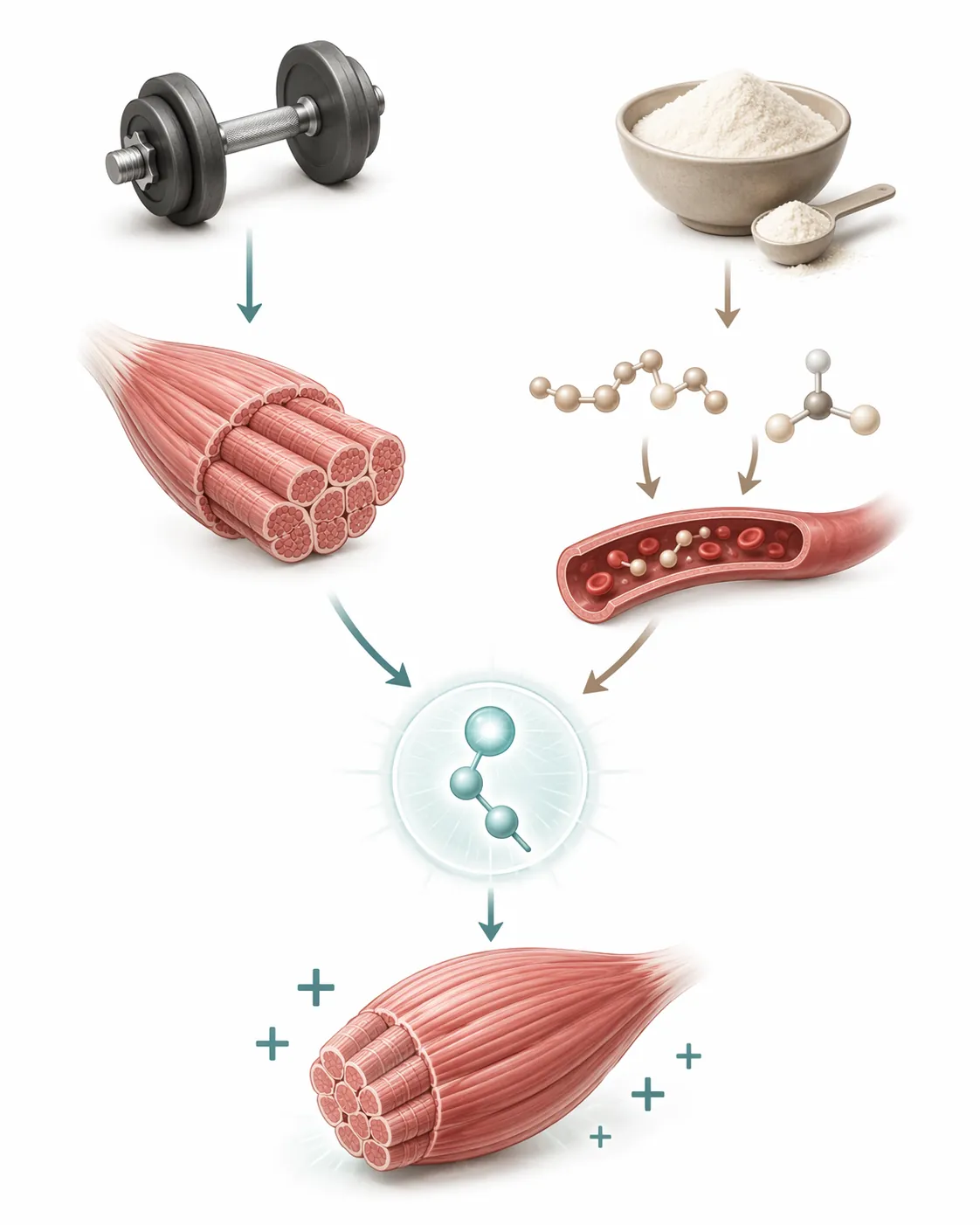
One in vitro study found that the collagen-derived dipeptide Hyp-Gly activated PI3K/Akt/mTOR signaling and induced hypertrophy in myotubes.[3] That is interesting because mTOR signaling is part of the muscle-growth conversation. It is also not the same as showing that a scoop of collagen grows muscle in a healthy adult. Cells in a dish are useful for mechanism; they do not carry the verdict.
The recovery evidence is more directly useful for someone training at home. A randomized controlled trial in Amino Acids reported that collagen peptides accelerated force recovery after damaging eccentric exercise.[4] Anyone who has tried to train legs two days after slow tempo split squats understands why that matters. Faster force recovery is not identical to more muscle growth, but it can affect whether the next session is productive or just a negotiation with soreness.
A broader review of bioactive peptides concluded that the evidence is still “far from being conclusive.”[5] That line should stay in the room. Collagen has the best fit for this question because it has human training data and a tolerable home-use profile, not because every mechanism has been settled.
What 15 Grams Per Day Actually Means at Home
The practical version is simple: take 15 grams of collagen peptides daily while running a progressive resistance-training plan. The supplement is the smaller half of that sentence.
- Keep the training progressive: more reps, more load, harder variations, slower eccentrics, or more total work over time.
- Do not count collagen as a complete replacement for high-quality dietary protein; it has a different amino acid profile than meat, dairy, eggs, soy, or whey.
- Use it as a support layer for connective tissue, recovery, and possible body-composition benefit, not as the driver of the program.
- Judge it over a training block, not a week. The key resistance-training studies used weeks of paired training and supplementation, not a few isolated doses.
A reasonable home setup might be a three- or four-day resistance plan using dumbbells, bands, a pull-up bar, or bodyweight progressions. Collagen fits around that. It does not decide whether the plan contains enough weekly sets for legs, whether the last reps are close enough to failure, or whether sleep has been wrecked for a month.
There is also a legal and medical distinction worth making clearly: collagen peptides are sold as supplements, and no peptide discussed here, including collagen, is FDA-approved for building muscle in healthy adults. The muscle-growth case is an evidence-based extrapolation from training studies, not an approved medical indication.
Why GH-Axis Peptides Keep Showing Up Anyway
CJC-1295, Ipamorelin, and tesamorelin attract attention because they sound like they sit upstream of muscle growth. The pitch is usually some version of this: increase growth hormone signaling, improve recovery, support lean mass, and make training work better. That logic is not random. Growth hormone and IGF-1 sit close enough to body composition that the story feels clinical even when the use case is a home lifter buying peptides outside ordinary medical care.
That is where the standard has to stay strict. Plausible endocrine logic is not the same as strong human evidence for healthy people doing home workouts. For unsupervised muscle growth, these compounds have a poor evidence-to-complexity ratio: injections, sourcing uncertainty, dosing uncertainty, possible lab changes, and limited direct proof that they improve muscle outcomes in the population asking the question.
CJC-1295 has an additional concern: FDA Category 2 compounding discussions have identified immunogenicity risk, meaning the body may mount an unpredictable immune response. That is not the kind of variable most people are equipped to evaluate between work, dinner, and a late workout in the spare room.
There are also metabolic concerns. Hone Health’s discussion of CJC-1295 notes possible increases in insulin resistance and HbA1c over time.[6] That does not prove every user will have that response, and it does not define the risk for every dose or context. It does make the compound a bad match for casual unsupervised experimentation, because the relevant outcomes are not visible in the mirror or obvious during a workout.
Tesamorelin is a useful example of how a real medical peptide can still be the wrong answer for home muscle growth. It has a clinical-sounding identity for a reason, but that does not convert it into an over-the-counter training aid. A prescription context, a defined medical indication, and monitored use are different from “best peptide for home workouts.”
The Peptide Market Makes the Confusion Easy
Part of the confusion comes from the way peptide articles sit next to each other online. A reader can find general bodybuilding peptide explainers at Healthline and ranking-style pages such as Innerbody’s 2026 muscle-growth peptide guide, then see clinic ads and social posts using similar names with much stronger claims.[7][8] The result is a category that feels more settled than it is.
BPC-157 and TB-500 show why the regulatory climate matters even when a compound is not the top muscle-growth candidate. Forbes reported that FDA scientists, before a July 23-24, 2026 advisory meeting, recommended against allowing compounding of BPC-157, TB-500, and five other peptides because of insufficient safety and efficacy data.[9] Final regulatory outcomes may still shift, but the recommendation alone is enough to undercut the idea that these are settled, low-risk home recovery tools.
NPR reported in February 2026 on safety concerns around untested peptides, including UC Davis researcher Paul Knoepfler’s warning that BPC-157’s possible angiogenic effects could be concerning around precancerous cells.[10] That is not a claim that every user faces that outcome. It is a reminder that “healing peptide” is a marketing phrase, not a safety assessment.
The Practical Verdict
For a home lifter trying to choose the best-supported peptide for muscle-growth support, collagen peptides are the cleanest answer: 15 grams per day alongside progressive resistance training. The case rests on human resistance-training studies, a workable dose, plausible recovery and signaling mechanisms, and a use pattern that does not require injections or medical supervision.
The limits stay attached to the recommendation. The strongest RCT evidence includes elderly sarcopenic men, not young healthy apartment lifters. Collagen is not FDA-approved for muscle building. It is not a substitute for total protein, progressive overload, or enough recovery to train hard again.
Injectable GH-axis peptides belong on the other side of the line. CJC-1295, Ipamorelin, and tesamorelin may sound more powerful, but for unsupervised home muscle growth they bring thinner direct evidence, more medical complexity, and unresolved safety and regulatory issues. Treat them as medically supervised territory, not as a home workout upgrade.
References
- Collagen peptide supplementation in combination with resistance training improves body composition and increases muscle strength in elderly sarcopenic men: a randomised controlled trial, British Journal of Nutrition, 2015.
- Prolonged Collagen Peptide Supplementation and Resistance Exercise Training Affects Body Composition in Recreationally Active Men, Nutrients, 2019.
- The collagen derived dipeptide hydroxyprolyl-glycine promotes C2C12 myoblast differentiation and myotube hypertrophy, PubMed, 2016.
- The effects of collagen peptides on muscle damage, inflammation and bone turnover following exercise: a randomized, controlled trial, Amino Acids, 2019.
- Bioactive Peptides and Their Potential Use for Health Promotion and Disease Prevention, 2021.
- CJC-1295: Benefits, Side Effects, Dosage, and More, Hone Health.
- Peptides for Bodybuilding: Do They Work?, Healthline.
- Best Peptides for Muscle Growth 2026, Innerbody, 2026.
- FDA Advisory Committee To Discuss Compounded Peptides Including BPC-157 And TB-500, Forbes, July 21, 2026.
- Unregulated peptides are being promoted for healing and longevity, but scientists warn of risks, NPR, February 23, 2026.
This is general fitness education, not medical advice. For diagnosis or treatment of pain or injury, consult a qualified clinician.
Pick your next session
Browse all routines to find an appropriately-spaced next session.
Spot something off?
This content sits adjacent to health guidance — tell us if a citation or figure needs a correction.