
How to Lower Cholesterol with Quiet Home Workouts in an Apartment
Learn whether quiet, low-impact home workouts can effectively lower cholesterol and how to build a weekly program that fits your apartment, respects neighbors, and meets CDC guidelines.
- Citation source
- CDC, ACSM
- Evidence level
- General guideline
- Recommended frequency
- 150 minutes per week
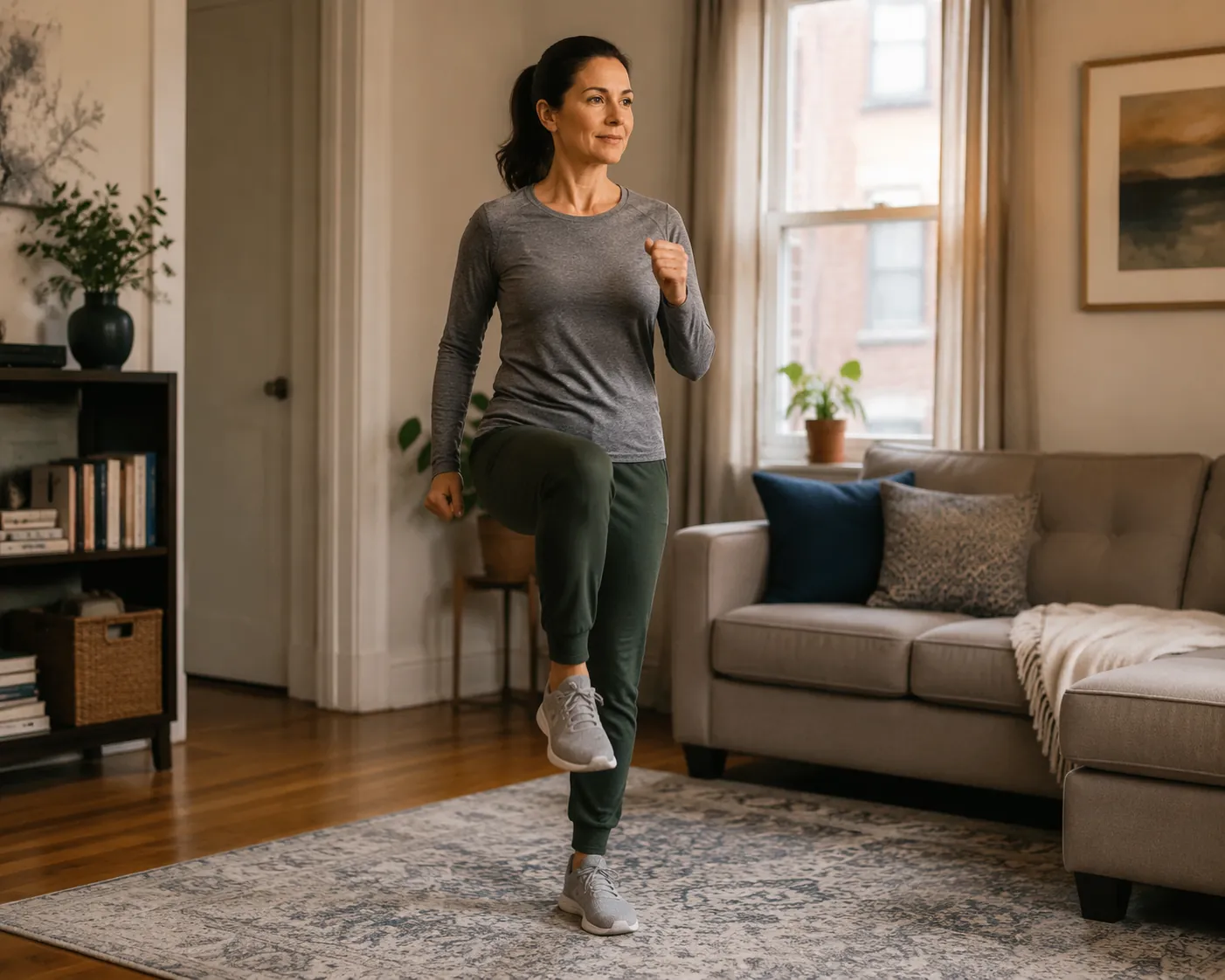
Yes: quiet, low-impact home workouts can help lower cholesterol if they add up to enough moderate-intensity work. The practical target is not a heroic workout. It is 150 minutes per week of moderate aerobic activity, plus 2 days of strength training, which is the adult minimum in the CDC physical activity guidelines.[1] In an apartment, that can mean marching, step-touch, low step-ups, stair repeats, shadowboxing, seated cycling, and floor-based strength work done at a pace where you can talk but would rather not sing.
That last part matters. A workout that is quiet enough for downstairs neighbors but too easy to raise your breathing probably will not carry the same weight. Cleveland Clinic describes moderate-intensity cardio as roughly 55% to 70% of maximum heart rate, and Erik Van Iterson, PhD, frames it plainly: “moderate-intensity cardio at 55% to 70% of your maximum heart rate is all you need.” Results, when they happen, usually take consistency over about 12 weeks rather than a few hard sessions.[2]
The dose matters more than the perfect exercise
Most cholesterol advice jumps too quickly from “do cardio” to exercises that do not fit the room: running, treadmill intervals, jumping jacks, burpees, rowers, or loud machines. For a renter with shared walls and aging knees, the better question is whether you can quietly accumulate the same weekly dose.
The CDC target gives the week a shape: 150 minutes of moderate aerobic activity can be five 30-minute sessions, three 50-minute sessions, or smaller blocks that total the same amount. The guideline also includes 2 days per week of muscle-strengthening activity.[1] That combination is useful for cholesterol because aerobic work carries the main volume target, while strength work helps make the body more capable of repeating that volume without turning every session into a joint complaint.
The evidence does not prove that “apartment workouts” are a special cholesterol treatment. It supports a narrower and more useful point: moderate exercise volume can improve blood lipids, and the mode can be flexible when the intensity and total work are high enough. In a 2022 Journal of the American Heart Association study, moderate-intensity exercise alone improved HDL-C by 6.6%, reduced LDL-C by 7.2%, and increased ABCA1-mediated cholesterol efflux by 13.5%.[3]
Those numbers are worth attention, but they should not be lifted out of context. The participants were healthy young male Army recruits with a mean age of 22, and the exercise exposure was about 9.3 hours per week.[3] That is much more volume than a new apartment exerciser is likely to start with. The study shows that exercise can move lipid markers in a meaningful direction; it does not prove that a 45-year-old beginner doing quiet living-room cardio will get the same percentage changes.
A 2014 review by Mann and colleagues helps bridge the gap without pretending the gap disappears. It concluded that moderate-intensity exercise, described as 50% to 75% of heart-rate reserve, is sufficient for HDL improvement, and that moderate-intensity resistance training at 50% to 75% of 1-repetition maximum can be as effective for LDL reduction as higher-intensity resistance training.[4] The same review notes that total energy expenditure can matter more than the exact exercise mode.[4] That is the opening apartment dwellers need: not a magic move, but a way to get enough moderate work done quietly.
What moderate feels like in a living room
Moderate does not mean easy. It means controlled. You should feel warmer after a few minutes. Breathing should be deeper than normal. You should be able to answer a question in a full sentence, but singing would be uncomfortable. If you are using a watch or chest strap, the useful range is roughly 55% to 70% of maximum heart rate.[2]
For most apartment workouts, intensity comes from pace, arm motion, range of motion, and how long you keep moving. You do not need floor impact to make the heart work. A brisk march with active arms can be harder than a lazy set of jumping jacks, and it will not thud through the ceiling below you.
| Quiet movement | How to make it moderate | Apartment notes |
|---|---|---|
| Marching in place | Lift knees to a comfortable height, swing arms, keep a steady rhythm | Best on a rug or mat; avoid stomping |
| Step-touch | Travel side to side, bend the knees slightly, add arm reaches or punches | Good for very small rooms |
| Shadowboxing | Use light footwork, steady punches, and relaxed shoulders | Keep feet gliding rather than bouncing |
| Low step-ups | Use a low, stable step and alternate legs without rushing | Quiet only if the platform is solid and does not creak |
| Stair repeats | Walk up at a firm pace, come down slowly, repeat in short blocks | Use only if the stairwell is safe and building rules allow it |
| Seated mini-bike cycling | Keep cadence smooth enough to raise breathing without rocking the chair | Optional equipment; check noise and floor vibration first |
| Floor-based resistance | Pair glute bridges, dead bugs, bird dogs, and side-lying leg raises with short rests | Very quiet; better for strength days than the full aerobic target |
Approximate metabolic-equivalent estimates put marching in place and walking lunges around 3 to 4 METs; seated cycling around 4 to 5 METs; and stair repeats, low step-ups, shadowboxing, and dumbbell or kettlebell swings around 5 to 6 METs. Those values are only rough guides, because the same movement changes quickly when you slow down, shorten the range, hold tension, or take longer rests.

A quiet 150-minute weekly plan
This is the center of the plan: collect 150 moderate minutes without jumping, running, or buying loud equipment. The sessions are written for a small living room, a rug, and enough space to take one or two steps in each direction. If you already have a mini bike, resistance bands, or dumbbells, they can help, but the no-equipment version comes first.
| Day | Session | Minutes counted toward 150 | Noise level |
|---|---|---|---|
| Monday | 30-minute quiet cardio circuit | 30 | Low |
| Tuesday | 20-minute floor-based strength + 10-minute easy walk or march | 10 | Very low |
| Wednesday | 30-minute shadowboxing and step-touch session | 30 | Low |
| Thursday | Rest, mobility, or gentle walking | 0 | Very low |
| Friday | 30-minute stair, step-up, or marching session | 30 | Low to moderate |
| Saturday | 20-minute strength + 20-minute steady cardio | 20 | Very low to low |
| Sunday | 30-minute comfortable continuous cardio | 30 | Low |
That totals 150 aerobic minutes and includes 2 strength days, matching the CDC adult guideline structure.[1] The strength sessions are not counted as full cardio unless your breathing stays in the moderate range for sustained stretches. Glute bridges with long pauses, for example, may be valuable work, but they are not the same as 20 uninterrupted minutes of step-touch or cycling.
Monday: quiet cardio circuit
Repeat this 6-minute block 5 times: 1 minute marching in place, 1 minute step-touch, 1 minute shadowboxing, 1 minute hamstring curls without hopping, 1 minute low knee lifts with arm reaches, and 1 minute slower marching. The last minute is not a full rest. It should bring breathing down slightly while keeping you moving.
If the floor is thin, the fix is usually smaller steps, softer knees, and a rug rather than less effort. Make the arms work harder before you make the feet louder.
Tuesday: strength without impact
Do 2 or 3 rounds of glute bridges, bird dogs, dead bugs, incline pushups against a counter, side-lying leg raises, and slow sit-to-stands from a chair. Use 12 to 15 controlled reps for most moves, or 20 to 30 seconds per side for holds. Mann and colleagues describe moderate resistance training in a range that can support LDL improvement, and bodyweight sets in this rep range are a practical way to keep the work controlled at home.[4]
After the strength work, add 10 minutes of easy marching or hallway walking. If you are tired, keep it below moderate. The point of Tuesday is to support the week, not steal recovery from it.
Wednesday: shadowboxing and step-touch
Use 3-minute rounds: 2 minutes of shadowboxing, then 1 minute of step-touch. Repeat 10 times. Keep the punches light and rhythmic, not tense. The feet should slide, tap, or shift weight; they should not bounce. If you want more technique ideas, a small-space boxing footwork routine can be a useful companion, as long as you keep the version low-impact.
The talk test is especially helpful here because punching can make people hold their breath. If you cannot speak, loosen your hands, lower the arms for a round, or reduce the pace before you stop entirely.
Friday: stairs, step-ups, or a no-stair substitute
If your building stairwell is safe, allowed, and not disruptive, walk up one or two flights at a moderate pace, descend slowly, and repeat for 20 to 25 minutes after a 5-minute warmup. Do not run the stairs. Running turns a useful moderate session into a noise and fall-risk problem.
If stairs are not an option, use low step-ups on a stable platform. If the platform shifts, squeaks, or bangs, skip it and return to marching intervals. A quieter substitute that you will actually repeat is better than a technically harder exercise that makes you dread the neighbor below.
Saturday and Sunday: make the week repeatable
Saturday pairs 20 minutes of strength with 20 minutes of steady cardio. Choose the cardio mode that felt best earlier in the week: marching, step-touch, seated cycling, or shadowboxing. Sunday is simpler: 30 continuous minutes at a comfortable moderate pace. This is a good day for a mini bike if you own one, or for a quiet indoor cycling session if that fits your apartment setup.
If you miss a day, do not cram 90 minutes into one evening unless you are already conditioned for that. Add 10 to 15 minutes to two later days, or accept a 120-minute week and return to the plan. Cholesterol training is a consistency project; the joints and the lease matter too.
How to progress without making the workout louder
Progression does not have to mean jumping. First, make the sessions more continuous. Reduce long pauses, keep transitions simple, and try to spend more of each 30-minute block in the talk-test zone. Then increase arm involvement: reach overhead, punch across the body, carry light dumbbells only if your shoulders tolerate them, or use resistance bands during strength work.
- If the workout feels too easy, increase arm motion before foot impact.
- If your knees complain, shorten the step, reduce stair work, and favor cycling, marching, and floor strength.
- If your breathing spikes too high, slow the pace for 1 minute instead of stopping completely.
- If the floor noise rises, move to a rug, soften the knees, and avoid quick direction changes.
- If tracking helps, use a wearable heart-rate estimate as a guide, not as a judge.
Optional equipment belongs after the habit is working. A quiet mini exercise bike can make 20 to 30 minutes easier to collect during bad weather or knee-sensitive weeks. Resistance bands fit the same apartment logic because they add strength work without clanking plates. If you are deciding whether to buy anything, test the no-equipment plan for two weeks first; the missing piece may be schedule, not gear.
What cholesterol changes are realistic?
Exercise can improve lipid markers, but it is not a loophole around diet, genetics, or medication. The Exercise is Medicine blood lipid disorders prescription sheet from the American College of Sports Medicine describes LDL reductions in the 5% to 8% range with exercise.[5] That is meaningful, especially when layered with better eating patterns, weight changes when appropriate, and medication when prescribed. It is not the same as guaranteeing that a high LDL result will normalize from home workouts alone.
HDL often gets the more encouraging exercise story. The JAHA recruit study found a 6.6% HDL-C increase with moderate-intensity exercise alone, and Mann and colleagues concluded that moderate-intensity exercise is sufficient for HDL improvement.[3][4] LDL is usually more stubborn. Some people respond modestly; others need dietary changes or medication because their numbers are driven by genetics, underlying conditions, or risk level.
That is why the cleanest plan is not “work out instead of seeing your clinician.” It is: build the 150-minute weekly habit, pair it with cholesterol-aware eating, retest when your clinician recommends, and use the lab result to decide what still needs attention. If you have chest pain, unusual shortness of breath, dizziness, known heart disease, very high cholesterol, diabetes, or multiple cardiovascular risk factors, get medical guidance before pushing intensity.
When a home plan needs a longer runway
A quiet apartment plan is a starting structure, not the only possible program. If you want more progression, a 4-week home workout plan to lower cholesterol can help you build from beginner consistency toward longer sessions. If your clinician has emphasized both food and exercise, a combined home workouts and diet plan is the more honest route than treating movement as the whole prescription.
For people who get bored easily, it is fine to specialize the cardio as long as the weekly dose survives. Boxing-style footwork, apartment cycling, stair walking, and marching circuits can all sit inside the same 150-minute framework. The movement is allowed to be ordinary. What makes it useful is that it is quiet enough, moderate enough, and repeatable enough to keep showing up on the calendar.
Quiet home workouts are not a cure-all, and they are not second-best just because they happen beside a sofa. They are a legitimate way to meet the exercise dose associated with modest, meaningful cholesterol improvements when running, jumping, and loud equipment are off the table.
References
- Adult Activity: An Overview, CDC, https://www.cdc.gov/physical-activity-basics/guidelines/adults.html
- Does Exercise Lower Cholesterol?, Cleveland Clinic, https://health.clevelandclinic.org/does-exercise-lower-cholesterol
- Exercise Training and Cardiometabolic Health in Overweight and Obese Army Recruits: A Randomized Clinical Trial, Journal of the American Heart Association, https://www.ahajournals.org/doi/10.1161/JAHA.121.023386
- Differential Effects of Aerobic Exercise, Resistance Training and Combined Exercise Modalities on Cholesterol and the Lipid Profile: Review, Sports Medicine, https://pmc.ncbi.nlm.nih.gov/articles/PMC4065252/
- Exercising with Blood Lipid Disorders, Exercise is Medicine / American College of Sports Medicine, https://exerciseismedicine.org/assets/page_documents/EIM%20Rx%20series_Exercising%20with%20Blood%20Lipid%20Disorders.pdf
This is general fitness education, not medical advice. For diagnosis or treatment of pain or injury, consult a qualified clinician.
Pick your next session
Browse all routines to find an appropriately-spaced next session.
Spot something off?
This content sits adjacent to health guidance — tell us if a citation or figure needs a correction.