
Injury Recovery Exercises for Renters in Small Spaces
Recovering from an injury in a rental apartment? This guide shows how to run an effective, PT-informed rehab program using quiet, compact equipment and simple floor protection — no drilling, no noise complaints, no lost deposit.
- Citation source
- Choose PT
- Evidence level
- restrained inference
A physical therapist can hand you a perfectly reasonable home program: heel slides, ankle pumps, band rows, glute bridges, maybe step-ups when you are ready. Then you get home to a second-floor apartment and realize the plan skipped three questions that decide whether you will actually do it: Will this thump through the floor? Will it mark up the hardwood or vinyl? Where is all this equipment supposed to live?
That mismatch matters because a real rehab routine does not need to turn a rental into a clinic. It does need to respect the apartment. For renters in small spaces, injury recovery home exercises work best when every choice is filtered through noise transmission, floor damage risk, and equipment footprint at the same time.
This is not a diagnosis guide or a replacement for care. A new injury, worsening pain, swelling, numbness, instability, post-surgical restriction, or condition-specific protocol belongs with a clinician. The goal here is narrower: how to make a prescribed or PT-informed recovery program more apartment-compatible without making it vague, loud, or impossible to repeat.
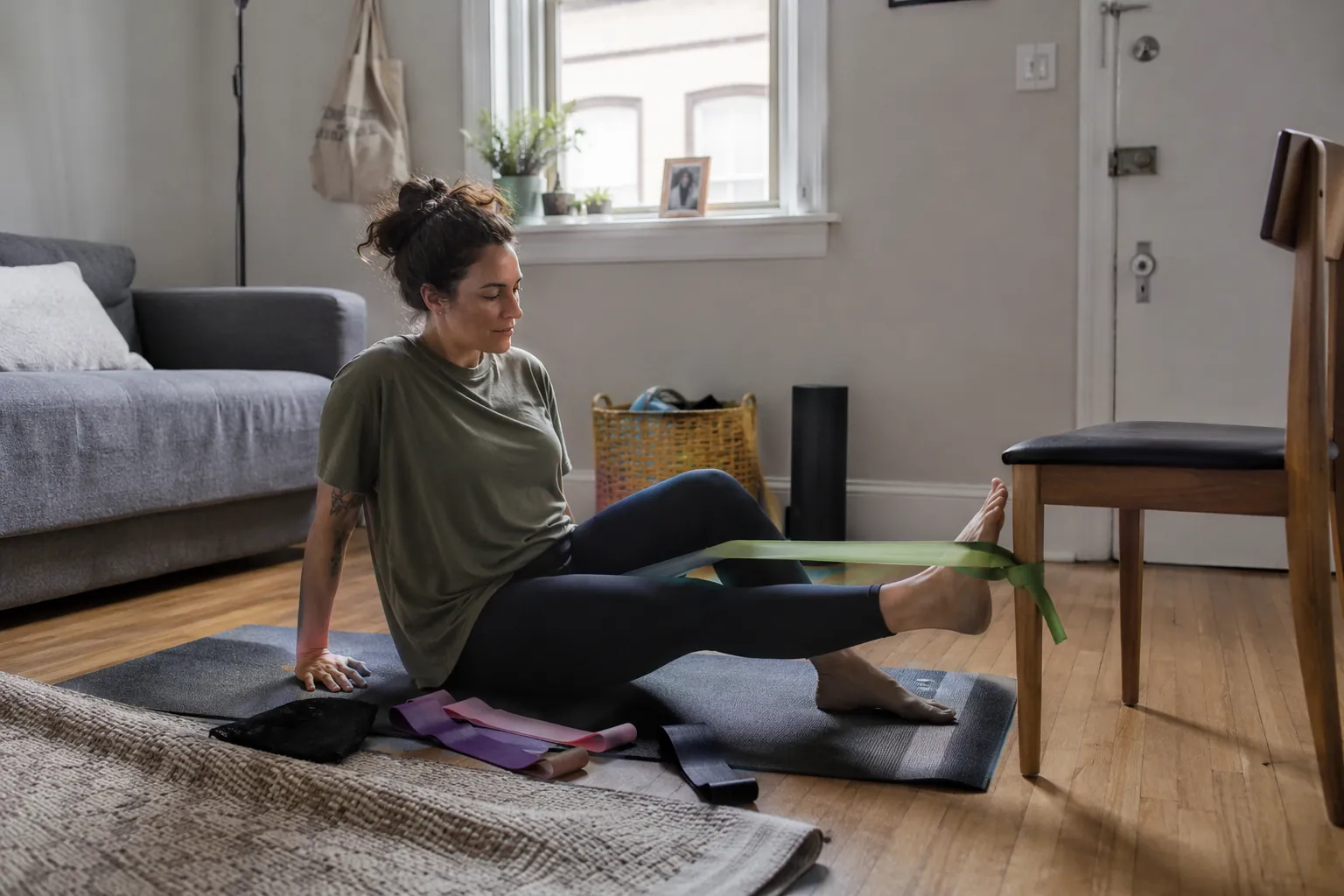
Start With the Apartment, Not the Exercise List
The usual home-exercise advice assumes “home” means open floor, forgiving surfaces, and no one below you. That is not how many renters live. Stern At Home Therapy points to recent housing data indicating that about 40% of Americans live in multi-unit housing, which makes the floor under your feet part of the recovery environment, not a side issue.[1]
The apartment filter is simple, but it changes decisions quickly:
- Noise transmission: Choose controlled, low-impact movements over hopping, dropping weights, or fast transitions.
- Floor damage risk: Put pressure, sweat, bands, chair legs, and equipment on a protective surface instead of directly on finished flooring.
- Equipment footprint: Favor tools that fit in a drawer, closet bin, or under a couch and do not require drilling, mounting, or permanent anchors.
A jump squat fails that filter for most injured renters. A slow sit-to-stand from a chair might pass it. Heavy dumbbells can work in a garage, but in an apartment they create storage, drop, and flooring problems. A resistance band can train the same general pattern quietly if the exercise fits your stage of recovery.
Build a 4-by-4 Rehab Zone
You do not need a home gym. For many recovery sessions, a roughly 4-by-4-foot zone is enough: a mat or foam-tile square, one chair, a towel, and bands. That gives you a place for floor exercises, a visual boundary for balance work, and a protected landing spot for anything that might sweat, slide, scuff, or press into the floor.
GymFlooringGuide’s review-based analysis of more than 4,900 Amazon reviews identifies 1/2-inch EVA foam tiles as a low-cost way to create a small rehab surface, with a 4-by-4-foot zone costing about $20. The same source discusses dense equipment mats such as SuperMats 12GS for equipment footprints, and reports a 65% to 75% vibration-reduction figure from Norsk-Stor through the guide. That last number should be treated as a manufacturer claim, not an independently measured guarantee.[2]
That caveat is important. A mat can reduce impact, protect surfaces, and make movement feel less exposed. It cannot make stomping silent, and it cannot promise your downstairs neighbor hears nothing. The point is not to buy your way out of considerate movement; it is to make quiet movement easier to repeat.
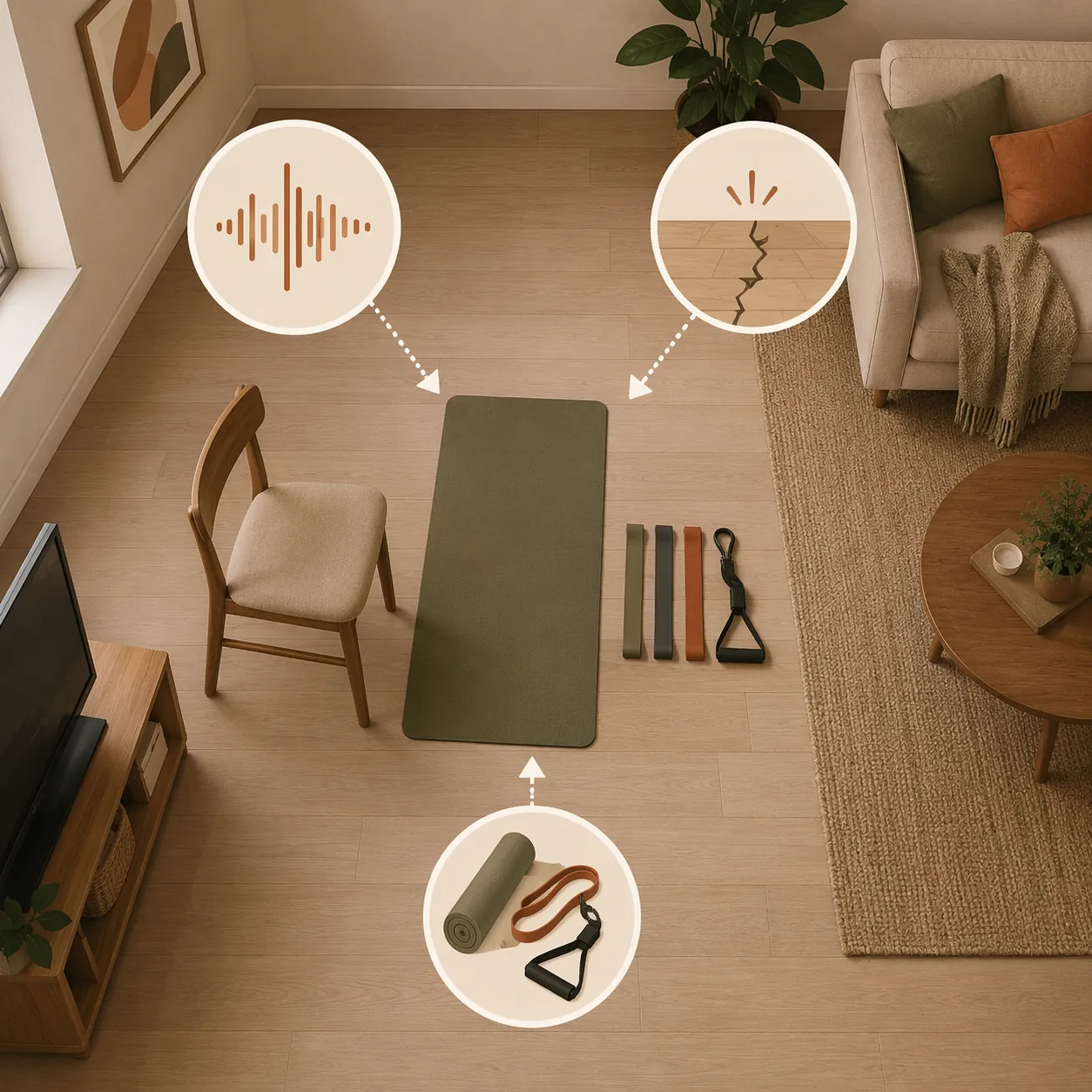
A practical setup looks boring in the best way: tiles or a dense mat under your body, chair legs sitting fully on the mat when you use the chair, bands kept in a drawer, and any backpack or water jug placed down instead of dropped. If flooring is your biggest worry, the same logic carries into broader home-gym decisions; more detailed floor-protection mistakes belong in Home Gym Flooring Mistakes That Cost You Money, Space, and Peace With Your Neighbors.
Why Resistance Bands Earn Their Space
Resistance bands are not magic rehab tools. They are simply well matched to rental constraints. PTSMC’s guide describes band use across acute range-of-motion work, strengthening, and functional recovery for areas including shoulder, hip and knee, and spine rehabilitation.[3] For a renter, the practical value is just as important: bands are quiet, removable, inexpensive, and small enough to disappear into a drawer.
They also make it easier to scale effort without changing the whole room. Move your hand position, shorten the band slightly, choose a lighter band, or reduce the range. That is different from owning a pile of weights you are afraid to set down on laminate at 7 a.m.
For no-drill setups, prioritize loop bands and long bands you can hold, step on, or wrap around your own body. Door anchors can be useful, but only if the door closes securely, the anchor is designed for exercise, and the setup does not damage paint, trim, or hardware. If the lease, door, or your confidence says no, skip it. A band row can often become a seated band row around your feet or a standing row with the band wrapped around your hands.
Small Gear That Makes Sense in a Rental
| Item | Typical role in rehab | Why it works for renters |
|---|---|---|
| Yoga mat | Comfort layer for floor work | Cheap, removable, quiet, and easy to roll away |
| 1/2-inch EVA foam tiles | Small protected movement zone | Covers a compact area and helps reduce pressure and vibration |
| Resistance bands | Range-of-motion, strength, and control work | No drilling, no noise, low storage burden |
| Chair | Balance support, sit-to-stand target, modified step work | Already in the apartment and easy to reposition |
| Towel | Stretch strap or sliding aid | Soft, washable, and not a permanent purchase |
Household substitutions should stay humble. Contemporary Rehab Services and Choose PT both describe common home items such as a loaded backpack in place of ankle weights, a towel as a stretch strap, a chair for balance support or step-up work, a door frame for rows, and water jugs as light dumbbells.[4][5] Those swaps are useful when they are stable and quiet. They are not a reason to improvise something wobbly while you are injured.
Use Pain as a Signal, Not a Dare
Apartment rehab has a specific trap: because you are trying to stay quiet and out of everyone’s way, you may treat “I got through it” as the only measure that matters. Pain needs a vote too.
The traffic-light pain model gives a usable way to make that decision during unsupervised sessions. Thomeé’s 1997 work on patellofemoral pain and Silbernagel’s 2007 work on Achilles tendinopathy support condition-specific versions of using pain response to guide loading, while Back Bay Health presents a practical version for home exercise: green at 0 to 3 out of 10, yellow at 3 to 5 out of 10, and red above 5 out of 10.[6][7][8]
| Pain signal | What it means during a home session | Apartment-friendly adjustment |
|---|---|---|
| Green: 0-3/10 | Usually acceptable to continue if movement quality stays controlled | Keep the same exercise, tempo, and range |
| Yellow: 3-5/10 | A cue to modify rather than push through automatically | Reduce range, lighten band tension, slow down, or switch to the easier version |
| Red: above 5/10 | Stop the exercise and do not try to rescue the session with harder variations | End that movement, use clinician guidance, and monitor symptoms |
The extension to every possible home rehab situation is not independently validated. A knee pain study, an Achilles tendinopathy study, and a general home guide do not prove the same rule fits every shoulder, back, ankle, or post-surgical case. Still, as a renter-facing self-check, it is better than guessing, and it pairs well with the three apartment constraints: quiet, protected, compact, and symptom-aware.
The next-day check matters too. If a movement stays in the green during the session but leaves you noticeably worse later or the next morning, treat the exercise as too much for now. In a small apartment, the easiest modification is often not a new exercise. It is a smaller range, a lighter band, one fewer set, or moving from standing to seated.
A Three-Level Framework for Quiet Recovery Sessions
The levels here are not a personal prescription. They are a way to think about progression when your clinician has cleared you for home exercise or when you are using PT-informed movements for a common, non-emergency recovery situation. If you already have a protocol, follow that first and use the apartment filter to make the setup workable.
| Level | Main goal | Examples that fit small rentals | Apartment filter |
|---|---|---|---|
| Level 1 | Restore comfortable motion and basic activation | Heel slides, ankle pumps, wall push-ups, gentle band-assisted range of motion | Mostly seated, lying, or wall-supported; quiet and mat-based |
| Level 2 | Build controlled strength | Glute bridges, clamshells with bands, seated or standing band rows, careful step-ups on stairs | Low impact, no dropped load, chair or wall nearby for support |
| Level 3 | Return to more functional control | Single-leg balance, band Pallof press, split squats, controlled sit-to-stand progressions | Still no jumping by default; progress load and balance before adding impact |
Level 1: Keep It Quiet Enough to Actually Start
Early recovery work often looks unimpressive, which is part of why it fits an apartment. Heel slides happen on your mat or bed. Ankle pumps happen seated. Wall push-ups use a wall instead of the floor. Gentle band-assisted motion can be done with the band in your hands, not anchored to the building.
The key at this level is removing friction. Leave the mat where it can be unrolled in one move. Keep the band with the rehab sheet or in the same drawer. Use a dining chair as the support instead of buying a balance tool you will resent storing. A session can be short and still count.
Level 2: Add Strength Without Adding Thuds
Strength work is where apartment advice often gets careless. You do not need to jump, stomp, or haul out bulky gear to make a recovery exercise harder. A glute bridge becomes more demanding with a pause at the top. A clamshell changes with a light loop band. A band row can be slowed down so the return phase is controlled instead of snapping back.
Step-ups need more judgment. A shared stairwell may be a bad place for rehab if it is busy, slippery, poorly lit, or awkward to use without blocking neighbors. Inside the apartment, a chair is usually not a safe step-up platform unless it is built for that load and does not move. If your program includes step-ups, a stable building stair used at a considerate time may make more sense than improvising furniture.
Level 3: Train Control Before Impact
Later-stage home rehab can still be renter-friendly. Single-leg balance on a mat, a band Pallof press, split squats, and controlled sit-to-stand progressions all ask more from the body without asking the floor to absorb repeated impact. A chair or countertop nearby is not a sign you are doing it wrong; it is how you keep a balance drill from becoming a lease incident.
This is also where injury-specific guidance matters most. Knee rehab, calf strain recovery, and broader tissue-healing timelines do not progress at the same pace. If your next question is about a particular body part, use a narrower guide such as 6 Evidence-Backed Knee Rehab Exercises for At-Home Recovery, Calf Strain Recovery at Home, or Home Training Routine for Your Injury Recovery Timeline instead of guessing from a general progression.
Keep Sessions Short Enough to Repeat
A recovery plan that requires rearranging the whole living room has a short life. Contemporary Rehab Services reports that adherence can drop to about 50% after six months and recommends 15- to 30-minute sessions with 2 to 3 exercises to improve completion rates.[4] That matches the reality of small-space rehab: the session you can start without negotiating with your apartment is the one you are more likely to finish.
A useful renter session might be as plain as this: unroll the mat, do one range-of-motion exercise, one strength exercise, and one balance or control exercise, then put the band away. If pain stays green and movement quality holds, you are done. If pain moves yellow, modify. If it turns red, stop the movement. There is no prize for turning a 20-minute rehab session into a noisy 50-minute workout.
Schedule Like Someone Else Lives There
Lease-aware scheduling is not about being timid. It is about protecting the routine. TurboTenant and CincyRents both emphasize the practical relevance of lease rules, quiet hours, and neighbor expectations for apartment exercise.[9][10] For rehab, that usually means putting any standing strength work away from late-night quiet hours, avoiding shared hallways when people are coming and going, and reading the lease before using door anchors, mounted straps, or anything that touches trim and walls.
If you are worried about noise, test the movement before making it part of the plan. A slow split squat on foam is different from a fast reverse lunge on bare floor. A band row is different from a cable-style setup that snaps the door every rep. The quiet version is usually not less serious; it is just better designed for the room you actually have.
What to Buy, and What to Skip for Now
For most renter rehab setups, the first purchases are modest: a yoga mat around $10 to $15, resistance bands around $10 to $30, and either a small set of interlocking foam tiles or a dense mat if the floor needs more protection.[2][3] Buy the item that removes the biggest barrier first. If floor anxiety keeps you from doing bridges or heel slides, start with the surface. If your plan needs gentle resistance, start with bands.
Skip anything that needs permanent mounting unless your lease and landlord clearly allow it. Skip heavy gear if you are mainly using it because general fitness advice told you a home gym needs weight. Skip unstable substitutions that turn a simple rehab exercise into a balance problem you did not ask for.
After recovery, you may decide to expand. That is a different decision from surviving the first few weeks of a rehab plan. A broader equipment framework such as Home Gym Equipment for Beginners: A Decision Framework is more useful once pain, space, and consistency are no longer the immediate constraints.
Make the Routine Fit the Room
Small-space rehab is not automatically equal to supervised physical therapy, and a foam mat does not erase every vibration. But renters can run effective, PT-informed recovery sessions at home when the apartment is part of the design from the beginning.
Keep the zone small. Choose two or three exercises. Work for 15 to 30 minutes. Use the traffic-light pain model instead of arguing with symptoms. Store the band where you can reach it tomorrow. The routine that respects the floor, the neighbor, the lease, and the injury is the routine with the best chance of actually getting done.
References
- Space-Smart Strategies, Stern At Home Therapy.
- GymFlooringGuide analysis of 4,900+ Amazon reviews, GymFlooringGuide.
- Comprehensive Guide to Resistance Bands for Injury Recovery, PTSMC.
- Exercise catalog and home exercise adherence guidance, Contemporary Rehab Services.
- Choose PT home exercise guidance, Choose PT.
- A comprehensive treatment approach for patellofemoral pain syndrome in young women, Thomeé, 1997.
- Continued sports activity, using a pain-monitoring model, during rehabilitation in patients with Achilles tendinopathy, Silbernagel, 2007.
- Practical traffic-light pain guide, Back Bay Health.
- Apartment exercise and lease-aware scheduling guidance, TurboTenant.
- Apartment quiet-hours and renter exercise guidance, CincyRents.
This is general fitness education, not medical advice. For diagnosis or treatment of pain or injury, consult a qualified clinician.
Pick your next session
Browse all routines to find an appropriately-spaced next session.
Spot something off?
This content sits adjacent to health guidance — tell us if a citation or figure needs a correction.